反歧视调查

Search documents
中方发起反歧视立案调查!涉及近年来美国对华集成电路领域相关措施
Di Yi Cai Jing· 2025-09-13 13:42
Core Viewpoint - The Chinese Ministry of Commerce has initiated an anti-discrimination investigation into the U.S. measures affecting the semiconductor industry, citing that these actions are discriminatory and detrimental to both China's technological development and the global semiconductor supply chain stability [1]. Investigation Scope - The investigation will focus on U.S. measures related to integrated circuits since 2018, including tariffs imposed based on Section 301 investigations and other prohibitive actions [3]. - It will also cover restrictions on exports of integrated circuit products and manufacturing equipment to China, as well as limitations on U.S. participation in Chinese semiconductor projects since 2022 [3]. - Additional measures under the CHIPS and Science Act that restrict trade and investment activities in relevant fields will be included, along with specific restrictions on advanced computing integrated circuits and AI chips used for training Chinese AI models [3]. Investigation Procedure and Timeline - The investigation will utilize various methods such as written questionnaires, hearings, and field investigations, with a typical duration of three months, extendable under special circumstances [4]. - Stakeholders have 30 days from the announcement to submit comments regarding the investigation process, and they can also request hearings within 20 days [5]. Stakeholder Participation - The Ministry of Commerce encourages all affected stakeholders, including domestic industries and enterprises, to actively participate in the investigation to ensure fairness and transparency [5].

事关芯片,商务部连续出手
财联社· 2025-09-13 13:20
Core Viewpoint - The Ministry of Commerce of China has initiated anti-dumping investigations against imported analog chips from the United States, responding to domestic industry requests and citing significant impacts on local production and pricing due to increased imports and decreased prices from the U.S. [19][20] Group 1: Anti-Dumping Investigation - The Ministry of Commerce received a formal application for an anti-dumping investigation on July 23, 2025, from the Jiangsu Semiconductor Industry Association, representing the domestic analog chip industry [1][2] - The investigation will cover the period from January 1, 2024, to December 31, 2024, for dumping and from January 1, 2022, to December 31, 2024, for industry damage [2] - The products under investigation include certain analog integrated circuits, specifically general interface chips and gate driver chips manufactured using 40nm and above process technology [5][6] Group 2: Product Details - General interface chips include various types such as CAN interface transceiver chips, RS485 interface transceiver chips, and I2C interface chips, which are used for efficient data transmission and signal conversion in automotive and industrial applications [5][6] - Gate driver chips are designed to control power semiconductor devices, providing necessary voltage and current levels for effective switching, including low-side gate driver chips and isolated gate driver chips [6][7] Group 3: Investigation Procedures - Interested parties must register to participate in the investigation within 20 days of the announcement, providing relevant information regarding their identity and involvement in the trade of the investigated products [9][10] - The investigation may utilize questionnaires, sampling, hearings, and on-site verifications to gather information from relevant stakeholders [13][14] - The investigation is expected to conclude by September 13, 2026, unless extended under special circumstances [18] Group 4: Discrimination Investigation - The Ministry of Commerce has also launched an anti-discrimination investigation against U.S. measures affecting China's integrated circuit sector, citing evidence of discriminatory practices since 2018 [21][22] - The investigation will assess various U.S. actions, including tariffs and restrictions on exports of integrated circuit products and related technologies to China [22][23] - The investigation is set to begin on September 13, 2025, with a typical duration of three months, subject to extension if necessary [25]

商务部再发重磅公告:立案调查!发言人回应焦点问题
Sou Hu Cai Jing· 2025-09-13 13:18
Core Points - The Ministry of Commerce of China has initiated an anti-discrimination investigation into the U.S. measures affecting the semiconductor industry, citing evidence of discriminatory practices against Chinese products [1][11][12] - The investigation will focus on various U.S. actions since 2018, including tariffs and export restrictions on integrated circuits and related products [2][12] - The investigation is set to begin on September 13, 2025, and will typically last for three months, with the possibility of extension [4][12] Investigation Details - The investigation will examine U.S. measures that include tariffs imposed since the 301 investigation, restrictions on exports of semiconductor-related products, and limitations on U.S. participation in Chinese semiconductor projects [2][3] - The investigation process may involve written questionnaires, hearings, and on-site investigations, with a report to be published based on the findings [3][12] - Stakeholders can submit comments and request hearings within specified timeframes to ensure transparency and fairness in the investigation [5][6] Context and Implications - The Chinese government views the U.S. measures as a form of protectionism that undermines China's development in advanced computing and artificial intelligence, potentially destabilizing the global semiconductor supply chain [11][12] - The Ministry of Commerce emphasizes that it will take necessary actions to protect the legitimate rights of Chinese enterprises affected by U.S. restrictions [12] - The anti-dumping investigation into U.S. imported simulation chips is also underway, prompted by a significant increase in import volume and a decrease in prices that have harmed domestic producers [13]
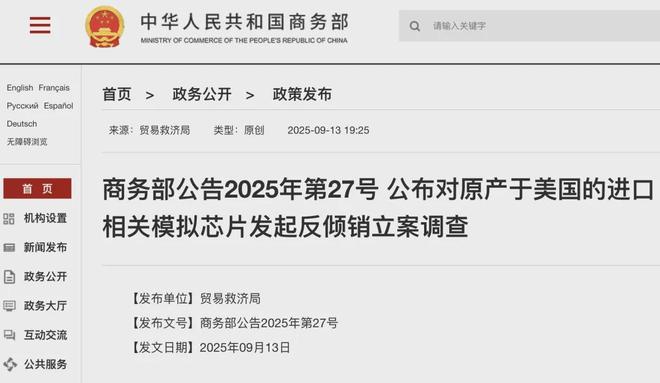
芯片突发!商务部出手
Zhong Guo Ji Jin Bao· 2025-09-13 13:03
Core Viewpoint - The Ministry of Commerce of China has initiated anti-dumping investigations against imported analog chips from the United States and has also launched a discrimination investigation regarding U.S. measures affecting China's integrated circuit sector, citing violations of WTO rules and harm to Chinese enterprises' legitimate rights [1][4]. Group 1: Anti-Dumping Investigation - The anti-dumping investigation was initiated following an application from the domestic semiconductor industry, in accordance with Chinese laws and WTO regulations [2]. - The investigation covers general interface and gate driver chips imported from the U.S., with evidence indicating a 37% increase in import volume and a 52% decrease in import prices from 2022 to 2024, adversely affecting domestic product sales [2][6]. - The investigation period is set from January 1, 2024, to December 31, 2024, with the industry damage assessment period from January 1, 2022, to December 31, 2024 [6][19]. Group 2: Discrimination Investigation - The Ministry of Commerce has decided to launch a discrimination investigation against U.S. measures in the integrated circuit sector, which are seen as discriminatory and harmful to China's high-tech industries [4][21]. - The investigation will examine various U.S. measures since 2018, including tariffs and restrictions on exports of integrated circuit products and manufacturing equipment to China [21][22]. - The investigation period is also set to begin on September 13, 2025, with a typical duration of three months, extendable under special circumstances [24].
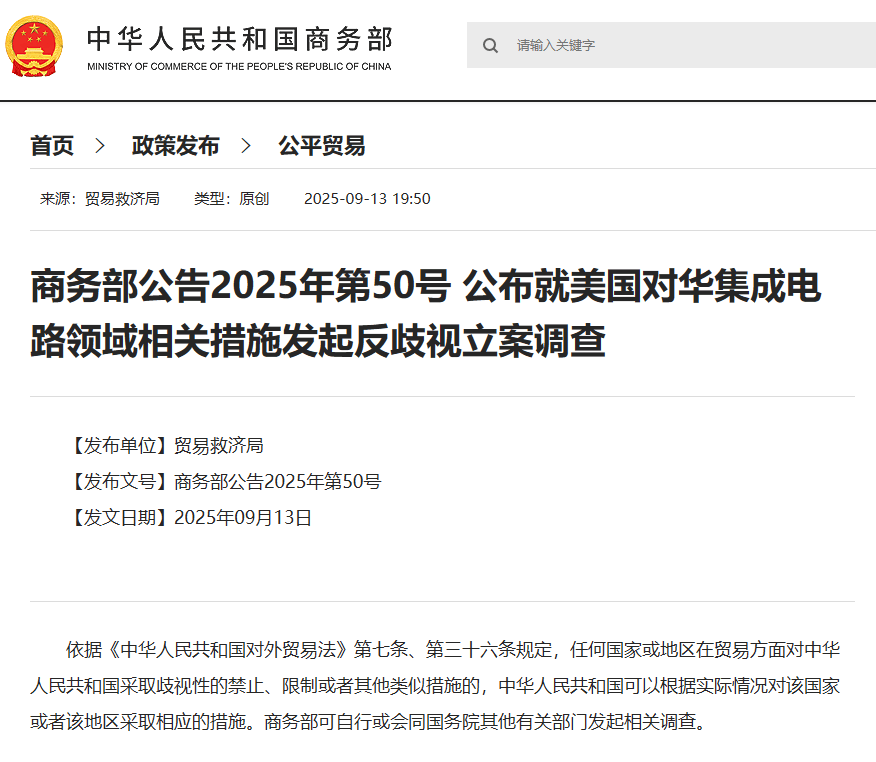
商务部公告2025年第50号 公布就美国对华集成电路领域相关措施发起反歧视立案调查
Xin Hua Wang· 2025-09-13 12:52
Core Points - The Ministry of Commerce of the People's Republic of China has decided to initiate an anti-discrimination investigation against the United States regarding measures taken in the integrated circuit sector, starting from September 13, 2025 [1][4]. Investigation Details - The investigation will focus on U.S. measures related to integrated circuits, including tariffs imposed since 2018 and restrictions on exports of related products and manufacturing equipment to China [1][2]. - Specific measures under investigation include those enacted since 2022, which limit U.S. participation in Chinese semiconductor projects and restrict the use of advanced Chinese chips in AI applications [2]. - The investigation will follow procedures outlined in the Foreign Trade Law, which may include written questionnaires, hearings, and on-site investigations [3]. Timeline and Procedures - The investigation is set to last for three months, with the possibility of extension under special circumstances [4]. - Stakeholders can access public information related to the investigation through the Ministry of Commerce's website or designated offices [5]. - Comments and opinions regarding the investigation can be submitted within 30 days of the announcement [6]. Hearing and Consultation - Stakeholders may apply for hearings within 20 days of the announcement [8]. - The U.S. government has the option to request intergovernmental consultations within 30 days to address the impacts of the measures under investigation [9].
事关芯片,商务部最新发声!
Wind万得· 2025-09-13 12:35
Group 1 - The Ministry of Commerce of the People's Republic of China has initiated an anti-dumping investigation into imported analog chips originating from the United States, following a formal application from the Jiangsu Semiconductor Industry Association [2][3] - The investigation period for dumping is set from January 1, 2024, to December 31, 2024, while the period for assessing industry damage is from January 1, 2022, to December 31, 2024 [2][6] Group 2 - The scope of the investigation includes certain analog integrated circuit chips, specifically commodity interface IC chips and gate driver IC chips manufactured using 40nm or larger process technology [4][5] - The investigated commodity interface chips include various types such as CAN interface transceiver chips, RS485 interface transceiver chips, I2C interface chips, and digital isolator chips [4] - The gate driver chips under investigation are designed to enhance the control signal output for power semiconductor devices, including low-side gate driver chips and isolated gate driver chips [5] Group 3 - Interested parties must register to participate in the investigation within 20 days from the announcement date, providing necessary information regarding their identity and the products involved [8][9] - The investigation may utilize methods such as questionnaires, sampling, hearings, and on-site verification to gather information from relevant stakeholders [12][20] Group 4 - The investigation is expected to conclude by September 13, 2026, unless extended under special circumstances [16][20]

商务部连发两条重磅公告:立案调查!发言人回应焦点问题
Bei Jing Ri Bao Ke Hu Duan· 2025-09-13 12:32
Core Points - The Ministry of Commerce of China has initiated anti-dumping investigations against imported analog chips originating from the United States and has also launched an anti-discrimination investigation regarding U.S. measures in the integrated circuit sector [1][5]. Group 1: Anti-Dumping Investigation - The anti-dumping investigation was initiated following an application from the domestic semiconductor industry, which claims that U.S. imports of certain analog chips have increased by 37% from 2022 to 2024 while their prices have decreased by 52%, adversely affecting domestic sales [3][6]. - The investigation will cover general interface and gate driver chips imported from the U.S., with the investigation period set from January 1, 2024, to December 31, 2024, and the injury investigation period from January 1, 2022, to December 31, 2024 [7][8]. Group 2: Anti-Discrimination Investigation - The Ministry of Commerce has decided to launch an anti-discrimination investigation against U.S. measures that are perceived as discriminatory towards Chinese products in the integrated circuit sector, including tariffs and export controls implemented since 2018 [21][22]. - The investigation will assess various U.S. actions that restrict trade with China in the semiconductor field, including limitations on exports of integrated circuit products and manufacturing equipment [22][23]. - The investigation period for this anti-discrimination inquiry will also commence on September 13, 2025, and is expected to last for three months, with possible extensions [24].
事关集成电路,商务部:美国保护主义做法涉嫌对华歧视
Shang Wu Bu Wang Zhan· 2025-09-13 12:24
Core Viewpoint - China has initiated an anti-discrimination investigation against the United States regarding measures taken in the integrated circuit sector, citing these actions as discriminatory and harmful to both China's development and the global semiconductor supply chain stability [1]. Group 1: Investigation Details - The investigation is a response to a series of prohibitive and restrictive measures imposed by the U.S. on China in the integrated circuit field, including Section 301 investigations and export controls [1]. - China asserts that these protectionist practices are aimed at suppressing the development of advanced computing chips and artificial intelligence in China [1]. - The investigation will be conducted based on principles of fairness, justice, and transparency, inviting participation from all stakeholders affected by U.S. measures, including domestic industries and enterprises in China [1]. Group 2: Legal Framework and Future Actions - The decision to launch the investigation is grounded in several provisions of the Foreign Trade Law of the People's Republic of China [1]. - China has indicated that it will take necessary measures to defend the legitimate rights and interests of Chinese enterprises in response to the U.S. actions [1].
加拿大敬酒不吃吃罚酒!中国“超级生气”,油菜籽成“炮灰”
Sou Hu Cai Jing· 2025-08-16 03:13
Group 1 - The core issue revolves around China's imposition of a 100% tariff on Canadian canola meal, which is seen as a retaliatory measure against Canada's recent tariffs on Chinese electric vehicles and steel products [1][3][5] - Canada is the largest supplier of canola to China, with exports valued at CAD 4.9 billion in 2024, accounting for 67% of its canola exports, making this a critical economic issue for Canada [1][5] - The 100% tariff and a 75.8% temporary anti-dumping tax effectively block Canadian canola from the Chinese market, while China can source canola from other countries like Australia and Russia [1][7] Group 2 - Canada's actions are viewed as aligning with U.S. strategies, which has led to accusations of trade protectionism and discrimination from China, citing violations of WTO rules [3][5] - The political implications of the tariff are significant, as it exacerbates tensions between the Canadian federal government and its western provinces, which are heavily reliant on canola farming [7][9] - China's strong response is framed as a warning to other nations, particularly the U.S. and EU, indicating that those who engage in trade wars will face consequences [7][9]

斗不过特朗普,加拿大打法变了,将对中国产品加税,中方反制就绪
Sou Hu Cai Jing· 2025-07-22 02:07
Group 1 - Canada announced a 25% tariff on steel and related products from China to protect its domestic industry from an influx of foreign steel following U.S. tariffs [1][3] - The Canadian government is responding to U.S. trade policies, particularly those imposed by the Trump administration, which have included tariffs ranging from 35% to 50% on various Canadian products [3][5] - The decision to target China is seen as a strategic move to demonstrate a tough stance externally while attempting to appease domestic dissatisfaction and signal cooperation to the U.S. [5][7] Group 2 - China is the largest steel producer globally and a significant source of steel imports for Canada, accounting for over 10% of Canada's steel imports last year, which could lead to increased costs for Canadian industries [5][7] - China's potential retaliatory measures include imposing punitive tariffs on Canadian agricultural products, which could severely impact Canada's agricultural sector that relies heavily on the Chinese market [7][9] - The evolving trade dynamics indicate a broader trend of countries aligning against China, with Canada’s actions reflecting this shift in international trade relations [7][9]