可再生能源发电

Search documents
国际能源署发布《2025年可再生能源》报告
Xin Lang Cai Jing· 2025-11-03 10:00
Core Insights - The International Energy Agency (IEA) predicts that global renewable energy generation capacity will double by 2030, increasing by 4600 GW, with solar power accounting for nearly 80% of this growth [1][2]. Group 1: Renewable Energy Growth - By 2030, global renewable energy generation capacity is expected to double, adding 4600 GW, equivalent to the total generation capacity of China, the EU, and Japan combined [1]. - Solar photovoltaic capacity is projected to more than double, leading the growth in renewable energy due to low costs, faster approval processes, and broad social acceptance [2]. - Wind energy capacity is also expected to nearly double, reaching over 2000 GW, despite facing supply chain issues and rising costs [2]. Group 2: Policy Impact and Regional Variations - The growth forecast for global renewable energy capacity has been slightly downgraded by 5% due to policy changes in the US and China, with the US forecast reduced by nearly 50% [2][3]. - India is expected to become the second-largest growth market for renewable energy, with capacity projected to increase 2.5 times by 2030, driven by higher bidding volumes and support for rooftop solar projects [3]. - The Middle East and North Africa region saw a 25% upward revision in forecasts, primarily due to rapid solar growth in Saudi Arabia [3]. Group 3: Financial Challenges in the Industry - Major manufacturers of solar and wind energy report significant losses, with solar prices in China dropping over 60% since 2023, leading to a profit margin of -10% for the largest manufacturers [4][5]. - Despite financial challenges, renewable energy developers have maintained or increased their deployment targets for 2030, with 20% of surveyed developers raising their goals [5]. Group 4: Supply Chain and Integration Challenges - The offshore wind industry faces multiple challenges, with growth forecasts downgraded by over 25% due to policy shifts and rising costs [6]. - The supply chain for solar photovoltaic and wind turbine components is highly concentrated in a single country, raising supply chain security risks [6]. - By 2030, intermittent renewable energy is expected to supply nearly 30% of global electricity, necessitating increased flexibility and investment in grid infrastructure [6]. Group 5: Renewable Energy in Heat and Transport - The share of renewable energy in transport energy demand is projected to rise from 4% to 6% by 2030, driven by electric vehicle usage and liquid biofuels [7]. - Renewable energy is expected to account for 18% of global heat demand by 2030, up from 14%, with a 42% increase in renewable heat consumption primarily from industrial and building sectors [7].
德黑兰时报编译版:伊朗能源部将与农村委员会合作在村镇建设太阳能发电厂
Shang Wu Bu Wang Zhan· 2025-10-20 05:22
Core Viewpoint - The Iranian government is promoting renewable energy development by allowing rural councils to collaborate with the Renewable Energy and Energy Efficiency Organization (SATBA) to obtain permits for building renewable energy power plants [1] Summary by Relevant Sections Renewable Energy Initiatives - Rural producers can sell electricity to SATBA at a guaranteed price of 38,500 rials per kilowatt-hour (approximately $0.028) and recover their initial investment within three to four years [1] - Alternatively, producers can sell renewable energy at prices exceeding 60,000 rials per kilowatt-hour (approximately $0.055) through the green electricity committee in the energy exchange [1] Government Support and Future Plans - The government plans to announce new guaranteed purchase prices for renewable energy in November [1] - The deputy minister urged municipal and rural management organizations to quickly identify funding sources and provincial capacity allocations, indicating that equipment procurement will focus on once financial resources are secured [1]

粤电力A:前三季度累计完成发电量933.63亿千瓦时,同比减少0.61%
Ge Long Hui· 2025-10-15 09:11
Core Viewpoint - The company reported a slight decrease in total power generation and on-grid electricity for the first three quarters of 2025, with notable growth in renewable energy sources such as solar and wind power [1][2]. Group 1: Power Generation Data - The total power generation for the first three quarters reached 93.363 billion kWh, a year-on-year decrease of 0.61% [1] - Coal power generation was 65.925 billion kWh, down 3.65% year-on-year; gas power generation was 19.334 billion kWh, remaining stable; wind power generation increased by 10.84% to 3.976 billion kWh; solar power generation surged by 82.09% to 3.203 billion kWh; hydro power generation rose by 14.45% to 0.388 billion kWh; biomass power generation increased by 8.48% to 0.0537 billion kWh [1] - The total on-grid electricity was 88.572 billion kWh, a decrease of 0.52% year-on-year [1] Group 2: Installed Capacity - The company has a controllable installed capacity of 43.1531 million kW, with 40.5593 million kW being controlling capacity and 2.5938 million kW being equity capacity [2] - Coal power controlling capacity is 20.01 million kW, accounting for 49.34%; gas power controlling capacity is 11.847 million kW, accounting for 29.21%; wind power controlling capacity is 3.895 million kW, accounting for 9.60%; solar power controlling capacity is 4.5745 million kW, accounting for 11.28% [2] - The total installed capacity for renewable energy sources (wind, hydro, solar, biomass) is 8.7023 million kW, making up 21.46% of the total [2] Group 3: New Capacity Additions - In the first three quarters of 2025, the company added 500,000 kW of wind power and 693,600 kW of solar power [2] - The company also increased coal power capacity by 60,000 kW through technical upgrades [2]

阳光电源资本野心不止“A+H”
Bei Jing Shang Bao· 2025-10-13 15:39
Core Viewpoint - The article highlights the significant growth and strategic shift of Sungrow Power Supply Co., Ltd. (阳光电源) as it prepares for its second IPO in Hong Kong, focusing on its transition from solar inverters to energy storage systems, which now represent a substantial portion of its revenue [1][3][5]. Group 1: Company Overview - Sungrow Power Supply, founded by Cao Renxian in 1997, has evolved into a leader in the photovoltaic industry, achieving a market capitalization of nearly 300 billion yuan since its A-share listing 14 years ago [3][4]. - The company has recently submitted its application for a Hong Kong IPO, aiming to enhance its global presence and capitalize on favorable market conditions [1][4]. Group 2: Financial Performance - In the first half of the year, Sungrow reported a revenue of approximately 435.33 billion yuan, marking a year-on-year growth of 40.34%, with a net profit of about 77.35 billion yuan, up 55.97% [5][6]. - The company's revenue from energy storage systems reached 178.03 billion yuan, accounting for 40.89% of total revenue, surpassing the revenue from solar inverters [6][5]. Group 3: Strategic Shift - Sungrow's business focus has shifted significantly towards energy storage, with the company projecting a compound annual growth rate of 20% to 30% in global storage demand over the next few years [6][5]. - The company has expanded its international operations, establishing over 20 branches and 60 representative offices worldwide, with overseas revenue now constituting 58.3% of total income [6][5]. Group 4: Inventory and Receivables - As of mid-2025, Sungrow reported high levels of inventory and receivables, with accounts receivable at 274.99 billion yuan and inventory at 297.06 billion yuan, indicating potential cash flow pressures [7][8]. - The company has improved its cash flow significantly, reporting a net cash flow from operating activities of 34.34 billion yuan in the first half of 2025, a turnaround from a negative cash flow in the previous year [8].


【8点见】全固态金属锂电池 中国获得重要突破
Yang Shi Wang· 2025-10-09 00:12
Group 1 - The Ministry of Agriculture and Rural Affairs is fully committed to the "Three Autumns" production work in the Huanghuaihai region [1] - The number of people expected to travel across regions during the National Day and Mid-Autumn Festival holidays is projected to reach a historic high of 2.432 billion [1] - China's contribution to global renewable energy generation has surpassed coal for the first time, accounting for over half of the clean energy growth [1] Group 2 - China's foreign exchange reserves have remained above 3.3 trillion for two consecutive months [1] - Research personnel in China have resolved the interface contact issue in all-solid-state lithium metal batteries [1] - The volume of seawater cooling used in China is expected to reach 188.3 billion tons by 2024 [1] Group 3 - The China-Europe Railway Express is projected to exceed 3,000 trains in transit volume by 2025 [1] - The total box office for the National Day holiday in 2025 is expected to surpass 1.8 billion [1] - The World Trade Organization has significantly lowered its global goods trade growth forecast for 2026 [1]

太阳能成为欧盟电力主要来源,丹麦可再生能源占比最高
Shang Wu Bu Wang Zhan· 2025-09-30 17:00
Core Insights - Renewable energy accounted for 54.0% of the EU's net electricity generation in Q2 2025, an increase from 52.7% in the same period of 2024, primarily driven by solar energy [1] - In June 2025, solar energy became the leading source of electricity in the EU for the first time, contributing 22.0% of total generation, surpassing nuclear (21.6%), wind (15.8%), hydro (14.1%), and natural gas (13.8%) [1] Renewable Energy Breakdown - In Q2 2025, Denmark had the highest share of renewable energy in net electricity generation at 94.7%, followed by Latvia (93.4%), Austria (91.8%), Croatia (89.5%), and Portugal (85.6%) [1] - The lowest shares of renewable energy were recorded in Slovakia (19.9%), Malta (21.2%), and the Czech Republic (22.1%) [1] - The main sources of renewable energy in the EU were solar (36.8%), wind (29.5%), and hydro (26.0%), with biomass and renewable fuels at 7.3% and geothermal energy at 0.4% [1]
【环球财经】巴西2025年电价预计涨幅超通胀水平
Xin Hua Cai Jing· 2025-09-30 06:58
Core Insights - Brazil's electricity prices are expected to rise by approximately 6.4% in 2025, exceeding the anticipated inflation rate of 4.8%, which may significantly impact household spending [1] - The increase in electricity costs is becoming a major burden for low-income families in Brazil, ranking alongside essential expenses such as food, housing, and water [1] - The reliance on renewable energy sources, particularly hydropower (55%) and wind and solar energy (approximately 25%), makes Brazil's electricity supply vulnerable to rainfall conditions [1] Energy Structure and Challenges - About 90% of Brazil's energy comes from renewable sources, with hydropower stations in the Midwest and Southeast generating around 70% of the country's electricity [1] - Current reservoir levels are only at 50%, increasing uncertainty in electricity supply [1] - Wind and solar energy, while rapidly developing, face limitations due to natural conditions, with solar power only generating electricity during the day and wind power dependent on specific climatic conditions [1] Recommendations for Improvement - Industry experts suggest that Brazil needs to optimize its energy structure by promoting energy storage, upgrading the grid, and diversifying investments to reduce over-reliance on hydropower and enhance the resilience of the energy system [1]
格制定国家十年电力发展规划
Shang Wu Bu Wang Zhan· 2025-09-17 17:31
Core Insights - Georgia's electricity supply has historically been less than demand, with electricity generation fluctuating between 11-12 billion kilowatt-hours until 2021, peaking at 14.4 billion kilowatt-hours in 2023 [1] - In 2022, electricity consumption reached a record high of 15.5 billion kilowatt-hours, necessitating electricity imports to meet the shortfall [1] - The country aims for energy independence by 2030, with a ten-year electricity development plan targeting the commissioning of 217 hydropower plants, 25 wind power plants, and 3 thermal power plants by 2034, alongside increased investment in hydropower and renewable energy [1]
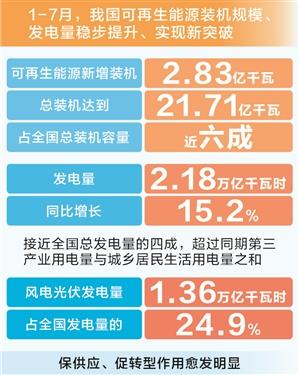
时报数说 | 1-7月我国可再生能源发电量同比增长15.2%
Zheng Quan Shi Bao· 2025-09-04 18:49
Core Viewpoint - The article discusses the recent financial performance and strategic developments of a specific company, highlighting its growth trajectory and market positioning [2] Group 1: Financial Performance - The company reported a revenue increase of 15% year-over-year, reaching $1.5 billion in the last quarter [2] - Net profit rose to $300 million, reflecting a 20% increase compared to the previous year [2] - The company's earnings per share (EPS) improved to $1.50, up from $1.25 in the same quarter last year [2] Group 2: Strategic Developments - The company announced plans to expand its operations into new markets, targeting a 10% market share within the next two years [2] - A new product line is set to launch, expected to contribute an additional $200 million in revenue annually [2] - The company is investing $50 million in technology upgrades to enhance operational efficiency [2]
突然,全线重挫!美国宣布:撤销!
券商中国· 2025-08-30 08:27
Core Viewpoint - The article highlights the significant setback faced by the U.S. renewable energy sector due to the recent decision by the U.S. Department of Transportation to withdraw $679 million in federal funding for offshore wind projects, which is seen as part of President Trump's broader strategy to curb renewable energy development [2][3][6]. Group 1: Funding Withdrawal - The U.S. Department of Transportation announced the cancellation of $679 million in federal funding originally intended for over a dozen offshore wind infrastructure projects [2][3]. - The most affected project is the Humboldt Bay offshore wind project in Northern California, which was set to receive $427 million (approximately 3 billion yuan) [7][8]. - Other projects losing federal funding include various offshore wind initiatives in Maryland, Connecticut, New Jersey, New York, Massachusetts, North Carolina, Ohio, Virginia, and Rhode Island [8]. Group 2: Market Impact - Following the funding withdrawal, shares of Danish wind energy giants Orsted and Vestas Wind Systems fell by over 3%, indicating a negative market reaction [2][3]. - Brookfield Renewable Partners also experienced a decline in stock value as a result of the announcement [3]. Group 3: Industry Concerns - Industry experts warn that the Trump administration's actions could exacerbate the imminent electricity supply shortage in the U.S., damage the power grid, and lead to increased consumer electricity prices [2][9]. - The U.S. Energy Information Administration (EIA) predicts that electricity prices will rise above inflation levels by 2026 due to increased demand and insufficient new renewable energy generation [10]. Group 4: Policy Implications - Trump's administration has been vocal about its discontent with renewable energy projects, particularly wind energy, stating that no new solar or wind projects will be approved even in areas facing electricity shortages [9][10]. - The administration prioritizes fossil fuels and nuclear energy as the most effective and reliable sources for national power supply, contrasting sharply with the renewable energy agenda [10].