可持续富足

Search documents
马斯克又来“画大饼”了?
Sou Hu Cai Jing· 2025-09-03 16:28
Core Viewpoint - Tesla is integrating hardware and software on a large scale to create a range of products and services that deeply incorporate artificial intelligence into the real world, aiming for a safer, cleaner, and better world [3] Group 1: Tesla's Vision and Strategy - Tesla envisions electric vehicles and humanoid robots as key components in transforming mobility and labor, with autonomous driving technology at the core of this vision [5] - Elon Musk indicated that approximately 80% of Tesla's future value will come from the Optimus humanoid robot project, shifting the company's focus from "energy sustainability" to "reshaping productivity with AI" [6] - Musk anticipates skepticism regarding this ambitious transformation, as some may view it as an impossible task or a mere fantasy without concrete plans [7] Group 2: Guiding Principles for Sustainable Prosperity - Musk outlined five guiding principles for achieving "sustainable prosperity": 1. Technological advancements can solve resource scarcity issues [9] 2. Innovation can break through constraints, similar to how internal combustion engines replaced horses [10] 3. Technology can address real-world problems, enhancing the availability and reliability of clean energy [11] 4. Automation must benefit all of humanity [12] 5. The more inclusive the technology, the more prosperous society will be [13] - These principles suggest a vision where machines create machines and serve humanity, hinting at high cost-performance products and potential regulatory considerations [15] Group 3: Progress and Challenges - Reflecting on Tesla's previous chapters, the ambitious goals of the fourth chapter appear daunting, especially given the unmet targets from earlier plans [16] - The first chapter set a three-step goal, with the third step of creating a more affordable electric vehicle still unfulfilled, and the zero-emission energy goal not yet meeting global standards [17] - The second chapter aimed to create an integrated energy ecosystem and expand product lines, but progress has been slower than expected [19] - The third chapter set quantitative targets for energy storage and renewable power equipment, but achieving these goals will take decades [22] - The fourth chapter seems more like a prelude to the release of Optimus, which is planned for this year, with mass production expected next year [24] Group 4: Market Reactions and Future Outlook - Following the release of the fourth chapter, Tesla's stock price declined for two consecutive days, reflecting market skepticism about the ambitious goals [25] - However, there are indications of interest from major logistics companies in North America, suggesting potential orders for the robots if initial production meets expectations [25] - The realization of a "robot utopia" hinges on the global robot population and profitability, aiming for a self-training cycle that could integrate high-performance robots into everyday life [25]


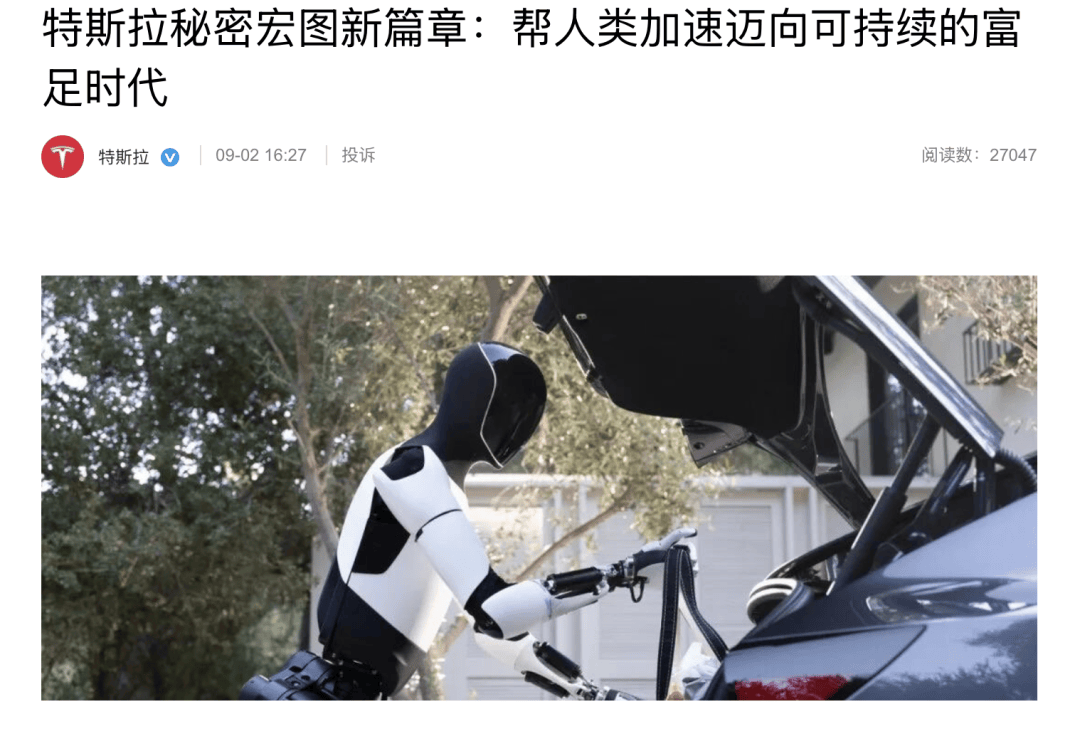
特斯拉未来重心转向AI,押注机器人走向车间
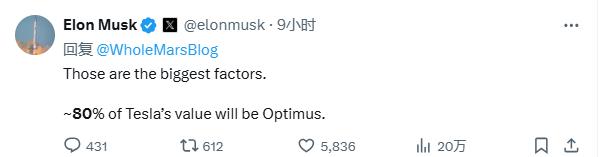
2 1 Shi Ji Jing Ji Bao Dao· 2025-09-03 13:02
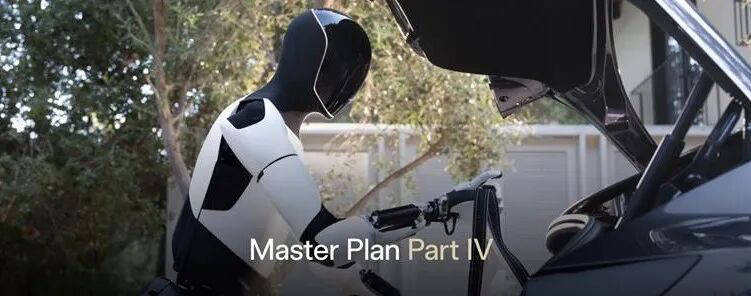
Core Insights - Tesla's "Master Plan" is a significant milestone in the global tech industry, with the fourth chapter focusing on integrating AI, automation, and large-scale manufacturing to accelerate the transition to sustainable prosperity [1][2] - The fourth chapter emphasizes products and technologies that promote prosperity, including solar power, battery storage, autonomous vehicles, and the Optimus robot, which is designed to replace humans in repetitive and dangerous tasks [1][3] - The rapid release of the fourth chapter, just two and a half years after the third, indicates a shift in Tesla's strategic focus from electric vehicles to AI-driven initiatives, which could be a pivotal moment for the company's future [1][3] Summary by Sections Master Plan Overview - The fourth chapter of the "Master Plan" aims to redefine fundamental elements of labor, transportation, and energy on a large scale, aspiring to create a sustainable and prosperous world [2] - Unlike previous chapters, the fourth chapter lacks specific implementation details, leading to criticism regarding its substance [4][6] Focus on Optimus Robot - Tesla's focus on the Optimus robot aims to change perceptions of labor and improve workforce availability and performance, with the goal of allowing people to pursue their passions [3] - Elon Musk stated that 80% of Tesla's future value will come from robots, suggesting a significant pivot in the company's value proposition [3] Historical Context - Previous chapters of the "Master Plan" had clear goals, such as developing reliable electric vehicles, solar energy utilization, and comprehensive energy storage solutions [5] - The lack of concrete plans in the fourth chapter has raised concerns that the second chapter's objectives have not yet been fully realized [6] Industrial Focus - Tesla's shift towards industrial applications for the Optimus robot follows internal challenges and a strategic pivot to focus on industrial scenarios, as indicated by leadership changes and project adjustments [6] - The broader industry trend shows a movement from entertainment-focused robots to those designed for industrial applications, with expectations of significant advancements in the next few years [7]

特斯拉“宏图计划4”发布:大规模地将AI融入物理世界,未来80%的价值在于机器人
美股研究社· 2025-09-03 12:56
Core Viewpoint - Tesla's latest "Master Plan Part IV" shifts the company's focus from electric vehicles and energy to artificial intelligence and robotics, aiming to create a "sustainable abundance" society through AI integration into the physical world [3][6]. Group 1: Vision and Goals - The ultimate goal defined in the plan is to achieve "unconstrained sustainability without compromise" [6]. - The plan emphasizes that Tesla has been building the foundation for nearly two decades in electric vehicles, energy products, and humanoid robots [6]. - Five guiding principles are introduced, asserting that the company is entering an unprecedented growth phase, which is described as a leap for both Tesla and humanity [6][10]. Group 2: Market Reactions - The market response to Tesla's ambitious vision is mixed, with some viewing it as a redefinition of large-scale autonomous driving [8]. - Critics argue that the plan lacks concrete execution paths and is seen as vague promises regarding AI, with some media commentators describing it as a collection of ambiguous AI commitments [4][13]. - There are concerns about Tesla's ability to attract top AI talent compared to competitors like OpenAI, Microsoft, Apple, and Amazon, due to Elon Musk's management style and company culture [15][17]. Group 3: Criticism of the Plan - Critics highlight that the plan appears to be more of a marketing document rather than a coherent strategy, contrasting it with previous plans that had clearer, actionable steps [21]. - There is skepticism regarding the feasibility of delivering a humanoid robot capable of performing useful tasks at an affordable price, with calls for Tesla to first prove its ability to create such a robot [14]. - The plan is perceived by some as an attempt to placate shareholders with fantasies of infinite growth in AI stocks, lacking substantial evidence of progress [13][15].
特斯拉发布“宏图计划”第四篇章,其中包含着哪些“秘密”?
Zhong Guo Qi Che Bao Wang· 2025-09-03 03:55
Core Insights - Tesla's "Master Plan" fourth chapter aims to integrate AI and autonomous driving technologies to accelerate the transition to sustainable abundance and human prosperity [2][3][4] - The plan emphasizes the creation of a safer, cleaner, and more enjoyable world through the unification of hardware and software [3][4] AI Empowerment - Tesla's innovations in electric vehicles, clean energy, and robotics lay the foundation for a technological renaissance aimed at eliminating scarcity [3][4] - The company believes that growth is limitless and that technological innovation can address resource shortages, similar to past industrial revolutions [3][4] Technological Integration - Tesla is building a collaborative network of AI and physical world technologies, including Full Self-Driving (FSD), Dojo supercomputer, and Optimus humanoid robots [5][6] - FSD is progressing towards full autonomy by continuously learning from millions of miles of road data, enhancing its ability to handle complex driving scenarios [5] - The Dojo supercomputer, with a processing power of 1.1 EFLOPS, supports AI model training and improves decision-making speed for vehicles [5] Robotics and Energy Solutions - The Optimus robot addresses labor shortages in repetitive and hazardous tasks, already being utilized in Tesla factories and service industries [6] - Tesla's Powerwall and Megapack are key components in energy transition, providing reliable energy storage solutions for homes and businesses [6][7] Virtual Power Plant Innovation - Tesla's Virtual Power Plant (VPP) connects dispersed battery systems to create a large energy buffer, effectively managing energy supply and demand [7] - The VPP model has shown significant success in pilot projects, indicating its potential as a critical infrastructure for renewable energy [7] Business Model Innovation - Tesla is transitioning to a data-driven business model, exploring innovations like the Robotaxi network and AI technology licensing to generate high-margin software revenue [8] - The Robotaxi service allows users to access autonomous vehicles through subscription or pay-per-use, projected to contribute 30% of Tesla's total revenue by 2030 [8] Industry Impact - The release of the fourth chapter of Tesla's "Master Plan" signifies a shift from product-focused innovation to a new stage of system capability integration [9] - The vision outlined in the plan is seen as forward-looking, but the path from concept to reality involves overcoming various challenges in technology and regulation [9][10] Societal Implications - Experts suggest that technology is not only a tool for economic development but also a key force in addressing global challenges like climate change and labor shortages [10] - The need for innovative companies to redefine future possibilities and contribute to a sustainable and prosperous society is emphasized [10]

特斯拉发布“宏图4.0”!未来机器人主导80%价值
Ge Long Hui· 2025-09-03 00:14
Core Insights - Tesla's "Master Plan Part IV" emphasizes the integration of artificial intelligence (AI) and robotics as the core focus for future growth and sustainability [1][3] - The plan aims to accelerate the transition to "sustainable abundance" through the unification of hardware and software, enhancing safety, cleanliness, and enjoyment in the world [3][4] - Tesla's future value is projected to be significantly derived from the Optimus robot, with approximately 80% of the company's value expected to come from this technology [4] Summary by Sections Master Plan Overview - The fourth chapter of the Master Plan marks a strategic shift from electric vehicles and energy solutions to a focus on AI and robotics [8] - The previous plans (1.0, 2.0, and 3.0) laid the groundwork for electric vehicle feasibility, solar energy solutions, and a roadmap for sustainable energy transition, but faced challenges in execution [5][7] Key Principles of Master Plan Part IV - Endless growth is emphasized, where growth in one area does not hinder another, akin to the industrial revolution and the internet [4] - Innovation is seen as a means to eliminate limitations, with Tesla's battery technology disrupting fossil fuel transportation [4] - Technology is aimed at solving real-world problems, enhancing the availability of clean energy and improving safety in transportation [4] - Autonomy must benefit humanity, making daily life safer and better [4] - Broader accessibility will drive stronger growth, promoting social democratization and improving quality of life through advanced products [4] Historical Context - Master Plan 1.0 focused on proving the viability of electric vehicles and expanding the market with models like the Roadster, Model S, Model X, and Model 3 [5] - Master Plan 2.0 aimed at integrating solar solutions with energy storage and developing significantly safer autonomous driving technology, though progress has been limited [6][7] - Master Plan 3.0 targeted the elimination of fossil fuels and outlined a global sustainable energy economy, but Tesla's involvement outside electric vehicles has been minimal [7]
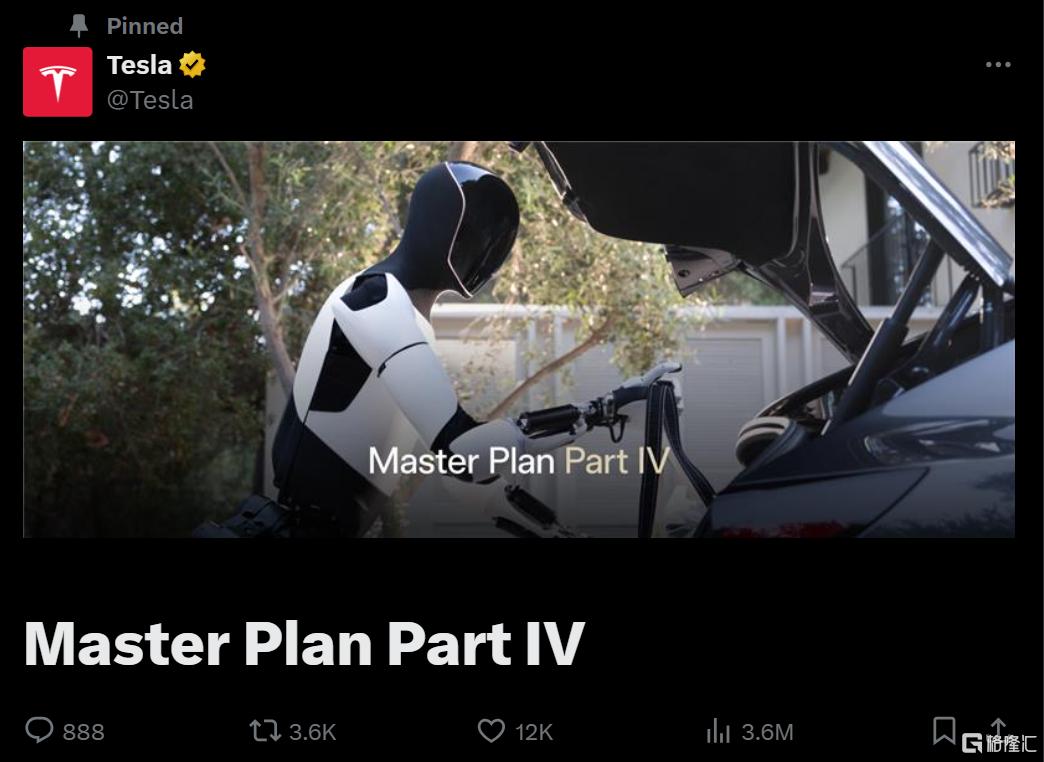
特斯拉“宏图计划4”发布:大规模地将AI融入物理世界,未来80%的价值在于机器人
3 6 Ke· 2025-09-03 00:10
Core Viewpoint - Tesla's latest "Master Plan Part IV" shifts the company's focus from electric vehicles and energy to artificial intelligence and robotics, aiming to create a "sustainable prosperity" society through AI integration into the physical world [1][3][5]. Group 1: Vision and Goals - The ultimate goal defined in the plan is to achieve "unconstrained sustainability without compromise" [3][5]. - The plan outlines five guiding principles: 1. Growth is unlimited: Technological innovation can solve resource shortages and create more economic opportunities [3][10]. 2. Innovation eliminates limitations: Continuous innovation can overcome seemingly impossible obstacles [3][12]. 3. Technology solves real problems: Products like autonomous vehicles and Optimus robots aim to address issues such as traffic safety and labor efficiency [3][14]. 4. Autonomy must benefit all humanity: The development and application of autonomous technology should enhance human well-being [3][18]. 5. Broader access drives greater growth: Providing advanced technology products at affordable prices is essential for building a prosperous society [3][19]. Group 2: Criticism and Skepticism - Critics argue that the plan lacks concrete execution paths and is seen as vague promises about AI, with some labeling it as a collection of empty AI commitments [2][28]. - There are concerns regarding Tesla's ability to attract top AI talent compared to competitors like OpenAI, Microsoft, and Apple, due to Elon Musk's management style [30]. - Observers question the feasibility of the ambitious goals set in previous master plans, noting that many steps remain unfulfilled, leading to skepticism about the current plan's viability [29][33].
马斯克预言特斯拉80%价值来自擎天柱,将特斯拉《宏伟蓝图4》押注AI与机器人
Sou Hu Cai Jing· 2025-09-02 13:24
Core Insights - Tesla's "Master Plan Part IV" emphasizes the integration of AI into physical products and services through robotics and automation, aiming for a sustainable and prosperous future [1][2] - Elon Musk stated that approximately 80% of Tesla's value will derive from the Optimus robot, highlighting its significance alongside the expansion of Tesla's full self-driving software [1][2] Summary by Sections Introduction - Tesla's guiding principle since its inception has been to achieve unrestricted sustainability without compromise, with a new mission to bring AI into the physical world [1] - The plan outlines five guiding principles: infinite growth, innovation eliminating limitations, using technology to solve real problems, automation benefiting humanity, and broader accessibility leading to greater growth [1][2] Key Principles - **Infinite Growth**: Growth in one area does not necessitate decline in another; resource scarcity can be addressed through technological advancements [1] - **Innovation Eliminating Limitations**: Tesla has historically challenged norms, such as the transition from fossil fuel vehicles to electric ones, proving the feasibility of low-cost battery production [1] - **Using Technology to Solve Real Problems**: Each Tesla product aims to be more efficient and sustainable than its predecessor, with the Optimus robot redefining labor and enabling humans to focus on preferred activities [1] - **Automation Benefiting Humanity**: The development of autonomous driving should enhance human living conditions, with Musk envisioning a transition from a "pre-autonomous" to a "post-autonomous" world [1] - **Broader Accessibility Leading to Greater Growth**: To create a prosperous society, Tesla aims to produce advanced products that are affordable and scalable, expanding its business from clean energy to intelligent systems that enhance labor and mobility [2] Conclusion - The plan concludes with a vision of tools that will help build a sustainable and prosperous world, redefining labor, mobility, and energy to benefit all [3] Reactions - Media and public reactions to the plan have been mixed, with some praising its ambitious vision while others criticize it as utopian and lacking clarity compared to previous plans [5][6]
特斯拉“宏图计划4”发布:大规模地将AI融入物理世界,未来80%的价值在于机器人
华尔街见闻· 2025-09-02 10:29
Core Viewpoint - Tesla's latest "Master Plan Part IV" shifts the company's focus from electric vehicles and energy to artificial intelligence and robotics, aiming to create a "sustainable prosperity" society through large-scale AI integration into the physical world [3][4][14]. Summary by Sections Vision and Goals - The ultimate goal defined in the plan is to achieve "unconstrained sustainability without compromise" [7][15]. - Tesla emphasizes its foundational work over the past two decades in electric vehicles, energy products, and humanoid robots to support this vision [8][18]. Guiding Principles - Five guiding principles are outlined: 1. **Growth is Infinite**: Technological innovation can solve resource shortages and create more economic opportunities [9][21]. 2. **Innovation Eliminates Constraints**: Continuous innovation can overcome seemingly impossible barriers, as demonstrated by Tesla's advancements in battery technology [10][23]. 3. **Technology Solves Real Problems**: Products like autonomous vehicles and Optimus robots aim to address real-world issues such as traffic safety and labor efficiency [11][25]. 4. **Autonomy Must Benefit Humanity**: The development and application of autonomous technology should enhance human well-being [12][31]. 5. **Wider Access Drives Greater Growth**: Providing advanced technology products at affordable prices is essential for building a prosperous society [13][32]. Market Reactions - The market response to Tesla's ambitious vision is mixed, with some viewing it as a redefinition of large-scale autonomous driving, while others criticize it as vague and lacking actionable steps [39][40]. - Critics argue that the plan resembles a collection of AI promises without substantial evidence of execution, likening it to a distraction for shareholders [5][43]. Challenges and Criticism - There are concerns regarding Tesla's ability to attract top AI talent compared to competitors like OpenAI and Microsoft, due to Elon Musk's management style and company culture [45][46]. - Skepticism exists about the feasibility of achieving the outlined goals, with past plans having seen significant unfulfilled promises [48][49][50].
特斯拉发布“宏图计划4”,揭密马斯克终极AI计划,机器人首被提及,新款赛博车曝光
Sou Hu Cai Jing· 2025-09-02 10:22
Core Insights - Tesla's "Master Plan Part 4" reveals Elon Musk's ultimate AI vision, focusing on a society led by AI and robotics, moving beyond just electric vehicles and energy products [2][3] - The plan emphasizes that 80% of Tesla's future value will come from the Optimus robot, marking a significant shift towards AI and robotics [5] - Critics have labeled the plan as "AI empty talk," lacking concrete execution steps and being a collection of vague AI promises [5] Group 1 - The new plan highlights the increasing influence of AI as a foundational technology, with cars, robots, and energy products becoming downstream applications [6] - Tesla aims to create affordable, scalable high-tech products to build a prosperous society, with the Optimus robot being a key focus [7] - Musk envisions a future where people are freed from boring or dangerous jobs, leading to high income and access to basic needs for everyone [8] Group 2 - Tesla intends to establish a fully integrated sustainable product ecosystem, addressing transportation, energy generation, battery storage, and robotics [8] - The report has drawn skepticism due to past unfulfilled promises in previous Master Plans, raising questions about the timeline for achieving stated goals [9] - A potential new SUV model was hinted at in a promotional video released alongside the plan, sparking speculation about Tesla's future vehicle offerings [10]
特斯拉“宏图计划4”发布:大规模地将AI融入物理世界,未来80%的价值在于机器人
硬AI· 2025-09-02 10:07
Core Viewpoint - Tesla's latest Master Plan Part IV shifts the company's strategic focus from electric vehicles to artificial intelligence and robotics, aiming to achieve a vision of "sustainable prosperity" through the deep integration of AI with the physical world. CEO Elon Musk stated that approximately 80% of Tesla's future value will come from the Optimus robot [2][3][4]. Group 1: Grand Vision - The ultimate goal defined in the Master Plan IV is to achieve "unconstrained sustainability without compromise" [7]. - The plan emphasizes the integration of AI into physical products and services, building on nearly two decades of experience in electric vehicles, energy products, and humanoid robots [7][14]. - Five guiding principles are proposed: 1. Growth is infinite: Technological innovation can solve resource shortages and create more economic opportunities [8]. 2. Innovation eliminates limitations: Continuous innovation can overcome seemingly impossible obstacles [9]. 3. Technology solves real problems: Products like autonomous vehicles and Optimus aim to address issues such as traffic safety and efficiency [10]. 4. Autonomy must benefit all humanity: The development and application of autonomous technology should enhance human well-being [28]. 5. Broader accessibility drives greater growth: Providing advanced technology products at affordable prices is essential for building a prosperous society [11][30]. Group 2: Mixed Reactions - The market response to Tesla's grand vision has been mixed, with some viewing it as a redefinition of large-scale autonomous driving, while others criticize it as vague promises lacking concrete execution paths [35][36]. - Critics argue that the plan resembles a collection of ambiguous AI commitments, with some questioning the feasibility of delivering on such ambitious goals [5][41]. - Concerns have been raised about Tesla's ability to attract top AI talent compared to competitors like OpenAI, Microsoft, and Apple, due to Musk's management style and company culture [44][45].