太空AI数据中心

Search documents
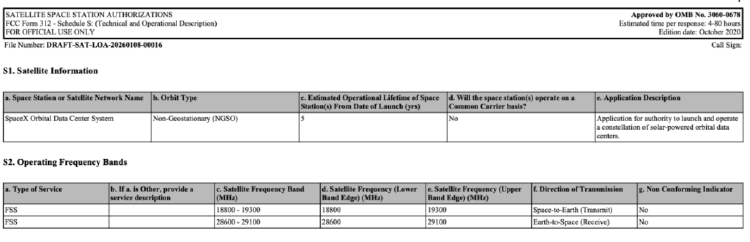
马斯克大消息!SpaceX申请部署100万颗卫星,公司财务数据首次曝光
Mei Ri Jing Ji Xin Wen· 2026-01-31 12:37
目前部分投行预计,SpaceX在IPO时的估值或将超过1.5万亿美元,融资规模可能会突破500亿美元。这一 估值水平将使其成为全球有史以来规模最大的IPO。 据此前报道,SpaceX计划在今年晚些时候上市,目标日期定在马斯克55岁生日(6月28日)前后。 从业务结构看,SpaceX的盈利能力高度集中于Starlink(星链)。 上述知情人士透露,马斯克的卫星互联网系统星链已成为公司绝对的营收主力,贡献了公司约50%至80% 的收入。 自2019年以来,SpaceX已累计发射约9500颗卫星,用户数超过900万,使其成为全球最大的卫星运营商。 星链产生的稳定现金流不仅支撑了商业扩张,也成为SpaceX持续投入重型火箭——星舰(Starship)研发 的核心资金来源。 马斯克此前透露,预计星舰2026年将开始执行商业载荷发射任务。该火箭自2023年以来已完成11次测试发 射。 每日经济新闻消息,据券商中国,美东时间1月30日,路透社报道,据两位知情人士透露,马斯克旗下 SpaceX公司2025年实现营收预计达150亿至160亿美元,息税折旧摊销前利润(EBITDA)约为80亿美元 (约合人民币556亿元)。相关财 ...

?蹭上“太空轨道算力”风口的Rocket Lab(RKLB.US)开年“喜忧参半”:Neutron受挫 Electron高轨告捷
Zhi Tong Cai Jing· 2026-01-22 14:28
(原标题:?蹭上"太空轨道算力"风口的Rocket Lab(RKLB.US)开年"喜忧参半":Neutron受挫 Electron高 轨告捷) Rocket Lab股价在周四美股盘前交易中下跌超2%,此前在周四也下跌了1.5%,2026年以来涨幅高达 26%。2025年全年,Rocket Lab股价涨幅更是高达175%。 自2025年以来股价大幅上行,更像是"公司自身基本面与订单结构的跃迁"叠加"航空航天赛道整体估值 重估"的结果;其中前者是主因,后者(主要包括SpaceX引领的史无前例商业航空热潮与估值攀升,以及 SpaceX引领的"太空数据中心/太空轨道算力'牛市叙事)更多起到情绪与倍数扩张的催化作用,但是这种 市场动态催化对于Rocket Lab股价狂野涨势堪称重大驱动力。 美国国家安全/国防巨额订单,可谓把Rocket Lab从"小火箭公司"推向"国防航天主承包商(prime)"型增长 叙事。2025年12月,Rocket Lab获得美国SDA(Space Development Agency,美国太空发展局)8.16亿美元 的TRKT3(Tracking Layer Tranche 3)合同,作为主 ...

AI数据中心上天,与其说黑科技不如说是作秀
3 6 Ke· 2025-12-17 12:39
Core Viewpoint - Starcloud, a space computing startup supported by Nvidia, has successfully trained and operated an AI model in space for the first time, marking a significant milestone in the field of space AI [1][3]. Group 1: Company Developments - Starcloud's satellite, Starcloud-1, successfully ran Google's open-source model Gemma and trained NanoGPT using the complete works of Shakespeare, sending a Shakespearean-style message back to Earth [3]. - Starcloud aims to achieve a tenfold reduction in energy costs for orbital data centers compared to ground-based data centers, validating the feasibility of constructing space data centers that require large computing clusters [3]. Group 2: Industry Trends - Google plans to begin building space AI data centers by early 2027, with ambitions to utilize solar energy in space, which is significantly more abundant than on Earth [5][6]. - The drive towards space AI data centers is largely motivated by the need to address energy shortages faced by tech giants in the U.S., where insufficient infrastructure has become a critical issue [9]. - The energy demands for AI data centers are projected to reach 347 GW by 2030, highlighting the urgency for alternative energy solutions [9]. Group 3: Technical Challenges - Space AI data centers face significant challenges, including heat dissipation and radiation protection, which have yet to be effectively resolved [11][15]. - The average temperature in low Earth orbit is -120°C, complicating heat management, as heat transfer in space occurs primarily through radiation [13]. - High-energy particles in space can cause single-event upsets in electronic components, leading to potential computational errors, which necessitates the use of older chip manufacturing processes for space applications [13][15].
中信建投:商业航天产业有望进入新纪元 国企与民营企业共振周期
智通财经网· 2025-12-15 02:32
Core Viewpoint - The commercial aerospace industry is expected to enter a new era driven by national policy support and technological breakthroughs, with a focus on various segments including remote sensing, satellite control systems, and space computing capabilities [1] Group 1: Industry Development - The goal of building a strong aerospace nation accelerates the development of the commercial aerospace industry, with China emphasizing the creation of a globally covered, efficient communication, navigation, and remote sensing infrastructure during the 14th Five-Year Plan [1] - The Chinese government is expected to evolve its policy support for commercial aerospace from infrastructure construction and market cultivation to rule-making and guiding exploration in frontier fields by the 15th Five-Year Plan [1] - The establishment of the Commercial Aerospace Department by the National Space Administration in November 2025 aims to enhance the scale, ecological collaboration, and safety regulation of the commercial aerospace industry by 2027 [1] Group 2: Information Technology in Aerospace - The remote sensing industry is a major area of development within commercial aerospace due to its wide application scenarios and direct economic value [2] - The demand for satellite intelligent flight control technology is expected to increase significantly as low-orbit satellite constellations become more densely deployed, ensuring the safe and efficient operation of the industry [2] - CAE technology plays a crucial role throughout the lifecycle of satellites, rockets, and probes, particularly in the design and testing phases [2] Group 3: New Application Scenarios - Space computing is anticipated to become a new application scenario, complementing ground computing, with Elon Musk proposing a 100 GW space AI data center as a cost-effective solution for large-scale AI operations [3] - Google's Project Suncatcher aims to launch satellites equipped with TPUs for on-orbit experiments, addressing challenges related to power consumption, land resources, and cooling in large-scale ground computing centers [3]

史上最大IPO将至!估值8000亿美元只是起点,碾压OpenAI!SpaceX只谈“天文数字”!
雪球· 2025-12-14 07:08
Group 1 - The core viewpoint of the article is that SpaceX is preparing for an IPO in 2026 with a target valuation of $1.5 trillion, significantly higher than its current valuation of $800 billion [2][5][6]. - SpaceX's stock price has surged to $421 per share, doubling from $212 in July, and has surpassed OpenAI's valuation, reclaiming its title as the world's most valuable unicorn [7][8]. - The anticipated IPO could raise $30 billion, potentially setting a record for the largest IPO in history, surpassing Saudi Aramco's $29.4 billion [7]. Group 2 - The urgency for the IPO is driven by the need for substantial funding for ambitious projects, including Mars colonization, lunar base construction, and a space-based AI data center [10][12]. - Analysts express concerns that the IPO may lead to the integration of Tesla and SpaceX, raising risks of related party transactions [12][13]. - Despite the potential for significant returns, there are worries about investor patience, as SpaceX remains a capital-intensive company focused on long-term projects [13][14].

马斯克酝酿“史上最疯狂IPO”! 当SpaceX登陆市场之时 美股从“Mag7”迈向“伟大八雄”时代?
智通财经网· 2025-12-11 13:20
Core Viewpoint - SpaceX is planning a potential IPO that could raise over $30 billion, with a target valuation of approximately $1.5 trillion, making it one of the largest IPOs in history, which could significantly support Elon Musk's ambitions for Mars exploration [1][2][3] Group 1: IPO Details - SpaceX aims to conduct its IPO as early as mid-2026, with a fundraising goal that may exceed $30 billion, potentially reaching $40 billion if 5% of shares are sold [2] - The IPO could surpass the previous record set by Saudi Aramco, which raised $29 billion in 2019 by selling only 1.5% of its shares [2] - A portion of the funds raised from the IPO is expected to be allocated towards developing large AI data centers in space [2][3] Group 2: Financial Projections - SpaceX's revenue is projected to reach approximately $15 billion in 2025 and increase to between $22 billion and $24 billion in 2026, primarily driven by the Starlink business [3] - The growth of the Starlink satellite internet service and advancements in the Starship rocket for lunar and Mars missions are contributing to the company's accelerated IPO timeline [3] Group 3: Market Sentiment and Risks - Investor interest in SpaceX is expected to be substantial, despite the high-risk nature of its capital-intensive business model [1][3] - Historical data indicates that high-valuation companies often face market sell-offs post-IPO, with long-term performance typically lagging behind broader market indices [10][11] - Analysts express that while Musk's unconventional management style may pose risks, it also brings a level of excitement that could attract investors [4][5] Group 4: Competitive Landscape - SpaceX is seen as a potential addition to the "Great Eight" tech giants alongside companies like Nvidia and Google, reflecting its strong growth prospects in the current tech revolution [7] - The ongoing AI boom is shifting investment focus from core platform companies to broader AI infrastructure and applications, indicating a structural expansion in the AI investment landscape [8]
谷歌新“登月计划”曝光:要把TPU数据中心搬上太空
3 6 Ke· 2025-11-05 09:32
Core Insights - Google has launched the "Project Suncatcher," aiming to build large-scale AI data centers in space to address the growing energy demands of AI development [1][3] - The project involves deploying a satellite network powered by custom TPU chips, utilizing near-continuous solar energy to operate [1][5] - Google has partnered with Planet to launch two prototype satellites in early 2027, marking the beginning of a "space AI race" [1][12] Group 1: Need for Space-Based AI Computing - The "Project Suncatcher" is a revolutionary response to the increasing energy demands of modern machine learning, which is growing exponentially [3] - As AI models become more complex, their computational and energy requirements are rising, leading to financial costs and environmental concerns [3] - Google's solution is to move computational infrastructure to space, where solar panel efficiency can be eight times higher than on Earth [3] Group 2: Technical Feasibility and Challenges - The project envisions a constellation of solar-powered satellites in low Earth orbit, maximizing solar energy collection [5][7] - Each satellite will act as a floating AI data center node, equipped with Google's custom TPU chips, and will communicate via laser links for high-speed data transfer [7][9] - Early ground tests have shown promising results for the TPU's radiation resistance, crucial for operation in space [8][9] Group 3: Economic Viability - The economic feasibility of space data centers hinges on significantly reduced launch costs, projected to fall below $200 per kilogram [9][11] - Google anticipates that this price point could be reached around 2035, supported by advancements from companies like SpaceX [11] - The financial model for the project relies on the assumption that space-based data centers can match the energy costs of terrestrial data centers [11] Group 4: Competitive Landscape - Google is entering a competitive field of orbital computing, with other tech giants like Microsoft and Amazon also exploring similar initiatives [12][13] - The first milestone for Google is the launch of prototype satellites in collaboration with Planet, which will test the TPU hardware in space [12] - Successful implementation of "Project Suncatcher" could redefine the economics of AI and open new frontiers for digital infrastructure [14]