
扩大有效需求

Search documents
李强在江苏调研时强调:坚持创新驱动发展,着力扩大有效需求,推动经济运行持续向好
news flash· 2025-06-18 11:34
Core Viewpoint - The emphasis on innovation-driven development and the expansion of effective demand to promote sustained economic improvement in China [1] Group 1 - The importance of implementing Xi Jinping's directives on economic work [1] - The focus on creating a strong atmosphere for entrepreneurship and innovation [1] - The commitment to deepening reform and opening up to stimulate high-quality development [1]
促进物价合理回升关键在于扩大有效需求
Jin Rong Shi Bao· 2025-05-14 01:50
Group 1 - The core viewpoint of the article emphasizes the need to promote reasonable price recovery by balancing supply and demand in the economy, with a focus on expanding effective demand [1] - The analysis indicates that the low price levels in China are influenced by multiple factors, including weak total demand, external uncertainties, and the need for further consumer confidence recovery [2][3] - The article highlights that excessive competition in certain industries exacerbates supply-demand contradictions, as traditional investment-driven growth leads to overcapacity in the context of insufficient effective demand [3] Group 2 - The relationship between currency and prices is complex, influenced by long-term factors such as globalization, demographic changes, and economic structure, making it difficult to apply traditional theories linearly [4] - It is noted that price changes vary across different industries, with some sectors, particularly those linked to outdated capacities, experiencing significant price declines, such as a drop of over 5% in the Producer Price Index (PPI) for certain industrial products [4] - The article suggests a shift in price regulation strategies from preventing price gouging to preventing low-price dumping, advocating for quality over quantity in business practices to maintain market order and sustainable operations [6]
金融时报:促进物价合理回升关键在于扩大有效需求
news flash· 2025-05-14 01:08
Core Viewpoint - The key to promoting a reasonable recovery in prices lies in expanding effective demand [1] Economic Supply and Demand - The People's Bank of China released the "Monetary Policy Implementation Report for the First Quarter of 2025," detailing the relationship between supply and demand in the real economy and price changes [1] - It emphasizes the need for a balance between economic supply and demand to facilitate a reasonable price recovery [1] Government and Business Strategies - Analysts suggest that government price management should shift from encouraging businesses to "exchange price for volume" to guiding them to "win by quality" [1] - Companies are advised to identify their operational direction and explore diversified competitive strategies, including technological innovation, brand building, service quality, and market segmentation [1]
社论丨扩大有效需求,畅通供需循环
2 1 Shi Ji Jing Ji Bao Dao· 2025-05-12 17:57
Group 1 - The core viewpoint of the articles emphasizes the importance of stabilizing prices and promoting reasonable price recovery through a combination of monetary and fiscal policies [1][2][3] - The April CPI showed a month-on-month increase of 0.1%, reversing a previous decline, driven by rising food and travel service prices, indicating the effectiveness of policies aimed at expanding domestic demand and consumption [1] - The central bank's report highlights that the key to boosting prices lies in expanding effective demand and ensuring smooth supply-demand cycles, while also addressing structural issues in the economy [2][3] Group 2 - The report indicates that total demand remains weak due to various uncertainties, including global growth slowdown and the ongoing transformation of China's economic structure, which requires time for new growth drivers to fill the gap left by traditional drivers [2] - There is a recognition of excessive competition in certain industries, which has exacerbated supply-demand imbalances due to a historical focus on investment-driven capacity expansion [2][3] - A coordinated approach involving fiscal, monetary, industrial, employment, and social policies is necessary to achieve a balance between supply and demand, and to promote reasonable price recovery [3]
证监会最新部署来了
Zheng Quan Shi Bao Wang· 2025-05-12 00:08
Monetary Policy - The People's Bank of China announced a 0.5 percentage point reduction in the reserve requirement ratio for financial institutions, effective May 15, 2025 [1] - The central bank also lowered the 7-day reverse repo rate from 1.50% to 1.40% starting May 8, 2025, as part of a moderately loose monetary policy [1] Economic Report - The People's Bank of China released the "2025 Q1 Monetary Policy Implementation Report," emphasizing the importance of boosting consumption to stabilize growth [2] - The report highlighted the sustainability of China's government debt compared to the US and Japan, and the need to promote a reasonable recovery in prices by balancing supply and demand [2] - It called for maintaining ample liquidity and aligning social financing scale and money supply growth with economic growth and price expectations [2] Financial Support Initiatives - The central bank established a service consumption and elderly care re-loan program with a quota of 500 billion yuan, aimed at increasing financial support for key service sectors and the elderly care industry [3] - The re-loan has a one-year term with a 1.5% annual interest rate and can be extended twice, with a maximum usage period of three years [3] Company News - Duople announced that shareholder Cai Shuping plans to reduce his stake by up to 2% through block trading [4] - Qujiang Cultural Tourism reported that its controlling shareholder's 4.7% stake is set to be auctioned, amounting to 12 million shares [5] - Chengfei Integration confirmed that there have been no significant changes in its operational environment despite recent stock price fluctuations [6][7] - Hongqiang Co. stated that there are no undisclosed significant matters regarding the company amid stock price volatility [8] - Guizhou Tire's controlling shareholder plans to increase its stake by between 50 million and 100 million yuan within six months [9] - Wanxiang Qianchao is in discussions for a major asset restructuring involving the acquisition of Wanxiang America Corp. [10] - Maiwei Bio's chairman is under investigation for suspected insider trading, but it is not expected to impact the company's operations significantly [11] - Bank of China received approval from the Shanghai Stock Exchange for a specific A-share issuance, pending further regulatory approval [12]
策略周报:逆周期政策提振市场信心-20250512
Orient Securities· 2025-05-11 23:30
Market Overview - During the week of May 5 to May 9, the A-share market experienced fluctuations, with the Shanghai Composite Index, CSI 300, and ChiNext Index rising by 1.92%, 2.00%, and 3.27% respectively. The defense and military industry led the gains with an increase of 6.33% [6] - The current PE (TTM) for CSI 300 is 12.44 times, with a risk premium of 6.40%, which is above one standard deviation. The ChiNext Index has a PE (TTM) of 30.25, below one negative standard deviation [6] Economic Policies - On May 7, the State Council held a press conference announcing a comprehensive financial policy package, including a 0.5 percentage point reduction in the reserve requirement ratio and a 0.1 percentage point cut in policy interest rates. Additionally, a 500 billion yuan "service consumption and pension relending" program was established [6] - The People's Bank of China emphasized the need for moderately loose monetary policy in its first-quarter monetary policy report, highlighting that boosting consumption is key to expanding domestic demand and stabilizing growth [6] Trade Performance - In the first four months of this year, China's total goods trade value reached 14.14 trillion yuan, a year-on-year increase of 2.4%. In April alone, the trade value was 3.84 trillion yuan, growing by 5.6% year-on-year [6] - Exports in April amounted to 2.27 trillion yuan, up 9.3%, while imports were 1.57 trillion yuan, an increase of 0.8% [6] Market Sentiment - The recent financial policies have effectively boosted market confidence, with market indices recovering from the impacts of tariff shocks. However, the high tariff barriers may gradually affect the real economy, and the latest CPI and PPI data indicate ongoing risks of endogenous deflation [6] - The report anticipates that the A-share market will maintain wide fluctuations with a focus on structural trends, particularly favoring sectors like technology and military in the medium term [6] Valuation Analysis - In terms of valuation, sectors such as food and beverage, agriculture, and forestry are at historical low PE levels, while real estate, computers, and steel are at historical high PE levels. For PB valuation, agriculture, construction materials, and oil and gas are at historical lows [28][30] - The report includes detailed tables showing the current PE and PB valuations of various sectors, indicating their positions within the historical percentiles over the past decade [29][30]
空头又危险了?
Ge Long Hui· 2025-05-10 08:56
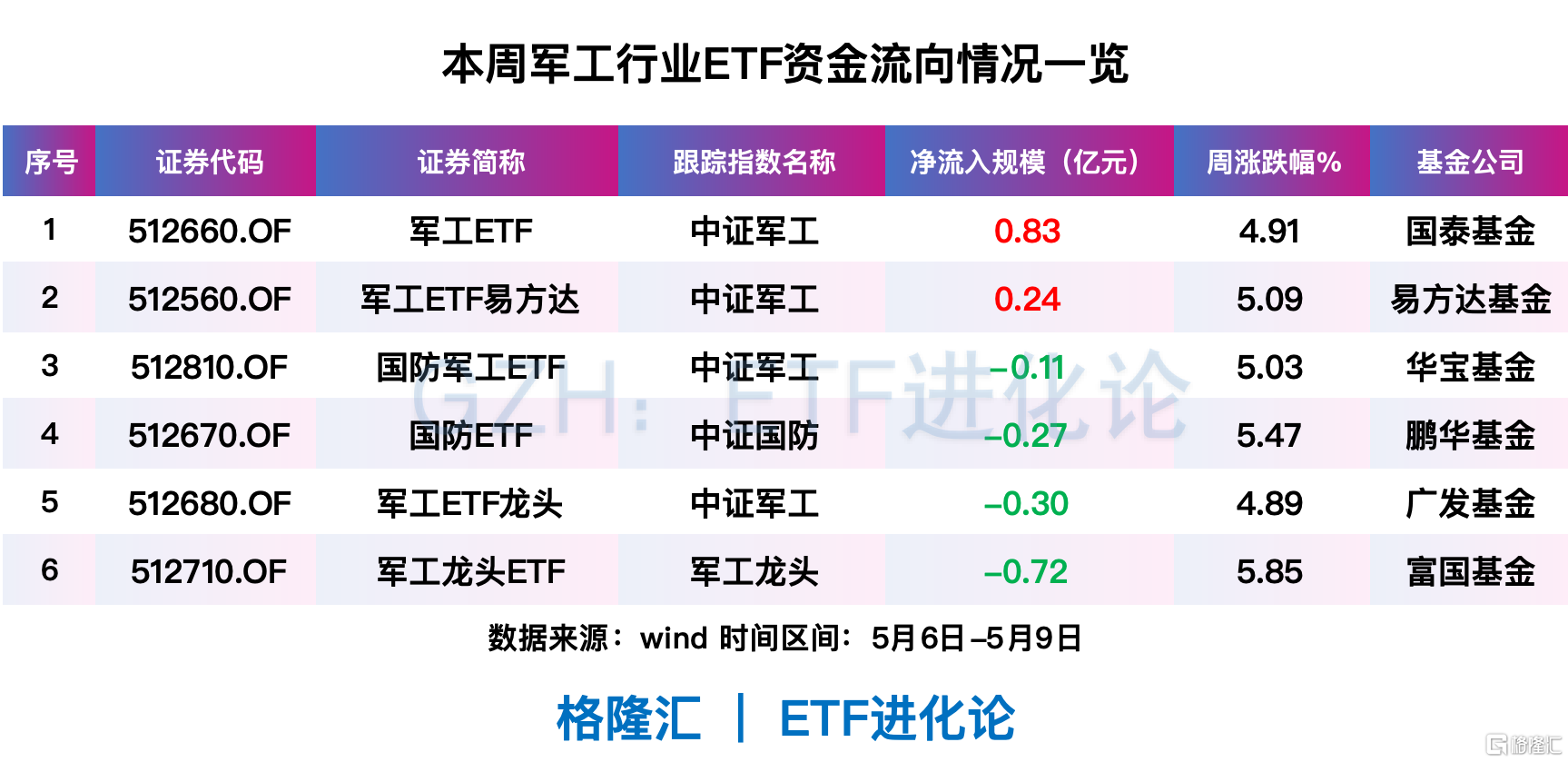
Group 1 - The KSE30 index in Pakistan experienced a significant drop of 7%, marking the largest decline since 2008, following a market halt due to escalating tensions between India and Pakistan [1][2] - Pakistan has initiated a military operation named "Copper Wall Iron Wall," which included cyber attacks on India, resulting in approximately 70% of India's power grid being incapacitated [2] - The military conflict has led to increased activity in the defense and aerospace sectors, with the military industry sector showing a strong five-day rally, accumulating over 7% in gains [2] Group 2 - The recent geopolitical tensions have prompted significant inflows into defense ETFs, with the Guotai Military ETF and the Military ETF from E Fund seeing net inflows of 83 million and 24 million respectively [4] - The U.S. stock market has shown a cautious stance ahead of the upcoming U.S.-China trade talks, with investors exhibiting a bearish sentiment, as evidenced by a record 11-week streak of bearish outlooks [6][8] - The recent monetary policy changes in China, including interest rate cuts, have led to an unusual rise in long-term interest rates, indicating a potential recovery in investment sentiment [10][16]

宏观政策思路转变,央行货币政策报告释放这些信号
Di Yi Cai Jing· 2025-05-09 13:18
Group 1 - The core viewpoint emphasizes the shift in macroeconomic policy from focusing on high prices to managing low prices, supporting quality development over scale expansion, and preventing disorderly competition instead of monopolies [1][7] - The People's Bank of China (PBOC) is prioritizing consumption alongside investment to stimulate economic growth, as indicated in the recent monetary policy report [1][2] - The report highlights the need for a financial product and service system that aligns with consumer demand to enhance consumption and create a virtuous cycle between consumption and finance [2][3] Group 2 - The report indicates that the Chinese government's debt is manageable, with total assets equivalent to 166% of GDP and total liabilities at 75% of GDP, suggesting a strong fiscal position to support economic initiatives [4] - There is a call for fiscal policy to focus more on areas that have a direct impact on consumption, such as elderly care, childcare, and healthcare services [4][5] - The report notes that the government has increased fiscal support significantly, with local special bond issuance reaching nearly 1 trillion yuan in the first quarter, which has positively influenced investment and confidence [4] Group 3 - The report stresses the importance of balancing supply and demand to promote reasonable price recovery, addressing deep-seated structural issues in the economy [6][8] - Experts suggest that price levels are primarily determined by supply and demand dynamics, with monetary factors being secondary; thus, increasing money supply alone will not resolve low price levels [7] - The PBOC plans to implement a moderately loose monetary policy to ensure that the growth of social financing and money supply aligns with economic growth and price level expectations [8]
延续回升向好态势 一季度南京市经济运行起步平稳、稳中有进
Nan Jing Ri Bao· 2025-04-28 02:23
Economic Overview - The economy of Nanjing showed a stable recovery in the first quarter, with a GDP of 471.87 billion yuan, a year-on-year increase of 5.3% [1] - The primary industry added value was 4.67 billion yuan, growing by 3.7%; the secondary industry added value was 141.80 billion yuan, increasing by 4.2%; and the tertiary industry added value was 325.41 billion yuan, rising by 5.8% [1] Industrial Production - The industrial production in Nanjing saw a year-on-year increase of 6.4%, with the manufacturing sector growing by 7.1% [2] - Among 37 major industrial categories, 30 experienced growth, resulting in an overall growth rate of 81.1% [2] - High-tech manufacturing increased by 10%, with significant growth in electric machinery (12.5%), medical manufacturing (13.7%), and other key sectors [2] Service Sector - The service sector's added value grew by 5.8%, with notable increases in information transmission (7.4%) and wholesale and retail (7.9%) [3] - The revenue of large-scale service enterprises rose by 5.6%, with the information technology services sector seeing a 13.8% increase [3] - Cultural, sports, and entertainment sectors experienced a significant growth of 16.9%, particularly in cultural and sports activities [3] Consumer Market - The total retail sales of consumer goods reached 232.31 billion yuan, a year-on-year increase of 7.5% [4] - Sales of essential and upgraded goods showed strong growth, with food and beverage sales increasing by 21.7% and automotive sales rising by 22.9% [4] - Online retail sales surged by 46.4%, accounting for 30.1% of total retail sales [4] Investment Trends - Fixed asset investment decreased by 7.2%, but the decline was less than in previous months, with industrial investment growing by 12.5% [5] - High-tech industry investment rose by 13.2%, with significant growth in new manufacturing sectors such as electronics (41.7%) and new materials (146.1%) [6] Price Trends - Consumer prices remained stable, with a slight year-on-year decrease of 0.4% in the first quarter [6] - The producer price index for industrial producers fell by 1.7%, indicating a decrease in production costs [6] Income Growth - The per capita disposable income for residents reached 24,411 yuan, a year-on-year increase of 4.5% [7] - Rural residents' income growth (5.0%) outpaced that of urban residents (4.3%), reflecting a narrowing income gap [7]