技术协同

Search documents
通业科技拟收购思凌科半导体100%股权 布局电网通信芯片领域
Ju Chao Zi Xun· 2025-08-19 02:01
Core Viewpoint - Tongye Technology announced the acquisition of 100% equity in Beijing Silin Semiconductor Technology Co., Ltd., marking a significant step in its strategic layout in the semiconductor field [1][2] Group 1: Acquisition Details - The acquisition will be executed through a "cash acquisition + equity transfer" dual-track model, allowing Tongye Technology to gain full control of Silin Semiconductor while binding the core team to the listed company through equity transfer [1] - The controlling shareholders of Tongye Technology, Xie Wei and Xu Jianying, along with their concerted parties, will transfer 10% of the company's shares to Silin Semiconductor's original shareholders, enhancing alignment of interests [1] Group 2: Business and Technology Implications - Silin Semiconductor specializes in power grid communication chips and modules, with major clients including large state-owned enterprises like the State Grid [1] - The company possesses core technological advantages in power line carrier communication chips, which have broad application prospects in smart grid construction [1] - The acquisition is expected to enable Tongye Technology to apply Silin Semiconductor's technology in rail transit power grid systems, facilitating technological synergy and market expansion [1] Group 3: Strategic Importance - The acquisition is highlighted as a crucial move for the company's strategic transformation, significantly enhancing its technical strength in smart network control systems [1] - The management believes that the integration of semiconductor technology with rail transit will open new business growth points and promote long-term sustainable development [1]
中国从世界工厂迈向创新策源地
news flash· 2025-07-17 10:36
Core Insights - In the first half of 2025, China's GDP reached 66,053.6 billion yuan, reflecting a year-on-year growth of 5.3% [1] - The total import and export volume was 21,787.6 billion yuan, with a year-on-year increase of 2.9% [1] - The third China International Supply Chain Promotion Expo showcased the resilience of the Chinese economy and attracted participation from 75 countries and regions, along with over 650 enterprises and organizations [1] Economic Performance - China's GDP growth of 5.3% indicates a stable economic recovery and resilience amidst global challenges [1] - The increase in import and export volume by 2.9% suggests a gradual recovery in trade activities [1] Supply Chain Dynamics - The expo highlighted China's role as a "stabilizer" in the global supply chain, with a 15% increase in European and American exhibitors compared to the previous year [1] - The introduction of an innovation chain section at the expo, featuring a system that covers 680,000 existing patents, signifies a shift from traditional trade to technological collaboration [1] Innovation and Technology - Over 100 globally launched products were showcased, including advancements in brain-computer interfaces and embodied intelligence from Zhejiang and Hubei, respectively [1] - This shift indicates China's transition from being the "world's factory" to becoming an "innovation source" [1]
长鸿高科拟收购广西长科100%股权 深化新材料领域布局
Zheng Quan Ri Bao Zhi Sheng· 2025-07-08 05:41
Group 1 - The core point of the news is that Ningbo Changhong High Polymer Technology Co., Ltd. is planning to acquire 100% equity of Guangxi Changke New Materials Co., Ltd. through a combination of issuing shares, convertible bonds, and cash payment, which is expected to constitute a significant asset restructuring without changing the actual controller of the company [1] - Guangxi Changke is a high-tech enterprise specializing in the R&D, production, and sales of specialty synthetic resin polymer materials, including transparent ABS, high transparency MS, high acrylonitrile AS, and high impact ABS/HIPS [1] - The acquisition is expected to enhance Changhong High Tech's competitive edge in the industry across multiple dimensions, particularly in technology, products, and the industrial chain [1] Group 2 - The transparent ABS process of Guangxi Changke fills a gap in Changhong High Tech's high-end specialty resin manufacturing, and the technological synergy is expected to accelerate cross-domain technology integration, leading to innovative products that meet the demands of new energy vehicles and green packaging [2] - Changhong High Tech has been focusing on developing high value-added and high-demand new products, with plans to invest in a "Acrylic Acid Industrial Park Project" in collaboration with Ningbo Haoxiang New Materials Technology Co., Ltd. in 2024 [2] - The completion of the acquisition will allow Changhong High Tech to further improve its product matrix and industrial layout in the high-performance and high value-added new materials sector [2] Group 3 - The company aims to optimize its industrial structure through project upgrades, new project construction, new product development, and capital operations, striving for product diversification, terminalization, and differentiation to achieve long-term development goals and create greater value for shareholders [3]

迈得医疗业绩断崖式下跌 存货减值是否埋雷
Xin Lang Zheng Quan· 2025-07-04 09:23
Core Viewpoint - The company, Maide Medical, is facing a significant decline in revenue and market challenges, particularly in its core safety infusion equipment segment, leading to concerns about its financial health and future prospects [2][3][4]. Revenue Performance - In 2024, Maide Medical's revenue plummeted by 42.77% year-on-year, totaling 275 million yuan, with core products experiencing substantial declines: safety infusion equipment revenue fell by 39.59%, and blood purification equipment revenue dropped to zero [2]. - The overall market for injection and puncture consumables in China shrank by 2.57% to 32 billion yuan, exacerbated by external pressures such as the FDA's safety reviews and tariffs on Chinese syringes [2]. Product Performance - The only bright spot was a 67.12% increase in revenue from blood purification connection machines, reaching 104 million yuan, although the average price halved from 20.78 million yuan to 8.01 million yuan [3]. - The shift towards lower-tier products in response to market demands raises concerns about the loss of technical premium and profitability [3]. Customer Concentration and Risks - The concentration of revenue among the top five customers increased, with the largest customer, Sanxin Medical, accounting for 32.65% of revenue (89.74 million yuan) and related transactions comprising 12.41% [3]. - The long repayment cycle of 1-3 years for major clients highlights potential liquidity risks for the company [3]. New Business Ventures - To counteract the decline in traditional business, Maide Medical is venturing into contact lens manufacturing through its subsidiary, Maide Shun, although this new business is currently in a cash-burning phase [4]. - Management expenses rose to 95 million yuan, and R&D expenses increased by 21.81% to 40 million yuan, with long-term loans of 30 million yuan fully invested in this new area [4]. Financial Health Indicators - Financial indicators are raising red flags, with inventory valued at 139 million yuan, constituting 22.99% of current assets, and a significant increase in contract liabilities by 78.59% to 98.84 million yuan [4]. - The company reported a goodwill impairment of 10.42 million yuan and a doubling of construction in progress to 50.01 million yuan, indicating potential asset bubble concerns [4].

思科瑞: 成都思科瑞微电子股份有限公司关于和北京长鹰恒容电磁科技有限公司签署增资扩股意向协议的公告
Zheng Quan Zhi Xing· 2025-06-26 16:17
Group 1 - The core point of the announcement is that Chengdu Sicore Microelectronics Co., Ltd. plans to invest RMB 52.1 million in Beijing Changying Hengrong Electromagnetic Technology Co., Ltd., acquiring a 51.028% stake, with the investment still subject to further negotiations and approvals [1][2][8] - The investment is intended to enhance business scale, optimize product structure, and improve market competitiveness, establishing a mutually beneficial cooperation between the two companies [5][8] - The investment is not expected to constitute a major asset restructuring or related party transaction as per the regulations [2][8] Group 2 - The target company, Changying Hengrong, specializes in electromagnetic compatibility (EMC) design, testing, and evaluation, focusing on defense research and technology [8] - The collaboration between Sicore and Changying Hengrong is expected to create a closed-loop capability in testing, protection, and certification, particularly in high-end markets such as military and aerospace [8] - The investment will allow Sicore to become the controlling parent company of Changying Hengrong, enhancing technical collaboration and resource integration, thereby improving testing capabilities and increasing revenue [8]

世名科技(300522) - 300522世名科技投资者关系管理信息20250616
2025-06-16 10:54
Group 1: Company Strategy and Developments - The company aims to enhance its product performance through the acquisition of a stake in Beijing Dingcai, leveraging its expertise in LCD display color photoresist products [3] - The company has approved a capital increase plan during the 2024 annual shareholders' meeting held on May 9, 2025, with further updates to be disclosed through legal media [4] - A joint venture with TCL Capital has been approved by the board on May 29, 2025, pending regulatory approvals [4] Group 2: Market Position and Competitive Advantage - The company holds a total of 135 valid patents, including 84 invention patents, primarily in the fields of nano coloring materials and electronic chemicals, enhancing its market competitiveness [5] - The traditional business remains a stable revenue source, while the emerging electronic chemicals segment is viewed as a growth engine for future development [6] Group 3: Financial and Investor Relations - The company is open to cash dividends in accordance with regulatory guidelines, contingent on meeting cash dividend conditions [6] - The company emphasizes the importance of rational investment and risk awareness among investors, ensuring that all significant information is disclosed accurately and timely [6]

兴业银锡:以“资产整合+技术协同”构建更具韧性业务组合
Zheng Quan Ri Bao· 2025-05-22 15:42
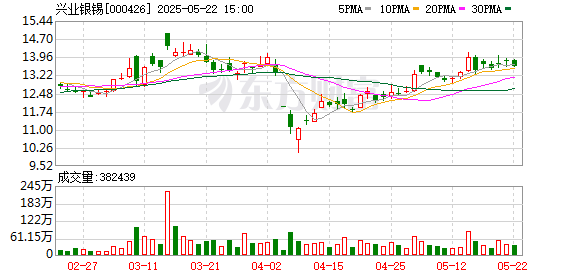
Core Viewpoint - Inner Mongolia Xingye Silver Tin Mining Co., Ltd. has demonstrated significant growth in both production and profitability, driven by strategic initiatives in resource integration, technological upgrades, and international expansion [3][4][5]. Financial Performance - In 2024, the company achieved operating revenue of 4.27 billion yuan, a year-on-year increase of 15.23% - The net profit attributable to shareholders reached 1.53 billion yuan, reflecting a substantial year-on-year growth of 57.82% [3]. Strategic Initiatives - The company has established Yunnan Mali Po Tin Precious Metals Mining Co., Ltd. to enhance resource integration and development in Yunnan, focusing on tin and copper [3]. - Technological innovations and equipment upgrades at its main mining operations, such as the successful implementation of a flotation process at Yinman Mining, have significantly improved ore processing capabilities and product quality [3]. Resource Development - The company is accelerating the conversion of geological exploration results into recoverable reserves at Yinman Mining and is planning a second-phase expansion project to enhance core mining competitiveness [4]. - There is a focus on domestic market acquisitions of mature and high-potential mining projects to optimize local resource allocation [4][7]. International Expansion - The company is committed to a "going global" strategy, with a significant investment in Australian company Far East Gold Limited, acquiring a 19.99% stake [5]. - An international division has been established to oversee overseas operations, focusing on silver and tin while also exploring copper and gold resources [5][6]. Future Outlook - The company aims to strengthen its resource foundation by building a multi-tiered mineral resource reserve system, enhancing the conversion of potential resources into recoverable reserves [7]. - There are plans for further cross-border mergers and acquisitions, particularly targeting silver, tin, copper, and gold resources to create a more resilient business portfolio [7].


2025上海车展,零部件企业破局重构产业格局
Jing Ji Guan Cha Bao· 2025-05-21 08:32
Core Insights - The 2025 Shanghai Auto Show serves as a significant platform for the automotive supply chain, showcasing a transformation from "supporting players" to "leading players" in the industry [1][16] - The exhibition area for auto parts spans 100,000 square meters, hosting over 1,500 suppliers from 28 countries, marking it as the largest auto parts display in history [2][4] - The event highlights the shift towards smart and electric vehicles, with a notable presence of both traditional suppliers and new tech companies [2][3] Industry Transformation - The automotive supply chain is evolving with technology companies entering the market, changing the competitive landscape from hardware manufacturing to a software-hardware integrated ecosystem [3] - The collaboration between component suppliers and vehicle manufacturers is shifting from "supplying" to "joint development," as seen in partnerships like Huawei with Jianghuai Auto and CATL with SAIC [3][5] Scale and Competition - More than half of the world's top 100 auto parts suppliers participated in the show, showcasing their advanced technologies and products [4][5] - Domestic companies like CATL and Huawei are demonstrating significant growth and technological advancements, indicating a shift in industry power dynamics [5][11] Technological Innovations - The event showcased breakthroughs in battery technology, including CATL's sodium-ion battery and BYD's all-solid-state battery, which address safety and performance concerns [7][8] - Major Tier 1 suppliers are accelerating local R&D efforts, with Bosch and Continental introducing advanced driver assistance systems that leverage local technology [9][10] Local Market Dynamics - Chinese auto parts companies are rapidly gaining ground, with over 1,200 domestic automotive chips displayed, reflecting a shift from being a backup option to a primary choice for automakers [11] - Companies like Huawei and CATL are setting benchmarks in technology and ecosystem development, with innovative solutions like rapid battery swapping and smart vehicle systems [12][13] Global Strategy and Localization - Multinational companies are deepening their local strategies in China, with significant investments and a focus on integrating into the local automotive ecosystem [13][14] - The trend of localization is becoming essential for global suppliers, as they adapt to the unique demands of the Chinese market while also aiming for global outreach [15][16]

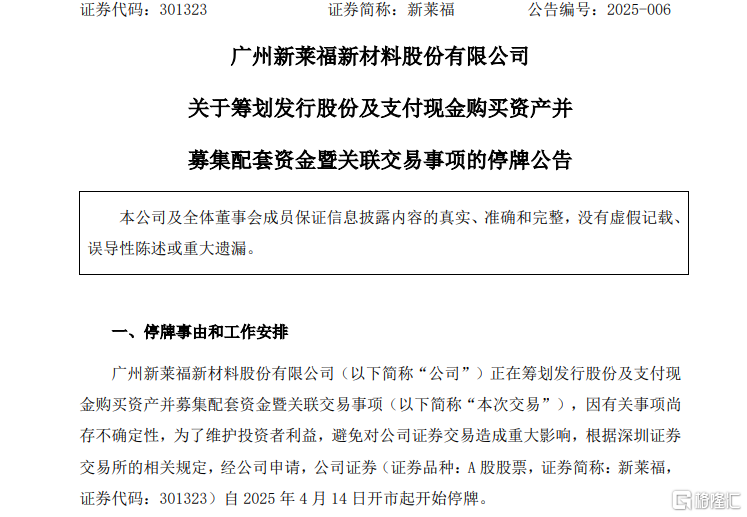
重大重组复牌,新莱福“20cm”高开跳水,并购疑云引分歧
Ge Long Hui· 2025-04-28 03:24
Core Viewpoint - New Lai Fu (301323.SZ) has resumed trading and announced a major asset restructuring plan to acquire 100% equity of Guangzhou Jin Nan Magnetic Materials through a combination of share issuance and cash payment [1][2]. Company Overview - The acquisition is seen as a horizontal integration within the industry, with both companies focusing on magnetic materials but in different segments. Jin Nan Magnetic Materials specializes in rubber-plastic magnets for micro motors, holding a 60% global market share in motor magnetic strips, while New Lai Fu excels in adsorption functional materials and electronic ceramic components [4][5]. Financial Data - For 2024, Jin Nan Magnetic Materials is projected to have a revenue of 502 million yuan and a net profit of 83.41 million yuan, with a net profit margin of 16.63%. New Lai Fu's revenue is expected to be 886 million yuan with a net profit of 145 million yuan. If the merger is completed, New Lai Fu's revenue will increase to 1.386 billion yuan, and net profit will rise to 225 million yuan, with total assets and net assets growing by 33% and 26% respectively [5][10]. Management and Control - The actual controller of both companies, Wang Xiaoming, has raised concerns due to the complex relationship between them. He holds 54% of Shengci Technology, which owns 50% of Jin Nan Magnetic Materials, and has a direct stake of approximately 26.59% in Jin Nan [7][9]. Regulatory Concerns - Regulatory scrutiny has previously been directed at the relationship between the two companies, particularly during New Lai Fu's IPO phase, where questions were raised about potential competition between them. The current acquisition emphasizes their shared industry, raising concerns about the transaction's legitimacy [9]. Financial Pressure - New Lai Fu faces significant financial pressure, with cash reserves dropping from 1.324 billion yuan at the time of its IPO to 283 million yuan, a decrease of 78.6%. The company has a total debt of 154 million yuan, and the source of cash for the acquisition remains unclear, leading to speculation about potential fundraising challenges [10]. Industry Outlook - The demand for magnetic materials is expected to grow significantly, with projections indicating that the global market for magnetic materials will exceed 100 billion USD by 2025, driven by sectors such as industrial automation, new energy vehicles, and robotics. If New Lai Fu can effectively integrate resources, it may position itself among the top players globally [12].