投资组合多元化

Search documents
澳大利亚掀起新淘金热黄金反弹修复
Jin Tou Wang· 2025-12-30 06:04
Group 1: Gold Market Overview - The current trading price of London gold is approximately $4378.12 per ounce, with a 1.07% increase, reaching a high of $4379.84 and a low of $4322.53 [1] - International gold prices have been consistently breaking historical records this year, surpassing the $4500 per ounce mark last Friday [1] - Goldman Sachs predicts that gold prices will rise to $4900 by the end of 2026, driven by geopolitical and fiscal uncertainties prompting private investors to diversify their portfolios [1] Group 2: Gold Mining and Exploration - In Victoria, Australia, the rising gold prices and social media influence have led to an influx of amateur prospectors in the "Golden Triangle" region, which spans 9600 square kilometers [2] - The Minelab Gold Monster 2000 metal detector has seen a surge in sales, with Lucky Strike Gold reporting increased revenue due to the rise in gold prices [2] - Codan, the world's largest manufacturer of handheld metal detection equipment, has experienced a doubling of its stock price this year, attributed to strong sales in both domestic and international markets [3] Group 3: Market Dynamics and Predictions - Recent market activity has shown significant volatility, with a notable drop exceeding 200 points in a single day, indicating a strong bearish trend [4] - The market is expected to see a rebound, with resistance levels identified at 4403, and a potential rebound range estimated between 4420 and 4373 [4] - The market is approaching the end of the month and year, which may lead to increased volatility, with key support around 4300 and resistance levels at 4375, 4403, and 4429 [4]
外资杀回东南亚!2026年亚洲投资“香饽饽”浮出水面
Zhi Tong Cai Jing· 2025-12-29 01:48
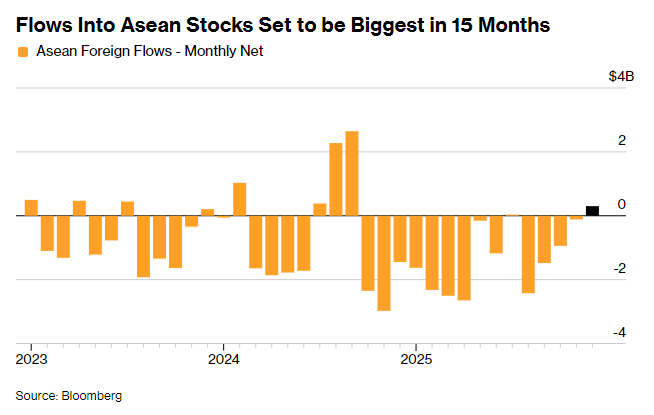
Group 1 - Southeast Asia is becoming a key segment in the global financial landscape by 2026, driven by undervaluation advantages and the need for portfolio diversification, with a net foreign inflow of $337 million in December, potentially reaching a new high since September 2024 [1] - The MSCI ASEAN index underperformed the broader Asia-Pacific index by approximately 13 percentage points in 2025, marking the largest gap in five years, primarily due to the lack of assets related to the booming AI industry [1] - Investors are seeking to diversify their allocations to reduce dependence on the US market and crowded sectors like AI, which directly benefits the ASEAN market [1] Group 2 - Markets like Vietnam are expected to benefit from global supply chain shifts and anticipated interest rate cuts by the Federal Reserve, with the FTSE Russell upgrading Vietnam's stock market to secondary emerging market status in October [2] - The earnings outlook for stock markets in Indonesia, Vietnam, and the Philippines is gradually improving, supported by large-scale fiscal spending plans, infrastructure development, and consumer demand stimulation [2] - Current dynamic P/E ratios for benchmark indices in Indonesia, Thailand, Malaysia, and Vietnam range from 12 to 15 times, while the Philippines' benchmark index is below 10 times, compared to over 22 times for the S&P 500 [2] Group 3 - The region's markets face multiple risks, particularly in Thailand and Indonesia, where domestic political instability is a concern, with Thailand's Prime Minister announcing a dissolution of parliament and elections scheduled for February 2024 [4] - If the AI investment trend continues to attract market interest, the ASEAN market may struggle to reverse its current underperformance [5] - Moderate valuation levels are gradually enhancing the ASEAN market's appeal to value investors, especially with a rebound in earnings growth, as indicated by December's fund flow data [5]

Why Overdiversifying Your Portfolio Is a Really Bad Idea
The Motley Fool· 2025-12-27 16:22
Core Viewpoint - Diversification is essential for protecting portfolio value, but overdiversification can lead to disappointing results [1][2][4] Group 1: Importance of Diversification - Diversification helps reduce the risk of poor-performing investments by including a mix of investment types that behave differently under specific economic conditions [1][2] - A well-diversified portfolio minimizes the impact of losses from any single investment, as seen in the example of spreading investments across 20 different stocks or asset types [2] Group 2: Risks of Overdiversification - Overdiversification can dilute the overall gains of a portfolio, as high-performing assets may not significantly contribute to returns if overshadowed by numerous low-performing investments [8] - Mental fatigue can arise from managing a complex portfolio, leading to less strategic decision-making [8] - Investors may miss opportunities to invest in higher-quality assets due to spreading their money too thin [8] - Higher transaction costs can occur from managing a larger number of assets, increasing fees and management costs [8] Group 3: Signs of Overdiversification - Indicators of overdiversification include owning too many similar investments, difficulty in tracking holdings, and a portfolio performance that mirrors or underperforms the market [8] - Challenges in rebalancing due to holding many small positions and inability to recall the rationale behind several investments are also signs of overdiversification [8]

Why is silver outperforming gold? What to know before you invest.
Yahoo Finance· 2025-12-22 23:16
Core Insights - Gold and silver prices have reached record highs in December due to economic pressures and geopolitical tensions, with gold at $4,480.60 per ounce (up 71% year-over-year) and silver at $69.38 (up 138% year-to-date) [1][4]. Group 1: Price Movements - Gold prices have increased significantly, reaching a record high of $4,480.60 per ounce, marking a 71% increase over the past year [1]. - Silver has outperformed gold, with prices rising to $69.38, a 138% increase since the beginning of the year [1][4]. - The gold-silver ratio has narrowed from 104 to 1 in April to 64 to 1 currently, indicating a stronger performance of silver relative to gold [4]. Group 2: Investment Dynamics - Experts suggest that rising inflation expectations may lead more investors to buy silver alongside gold, as silver is considered a more affordable option for exposure to precious metals [5]. - The potential for industrial demand for silver, particularly as interest rates decrease, may also drive investment in silver due to its conductive properties [5]. - Silver's dual role as both an investment and an industrial metal contributes to its price volatility compared to gold [7]. Group 3: Investment Strategies - Investors typically view precious metals like gold and silver as a hedge against inflation and economic uncertainty, diversifying portfolios during market volatility [6]. - Various investment methods in precious metals include digital assets like ETFs, futures contracts, and mining stocks, as well as physical assets such as jewelry and coins [7][8].
外媒:黄金或成为“长期性重要资产”
Sou Hu Cai Jing· 2025-12-21 09:21
Group 1 - Gold prices have seen a historic surge, reaching a high of $4,381 per ounce in October 2025, with predictions of hitting $5,000 by 2026 due to factors like U.S. policies, geopolitical tensions, and increased demand from central banks and new investors [2] - Central banks have diversified their reserves for five consecutive years, which analysts believe will provide solid support for gold prices in 2026, with a quarterly demand expectation of 585 tons compared to the current requirement of 350 tons to maintain price levels [2] - The proportion of gold assets held by investors has increased from 1.5% to 2.8% of total assets since before 2022, indicating a growing interest in gold as a hedge against market downturns [3] Group 2 - The International Bank for Settlements noted a rare simultaneous rise in gold and stock prices, raising concerns about a potential bubble, while geopolitical conflicts have made gold a preferred hedge against stock market declines [3] - Despite a 23% decline in jewelry demand in Q3, there is a shift towards investment in gold bars and coins, as evidenced by increased retail demand in Australia and Europe [3] - The overall gold supply response has been limited, with only a 6% increase in recycling and minimal central bank sell-offs, while total gold demand is expected to grow by 11% this year but will slow down by 2026 [3][4]
Silver and Gold are On the Rise. Should Precious Metals ETF Investors Pick GDX or SIL?
The Motley Fool· 2025-12-20 15:14
Core Insights - The article compares two mining ETFs: Global X - Silver Miners ETF (SIL) and VanEck Gold Miners ETF (GDX), highlighting their differences in expense ratios, portfolio breadth, and risk profiles for investors seeking precious metals exposure [2][8]. Expense Ratios and Performance - GDX has a lower expense ratio of 0.51% compared to SIL's 0.65%, making it more cost-effective for investors [3] - Both ETFs have shown a 1-year return of 151% as of December 16, 2025, indicating strong performance in the precious metals sector [3] - GDX offers a lower dividend yield of 0.5% versus SIL's 1.08%, which may attract income-focused investors [3] Portfolio Composition - GDX provides exposure to 56 gold mining companies, primarily large-cap, with significant holdings in Agnico Eagle Mines Ltd, Newmont Corp, and Barrick Mining Corp, reflecting a diversified approach [5] - SIL focuses exclusively on silver miners, holding 39 stocks, with top positions in Wheaton Precious, Pan American Silver Corp, and Coeur Mining Inc, appealing to those seeking direct silver exposure [6] Market Context - Precious metals investing is seen as a hedge against inflation and a means of portfolio diversification, with silver prices recently reaching an all-time high and gold steadily rising [9] - Silver is noted for its higher volatility compared to gold due to its dual role as an industrial metal and a store of value, while gold is primarily viewed as a safe haven during economic or political instability [10] Risk Considerations - Both ETFs are focused on mining companies, which carry specific operational risks that can affect stock performance independently of the precious metals they mine [11]
近半个世纪的最猛涨幅,依旧吓不跑黄金多头!
Jin Shi Shu Ju· 2025-12-17 14:57
Core Viewpoint - The price of gold is expected to reach $5,000 per ounce by 2026, driven by a growing investor base and various geopolitical factors, despite the historical context suggesting a potential market correction [2][7]. Group 1: Gold Price Trends - Gold prices have doubled over the past two years, reaching a historical high of $4,381 in October, with predictions for further increases to $5,000 by 2026 [2][6]. - Analysts from Morgan Stanley and JPMorgan expect gold prices to average $4,500 and $4,600 respectively in 2026, with a potential peak above $5,000 in the fourth quarter [7][8]. Group 2: Central Bank Influence - Central banks have shifted their foreign exchange reserves from dollar assets to diversified allocations for five consecutive years, laying the groundwork for the gold market in 2026 [3][6]. - Global central banks purchased 634 tons of gold in the first nine months of the year, indicating strong demand that supports higher gold prices [6]. Group 3: Investor Behavior - The proportion of gold assets held by investors has increased from 1.5% to 2.8% of total managed assets, suggesting a growing interest in gold as a safe-haven asset [6]. - The demand for gold is partly driven by investors seeking to hedge against potential stock market downturns, with geopolitical tensions further fueling this trend [8][9]. Group 4: Market Dynamics - The demand for gold jewelry has declined by 23% in the third quarter, although retail demand for gold bars and coins has partially offset this decline [9][12]. - The global gold demand is projected to grow by 11% in 2025, reaching 5,150 tons, before declining to 4,815 tons in 2026 [12]. Group 5: Expansion of Investor Base - The gold investment community is expanding, particularly in Asia, with India allowing pension funds to invest in gold and silver ETFs, and China permitting certain insurance funds to invest in gold [13].

5 Stocks Worth Watching on Their Recent Dividend Hikes
ZACKS· 2025-12-17 14:36
Market Overview - The U.S. market has shown volatility, with returns of 19.2% for the Nasdaq Composite, 15.8% for the S&P 500, and 13.7% for the Dow Jones Industrial Average over the past year [1] - Concerns are rising regarding the moderating pace of the economy, influenced by a cooling labor market and high valuations in the technology sector [1] Federal Reserve Actions - The Federal Reserve cut its key interest rate by a quarter percentage point in December to support the job market and stimulate growth, with inflation trending near the 2% target [2] - The Fed has reduced borrowing costs three times this year, bringing the overnight borrowing rate to a range of 3.50-3.75% [2] Labor Market Conditions - The job market is showing signs of cooling, with softer hiring, rising unemployment at 4.6%, and a narrowing gap in job openings [3] - Nonfarm payrolls increased by 64,000 jobs in November after a decline of 105,000 jobs in October, the largest drop since December 2020 [3] Investment Opportunities - Investors looking to diversify can consider dividend-paying stocks, which indicate a healthy business model and tend to outperform non-dividend-paying stocks in volatile markets [4] - Notable dividend-paying companies include: - **Pentair (PNR)**: Declared a dividend of 27 cents per share with a yield of 1% and a payout ratio of 21% [5][6] - **nVent Electric (NVT)**: Declared a dividend of 21 cents per share with a yield of 0.8% and a payout ratio of 26% [7][8] - **CenterPoint Energy (CNP)**: Declared a dividend of 23 cents per share with a yield of 2.3% and a payout ratio of 51% [10][11][12] - **Marriott Vacations Worldwide (VAC)**: Declared a dividend of 80 cents per share with a yield of 5.5% and a payout ratio of 44% [10][13][14] - **PG&E (PCG)**: Declared a dividend of 5 cents per share with a yield of 0.7% and a payout ratio of 7% [15]


继续看涨黄金!法兴银行维持10%顶配,目标价5000美元
Jin Shi Shu Ju· 2025-12-16 06:36
Core Viewpoint - Societe Generale predicts that gold will continue to outperform U.S. bonds and the dollar until 2026, maintaining its maximum allocation and advising investors to buy on dips [1] Group 1: Investment Strategy - Societe Generale has reduced its exposure to U.S. inflation-linked bonds to zero and halved its corporate bond holdings to 5%, while maintaining a 10% allocation to gold in multi-asset portfolios [1] - The bank's analysts suggest that retail investors are diversifying their assets by entering the gold market through bullion, coins, and ETFs, recommending buying on dips due to central banks continuing to diversify away from dollar assets [1] Group 2: Market Outlook - Analysts expect gold prices to reach $5,000 per ounce by the end of next year, driven by anticipated aggressive and dovish monetary policy from the Federal Reserve [1] - The bank forecasts that inflation pressures will ease next year, but acknowledges increasing risks in the U.S. labor market [1] - Societe Generale's economists predict a further 50 basis points cut in the federal funds rate by April next year, aligning with current market expectations, which would support a gradual easing of financial conditions [1] Group 3: Economic Context - The current real federal funds rate remains relatively restrictive, despite a recent drop from 5.5% to 4%, indicating that inflation-adjusted monetary conditions are still tight [1] - The dual mandate of the Federal Reserve, combined with the political necessity to control food prices ahead of midterm elections, is expected to serve as a strong anchor for policy rates until 2026 [1] - The correlation between the U.S. stock market and bond market remains higher than historical norms, enhancing gold's value as a diversification tool in investment portfolios [1]

机构看好黄金前景,高盛看高金价至4900美元
Huan Qiu Wang· 2025-12-14 02:50
Group 1 - Precious metals, particularly gold and silver, have shown remarkable performance in 2023, with gold up 63.83% and silver up 114.35% as of December 12 [1][3] - Recent price movements indicate a divergence between gold and silver, with gold rising 0.47% to $4299.29 per ounce, while silver fell 2.5% and New York silver futures dropped by 3.88% [1][3] Group 2 - Analysts from Swiss Bank Pictet noted that silver is known for its price volatility, and recent gains were driven by its inclusion in the U.S. critical minerals list and rising expectations for Federal Reserve rate cuts, but the price reaction may have been excessive [3] - The World Gold Council predicts that gold will reach over 50 historical highs by 2025 due to increasing geopolitical and economic uncertainties, a weakening dollar, and sustained buying momentum [3] - Goldman Sachs has set an aggressive target price for gold at $4900 per ounce by the end of 2026, citing potential significant price increases if household or institutional investors continue to increase their gold holdings [3]