
欧洲央行降息

Search documents
欧元区8月通胀小幅回升,欧央行9月会议降息无望?
Hua Er Jie Jian Wen· 2025-09-02 12:02
Group 1 - Eurozone's August CPI rose by 2.1% year-on-year, up from 2.0% in July, aligning with economists' expectations [1] - Core inflation, excluding volatile items like energy and food, remained stable at 2.3% [1] - The European Central Bank (ECB) is expected to maintain interest rates at 2% during the upcoming meeting on September 11, as indicated by the latest inflation data [1] Group 2 - ECB decision-makers generally support keeping interest rates stable, with the German central bank president describing the current economic state as "some kind of equilibrium" [2] - Some officials, however, suggest that the possibility of future rate cuts remains, citing uncertainties in the economic outlook [3] - The inflation data reveals a mixed performance across Eurozone countries, with France, Italy, and Spain showing lower-than-expected inflation, while Germany's inflation was slightly above expectations [3]
潘森宏观:欧央行9月或无视粘性通胀再次降息
Jin Tou Wang· 2025-09-01 04:00
Core Viewpoint - The Euro is experiencing an upward trend against the US dollar, currently trading around 1.17, with a slight increase of 0.23% from the previous close [1] Economic Indicators - Eurozone inflation remains unchanged at an annual rate of 2.0% for July, with core inflation also stable [1] - Food inflation is accelerating, and the base effect of oil prices may lead to a rebound in Eurozone inflation in the remaining months of the year [1] Central Bank Actions - The European Central Bank (ECB) may consider another rate cut in September, potentially lowering the rate to 1.75% [1] - A decrease in core inflation in August would further support the ECB's decision to cut rates [1] Market Dynamics - The Euro to USD exchange rate shows some momentum but is still within a consolidation range [1] - Key resistance levels for the Euro include the August high of 1.1742, with further targets at 1.1788 and 1.1830 [1] - A strong upward movement could challenge the September 2021 high of 1.1909, just below the significant psychological level of 1.2000 [1]
潘森宏观:9月可能是欧洲央行最后一次降息机会
Xin Hua Cai Jing· 2025-08-27 06:26
Core Viewpoint - September appears to be the last opportunity for the European Central Bank (ECB) to lower interest rates in the Eurozone, as the key rate was maintained at 2.00% during the last meeting in July, and investors largely expect no rate cuts next month [1] Group 1 - If August's consumer price inflation is lower than expected, the situation regarding interest rates may change [1] - Eurozone CPI data is set to be released next week, which could influence the ECB's decision [1] - Rising energy and commodity prices may lead to further inflation spikes, potentially closing the window for additional easing starting in September [1]
巴克莱修正预期:欧洲央行或12月降息而非9月
Jin Tou Wang· 2025-08-26 05:21
Group 1 - The euro against the US dollar has risen to around 1.16, with a current quote of 1.1628, reflecting a 0.11% increase from the previous closing of 1.1615 [1] - Barclays has revised its prediction for the European Central Bank (ECB) to potentially cut interest rates in December instead of September, due to weak economic activity in the second half of the year [1] - The economist Mariano Sinha from Barclays noted that trade policy issues and the impact of early imports from the US have contributed to this economic slowdown [1] Group 2 - Barclays expects clearer signals regarding trade headwinds by December, which may alleviate concerns about inflation due to supply chain disruptions [1] - Confidence that the fiscal plan for 2026 will not reignite inflationary pressures may support a 25 basis point rate cut [1] - The terminal deposit rate of the ECB is projected to remain at 1.75% by 2026 [1] Group 3 - The resistance levels for the euro against the US dollar are identified at 1.1788 (July 24 high), 1.1830 (yearly high on July 1), and 1.1909 (September 3, 2021 high) [2] - Initial support levels are at the 100-day simple moving average of 1.1460, followed by the August 1 low of 1.1391 and the weekly low of 1.1210 from May 29 [2] - Momentum indicators show weakening upward momentum, with the Relative Strength Index (RSI) dropping below 52 and the Average Directional Index (ADX) below 12, indicating a lack of market direction [2]

欧洲央行9月或按兵不动 降息大门尚未关上
Jin Tou Wang· 2025-08-25 03:22
Group 1 - The European Central Bank (ECB) has maintained interest rates steady, with market speculation about a long-term pause in rate cuts following hawkish comments from President Lagarde and a trade agreement between the EU and the US [1] - Investor expectations for a rate cut by the ECB before the end of the year have decreased to 10 basis points, with a 45% probability of a 25 basis point cut before December [1][2] - The ECB is likely to keep rates unchanged in the September meeting, but may reconsider further cuts if economic weakness is observed [1][2] Group 2 - Recent data indicates that the Eurozone economy is showing unexpected resilience, with inflation hovering near the ECB's 2% target [2] - Unless upcoming inflation data and economic activity surveys show unexpected deterioration, the necessity for a rate cut on September 11 is low [2] - The ECB's latest economic forecasts have included considerations for further rate cuts, predicting that inflation may temporarily fall below the 2% target next year [2] Group 3 - The ECB may revisit monetary policy easing during meetings on October 30 and December 18, especially if US tariffs negatively impact Eurozone exports or geopolitical risks escalate [3] - The euro to dollar exchange rate showed support above 1.1580 and resistance below 1.1745, indicating potential for an upward trend if it stabilizes above 1.1680 [3] - Short-term resistance for the euro is identified between 1.1780 and 1.1785, with significant support between 1.1680 and 1.1685 [3]
欧元区薪资加速上涨 欧洲央行降息或更趋谨慎
Xin Hua Cai Jing· 2025-08-22 16:31
Core Viewpoint - A significant increase in a key wage growth indicator in the Eurozone has made the European Central Bank (ECB) more cautious regarding further interest rate cuts [1] Group 1: Wage Growth - In the second quarter, negotiated wages increased by 3.95% year-on-year, up from 2.46% in the first quarter, but still below the peak of 5.4% reached in 2024 [1] - The ECB's confidence in stabilizing inflation at 2% relies on a slowdown in wage growth and a decrease in price increases in labor-intensive service sectors, which are currently close to 3% [1] Group 2: Market Expectations - The market widely anticipates that the ECB will maintain the key deposit rate at 2% in September [1] - The ECB's tracking indicator for wages across 20 countries suggests that wage growth will significantly slow down by early next year [1]
欧元区商业活动创15个月新高,制造业结束三年收缩态势,德国制造业强势复苏
Hua Er Jie Jian Wen· 2025-08-21 11:15
Core Insights - Despite higher tariffs on exports to the U.S. due to the EU-U.S. trade agreement, the Eurozone private sector grew at its fastest pace in 15 months, with manufacturing ending a three-year contraction [1][2] Economic Indicators - The Eurozone Composite Purchasing Managers' Index (PMI) rose from 50.9 in July to 51.1 in August, surpassing analysts' expectations of 50.6 [1] - The Eurozone Manufacturing PMI increased from 49.8 to 50.5, marking the first time since June 2022 that it has crossed above the growth threshold [2] - The Services PMI slightly decreased to 50.7 but remained above the growth line [2] Country-Specific Performance - Germany's Composite PMI rose to 50.9, exceeding market expectations of 50.2, while the Manufacturing PMI jumped from 46.9 to 49.9, nearing expansion territory for the first time since June 2022 [4] - The Manufacturing Output Index climbed to 52.6, a 41-month high, with new orders growing at the fastest rate since March 2022 [4] - France's Composite PMI unexpectedly increased from 47.4 to 49.8, although it still remains below the growth threshold [6] Trade and External Factors - Eurozone manufacturing foreign orders declined for the second consecutive month, reflecting the impact of U.S. tariffs [7] - The European Central Bank (ECB) President noted that the new tariffs are slightly higher than previous forecasts but still below more severe scenarios [7] Monetary Policy Outlook - Strong PMI data provides evidence of the Eurozone's resilience against various challenges, supporting the view that the ECB may not need to rush into further rate cuts [8] - Market expectations suggest that the ECB will maintain the key deposit rate at 2% in September [8]

内需复苏成亮点 欧洲央行降息路径生变
Jin Tou Wang· 2025-08-21 04:13
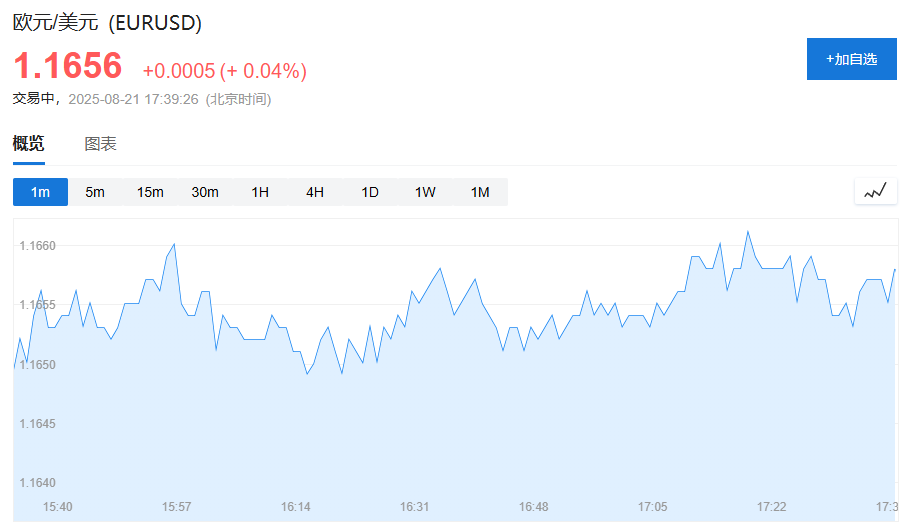
Group 1 - The euro against the US dollar has seen a slight decline, currently trading around 1.1644, down 0.06% from the previous close of 1.1651, indicating a stable but cautious market sentiment [1] - Eurozone retail sales increased by 0.3% in June, reversing the 0.3% decline in May, suggesting a recovery in consumer demand [1] - Strong domestic demand is becoming increasingly important for economic growth, potentially supporting growth in the second half of 2025 despite external challenges such as tariffs and a strong euro [1] Group 2 - The current trading range for the euro/dollar exchange rate is between 1.1455 and 1.1829, indicating a period of volatility without clear breakout directions [2] - The price movement is constrained by the Bollinger Bands, suggesting that the market may continue to oscillate within this range until clearer market drivers emerge [2]
欧元区7月PMI小幅回升至4个月新高 但仍难掩经济增长颓势
Zhi Tong Cai Jing· 2025-08-05 09:09
Group 1: Economic Activity and PMI Data - The HCOB Eurozone Composite PMI index rose slightly from 50.6 in June to 50.9 in July, still below the long-term average of 52.4, indicating ongoing economic weakness in the Eurozone [1] - The Eurozone services PMI increased from 50.5 in June to 51.0 in July, but was below the market expectation of 51.2, reflecting a modest improvement in service sector activity [1] - Spain showed the strongest performance among major Eurozone economies, with a composite PMI rising from 52.1 in June to 54.7 in July, while France experienced a contraction with a PMI of 48.6 [1] Group 2: Employment and Business Confidence - Eurozone businesses increased employment for the fifth consecutive month in July, reaching the fastest growth rate in over a year, despite weak demand [2] - Business confidence declined for the first time since April, with optimism waning in both manufacturing and services sectors, leading to overall confidence falling below long-term averages [2] Group 3: Inflation and Monetary Policy - Cost pressures have decreased to the lowest level since October of the previous year, primarily driven by the service sector, while output price inflation slightly increased to a three-month high [2] - The European Central Bank (ECB) may consider further rate cuts in the second half of the year due to easing service sector inflation, despite many officials suggesting insufficient reasons for continued accommodative policies [3] - The recent EU-US trade agreement may negatively impact Eurozone exports and economic growth, raising concerns about the sustainability of the Eurozone's economic recovery [3]