
煤炭供需平衡

Search documents
华源证券:“查超产”改善供需 煤价反弹或助力25Q3煤企业绩环比转增
Zhi Tong Cai Jing· 2025-10-24 07:21
Core Viewpoint - The recent "overproduction check" policy in the coal industry has led to a significant supply-side contraction, which is expected to stabilize and potentially increase coal prices in the long term [1][6]. Group 1: Supply-Side Policy Impact - The "overproduction check" initiated by the National Energy Administration on July 10, 2025, has resulted in a notable decrease in domestic raw coal production, with year-on-year declines of -3.8% and -3.2% in July and August respectively [1]. - The cumulative supply-demand surplus has decreased sharply from 96.29 million tons in the first half of the year to 14.96 million tons by the end of August 2025 [1]. - The price of Qinhuangdao 5500 kcal thermal coal increased from 621 CNY/ton on June 30, 2025, to 699 CNY/ton by September 30, 2025, marking a cumulative increase of 12.6% in Q3 [1]. Group 2: Price Trends and Performance - The average price of Qinhuangdao 5500 kcal thermal coal in Q3 2025 was reported at 672 CNY/ton, reflecting a quarter-on-quarter increase of 6.5% [2]. - The long-term contract price for thermal coal showed a slight decline of -0.7% in Q3, but this is not expected to have a significant negative impact due to the recovery of contract fulfillment rates [2]. - The price of coking coal saw a substantial increase, with the average price for main coking coal at Jing Tang Port reaching 1562 CNY/ton, up 18.8% quarter-on-quarter [2]. Group 3: Production and Cost Management - The overall production of listed coal companies remains within approved capacity limits, with minor overproduction expected to have limited impact on performance [3]. - Cost control has become a key strategy for coal companies in response to declining prices, with significant reductions in labor, material, and safety production costs observed in Q2 2025 [4]. - As coal prices rebound in Q3, it is anticipated that companies will maintain their cost levels rather than pursue further reductions [4]. Group 4: Seasonal Demand and Future Outlook - Despite September typically being a low-demand season for coal, the supply-side contraction is expected to keep prices stable, with a slight increase of 0.1% in September [6]. - The winter season is projected to see stronger demand for heating coal, which, combined with ongoing supply-side policies, may lead to a tighter coal supply and sustained high prices [6]. Group 5: Investment Recommendations - Companies to watch include stable large-scale thermal coal producers such as China Shenhua (601088), China Coal Energy (601898), and Shaanxi Coal and Chemical Industry (601225) [7]. - High-elasticity coal companies like Yanzhou Coal Mining (600188) and Jincheng Anthracite Mining (601001) are also recommended for potential investment [7]. - Quality coking coal companies such as Huaibei Mining (600985) and Pingdingshan Tianan Coal (601666) are highlighted as attractive investment opportunities [7].






\查超产\改善供需煤价反弹或助Q3业绩环比转增:煤炭2025年三季度业绩前瞻
Hua Yuan Zheng Quan· 2025-10-23 10:07
Investment Rating - The investment rating for the coal mining industry is "Positive" (maintained) [4] Core Viewpoints - The "check for overproduction" policy has significantly improved supply and demand, leading to a rebound in coal prices. The domestic raw coal production in July and August 2025 saw a year-on-year decline of -3.8% and -3.2%, respectively, resulting in a substantial improvement in the supply-demand balance [4] - The average price of Qinhuangdao 5500 kcal thermal coal increased from 621 RMB/ton on June 30, 2025, to 699 RMB/ton on September 30, 2025, marking a cumulative increase of 12.6% in Q3 [4] - The rebound in coal prices is a key positive variable for Q3 performance, with the average price of Qinhuangdao 5500 kcal thermal coal reported at 672 RMB/ton, a 6.5% increase quarter-on-quarter [4] - The report suggests that winter coal prices are expected to remain strong due to supply-side contraction and increased heating demand [5] Summary by Sections Section: Market Performance - The coal market is experiencing a rebound in prices due to effective supply-side policies, with a notable decrease in cumulative supply surplus from 96.29 million tons in the first half of the year to 14.96 million tons by the end of August 2025 [4] Section: Price Trends - The average price of thermal coal in Q3 2025 is projected to be 672 RMB/ton, reflecting a 6.5% increase from the previous quarter, while the long-term contract price slightly decreased by 0.7% [4] - The price of coking coal has also seen a significant increase, with the average price at Jing Tang Port reaching 1562 RMB/ton, an 18.8% increase quarter-on-quarter [4] Section: Production and Cost Control - The production of listed coal companies is expected to remain within approved capacity limits, with minor fluctuations anticipated. The impact of production on performance is expected to be limited due to the significant rebound in coal prices [4] - Cost control remains a primary focus for coal companies, with expectations that costs will stabilize in Q3 2025 following a period of significant reductions in H1 2025 [4] Section: Investment Recommendations - The report recommends actively monitoring robust thermal coal companies such as China Shenhua, China Coal Energy, and Shaanxi Coal and Chemical Industry, as well as high-elasticity coal companies like Yanzhou Coal Mining and Jinneng Holding Group [5]
煤炭开采行业9月数据全面解读:9月供给维持收缩,煤价环比提升
Guohai Securities· 2025-10-21 11:12
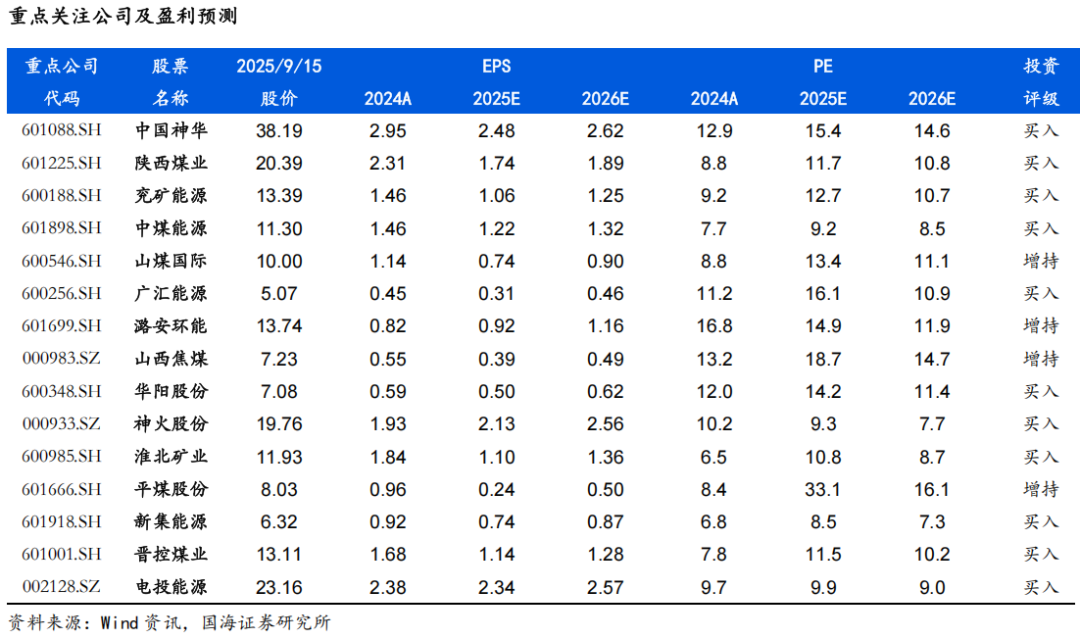
Investment Rating - The report maintains a "Recommended" rating for the coal mining industry [1] Core Views - The coal mining industry is experiencing a supply-side constraint, with production and imports both showing a year-on-year decline, but the rate of decline is narrowing. The demand side is expected to fluctuate, leading to a dynamic rebalancing of prices. The leading coal companies exhibit high asset quality, strong cash flow, and characteristics of high profitability, high cash flow, high barriers to entry, high dividends, and high safety margins [11][25] Summary by Sections Supply Side - In September 2025, the industrial raw coal production was 410 million tons, a year-on-year decrease of 1.8%, with the decline rate narrowing by 1.4 percentage points compared to August. The average daily production was 13.72 million tons, an increase of 1.12 million tons per day month-on-month, but a decrease of 98,000 tons year-on-year [17][18] - Coal imports in September 2025 were 46 million tons, a year-on-year decrease of 3.3%, with the decline rate narrowing by 3 percentage points compared to August. Cumulatively, coal imports from January to September 2025 were 350 million tons, a year-on-year decrease of 11.1% [24][25] Demand Side - The demand for thermal power generation decreased year-on-year by 5.4% in September, while metallurgical and chemical sectors showed positive contributions, with coke production increasing by 8% year-on-year [9][25] - The industrial electricity production in September was 826.2 billion kWh, a year-on-year increase of 1.5%. Cumulatively, from January to September, the industrial electricity production was 7,255.7 billion kWh, a year-on-year increase of 1.6% [5][9] Inventory - By the end of September, the inventory of thermal coal at production enterprises decreased by 133,000 tons to 4.141 million tons, while the inventory at northern ports increased by 564,000 tons to 22.698 million tons [10][12] Price Trends - The average price of Qinhuangdao 5500 kcal port coal in September was 691 RMB/ton, remaining stable compared to August. The report anticipates that coal prices will maintain a strong oscillating trend in the fourth quarter due to seasonal demand [10][11] Key Companies and Investment Recommendations - Recommended companies include China Shenhua, Shaanxi Coal and Energy, and China Coal Energy, with a focus on their strong cash flow and profitability [11][12]

冷空气来袭“冬炒煤炭”,大有能源12天8板
3 6 Ke· 2025-10-21 04:12
Core Viewpoint - The coal market is experiencing a significant rally driven by cold weather, increased demand, and supply constraints, leading to a bullish outlook for coal companies' performance. Group 1: Market Performance - On October 20, the coal sector continued its strong performance, with Dayou Energy (600403.SH) achieving 11 consecutive trading days of gains, and other companies like Pingmei Shenma (601666.SH) and Shanxi Coking Coal (000983.SZ) also rising [1][2] - The coal index (886003.WI) reached a peak of 10,430.72 points on October 20, closing at 10,429.77 points, marking a daily increase of 3.16%, the largest daily gain in October, with a monthly increase of 12.95% [1][2] Group 2: Price Drivers - The increase in coal prices is attributed to rising demand and tightening supply, with significant price increases reported at northern ports and pithead prices in Shanxi, Inner Mongolia, and Shaanxi [2][3] - The onset of the heating season has led to increased coal demand, with many regions experiencing early heating due to dropping temperatures [3][4] Group 3: Supply Constraints - The coal supply has been affected by regulatory measures aimed at stabilizing production, with the National Energy Administration enforcing production limits to prevent overproduction [5][6] - Recent heavy rainfall and safety inspections have led to temporary production halts in some coal mines, contributing to supply tightness [7][8] Group 4: Future Outlook - Analysts expect coal companies' performance to improve in Q3 2025, with the upcoming heating season likely to drive up demand and support higher coal prices [9] - The price of thermal coal is projected to rise, with estimates suggesting a price range of 740 to 770 yuan/ton in the last quarter of 2025, supported by both seasonal demand and regulatory policies [9]

煤炭板块发力走高,宝泰隆、大有能源涨停,陕西黑猫等拉升
Zheng Quan Shi Bao Wang· 2025-10-10 02:25
Group 1 - The coal sector experienced a significant rise on October 10, with companies such as Baotailong and Dayou Energy hitting the daily limit, and Shaanxi Heimao increasing by over 6% [1] - Since the third quarter, domestic coal production growth has gradually slowed due to safety regulations and overproduction checks, with expectations that these supply constraints will persist into the fourth quarter [1] - Short-term hydropower generation may impact the coal consumption growth of thermal power, leading to a relatively loose coal supply from October to November, but a supply gap is anticipated in December as the winter peak season approaches [1] Group 2 - CITIC Securities forecasts that the coal sector's performance in the third quarter will improve sequentially due to a rebound in coal prices, with further price increases expected in the fourth quarter during peak months [1] - If the enforcement of supply reduction policies strengthens, coal prices may exceed expectations, indicating a potential for sector rebound in the fourth quarter [1] - The report suggests focusing on leading companies benefiting from thermal coal and also considering undervalued companies with good earnings elasticity [1]
【国海能源开采】 8月供给延续收缩,火电需求同比依然增长,煤价环比提升明显——煤炭开采行业8月数据全面解读
Xin Lang Cai Jing· 2025-09-16 14:10
Event Summary - In August 2025, the National Bureau of Statistics reported a narrowing decline in coal production, with industrial raw coal output at 390 million tons, down 3.2% year-on-year, a decrease of 0.6 percentage points compared to July. Daily average production increased to 12.6 million tons, with a month-on-month rise of 307,000 tons per day, but a year-on-year decrease of 195,000 tons per day. From January to August, the total industrial raw coal output reached 3.17 billion tons, up 2.8% year-on-year [1][10][11]. Supply Side - August coal production saw a year-on-year decline of 3.20%, but the decrease was less than in July, primarily supported by peak summer demand. The daily average production in August was 12.6 million tons, with a month-on-month increase of 307,000 tons per day [2][11]. - Major coal companies showed production differentiation in August. For instance, Shaanxi Coal and Chemical Industry produced 14.3 million tons, up 5.3% year-on-year, while China Coal Energy's output was 11.6 million tons, down 1.8% [2][14]. Import Side - Coal imports in August were 42.74 million tons, down 6.77% year-on-year, with the decline narrowing by 16 percentage points compared to July. Cumulatively, from January to August, coal imports totaled 300 million tons, down 12.20% year-on-year [3][16]. Demand Side - Thermal power demand remained positive in August, with industrial thermal power generation increasing by 1.7% year-on-year, although the growth rate slowed by 2.6 percentage points compared to July. The total industrial power generation in August was 936.3 billion kWh, up 1.6% year-on-year [4][16]. - In the steel sector, pig iron production reached 69.79 million tons in August, up 1.00% year-on-year, while coke production was 42.60 million tons, up 3.90% year-on-year [20][25]. Inventory - The inventory of thermal coal at northern ports decreased significantly, with a reduction of 2.505 million tons to 22.232 million tons by the end of August, which is 1.433 million tons lower than the same period last year [6][33]. - Coking coal inventories remained low, with production enterprise stocks increasing slightly but still at a low level [7][36]. Price Movement - The price of coal saw a noticeable increase in August, with the Qinhuangdao port price for 5500 kcal coal rising by 51.37 yuan per ton, an increase of 8.05% month-on-month [41]. Investment Recommendations - The coal mining industry is recommended for investment, focusing on companies with strong cash flow and high dividend yields. Key companies to watch include China Shenhua, Shaanxi Coal, and China Coal Energy [8][42][44].

煤炭开采行业8月数据全面解读:8月供给延续收缩,火电需求同比依然增长,煤价环比提升明显
Guohai Securities· 2025-09-16 12:51
Investment Rating - The report maintains a "Recommended" rating for the coal mining industry [1] Core Insights - In August, coal production continued to decline, while thermal power demand showed year-on-year growth, and coal prices increased significantly month-on-month [1][11] - The overall coal supply in August decreased by 3.6% year-on-year, with a narrowing decline compared to July [25] - The report highlights a positive outlook for coal companies due to high cash flow, profitability, and dividend yields, suggesting a focus on value attributes in the coal sector [11] Supply Analysis - In August, the industrial raw coal production was 390 million tons, a year-on-year decrease of 3.2%, with the decline narrowing by 0.6 percentage points compared to July [17][19] - Daily average production in August was 12.6 million tons, an increase of 307,000 tons per day month-on-month, but a decrease of 195,000 tons per day year-on-year [19] - Coal imports in August were 42.74 million tons, down 6.77% year-on-year, with the decline narrowing by 16 percentage points compared to July [24] Demand Analysis - Thermal power demand in August increased by 1.7% year-on-year, although the growth rate slowed by 2.6 percentage points compared to July [26] - The total industrial electricity generation in August was 936.3 billion kWh, a year-on-year increase of 1.6% [18] - The report notes that the construction and manufacturing sectors showed slight slowdowns, while the real estate market remained weak [34] Inventory and Price Trends - By the end of August, coal inventories at northern ports decreased by 2.505 million tons to 22.232 million tons, showing a significant reduction year-on-year [10] - The report indicates that the coal price at Qinhuangdao port for 5500 kcal coal increased by 51.37 CNY/ton month-on-month, reflecting a rise of 8.05% [11] Company Focus and Recommendations - The report emphasizes the importance of focusing on robust companies such as China Shenhua, Shaanxi Coal, and China Coal Energy, which exhibit strong financial health and growth potential [11] - It suggests that investors consider companies with high dividend yields and cash flow, highlighting the investment value of coal stocks in the current market environment [11]
供应端仍是未来行情的关键变量
Xin Lang Cai Jing· 2025-09-15 10:23
Policy Impact on Supply - Coal imports in the first eight months of 2025 showed a significant decline, totaling 300 million tons, a year-on-year decrease of 12.2%. However, the price advantage of imported coal has become apparent, leading to a notable rebound in August imports. With the expected fulfillment of long-term contracts for imported coal in the fourth quarter and the relaxation of Indonesia's HBA policy, it is anticipated that coal imports in the second half of the year will increase compared to the first half, narrowing the year-on-year decline. Overall supply remains primarily dependent on domestic production conditions [1][2][3]. Domestic Production and Policy Enforcement - The National Energy Administration has initiated a verification of coal mine production, strictly investigating behaviors that exceed announced production capacities. This measure aims to curb the "volume compensating for price" competition among coal enterprises, promoting stable and orderly coal supply. From January to August, the domestic output of industrial raw coal reached 3.17 billion tons, a year-on-year increase of 2.8%. However, coal production in July was 380 million tons, a month-on-month decrease of nearly 40 million tons and a year-on-year decline of 3.8%. August production slightly recovered to 390 million tons, with a year-on-year decrease of 3.2%. The decline in production is attributed to policy factors, military parades, and excessive rainfall in production areas, which requires ongoing observation [1][2]. Inventory and Demand Trends - Recent supply declines and reasonable demand during the peak summer season have led to a significant reduction in inventory levels at production sites and transit ports. Overall inventory has fallen to a relatively reasonable range, with northern port inventories at a historically low level and eastern port inventories decreasing by over 20% from previous highs. Despite this, coal demand remains relatively weak, influenced by uncertain weather conditions. The overall coal demand in major domestic industries has been lackluster, with electricity generation growth slowing down due to factors like a warm winter and economic restructuring. From January to August, the cumulative growth of electricity generation was only 1.5%, while thermal power generation saw a year-on-year decline of 0.8% [2][3]. Future Outlook - The supply-demand situation is expected to tighten compared to the relatively loose conditions observed in the first half of the year. However, factors such as policy and weather still require continuous monitoring. Price performance is anticipated to be volatile but biased towards strength, with the possibility of a temporary breakthrough of mid-year highs [3].

煤炭行业周报:持续大雨及查超产致产地供应偏紧,短期煤价震荡-20250824
Shenwan Hongyuan Securities· 2025-08-24 13:43
Investment Rating - The report maintains a "Positive" outlook on the coal industry, indicating an expectation for the sector to outperform the overall market performance [3]. Core Insights - The report highlights that the coal market is experiencing short-term price fluctuations due to supply constraints caused by heavy rainfall and production checks in key mining areas. It anticipates that coal prices will stabilize as temperatures drop across most regions [3]. - The report provides specific price data for thermal coal and coking coal, noting that while some thermal coal prices have decreased, others have seen slight increases. The overall trend suggests a mixed but stable pricing environment [3][10][12]. - The report emphasizes the importance of supply and demand dynamics, with increased daily coal inflow and outflow at the ports, leading to a decrease in coal inventory levels [21]. Summary by Sections Recent Industry Policies and Developments - The report discusses recent developments in coal mining projects and safety initiatives, including approvals for increased production capacities in certain regions [9]. Price Trends - Thermal coal prices have shown mixed results, with some prices remaining stable while others have increased slightly. Coking coal prices are expected to experience minor fluctuations before potentially rising again due to seasonal demand [10][12]. International Oil Prices - The report notes an increase in Brent crude oil prices, which may influence coal pricing dynamics. The relationship between international oil prices and coal prices is highlighted, with a noted increase in the ratio of oil to coal prices [17]. Port Inventory and Shipping Costs - The report indicates a decrease in coal inventory at the ports, with increased daily inflow and outflow rates. Shipping costs for domestic routes have also risen slightly, reflecting broader market trends [21][27]. Company Valuation - The report includes a valuation table for key companies in the coal sector, providing insights into their market performance and earnings projections. Companies such as China Shenhua and Shaanxi Coal are highlighted for their stable operations and high dividend yields [33].

煤炭“反内卷”政策再起,供需拐点明确
2025-07-22 14:36
Summary of Key Points from Conference Call Industry Overview - The coal industry is experiencing a "anti-involution" policy aimed at regulating production levels, with national coal output expected to remain around 1 billion tons in 2025 to curb overproduction and maintain market order [1][2] - The overall coal supply is projected to decline, with domestic production expected to see slight growth while imports are anticipated to decrease significantly [6][8] Core Insights and Arguments - The National Energy Administration's anti-involution policy mandates inspections and shutdowns of coal mines exceeding 10% overproduction, which has positively influenced market expectations and led to a surge in coal sector stocks [2] - In Q1 and Q2 of 2025, the coal industry faced significant downward pressure, prompting some companies to increase production to offset falling prices, which worsened market competition [2] - Electricity consumption growth slowed in early 2025 but began to recover in April, with expectations that annual growth will align with GDP growth at around 5% [9] - The prices of thermal coal and coking coal have risen since late June, indicating a recovery in the coal sector, driven by strong downstream steel demand and lower-than-expected supply due to environmental regulations [11] Regional Production Insights - In April 2025, national coal production was 390 million tons, a decrease of 50 million tons from March, but production rebounded in May and June due to reduced railway freight costs in Inner Mongolia and Xinjiang [4] - Inner Mongolia's production is expected to decline due to the lack of approval for capacity increases, while Xinjiang's production may stabilize around 50 million tons per month for the year [4][5] Future Production and Capacity Planning - The production elasticity in Xinjiang is limited, with costs expected to rise again after the end of railway discounts, impacting short-term production [5][7] - New capacity planning in Xinjiang may be influenced by the new leadership's policy direction, which could differ significantly from previous plans [7] Global Supply Trends - Global coal supply is expected to peak in 2025 and begin to decline in 2026, with Australia and Russia's production likely to decrease, and the U.S. restarting coal power plants may reduce export volumes [8] Investment Opportunities and Recommendations - The coal sector, particularly companies benefiting from the anti-involution policy, presents significant investment opportunities. Recommendations include investing in coal ETFs and specific companies such as Jincheng Anthracite, Shanxi Coal, and Shenhua for thermal coal, and Huaiyin Mining and Shanxi Coking Coal for coking coal [16] Additional Considerations - The coal sector's institutional holdings have dropped to a five-year low, indicating a clean chip structure, which may lead to a favorable market environment for future investments [12][15] - The recent recovery in the cyclical commodities market reflects increased market confidence, driven by policy support for infrastructure projects [13][14]