
盈利

Search documents
李斌称乐道欲以规模化盈利
Zhong Guo Zheng Quan Bao· 2025-07-11 20:50
Core Viewpoint - NIO's CEO Li Bin emphasizes that the profitability of the L90 model is driven by cost reduction capabilities stemming from technological advancements and economies of scale, with a focus on achieving operational profit rather than merely increasing sales [1][2][3] Group 1: Product Strategy and Market Positioning - The L90 model is priced at 193,900 yuan under a battery rental model, raising questions about its profitability; however, Li Bin asserts that the model still maintains a gross margin at this price point [2] - The L90 features a 900V high-voltage architecture, which enhances efficiency and significantly reduces material costs through integrated design and proprietary technologies [2] - The L90 targets a market gap in the 300,000 yuan segment for six- and seven-seat pure electric SUVs, challenging the dominance of range-extended models with its spacious design and standard 85kWh battery [4] Group 2: Financial Performance and Profitability Goals - Li Bin has consistently highlighted the goal of achieving profitability, with expectations to reach this milestone by Q4 2025, contingent on sales of 50,000 vehicles per month and maintaining a gross margin of 17-18% [3][5] - NIO's financial reports indicate a positive trend, with Q4 2024 gross margin rising to 13%, suggesting that previous R&D investments are beginning to yield returns [3] - The company aims to reduce vehicle material costs by an additional 10% by 2025, supported by a dedicated team reporting directly to the CFO [5] Group 3: Infrastructure and Service Network - NIO has established over 1,000 battery swap stations across 550 cities, with peak service volumes exceeding 137,000 transactions per day, enhancing the efficiency and reliability of its energy service network [1][4] - The investment of over 18 billion yuan in building more than 3,000 battery swap stations is seen as a sustainable revenue source beyond vehicle sales [4]

X @Yuyue
Yuyue· 2025-06-30 09:27
Market Analysis & Reflection - Useless reached a 200 million ATH (All-Time High), but the profit was only several ten thousand dollars, indicating a missed opportunity in the Bonk ecosystem [1] - The analyst initially favored Believe and Bonk among new projects, particularly trusting @theunipcs Bonkguy's capabilities within the Bonk ecosystem [1] - Launchcoin generated more profit than the Bonk series, suggesting a more successful investment strategy in that particular case [1] - The light position in Useless during the second dip-buying phase resulted in limited gains, as the holdings were gradually sold off [1] - The decision to sell the remaining Useless holdings above 100 million was influenced by the perception of lower market liquidity compared to Launchcoin's period [1] - Similar to Useless, the position in $ikun was not sufficiently increased after an initial high purchase at 4 million, missing an opportunity to accumulate more at 1 million [1] Investment Strategy & Considerations - Bonkguy, a key figure in the Bonk ecosystem, had only invested in a few coins, including Useless and ikun [1] - Despite its entertainment nature, $ikun had the potential to attract attention due to kunkun's recent popularity and reputation, making it a potentially attractive target for market makers [1] - The analyst emphasizes the importance of reviewing past trades and making more substantial investments in future opportunities [1]
造车新势力能打赢盈利“冲锋战”吗
Zhong Guo Qi Che Bao Wang· 2025-06-24 01:29
Core Insights - NIO, Xiaomi, and Xpeng have set ambitious profitability timelines, indicating a shift in the electric vehicle (EV) industry from a "burning cash" competition to a focus on sustainable quality and profitability [2][3][4] Group 1: Company Performance - NIO's Q1 2025 revenue increased, but net losses widened, with a goal to achieve profitability by Q4 2025, facing challenges in maintaining specific gross margins and controlling costs [5] - Xpeng's Q1 2025 delivery volume surged, leading the new force in vehicle sales, but the reliance on low-priced models has significantly reduced average revenue per vehicle, making it difficult to reach breakeven with a target of 600,000 annual sales [4][5] - Xiaomi's automotive division is expected to enter profitability by the end of this year or next year, driven by increased production capacity and a solid order backlog [3] Group 2: Industry Trends - The EV industry is experiencing a "淘汰赛" (elimination race), with traditional automakers like GAC Toyota and Dongfeng Nissan entering the low-price electric vehicle market, increasing competition for new forces [4] - The financing environment for new energy vehicles is tightening, making 2025 a critical year for new forces to demonstrate cash flow health and profitability to regain investor confidence [3][4] - The transition from rapid growth to sustainable profitability is essential for the industry, as mere financial turnaround does not equate to sustainable profitability [5]


稀土ETF嘉实(516150)近1周新增规模同类居首!机构:稀土有望迎来盈利、估值双击
Sou Hu Cai Jing· 2025-06-18 05:53
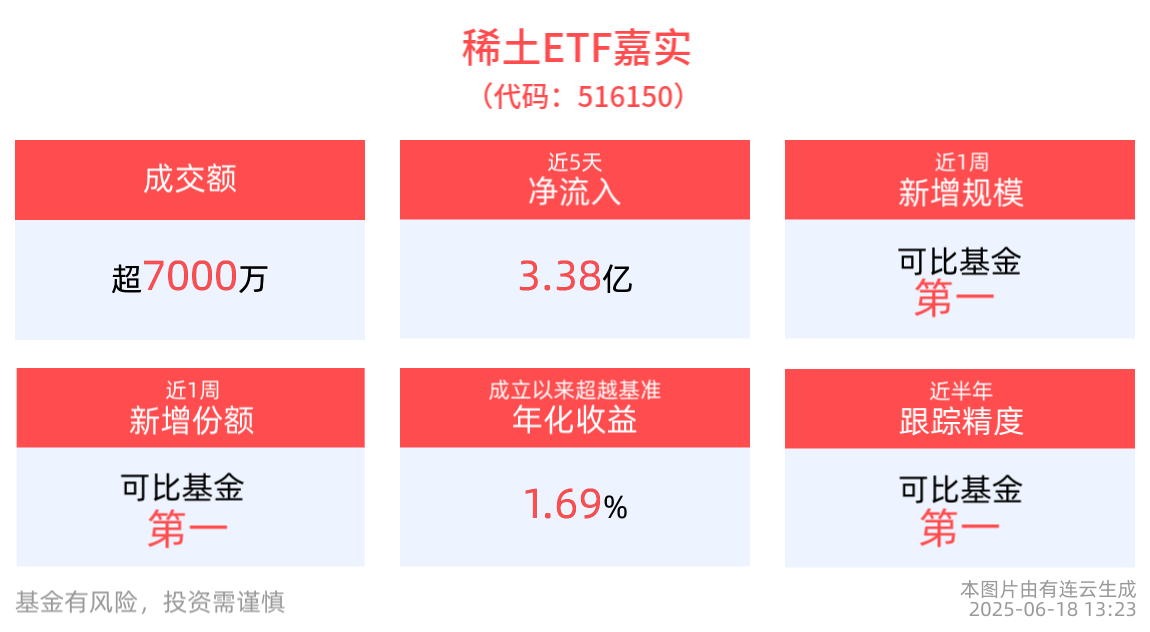
Group 1: Liquidity and Performance of Rare Earth ETF - The liquidity of the Rare Earth ETF managed by Jiashi has a turnover rate of 2.9% with a transaction volume of 71.903 million yuan [2] - Over the past week, the average daily transaction volume of the Rare Earth ETF reached 174 million yuan, ranking first among comparable funds [2] - The fund's scale increased by 244 million yuan in the past week, also ranking first among comparable funds [2] - The number of shares increased by 22.2 million in the past week, achieving significant growth and ranking first among comparable funds [2] - In the last five trading days, there were net inflows on four days, totaling 338 million yuan [2] - As of June 17, the net value of the Rare Earth ETF has risen by 34.53% over the past year, ranking 284 out of 2854 in the index stock fund category, placing it in the top 9.95% [2] - The highest monthly return since inception was 41.25%, with the longest consecutive monthly increase being four months and the longest increase percentage being 83.89% [2] Group 2: Key Holdings and Market Dynamics - As of May 30, 2025, the top ten weighted stocks in the China Rare Earth Industry Index accounted for 57.28% of the index, including Northern Rare Earth, China Rare Earth, and others [2] - Recent reports indicate a phased relaxation of rare earth export controls, allowing some rare earth magnetic material companies to obtain export licenses, although controls are not fully lifted [4] - The demand for rare earth materials is expected to remain strong due to sectors like new energy vehicles, home appliances, and wind power, with potential upward pressure from humanoid robots [5] - The market anticipates a reversal in supply and demand dynamics, with rare earths expected to benefit from both profit and valuation increases due to tariff policies exceeding market expectations [5]


创金合信基金魏凤春:产业的基本面及风险分析
Xin Lang Ji Jin· 2025-06-09 09:34
Market Review - Commodity prices have surged, with COMEX silver up 9.4%, coking coal up 7.2%, and IPE Brent crude oil up 6.2%, but this does not change the macro and industrial trends [1][2] - The increase in commodity prices is attributed to several factors: improved demand due to economic recovery, supply constraints, and the financial attributes of commodities influenced by a weaker dollar [1][2][3] Industry Focus - The consensus is that real estate is no longer the leading industry, and investors should focus on manufacturing, particularly high-end manufacturing and the automotive sector, especially new energy vehicles [4] - The automotive industry is experiencing intense competition, characterized by price wars and excess capacity, driven by weak domestic demand [4] Capacity Analysis - The analysis of capacity across various industries is crucial for future industrial layout, with specific attention to operating and financial leverage [5][6] - Industries with high non-current asset ratios and debt ratios, such as non-metallic minerals and oil extraction, face significant risks due to capacity and leverage expansion [6][7] Inventory Analysis - The automotive and pharmaceutical industries are currently in a passive inventory replenishment phase, with price reductions being a common strategy to address inventory buildup [8] Macro-Level Industry Concerns - The focus on funding issues behind capacity is critical, with significant accounts receivable in industrial enterprises indicating potential risks in production stability [9] - The risk of "triangle debts" in manufacturing has not been adequately addressed in policy discussions, highlighting a potential area of concern for investors [9]
小米卢伟冰谈 SU7 竞争力:市面上一个能打的都没有丨一分钟财报
晚点Auto· 2025-05-27 15:44
Core Viewpoint - The company achieved its best quarterly report in history, driven by strong sales of the SU7 model, indicating that strong product capability ensures profitability [2][4]. Group 1: Financial Performance - In the first three months of the year, the company delivered 76,000 new cars, a quarter-on-quarter increase of 8.9%, leading to automotive business revenue of 18.1 billion yuan, a 10.8% increase from the previous quarter [2]. - Losses in the automotive and AI innovation sectors narrowed to 500 million yuan, a reduction of 200 million yuan from the previous quarter [2]. - The gross margin increased to 23.2%, surpassing competitors like Li Auto (19.7%) and BYD (20.07%) [2]. Group 2: Product Strength and Market Position - The SU7 has not seen a price drop since its launch, and the introduction of the higher-priced SU7 Ultra has contributed to revenue [4]. - The company’s management efficiency and cost structure are reportedly 2-3 times more effective than traditional automotive companies [4]. - The SU7 has faced no direct competitors since its launch, allowing the company to maintain pricing power and reasonable profit margins [5][6]. Group 3: Future Prospects - The YU7 model, set to launch in July, is anticipated to impact the SU7's market position, with early indicators showing higher interest and engagement compared to the SU7 at the same stage [5]. - The company’s president emphasized that strong product capability will ensure profitability, regardless of competition [5][6].


Bernstein分析师:小马智行到今年年底可能实现盈亏平衡,但实现盈利可能要到2030年左右。
news flash· 2025-04-28 16:40
Core Viewpoint - Bernstein analysts suggest that Pony.ai may achieve breakeven by the end of this year, but profitability might not be realized until around 2030 [1] Company Summary - Pony.ai is projected to reach breakeven by the end of 2023 [1] - The timeline for achieving profitability is estimated to be around 2030 [1]