芯片出口管制

Search documents
X @外汇交易员
外汇交易员· 2025-08-21 01:29
FT:中国对英伟达H20 AI芯片的态度转变源于美国商务部长卢特尼克的“侮辱性”言论。7月15日,也就是特朗普政府解除 H20出口管制的第二天,卢特尼克称“我们不会把最好的产品卖给他们,第二好甚至是第三好的也不会。”“给中国人出售足够多的产品,让他们的开发人员沉迷于美国的技术堆栈,这就是我们的想法。”外汇交易员 (@myfxtrader):央视玉渊谭天:美国曾设计“片上治理机制”,包括许可锁定、追踪定位、使用监测、使用限制等功能,英伟达芯片已广泛部署了所需的大部分功能。无论从哪个角度讲,H20对于中国来说,都算不上是一款安全的芯片。当一款芯片,既不环保,也不先进,更不安全时,作为消费者,我们当然可以选择,不买。 ...

外媒:管制芯片,阻止不了中国AI
半导体行业观察· 2025-08-17 03:40
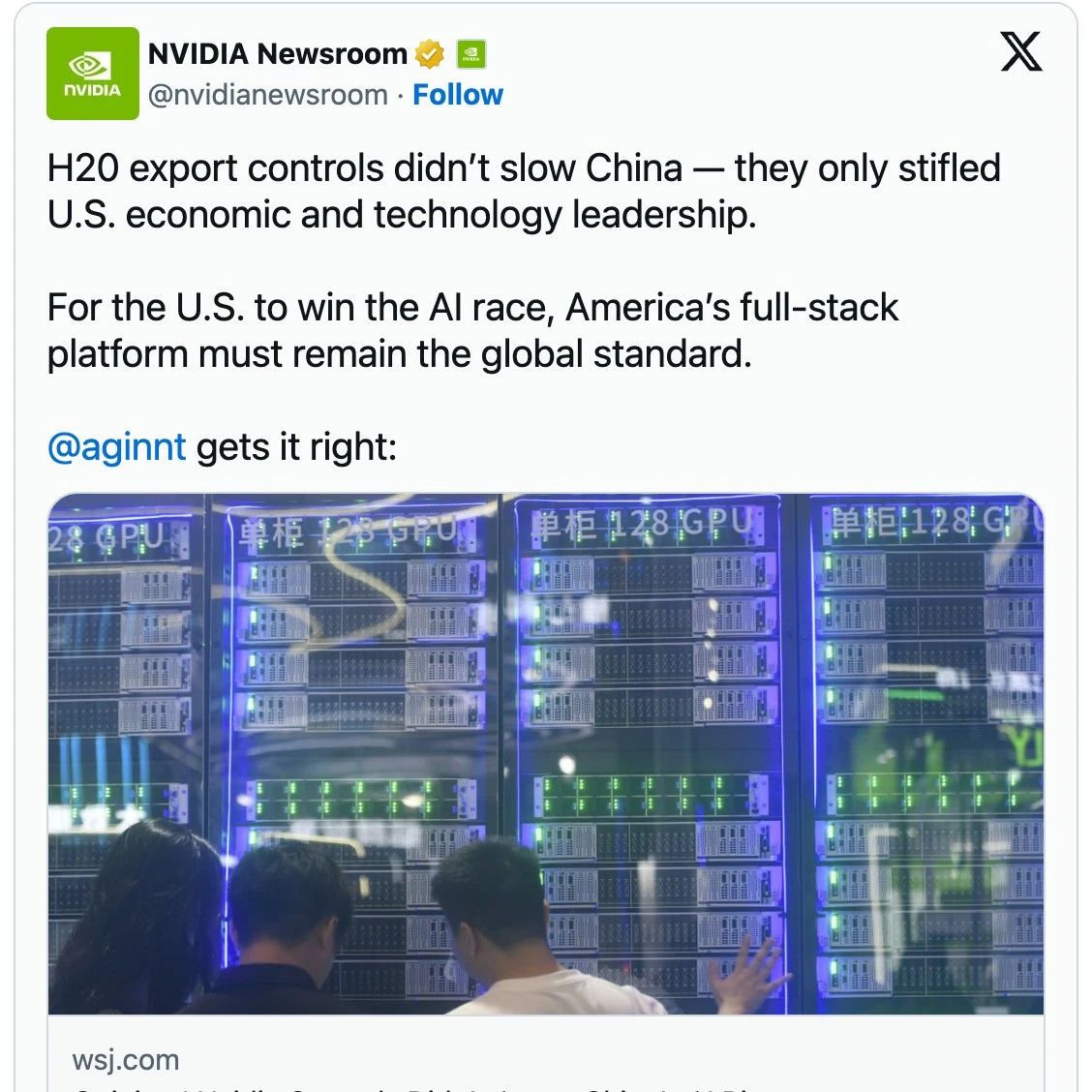
Core Viewpoint - Despite U.S. export controls on Nvidia's H20 chips, China continues to make significant advancements in artificial intelligence, suggesting that such restrictions may hinder U.S. economic and technological leadership instead [2][4]. Group 1: Export Controls and AI Development - Nvidia's social media statement emphasizes that the H20 export controls have not slowed down China's AI development but have instead stifled U.S. economic and technological leadership [4]. - Aaron Ginn argues that the U.S. government's approach to doubling down on failed GPU export controls is ineffective, as China has continued to progress in AI technology despite these restrictions [4][5]. - In the last three months alone, Chinese companies have reportedly "purchased" Nvidia AI GPUs worth $1 billion, indicating strong demand for advanced semiconductors [4]. Group 2: Importance of Software and Integration - Ginn highlights that Nvidia's CUDA platform, which includes programming models and AI toolkits, is more critical than its high-end chips, making it difficult for Chinese competitors to replicate [5]. - The comparison is made between Nvidia and companies like Apple, where the value lies in the software stack and integrated design rather than just hardware [5]. - The misconception between purchasing semiconductors and manufacturing them is criticized, illustrating that owning a gaming console does not equate to being a game developer [5]. Group 3: Critique of U.S. AI Policies - Ginn criticizes former President Biden's AI diffusion rules for conflating developed and developing countries, which could have adverse effects on U.S. interests [5]. - Nvidia's CEO Jensen Huang shares a similar stance on export controls, advocating for more proactive measures rather than merely blocking competitors from accessing U.S. technology [5]. - Some experts argue that maintaining AI export bans is essential for the U.S. to establish a strong position in the global AI chip market [5].

H20芯片,中美贸易战的焦点
半导体行业观察· 2025-08-16 03:38
Core Viewpoint - Nvidia is attempting to restart chip sales in China amidst high geopolitical risks, focusing on the H20 chip, which is a downgraded version of its Hopper line designed to comply with U.S. export restrictions on AI hardware [3][4]. Group 1: Nvidia's Market Position and Financial Impact - Nvidia generated $17.1 billion in revenue from the Chinese market last fiscal year, accounting for 13.1% of its total sales [4]. - Due to restrictions imposed by the Trump administration, Nvidia has been effectively banned from selling products in China, leading to significant financial risks [4]. - CEO Jensen Huang predicts that the Chinese AI market could reach $50 billion within the next two to three years, indicating a strong potential market opportunity [4]. Group 2: H20 Chip Specifications and Market Demand - The H20 chip, while less powerful than Nvidia's top-tier chips, has features that are becoming increasingly critical in the AI race due to U.S. export controls [3][7]. - Nvidia has ordered 300,000 H20 chipsets from TSMC and is committed to increasing production rather than reducing inventory, which is currently estimated at 600,000 to 900,000 units [4][8]. - Despite being an older product, there remains high market demand for the H20 chip, as indicated by Huang's comments [4]. Group 3: Geopolitical and Competitive Landscape - The Chinese government is reportedly urging local companies to abandon the H20 chip, which could hinder Nvidia's sales efforts [4][6]. - Concerns have been raised regarding the security of Nvidia's chips, with the Chinese government questioning their environmental impact [6]. - The U.S. export controls have inadvertently motivated Chinese companies to develop their own technologies, potentially increasing competition for Nvidia [12]. Group 4: Future Prospects and Strategic Considerations - Nvidia is developing a downgraded version of its upcoming Blackwell product, hoping to gain approval for sales in China [4][12]. - The company faces challenges in maintaining its market position as local Chinese companies seek to create alternatives to Nvidia's CUDA platform [11][13]. - Analysts suggest that while Nvidia's H20 chip may not pose a direct threat to U.S. AI dominance, the long-term sustainability of its sales in China is uncertain due to rising local competition [10][12].
英伟达的代价:向特朗普政府上交15%中国收入,美国本土生产5000亿AI算力
3 6 Ke· 2025-08-12 08:35
Core Insights - Nvidia faces significant challenges in maintaining its business in the Chinese market amid the strategic competition between the US and China, particularly regarding tariff negotiations [2] - The US government has fluctuated in its stance on Nvidia's H20 chip exports to China, initially imposing restrictions but later granting licenses for sales [2][3] - The easing of restrictions is linked to positive developments in US-China trade talks, which have led to a partial relaxation of AI chip export controls [2] Group 1: Nvidia's Business Dynamics - Nvidia and AMD have reportedly agreed to pay 15% of their revenue from chips sold to China to the US government in exchange for export licenses [3] - The Trump administration has allowed Nvidia to sell a simplified version of its next-generation AI chip, the Blackwell series, to China, which has sparked domestic criticism in the US [3] - Nvidia's sales of H20 chips to China are projected to generate approximately $23 billion in revenue by 2025, with AMD expected to contribute an additional $800 million [4] Group 2: Financial Implications - The US government is expected to receive over $3.6 billion from Nvidia and AMD combined, with Nvidia alone contributing more than $3.4 billion [5] - Nvidia's net profit margin for 2024 is estimated at 56%, suggesting that its net profit from H20 chip sales in China could exceed $12.8 billion in 2025, even after accounting for the revenue share to the US government [5] Group 3: Manufacturing and Investment Requirements - Nvidia's ability to sell advanced AI chips in China comes with conditions, including direct payments to the US government and significant investments in domestic manufacturing to create local jobs [4][6] - Nvidia has committed to collaborating with companies like TSMC and Foxconn to generate over $500 billion in AI infrastructure in the US over the next four years [6][7] Group 4: Strategic Balancing Act - Nvidia's CEO, Jensen Huang, emphasizes the need to maintain good relationships with both the US and Chinese governments, highlighting the company's global nature and the demand for its technology [8] - The US government's goal remains to maintain a generational gap in semiconductor technology between the US and China, which complicates Nvidia's ability to sell its most advanced AI chips to China [9] Group 5: Market Trends and Future Outlook - Despite the temporary easing of export controls, the long-term trend indicates a shift towards increased self-sufficiency in China's AI chip industry, with domestic chip production expected to rise significantly [10] - Nvidia's market share in China is projected to decline from 66% in 2024 to 54% in 2025, as domestic competitors like Huawei and Cambricon gain traction [10]
美官员称英伟达和AMD同意向美政府上缴15%收入换出口许可
Sou Hu Cai Jing· 2025-08-11 16:35
Core Viewpoint - The article discusses a unique agreement between U.S. chip manufacturers Nvidia and AMD with the Trump administration, where both companies will pay 15% of their revenue from chip sales in China to the U.S. government in exchange for export licenses [1][3]. Group 1: Agreement Details - Nvidia and AMD have agreed to pay 15% of their revenue from specific chips sold in China to the U.S. government to obtain export licenses [1]. - Nvidia will pay 15% of its revenue from the H20 chip sales in China, while AMD will do the same for the MI308 chip [1]. - The U.S. Department of Commerce has begun issuing export licenses to these companies for the Chinese market [1]. Group 2: Context and Implications - This arrangement of requiring companies to pay a portion of their revenue for export licenses is unprecedented and aligns with the Trump administration's approach of demanding specific actions from companies, such as investments in the U.S., in exchange for benefits [3]. - The agreement reflects a broader strategy to generate revenue and create jobs in the U.S. by leveraging corporate compliance with government regulations [3].

史无前例,英伟达AMD中国芯片收入将上缴!美政府被炮轰变相赚钱,或增收20亿美元
美股研究社· 2025-08-11 11:44
Core Viewpoint - The article discusses the unprecedented arrangement where Nvidia and AMD will pay 15% of their AI chip sales revenue to the U.S. government in exchange for export licenses to China, raising questions about the implications of using national security as a means for financial gain [6][7]. Group 1: Export License Agreement - Nvidia and AMD are expected to pay 15% of their revenue from AI chip sales in China to the U.S. government as a condition for receiving export licenses for their H20 and MI308 chips [6]. - This arrangement is described as unprecedented, with experts noting that no U.S. company has previously agreed to share revenue in exchange for export licenses [6][7]. Group 2: Financial Impact - Nvidia is projected to sell over 1.5 million H20 chips to China by the end of the year, generating approximately $23 billion in revenue [7]. - AMD anticipates $620 million in revenue from chip sales in China for 2024, indicating the significant financial stakes involved [6][7]. - The agreement could potentially yield over $2 billion (approximately 14.4 billion RMB) in revenue for the U.S. government [7]. Group 3: Market Significance - China represents a crucial market for both Nvidia and AMD, with Nvidia earning $17 billion from China, accounting for 13% of its total sales, and AMD generating $6.2 billion, which is 24% of its total revenue [6][7]. - The U.S. government’s actions are seen as a way to maintain competitiveness in the global market while navigating complex geopolitical tensions [7].
访华前,英伟达CEO驳斥强硬派:中国军方不可能使用美国技术
Sou Hu Cai Jing· 2025-07-15 03:17
Core Viewpoint - The article discusses NVIDIA CEO Jensen Huang's statements regarding China, highlighting the potential implications of his remarks in the current international context [1]. Group 1: NVIDIA's Market Position - NVIDIA has gained significant attention in the chip industry, with its market capitalization surpassing $4 trillion, making it the highest-valued company globally [1]. - Huang's upcoming visit to China has drawn warnings from U.S. politicians, indicating the sensitive nature of NVIDIA's operations in the current geopolitical climate [1]. Group 2: U.S.-China Relations - Huang responded to concerns about NVIDIA's chips potentially being used by the Chinese military, stating, "We don't have to worry about this matter," emphasizing that the Chinese military would avoid reliance on U.S. technology due to associated risks [3]. - U.S. senators have warned Huang to avoid interactions with companies that may violate U.S. chip export controls during his visit to China, particularly those linked to the military or security sectors [4]. Group 3: Business Strategy - Despite facing domestic political pressure, Huang's trip to China appears unaffected, suggesting a cautious approach from the U.S. government regarding his visit [4]. - NVIDIA has defended its business cooperation with China, asserting that when its technology becomes a global standard, it signifies a victory for the U.S. [4].
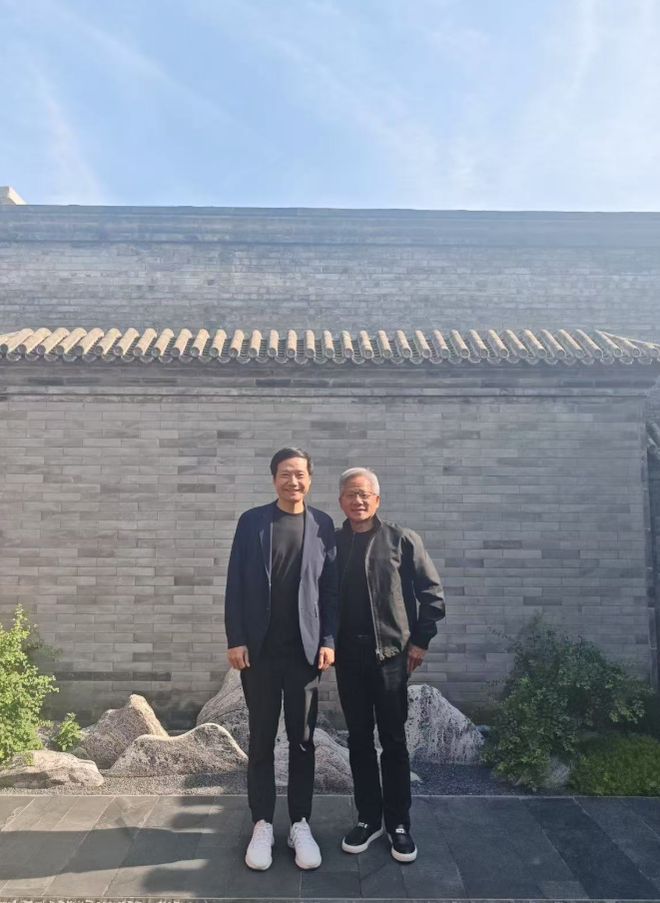
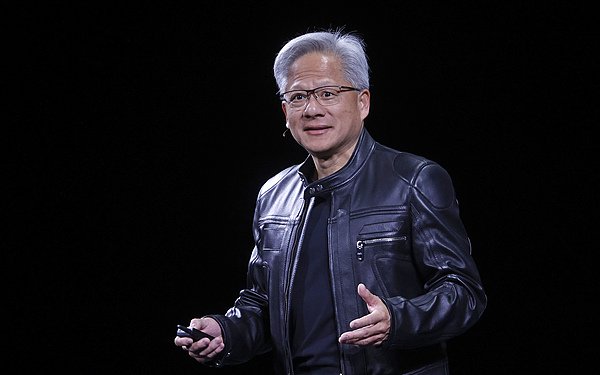
黄仁勋年内第三次访华,高温下与雷军微笑合影
Guan Cha Zhe Wang· 2025-07-14 09:36
Core Viewpoint - Nvidia's CEO Jensen Huang is making his third visit to China this year, indicating the company's commitment to the Chinese market amidst geopolitical tensions and U.S. export controls [5][8]. Group 1: CEO's Visit and Meetings - Huang was photographed with Xiaomi's CEO Lei Jun in Beijing, suggesting a close relationship and potential business discussions [1][5]. - The visit includes participation in the China International Supply Chain Promotion Expo on July 16, where Huang is expected to reaffirm Nvidia's commitment to China [5][8]. - Huang's previous visits in January and April 2023 highlight Nvidia's ongoing efforts to maintain its presence in the Chinese market [8]. Group 2: New AI Chip Development - Nvidia plans to launch a new AI chip designed specifically for China, expected to be introduced as early as September 2023 [5][6]. - This new chip will be a modified version of the existing Blackwell RTX Pro 6000 processor, omitting advanced technologies to comply with U.S. export regulations [6][8]. Group 3: Historical Context and Relationship - Huang and Lei have a history of collaboration, dating back to the launch of the Xiaomi 3 smartphone in 2013, where Huang promoted Nvidia's chips [10]. - The relationship between the two CEOs has been characterized by mutual respect and shared interests in technology and innovation [10][12].

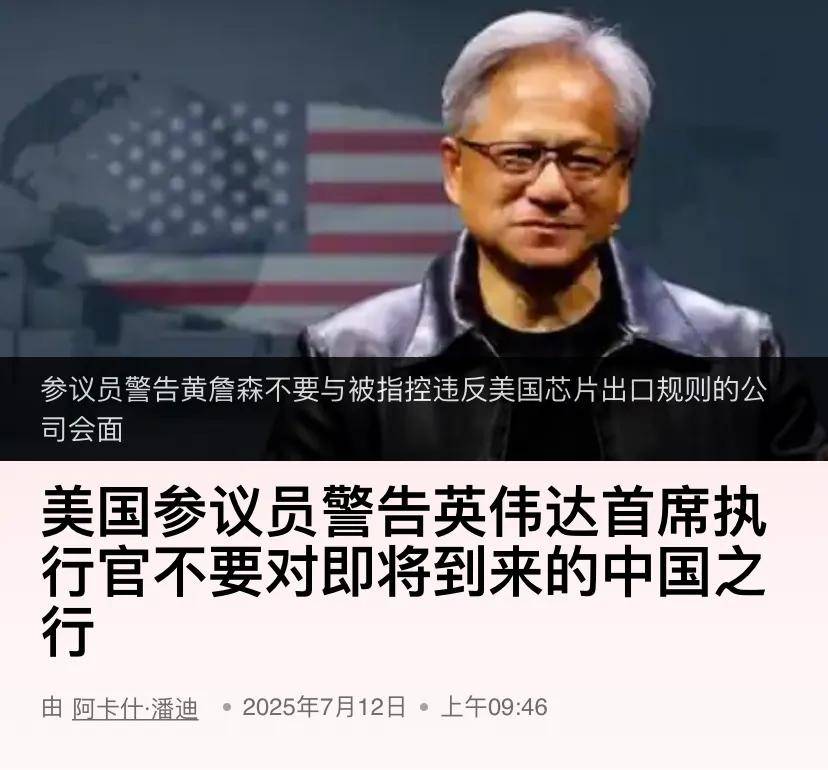
黄仁勋访华求合作,却遭美国两党参议员警告
Guan Cha Zhe Wang· 2025-07-12 00:59
Core Viewpoint - Nvidia's CEO Jensen Huang is set to visit China, raising concerns among some U.S. politicians regarding potential violations of U.S. chip export controls [1][2]. Group 1: U.S. Political Response - Two U.S. senators, Jim Banks and Elizabeth Warren, have warned Huang against meeting with companies allegedly violating U.S. export controls, emphasizing the strategic importance of Nvidia's hardware for advanced AI [1]. - The senators claim that Huang's visit could undermine U.S. export controls and accelerate China's military modernization [1]. Group 2: Nvidia's Strategic Moves - Huang is expected to attend the China International Supply Chain Promotion Expo on July 16, where he may reaffirm Nvidia's commitment to the Chinese market amid U.S. export restrictions [1]. - Nvidia plans to launch a new AI chip designed specifically for China by September, which will exclude some advanced technologies to comply with U.S. regulations [2]. Group 3: Financial Implications - Nvidia anticipates a loss of up to $8 billion in sales due to export controls, with Huang previously stating that these restrictions have already cost the company $15 billion in sales [4].
美解除对华芯片设计软件出口管制
财联社· 2025-07-03 05:24
Core Viewpoint - The U.S. government has lifted the licensing requirements for chip design software exports to China, allowing companies to fully resume their services in the region [1] Group 1: Policy Changes - The U.S. Department of Commerce has notified major chip design software suppliers, including Synopsys, Cadence, and Siemens, that the previous requirement for government licensing for their operations in China has been revoked [1] - Siemens has confirmed that it has fully restored access for Chinese customers to its software and technology [1] Group 2: Company Responses - Synopsys and Cadence have indicated that they are gradually restarting their related services in China following the policy change [1]