
长期资本

Search documents
淡马锡中国区主席吴亦兵:将继续投入长期资本、耐心资本和价值资本
Zheng Quan Ri Bao Wang· 2025-11-12 09:24
Group 1 - The core viewpoint is that Temasek's investment strategy in China aligns with the country's transition from high-speed growth to high-quality development over the past two decades [1] - Temasek's investment approach in China has diversified, covering public market investments, private equity, special opportunity funds, and strategic partnerships [1] - The focus is on a dual-driven model of innovation and mergers & acquisitions (M&A), with mature companies entering a conducive environment for M&A to enhance operational efficiency [1][2] Group 2 - The unique demand-supply iteration ecosystem in China is creating a strong innovation flywheel effect, leading to the emergence of world-class leading companies and growth investment opportunities [2] - M&A is highlighted as a crucial function of the capital market, aiding in resource optimization and industry restructuring, while providing market exit and value rediscovery channels for listed companies [2] - Temasek aims to continue investing long-term, patient, and value capital to build a resilient and forward-looking investment presence in China, focusing on opportunities that align with investment trends [2]
新华资产总经理陈一江: 四大路径推动保险资管持续创新丰富支持科创的“工具箱”与“生态圈”
Zheng Quan Shi Bao· 2025-10-29 18:42
Core Viewpoint - The insurance asset management industry has a responsibility to support national strategies and technological innovation, which is also essential for its own high-quality development [1] Group 1: Support for Technological Innovation - Insurance capital is recognized as "patient capital" and "long-term capital," becoming an indispensable force in supporting technological innovation [2] - The core advantages of insurance asset management include unique funding attributes, comprehensive investment tools, and significant potential for industrial collaboration [2][3] - Insurance funds have established a combination of direct and indirect investments to cover the entire lifecycle of technology enterprises, from seed to maturity [3] Group 2: Balancing Risk and Innovation - The industry must master the "art of balance" between supporting innovation and ensuring capital safety, which is reflected in a scientific asset allocation framework and a rigorous risk management system [4] - A "core + satellite" strategy is commonly adopted to ensure overall portfolio stability, alongside a comprehensive risk management system that spans the entire investment process [4][5] Group 3: Strategic Position and Future Directions - The strategic position of the insurance asset management industry in supporting technological innovation is expected to become more prominent [6] - Current challenges include the need for deeper professional capabilities, more flexible market mechanisms, and diversified exit channels for investments [6][7] - Proposed reforms include restructuring organizational frameworks, enhancing research capabilities, embracing technology, and advocating for optimized top-level design [7]
上交所理事长邱勇:持续深化投资端改革 着力培育耐心资本、长期资本
证券时报· 2025-10-28 02:28
Group 1 - The core viewpoint emphasizes the need for continuous deepening of investment reforms to cultivate patient and long-term capital, enhance market attractiveness and competitiveness, and improve the quality and investment value of listed companies [1] - The focus is on exploring regulatory methods that align with the laws of technological innovation to boost market confidence in sci-tech enterprises [2] - There is a commitment to deepen adaptive reforms in areas such as issuance underwriting, refinancing, and mergers and acquisitions to accelerate the gathering of resources towards the sci-tech sector [3] Group 2 - The initiative includes supporting more cutting-edge technology fields, such as artificial intelligence and commercial aerospace, under the fifth set of standards, aiming to identify high-quality sci-tech companies [4]


上交所理事长邱勇:持续深化投资端改革 着力培育耐心资本、长期资本
Zheng Quan Shi Bao Wang· 2025-10-28 01:57
Core Viewpoint - The Shanghai Stock Exchange aims to enhance market attractiveness and competitiveness by promoting coordinated development of investment and financing, focusing on cultivating patient and long-term capital, and advancing index-based investment [1] Group 1 - The Shanghai Stock Exchange will continue to deepen reforms on the investment side to improve the quality and investment value of listed companies [1] - There is a strong emphasis on creating a market ecosystem where capital is willing to enter, companies can retain their presence, and investors can achieve returns [1]
力争科创领域在京新设基金规模超万亿元,北京详解科技金融发展“路线图”
Bei Jing Shang Bao· 2025-10-16 13:15
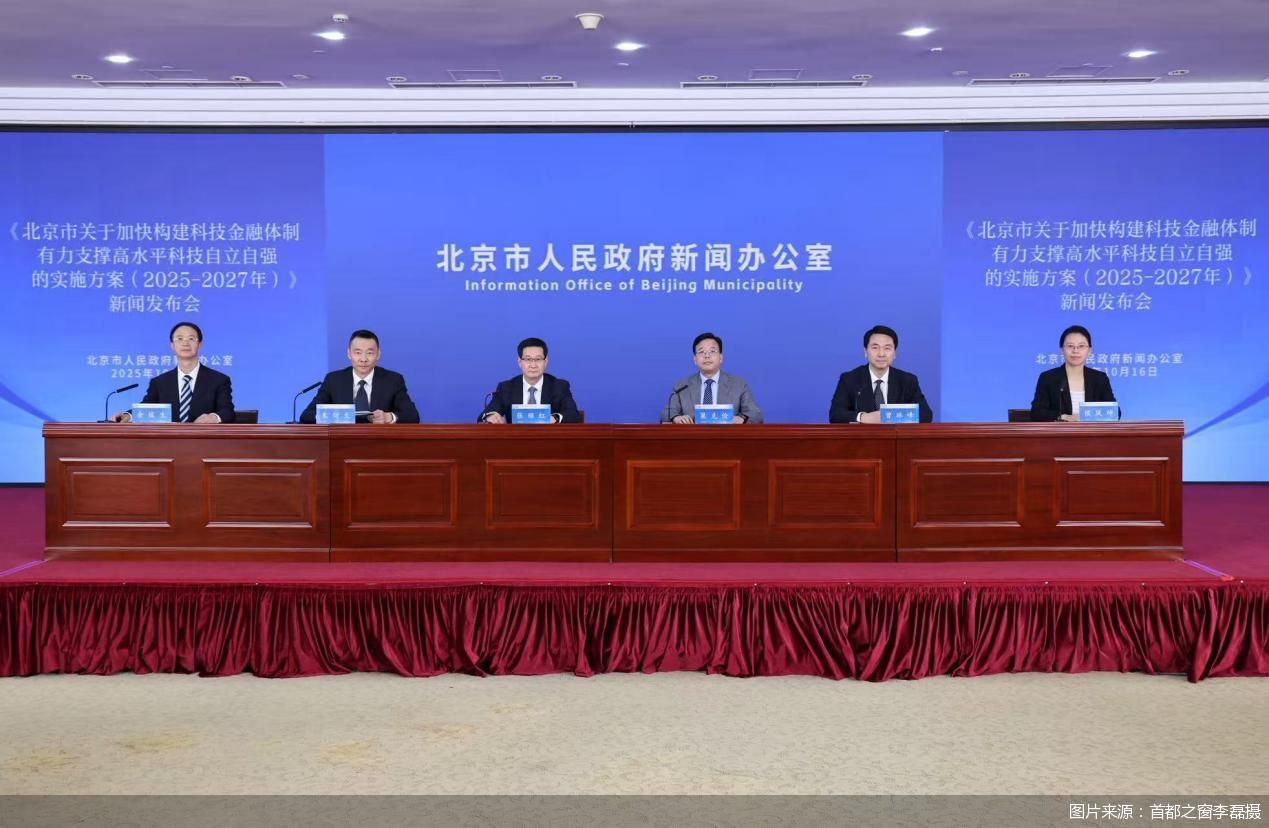
Core Points - Beijing's implementation plan aims to accelerate the development of a technology finance system to support high-level technological self-reliance and innovation by 2027, targeting over 1 trillion yuan in new fund establishment in the tech innovation sector [1][3][4] - The plan includes specific measures to address financing challenges in technology transfer and emphasizes the role of venture capital and equity investment in supporting technological innovation [3][4][5] - The plan outlines a comprehensive approach to enhance credit support for technology innovation, including product innovation and service layout improvements [5][6][7] Group 1: Long-term Capital and Investment - The plan sets a goal to introduce long-term and patient capital, with new fund establishment in the tech innovation sector expected to exceed 1 trillion yuan by the end of 2027 [3][4] - It aims to increase the balance of technology loans and loans to tech enterprises to over 5.5 trillion yuan and 2.5 trillion yuan respectively, with annual growth rates surpassing national and city averages [3][4] - The plan emphasizes the need for collaboration between national funds and local capital, and aims to establish a cooperative fund scale of no less than 50 billion yuan by 2027 [4] Group 2: Credit Support and Financial Services - The plan proposes a new evaluation model, "Zhongguancun Leading Points," to enhance credit support for tech enterprises by considering various innovation-related metrics [6][7] - It encourages banks to offer long-term "tech loans" and implement policies to avoid interruptions in funding for R&D projects [6][7] - The plan aims to optimize the cultivation mechanism for leading financial institutions and expand specialized tech credit service nodes in resource-rich areas [7][8] Group 3: Capital Market Innovations - The plan includes initiatives to strengthen Beijing's role as a technology finance hub, such as establishing a dedicated listing service for high-tech enterprises and creating a "Zhongguancun Technology Board" for bond financing [9][10] - It encourages high-quality overseas-listed companies to return to domestic markets and aims to enhance the liquidity of private equity and venture capital funds [9][10] - The plan also focuses on international financial cooperation and cross-border capital facilitation to extend Beijing's technology finance ecosystem globally [10][11]
事关北京加快构建科技金融体制,实施方案发布,共20条
Bei Jing Ri Bao Ke Hu Duan· 2025-10-16 03:32
Core Viewpoint - Beijing's implementation plan aims to accelerate the construction of a technology finance system to support high-level technological self-reliance and strength from 2025 to 2027, aligning with national policies and local innovation goals [1][2]. Overall Goals - The plan targets the establishment of a comprehensive technology finance service system, enhancing financial services for national laboratories and leading technology enterprises, with a goal to exceed 10 trillion yuan in newly established funds by 2027 [3]. - By the end of 2027, the balance of technology loans and loans to technology enterprises is expected to surpass 5.5 trillion yuan and 2.5 trillion yuan respectively, with annual growth rates exceeding national and municipal averages [3]. Venture Capital Support - The plan emphasizes securing various national-level funds to be established in Beijing, enhancing financial support for major technological breakthroughs and original innovations [4]. - It aims to deepen pilot projects for financial asset investment companies, targeting a total cooperative fund scale of no less than 50 billion yuan by 2027 [5]. Monetary and Credit Support - The plan intends to leverage structural monetary policy tools to support technology innovation financing, aiming to mobilize no less than 100 billion yuan annually for related loans [7]. - It proposes optimizing evaluation models for technology enterprises to improve credit access and enhance the precision of financial services [7]. Capital Market Support - The initiative seeks to support high-quality technology enterprises in listing, utilizing capital market reforms to facilitate their growth and financing [10]. - It plans to establish a "Zhongguancun Technology Board" for issuing technology innovation bonds, enhancing the registration and issuance process [10]. Technology Insurance Role - The plan encourages the development of insurance products that cover the entire cycle of technological innovation, aiming to provide comprehensive risk protection for technology enterprises [12]. Fiscal Policy Guidance - It emphasizes the use of fiscal funds to amplify and guide technology finance, supporting financing guarantees for technology enterprises [13]. Open Innovation Ecosystem - The plan aims to enhance the convenience of cross-border fund usage and promote international cooperation in technology finance, encouraging foreign investment in local technology enterprises [14][15]. Organizational Implementation - The plan outlines a coordinated mechanism for implementing technology finance initiatives, establishing a comprehensive evaluation system for financial institutions' contributions to technological innovation [16][17].
北京计划到2027年底推动REITs发行规模居全国前列
Zhong Guo Xin Wen Wang· 2025-10-15 19:47
Core Points - Beijing aims to introduce over 1 trillion RMB in long-term and patient capital into the technology innovation sector by the end of 2027 [1] - The plan includes promoting technology innovation bonds, technology insurance, and the issuance of REITs, positioning Beijing as a leader in these areas nationally [1] - The initiative seeks to attract national venture capital guidance funds and enhance financial support for major technological breakthroughs and core technologies [1] Group 1 - The plan emphasizes support for high-quality technology companies to go public and encourages quality overseas-listed companies to return to domestic markets [1] - Beijing will leverage the Beijing Stock Exchange as a testing ground for reforms, providing tailored services for companies involved in significant technological challenges and breakthroughs [1] - The establishment of a "Zhongguancun Technology Bond" is proposed to facilitate the issuance of technology innovation bonds by various financial entities [2] Group 2 - The initiative promotes international cooperation in technology finance, encouraging foreign venture capital and private equity firms to establish branches in Beijing [2] - The plan aims to enhance collaboration between domestic and foreign financial institutions and to guide foreign capital to invest in Beijing's technology innovation sector [2] - There is a focus on cultivating international technology finance talent to support these initiatives [2]
超3500亿!科技部:将设一批母基金、S基金等
母基金研究中心· 2025-09-20 07:56
Core Viewpoint - The establishment of the National Venture Capital Guidance Fund is expected to significantly boost the venture capital industry by attracting nearly 1 trillion yuan in local and social capital, focusing on early-stage, small, long-term investments in hard technology sectors [2][3][4]. Group 1: National Venture Capital Guidance Fund - The National Venture Capital Guidance Fund aims to enhance the growth of innovative enterprises by directing financial capital towards early, small, long-term investments in hard technology, particularly in fields like artificial intelligence and quantum technology [3][4]. - The fund's lifespan is set to be 20 years, which is longer than typical venture capital funds, indicating a commitment to long-term capital support [3][4]. - The fund is expected to leverage local and social capital, potentially leading to a total investment of around 1 trillion yuan [2][3]. Group 2: Impact on the Venture Capital Industry - The creation of a national-level mother fund is seen as a significant opportunity for the venture capital sector, especially given the lack of new national-level mother funds in recent years [4][5]. - The initiative is anticipated to restore confidence in the venture capital industry and provide essential support to private equity funds [4][6]. - The government has been actively promoting policies to support venture capital, including the recent "17 Measures for Promoting High-Quality Development of Venture Capital" [6][7]. Group 3: Long-term Capital and Market Dynamics - The venture capital industry has faced challenges in securing long-term capital, which is crucial for supporting investments in early-stage companies [6][7]. - The current policy environment is favorable, with increased government support aimed at enhancing the availability of long-term capital sources [6][7]. - The establishment of various funds, including technology industry integration funds and secondary market funds, is expected to exceed 350 billion yuan, further supporting the venture capital ecosystem [5][6].

今年,长期资本LP如何投GP
母基金研究中心· 2025-09-12 09:42
Group 1 - The 2025 Sixth China Fund of Funds Summit was successfully held in Beijing, gathering over 300 representatives from government departments, industry associations, mainstream funds, insurance asset management, and top investment institutions [1] - The summit featured a roundtable forum titled "Decoding Long-term Capital LP's Investment Strategies," where industry leaders discussed core considerations for long-term capital LPs when selecting funds and balancing risk and return strategies [2][4] Group 2 - Long-term capital is a key force supporting hard technology and the real economy, with LPs focusing on the professional capabilities and past performance of fund management teams, decision-making processes, risk control systems, and post-investment management capabilities [4] - The Zhejiang Provincial Industrial Fund has established sub-funds exceeding 170 billion to expand cooperation with leading GPs, emphasizing the importance of selecting GPs with significant professional characteristics and stable core teams [4][5] - LPs need to adopt multiple measures to balance long-term investment and returns, including extending investment cycles, refining assessment and due diligence rules, and incentivizing management teams through LP yield concessions [5] Group 3 - The role of long-term capital LPs is evolving, as they increasingly participate in fund governance and strategic guidance, highlighted by recent central government meetings emphasizing the importance of long-term and strategic capital [7] - The concept of patient capital has shifted from traditional financial investment to industrial investment, focusing on promoting the integration and competitiveness of industrial chains through equity investment [8] - Organizations like Zhongguancun Capital are actively engaging with insurance capital and financial institutions to promote the establishment of funds focused on strategic emerging industries, supporting growth projects through additional investments [9] Group 4 - The investment philosophy of companies like Times Bole aligns with the spirit of recent government policies, emphasizing long-term, continuous investment to support industrial upgrades and capital appreciation [9][10] - The thriving development of the fund of funds industry is expected to contribute significantly to the revitalization of China's primary market, technological innovation, and high-quality development [10]

专访南方科技大学副校长金李:促进“四链”融合 构建更具活力的国家创新体系
Zheng Quan Shi Bao· 2025-09-03 21:10
Core Viewpoint - China is at a critical juncture transitioning from "catching up" to "keeping pace" and even "leading" in global technology innovation, with significant opportunities in fields like AI, nanotechnology, quantum information, and healthcare, but also faces challenges in research result transformation, startup financing, and high-end talent cultivation [2] Group 1: Challenges in the "Four Chains" Integration - The integration of the innovation chain, industry chain, capital chain, and talent chain faces four major challenges: insufficient linkage between the innovation and industry chains, a shortage of key talent, inadequate funding support for startups, and a lack of diverse application scenarios in the industry chain [3][4] - The innovation chain and industry chain often operate in silos, leading to low conversion efficiency of research results into market applications [3] - There is a need for optimized talent support, as there is a shortage of interdisciplinary talents who understand technology, market dynamics, and finance [3][4] Group 2: Systematic Solutions Proposed - A "tropical rainforest" ecosystem for technology innovation should be established to enhance the overall success rate of the innovation ecosystem rather than focusing solely on individual project success [4] - The talent chain support system needs optimization, including the establishment of market-oriented technology transfer personnel incentives and better integration of technology transfer roles within universities and enterprises [4][5] - A comprehensive technology finance service system should be developed, optimizing government guidance funds and encouraging social capital participation in early-stage investments [5] Group 3: Enhancing Research Result Transformation - The low conversion rate of research results is primarily hindered by policy execution, research ecosystem issues, and transformation capabilities [6][7] - Three key areas to focus on during the "14th Five-Year Plan" include optimizing policy services, reinforcing the role of enterprises in innovation, and enhancing transformation capabilities through better support platforms [7][8] Group 4: Talent Mobility and Institutional Innovation - To facilitate talent mobility between universities, research institutions, and enterprises, institutional barriers must be addressed, including flexible personnel management systems and the establishment of rotating positions [8] - Middle and small enterprises, crucial to the innovation ecosystem, require innovative systems to attract talent, such as "technology vice president" roles and dual-employment systems [8] Group 5: Long-term Capital in Equity Investment - A systematic layout is needed to build a technology finance system that covers the entire lifecycle of enterprises, focusing on cultivating long-term capital and promoting diversified development in the venture capital industry [9][10] - Specific recommendations include raising investment limits for long-term funds in equity markets, encouraging diversified investment approaches, and developing S funds to enhance investment returns [10][11]
