
AI需求

Search documents
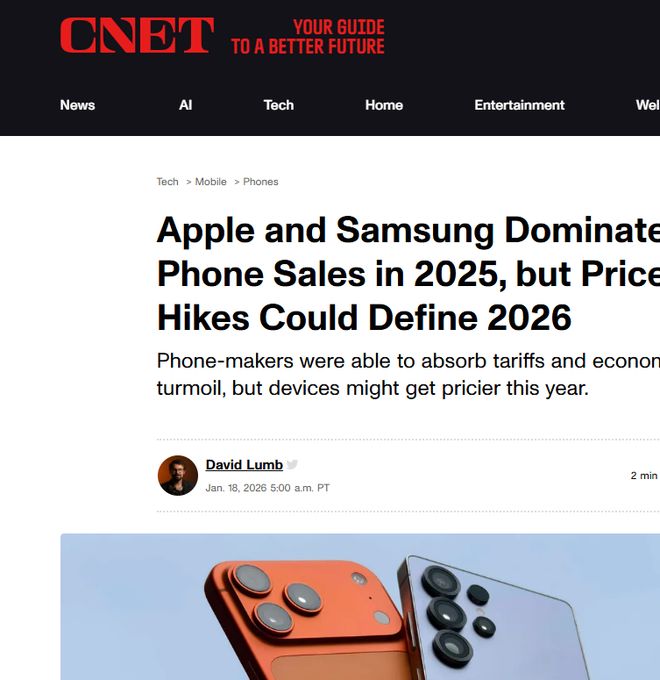
苹果三星领跑2025手机市场,2026年涨价或成定局
Huan Qiu Wang Zi Xun· 2026-01-19 02:28
Group 1 - The global smartphone market is expected to achieve a 1.9% year-on-year growth in 2025 despite challenges such as tariff disruptions, economic turmoil, and limited consumer spending [1] - High-end models (priced at $800 and above) are showing strong sales performance, with Apple and Samsung leading the industry in shipment growth, collectively increasing their market share to 39%, up 2 percentage points from 2024 [1] Group 2 - The growth momentum may not continue into 2026, as the industry faces a drastically different outlook due to an unprecedented shortage of RAM affecting the home PC market, which could lead to a contraction in the smartphone market [4] - The duration of the memory shortage will determine the extent of market shrinkage, with rising component costs due to tight memory supply putting pressure on average smartphone prices for consumers [4] - Manufacturers may respond to weak consumer demand by concealing price increases, delaying price adjustments, and adjusting configurations to control costs, particularly impacting mid-range and low-end models [4] - High-end models, such as foldable phones averaging around $2000, face less resistance to price adjustments, allowing manufacturers to increase prices or absorb lower profit margins, while mid-range and low-end models are also likely to experience price hikes [4]


存储及产业链-在发生什么变化
2026-01-05 15:42
存储行业国产化进程如何? 长鑫科技提交了招股说明书,其 25Q4 的利润、收入和产能利用率均表现超预 期。这表明存储行业国产化需求强劲,并且未来新增产能更多依赖于新建晶圆 厂和新增产能,这将带动设备、材料及洁净室等环节的资本开支需求。因此, 存储封测领域机会:新峰公司有望成为长鑫重要测试封测供应商,推进 高端测试封测业务,先进存储封测价值量提升 2-3 倍,提升盈利能力, 未来有望成长为年产值超 30 亿元,利润超 3 亿元的公司。 洁净室需求增长:美光等海外客户对洁净室需求迫切,国内市场伴随先 进制程扩产及新产线建设,对洁净室需求乐观预期,亚翔集成等相关企 业毛利率提高。 存储及产业链,在发生什么变化?20260105 摘要 存储合约价超预期上涨:一季度原厂全面上调存储合约价,反映供不应 求背景下卖方市场强势,原厂价格主导能力强,预计全年涨幅上修至 33%-38%。 国产存储需求强劲:长鑫科技招股书显示 25Q4 利润、收入和产能利用 率超预期,国产化需求带动新建晶圆厂和新增产能,利好设备、材料及 洁净室等产业链投资机会。 利基存储价格上涨:NOR Flash 在 2026 年一季度及全年涨幅有望超预 期, ...
港股异动 有色股涨幅进一步扩大 中国宏桥(01378)涨超4% 紫金矿业(02899)涨超3%
Jin Rong Jie· 2026-01-02 07:24
Group 1 - The core viewpoint of the articles highlights the significant rise in the prices of non-ferrous metal stocks, driven by new policies from the National Development and Reform Commission aimed at optimizing traditional industries, particularly in alumina and copper smelting [1] - Ganfeng Lithium (01772) increased by 4.04% to HKD 54.05, China Hongqiao (01378) rose by 4.17% to HKD 33.98, Shandong Gold (01787) gained 4.1% to HKD 36.02, Luoyang Molybdenum (03993) went up by 3.9% to HKD 19.99, and Zijin Mining (02899) increased by 3.76% to HKD 37 [1] - Morgan Stanley anticipates that the new policies may restrict the planning of new alumina production capacity and expects capacity consolidation to benefit industry leaders, while lower annual copper concentrate processing and refining fees may lead to a reduction in refined copper output by 2026 [1] Group 2 - CITIC Securities points out that insufficient capital expenditure, limited resource supply, strong AI demand prospects, expanding fiscal deficits, and declining interest rates are creating a new resource pricing paradigm globally, leading to a feast in the non-ferrous sector [2] - The article notes that the distribution of physical resources between the US and non-US regions is uneven due to threats from US tariffs on key minerals, resulting in liquidity shortages in certain markets and increased capital inflow to long positions [2]

有色股涨幅进一步扩大,中国宏桥涨超4%,紫金矿业涨超3%
Zhi Tong Cai Jing· 2026-01-02 06:23
Group 1 - The core viewpoint of the article highlights the significant rise in non-ferrous metal stocks, driven by new policies from the National Development and Reform Commission aimed at optimizing traditional industries, particularly in alumina and copper smelting [1] - Ganfeng Lithium saw a rise of 4.04% to HKD 54.05, China Hongqiao increased by 4.17% to HKD 33.98, Shandong Gold rose by 4.1% to HKD 36.02, Luoyang Molybdenum increased by 3.9% to HKD 19.99, and Zijin Mining rose by 3.76% to HKD 37 [1] - Morgan Stanley suggests that the new policies may limit the planning of new alumina production capacity and that capacity consolidation will benefit industry leaders, while lower annual copper concentrate processing and refining fees may lead to a reduction in refined copper output by 2026 [1] Group 2 - CITIC Construction pointed out that insufficient capital expenditure, limited resource supply, strong AI demand prospects, expanding fiscal deficits, and declining interest rates are creating a new resource pricing paradigm globally, leading to a surge in non-ferrous metal investments [1] - The article indicates that the distribution of physical resources between the US and non-US regions is uneven due to threats from US tariffs on key minerals, resulting in liquidity issues in certain markets [1] - The combination of these factors is expected to support copper prices at high levels, with stable demand contributing to this trend [1]
港股异动 | 有色股涨幅进一步扩大 中国宏桥(01378)涨超4% 紫金矿业(02899)涨超3%
智通财经网· 2026-01-02 06:09
Group 1 - The core viewpoint of the articles highlights the significant rise in the prices of non-ferrous metal stocks, driven by new policies from the National Development and Reform Commission aimed at optimizing traditional industries, particularly in alumina and copper smelting [1] - Major non-ferrous metal companies such as Ganfeng Lithium, China Hongqiao, Shandong Gold, Luoyang Molybdenum, and Zijin Mining have seen substantial stock price increases, with Ganfeng Lithium rising by 4.04% to HKD 54.05, and China Hongqiao increasing by 4.17% to HKD 33.98 [1] - Morgan Stanley anticipates that the new policies may limit the planning of new alumina production capacity and that capacity consolidation will benefit industry leaders, while lower annual copper concentrate processing and refining fees may lead to reduced refined copper output by 2026 [1] Group 2 - CITIC Securities points out that insufficient capital expenditure, limited resource supply, strong AI demand prospects, expanding fiscal deficits, and declining interest rates are creating a new resource pricing paradigm globally, leading to a feast in the non-ferrous sector [2] - The article notes that the distribution of physical resources between the US and non-US regions is uneven due to threats from US tariffs on key minerals, resulting in liquidity shortages in certain markets and increased capital inflow to long positions [2]
2026开门红!多板块共振上涨,港股半导体股领涨,百度拟分拆昆仑芯催化科网股
Zheng Quan Shi Bao· 2026-01-02 04:48
Market Overview - The Hong Kong stock market opened strong on the first trading day of 2026, with the Hang Seng Technology Index rising over 3.5% and the Hang Seng Index increasing by more than 2% [1] - Key sectors such as semiconductors, internet giants, home appliances, and automobiles showed significant gains, driven by favorable policies [1] Semiconductor Sector - The semiconductor sector experienced a collective surge, with companies like Hua Hong Semiconductor rising over 10% and SMIC increasing by more than 5% [1] - Hua Hong Semiconductor announced plans to acquire a 97.4988% stake in Huali Micro for a transaction price of 8.268 billion yuan, aiming to enhance its 12-inch wafer foundry capacity [2] - The semiconductor industry is benefiting from a price surge in the supply chain, sustained AI demand, and a strengthened domestic substitution logic [2] Internet Sector - Internet giants such as Baidu, NetEase, Tencent, and Alibaba saw significant stock price increases, with Baidu rising over 8% following its announcement to spin off Kunlun Chip for an independent listing on the Hong Kong Stock Exchange [3] - The move to list Kunlun Chip is expected to stimulate Baidu's stock performance further [3] Home Appliances and Automotive Sector - The home appliance and automotive sectors are also experiencing strong performance, supported by government policies promoting the replacement of old appliances and vehicles [3] - The National Development and Reform Commission and the Ministry of Finance announced continued subsidies for vehicle scrappage and replacement, as well as for home appliance upgrades, which are expected to boost domestic consumption [4] - Analysts suggest that the continuation of these policies will stabilize the automotive market and alleviate consumer hesitation, benefiting companies in the new car cycle and those focusing on high-end and intelligent products [5]
工业有色ETF(560860)盘中涨近3%,近5日累计“吸金”超4亿元
Xin Lang Cai Jing· 2025-12-31 02:43
2025年12月31日早盘,有色金属板块盘中拉升,截至 09:53,中证工业有色金属主题指数(H11059)强势 上涨2.78%,成分股江西铜业上涨9.95%,云南铜业上涨7.25%,紫金矿业上涨5.45%,铜陵有色、洛阳 钼业等个股跟涨。工业有色ETF(560860)上涨2.74%。 规模方面,截至2025年12月30日,工业有色ETF最新规模达83.30亿元。资金流入方面,工业有色ETF最 新资金净流入2.54亿元。拉长时间看,近5个交易日内有4日资金净流入,合计"吸金"4.32亿元。 数据显示,截至2025年11月28日,中证工业有色金属主题指数前十大权重股分别为洛阳钼业、北方稀 土、中国铝业、云铝股份、兴业银锡、华友钴业、铜陵有色、江西铜业、神火股份、西部矿业,前十大 权重股合计占比54.56%。 工业有色ETF(560860)紧密跟踪中证工业有色金属主题指数,覆盖铜、铝、稀土等战略资源龙头,场 外投资者可通过联接(A类:018489;C类:018490)布局顺周期与政策红利共振机遇。 MACD金叉信号形成,这些股涨势不错! 在供需紧平衡背景下,宏观因素对工业金属价格走势影响显著。国泰君安证券指出,货 ...
有色股多数活跃 中国铝业涨超5% 洛阳钼业涨超3%
Zhi Tong Cai Jing· 2025-12-30 06:09
Group 1 - The core viewpoint of the article highlights the active performance of non-ferrous metal stocks, with significant gains observed in companies such as China Aluminum, Luoyang Molybdenum, and Zijin Mining [1] - China Aluminum (601600) increased by 5.61%, reaching HKD 12.23; Luoyang Molybdenum (603993) rose by 3.3% to HKD 19.08; Zijin Mining (601899) saw a 3.05% increase to HKD 35.16; Jiangxi Copper (600362) gained 2.47% to HKD 40.64; and China Hongqiao (01378) was up by 1.7% to HKD 32.3 [1] - Precious metals have regained upward momentum, with spot gold rising over 1% to touch USD 4,380, and spot silver increasing by over 4% to surpass USD 75 [1] Group 2 - CITIC Construction Investment (601066) noted that insufficient capital expenditure, limited resource supply, strong AI demand prospects, expanding fiscal deficits, and a downward interest rate cycle are contributing factors to the uneven distribution of physical commodities between the US and non-US markets [1] - The article suggests that these factors are leading to a lack of liquidity in certain commodities, prompting capital inflows to take long positions [1] - A new resource pricing paradigm is emerging globally, driven by the interplay of limited resources and weakening US dollar credit, indicating a vibrant market for non-ferrous metals [1]


港股异动 | 有色股多数活跃 中国铝业(02600)涨超5% 洛阳钼业(03993)涨超3%
智通财经网· 2025-12-30 06:08
Group 1 - The core viewpoint of the article highlights the active performance of non-ferrous metal stocks, with significant price increases observed in companies such as China Aluminum, Luoyang Molybdenum, Zijin Mining, Jiangxi Copper, and China Hongqiao [1] - Precious metals have regained upward momentum, with spot gold rising over 1% to reach $4,380 and spot silver increasing by more than 4% to surpass $75 [1] - Citic Securities pointed out that factors such as insufficient capital expenditure, limited resource supply, strong AI demand prospects, expanding fiscal deficits, and declining interest rates are contributing to a new resource pricing paradigm globally, leading to increased liquidity issues in certain markets [1] Group 2 - The article indicates that the interplay of limited resources and weakening dollar credit is creating a new expression in the market, suggesting a shift in how resources are priced [1] - The performance of non-ferrous metal stocks is seen as part of a broader trend influenced by these economic factors, indicating a potential investment opportunity in this sector [1]

2025年全球芯片设备销售额将达1330亿美元
Zhong Guo Chan Ye Jing Ji Xin Xi Wang· 2025-12-25 00:16
Group 1 - The International Semiconductor Industry Association (SEMI) predicts that global chip equipment sales will increase by 13.7% to reach $133 billion by the end of 2025, setting a new historical record [1] - SEMI forecasts continuous growth in chip equipment sales for the next two years, with projections of $145 billion in 2026 and $156 billion in 2027, marking a significant milestone as sales are expected to surpass $150 billion for the first time in 2027 [1] - The CEO of SEMI, Ajit Manocha, noted that the robust sales in global chip equipment are driven by increased investments supporting AI demand, leading to an upward revision of sales forecasts [1] Group 2 - In the wafer fabrication equipment (WFE) segment, the sales growth rates for foundry/logical applications are projected to be 9.8%, 5.5%, and 6.9% over the next three years, reaching $75.2 billion by 2027 [2] - The growth rates for DRAM memory and NAND flash memory during the same period are expected to be 15.4%, 15.1%, 7.8% and 45.4%, 12.7%, 7.3% respectively [2]