
ESG投资

Search documents
世邦魏理仕:2026年中国投资者意向调查报告
Sou Hu Cai Jing· 2026-01-24 13:23
Investment Intentions - The overall sentiment of investors remains cautious for 2026, with 43% planning to invest more actively and 52% intending to sell more actively, indicating a slight increase from the previous year [16][9] - Domestic investors, driven by institutional investors and real estate funds, have shifted their net investment intention from negative to positive (+7%), while foreign investors continue to show a strong net selling intention [16][10] - 39% of respondents plan to increase their real estate asset allocation, with the main drivers being reasonable asset price adjustments and opportunities in distressed assets [18][10] Investment Strategies - Core and core-plus strategies are favored by 58% of investors, reflecting a heightened focus on cash flow stability [34][10] - The top three property types of interest are industrial logistics, rental residential, and retail properties, with high-standard warehouses in East China and Central-West regions expected to see cyclical opportunities [24][10] - There is a significant increase in interest in alternative assets, particularly student apartments and infrastructure, with data centers becoming the most optimistic property type due to AI computing demand [30][10] Financing and Interest Rate Environment - 77% of investors expect further interest rate cuts from the central bank, with most anticipating a reduction of up to 50 basis points [2][10] - The easing of merger loan regulations provides more flexible financing support, although refinancing gaps remain a major concern for investors [2][10] Environmental, Social, and Governance (ESG) - 83% of investors have already incorporated or plan to incorporate ESG factors into their investment decisions, with a focus on green buildings, renewable energy facilities, and green financing [2][10] - 66% of investors recognize the premium associated with ESG assets, although their attitudes are becoming more cautious [2][10] Market Trends - Shanghai remains the most favored investment destination, with 64% of respondents selecting it, followed by Beijing at 22% [36][10] - The focus on second and third-tier cities has increased by 5 percentage points, with retail properties becoming a focal point for investors [36][10] - The main risks identified for the real estate market include economic recession (68%) and geopolitical uncertainties (47%) [21][10]


A股绿色周报|5家上市公司暴露环境风险 晶科科技控股公司违规占用毁坏林地被罚约666万元
Sou Hu Cai Jing· 2026-01-23 09:41
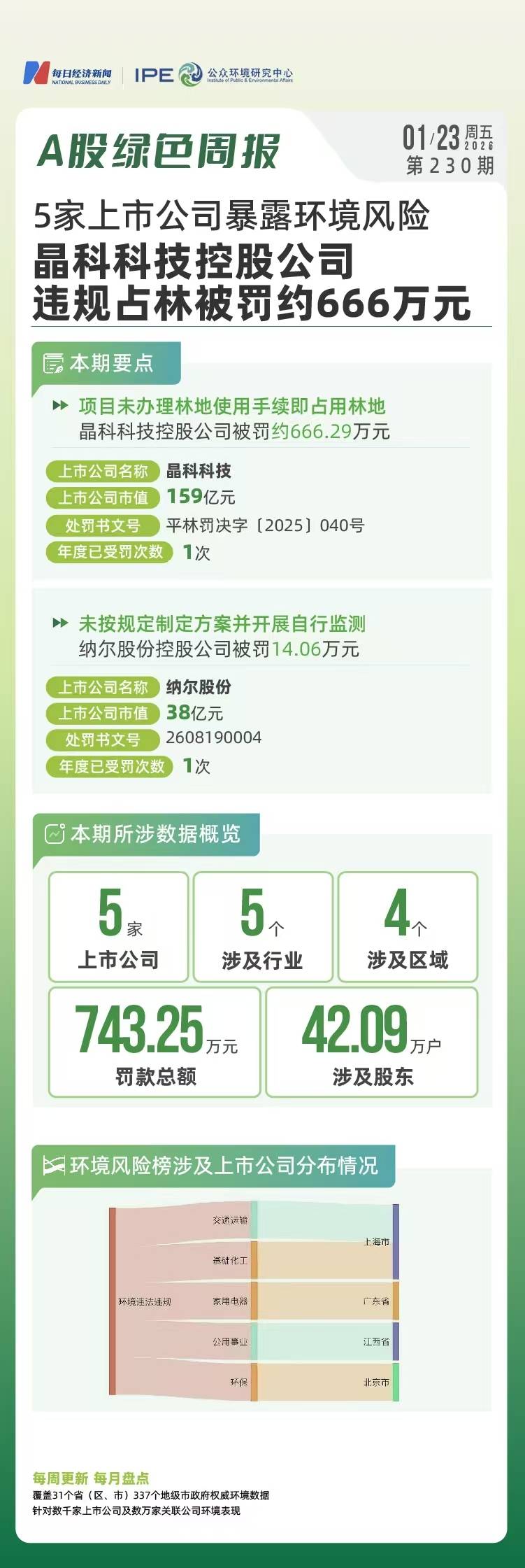
Core Viewpoint - Five listed companies in A-shares have recently exposed environmental risks, highlighting the increasing importance of environmental responsibility in corporate operations [8][11]. Group 1: Environmental Violations and Penalties - JinkoSolar Technology Co., Ltd. was fined approximately 6.66 million yuan for occupying forest land without proper usage permits [8][11]. - NAR Holdings Co., Ltd. was penalized 140,600 yuan for failing to develop a monitoring plan and conduct self-monitoring as required [13]. - Jiangxi Xin Feng Microcrystalline Jade Co., Ltd. was fined 100,000 yuan for improperly disposing of industrial solid waste without verifying the qualifications of the contractor [15]. Group 2: Company Responses and Actions - JinkoSolar stated it is actively working on obtaining the necessary land usage permits and is committed to sustainable development practices [12]. - NAR Holdings did not provide an effective response to inquiries regarding its environmental violations [13]. - Xin Feng Microcrystalline Jade submitted a rectification report indicating that it has recovered the illegally disposed waste and is now compliant with regulations [15]. Group 3: Broader Implications for Investors - The five companies involved have a combined total of 420,900 shareholders, indicating potential investment risks associated with their environmental standings [11]. - The increasing focus on ESG (Environmental, Social, and Governance) factors among investors emphasizes the need for companies to maintain sustainable practices [16].


好书推荐·赠书|《2025年中国资产管理行业发展报告》
清华金融评论· 2026-01-23 09:35
Core Viewpoint - The article discusses the development status and future trends of China's asset management industry under the backdrop of tariff friction and AI transformation, providing a comprehensive analysis of market size, structure, and sub-industry dynamics since 2005 [3][4]. Group 1: Industry Landscape - The asset management industry is experiencing a new development pattern amid increasing market uncertainty [7]. - Regulatory policies are guiding the high-quality development of the asset management industry [7]. - The entry of AGI into its second phase is driving fundamental innovations in the asset management sector through technological breakthroughs and integration [7]. - The AI era is transforming personal investment strategies, directions, and opportunities [7]. - The "silver economy" is entering its first year, with a comprehensive promotion of personal pensions [7]. - Mandatory disclosure of climate risk information is pushing the ESG concept towards practical implementation [7]. - In the context of macroeconomic changes, the value of stable cash flow assets is becoming more prominent [7]. - The Chinese cross-border asset management sector faces challenges and opportunities amid low interest rates and tariff impacts [7]. Group 2: Institutional Focus - The financial management industry is encouraged to embrace market changes and promote high-quality development through transformation [8]. Group 3: International and Hong Kong Asset Management - The report includes insights from international asset management markets, providing references for high-quality development in the industry [4].

绿色规则重塑资本逻辑 ESG尽责管理驱动价值发现
Zhong Guo Zheng Quan Bao· 2026-01-22 20:56
Core Insights - The implementation of the EU Carbon Border Adjustment Mechanism (CBAM) marks a significant shift in global low-carbon governance, impacting trade flows and reshaping industry competition and capital movement [1][2] - China's ESG investment ecosystem is maturing, with a focus on transitioning from passive screening to active value discovery and creation [1] Group 1: Impact of CBAM and Hainan Free Trade Port - The CBAM is seen as a "green valve" affecting global trade, particularly for industries like cement, steel, and aluminum, increasing compliance costs for Chinese exporters [1][2] - The Hainan Free Trade Port is positioned as a testing ground for innovative carbon management practices, potentially leading to cross-border carbon asset trading and green financing [2][6] Group 2: Industry Transformation and Valuation Reconstruction - The introduction of CBAM is accelerating the restructuring of valuation systems in China's capital markets, with companies that adopt energy-saving measures and carbon management systems likely to receive a "green premium" [2][3] - The Chinese carbon market is rapidly developing, with major energy-intensive industries included, and efforts are needed to optimize carbon pricing mechanisms to align with international standards [3] Group 3: ESG Management Challenges - Despite the growing popularity of ESG investment, asset management institutions still exhibit a tendency to focus on screening rather than deep engagement, hindered by insufficient research capabilities and short-term performance incentives [4] - The quality of ESG data remains a challenge, particularly in high-energy sectors and among smaller enterprises, necessitating collaborative efforts to enhance data disclosure and verification [4] Group 4: ESG Practices and Investment Strategies - China Galaxy Securities has developed an ESG rating system that integrates international frameworks with local characteristics, aiding investment decisions and responsible management [5] - The emergence of ESG-enhanced indices indicates a shift towards proactive value influence in ESG investments, signaling to companies that strong ESG performance can enhance valuation and attract capital [5][6] Group 5: Focus on Green Premium and High Certainty Sectors - In high-carbon industries covered by CBAM, green transformation is becoming essential for survival, with technology innovations expected to create economic and environmental benefits [6] - Investment strategies should prioritize sectors like banking, steel, non-bank finance, transportation, and power equipment, which align well with green transformation and compliance requirements [6][7] Group 6: Market Outlook and ESG Integration - The anticipated improvement in market conditions and the advantages of ESG integration strategies are expected to resonate deeply, providing a clear investment rationale for 2026 and beyond [7] - Companies with strong ESG performance are likely to demonstrate robust operational structures and risk resilience, aligning with long-term trends in green transformation and economic restructuring [7]
以创新践行使命 用责任书写“金融强国”篇章
Shang Hai Zheng Quan Bao· 2026-01-22 18:37
Core Viewpoint - The private equity industry plays a crucial role in implementing the national innovation-driven development strategy, serving the real economy, and promoting the development of new productive forces, as outlined in the 20th National Congress of the Communist Party of China [1][2]. Group 1: Industry Development and Strategic Focus - The private equity sector is emphasized as a key driver for original innovation and tackling core technologies, providing essential funding support for the integration of technological and industrial innovation [2]. - The company aims to guide capital towards strategic emerging industries such as integrated circuits, new-generation information technology, high-end equipment, new energy, and biomedicine, while also acting as a value discoverer and resource allocator [2]. - During the 14th Five-Year Plan period, the company will continue to support strategic emerging industries and future sectors like quantum technology, hydrogen energy, and biomanufacturing, contributing to the enhancement of the technological innovation system [2][4]. Group 2: Investment Strategies and Market Adaptation - The current investment ecosystem in China is undergoing significant changes, with challenges in the entire investment chain, particularly in exit strategies, which are critical for high-quality and stable industry development [3]. - The company focuses on product and business innovation, utilizing S funds and mergers to achieve cyclical investments and enhance liquidity in the primary market [3]. Group 3: Responsibility and ESG Investment - The company actively practices ESG investment principles, integrating social and environmental benefits into its operations and investment processes, promoting responsible investment as an industry consensus [4]. - The growth of innovative enterprises requires patient and responsible capital, which can support long-term and stable development while enhancing social and environmental impacts [4]. Group 4: Internationalization and Global Strategy - Chinese investment institutions and enterprises are increasingly pursuing international markets, with a focus on green and sustainable development as a consensus in finance and industry [5][6]. Group 5: Corporate Governance and Risk Management - The company adheres to the principles of "honesty and trustworthiness" and emphasizes a robust governance structure to enhance risk management capabilities and protect shareholder interests [7]. - Effective risk management is seen as foundational for stable development and innovation, with a focus on embedding risk prevention in all strategic and operational processes [7]. Group 6: Talent Development and Digital Transformation - Strengthening research capabilities, talent development, and digital transformation are identified as essential for building long-term competitiveness [8]. - The company aims to foster a positive workplace culture and ethical behavior among employees through various mechanisms [8].
招商证券定量研究2026年度十大展望
CMS· 2026-01-20 07:35
Quantitative Models and Construction Methods Model 1: Active Quantitative Stock Selection Based on Free Cash Flow - **Model Name**: Active Quantitative Stock Selection Based on Free Cash Flow - **Model Construction Idea**: The model aims to select stocks with high free cash flow quality and enhance the selection with valuation, quality, dividend, and momentum factors[27] - **Model Construction Process**: 1. **Sample Space**: Exclude newly listed stocks (less than one year), ST and *ST stocks, and stocks in the comprehensive financial, banking, non-bank financial, and real estate sectors[29] 2. **Initial Screening**: Retain stocks with positive free cash flow, positive enterprise value, and positive net cash flow from operating activities over the past five years. Exclude stocks in the bottom 20% of profitability quality[29] 3. **Free Cash Flow Selection**: Construct free cash flow factors from valuation, quality, and growth dimensions. Neutralize these factors by market value and industry, then combine them equally to form a comprehensive free cash flow factor. Select the top 50% of stocks based on this factor to form a self-built cash flow stock pool[29] 4. **Enhancement Dimensions**: Introduce valuation, quality, dividend, and momentum factors to further enhance the stock pool[29] - **Model Evaluation**: The model has shown stable performance with an annualized return of 32.28% and an annualized excess return of 26.68% relative to the CSI 500, with an information ratio (IR) of 2.42[30] Model 2: High Dividend Stock Selection Strategy - **Model Name**: High Dividend Stock Selection Strategy - **Model Construction Idea**: The model focuses on selecting stocks with high dividend yields and stable dividend payments to construct a high dividend investment strategy[33] - **Model Construction Process**: 1. **High Dividend Base Stock Pool**: Select the top 20% of companies in each CITIC first-level industry based on dividend yield[35] 2. **Avoid Dividend Trap**: Select companies with an average dividend yield greater than 2% over the past three years and a standard deviation of dividend yield less than 2%[35] 3. **Avoid Low Valuation Trap**: Select companies with the current quarterly ROE greater than or equal to the same quarter last year and with a positive consensus forecast for future compound growth rate[35] 4. **High Dividend Yield Portfolio**: Select the top 30 companies based on dividend yield from the remaining stock pool[35] - **Model Evaluation**: The model has achieved an annualized excess return of 16.42% relative to the CSI Dividend Index, with an IR of 2.42[37] Model 3: Technical Growth Expectation Stock Selection Strategy - **Model Name**: Technical Growth Expectation Stock Selection Strategy - **Model Construction Idea**: The model aims to identify high-growth opportunities by constructing a future growth portfolio based on current growth indicators and enhancing it with technical factors[39] - **Model Construction Process**: 1. **Growth Expectation Portfolio Construction**: Select companies with the latest quarterly net profit growth to form the base stock pool. Exclude companies in the bottom 20% of quarterly ROE and select the top 50% based on the slope of quarterly ROE[41] 2. **Technical Enhancement**: Select the top 30% of companies based on the standardized unexpected earnings (SUE) indicator and the top 100 stocks based on excess returns on the day after earnings announcements. Further select the top 30 stocks based on the standard deviation of turnover rate moving average[41] - **Model Evaluation**: The model has shown an annualized return of 40% and an annualized excess return of 32.13% relative to the CSI 500, with an IR of 2.91[42] Model Backtest Results Active Quantitative Stock Selection Based on Free Cash Flow - **Annualized Return**: 32.28% - **Annualized Excess Return**: 26.68% - **Information Ratio (IR)**: 2.42[30] High Dividend Stock Selection Strategy - **Annualized Excess Return**: 16.42% - **Information Ratio (IR)**: 2.42[37] Technical Growth Expectation Stock Selection Strategy - **Annualized Return**: 40% - **Annualized Excess Return**: 32.13% - **Information Ratio (IR)**: 2.91[42] Quantitative Factors and Construction Methods Factor 1: Free Cash Flow Factor - **Factor Name**: Free Cash Flow Factor - **Factor Construction Idea**: The factor aims to capture the quality of free cash flow from valuation, quality, and growth dimensions[29] - **Factor Construction Process**: 1. **Valuation Dimension**: Free Cash Flow to Firm/Enterprise Value (FCFF/EV) 2. **Quality Dimension**: Free Cash Flow to Firm/EBITDA (FCFF/EBITDA) 3. **Growth Dimension**: Free Cash Flow Growth Rate (FCFF Growth Rate) 4. **Combination**: Neutralize these factors by market value and industry, then combine them equally to form a comprehensive free cash flow factor[29] - **Factor Evaluation**: The factor has shown long-term effectiveness and stability in predicting future dividends and achieving excess returns[27] Factor Backtest Results Free Cash Flow Factor - **Annualized Return**: 32.28% - **Annualized Excess Return**: 26.68% - **Information Ratio (IR)**: 2.42[30]
渤海证券研究所晨会纪要(2026.01.20)-20260120
BOHAI SECURITIES· 2026-01-20 00:27
Macro and Strategy Research - The performance of corporate credit is better than that of household credit, with a slight year-on-year decrease in RMB loans in December 2025, where corporate short-term and medium-to-long-term loans significantly outperformed the same period in 2024 [3][5] - The increase in M2 year-on-year indicates a positive trend, with non-bank financial institutions showing better deposit performance compared to the same period in 2024 [4][5] - The financial data for December 2025 highlights the growth in corporate credit, while household credit remains under pressure, necessitating further observation of sustainability [5] Fixed Income Research - Green bonds are defined as securities issued to raise funds specifically for green industries, projects, or economic activities, with a cumulative issuance scale of 5.32 trillion yuan by the end of 2025 [6][9] - The development of China's green bond market can be divided into three stages: exploratory phase (2015), standardized development phase (2016-2020), and system improvement phase (2021-present), with significant growth in issuance scale and variety [9][10] - Green bonds generally exhibit a stable interest rate advantage, with their issuance rates lower than corresponding non-green bonds, although this advantage has slightly diminished in recent years [10] Fund Research - The first gold ETF exceeding 100 billion yuan has been established, indicating a significant milestone in the market [11] - The public fund market saw a net outflow of 157.33 billion yuan in the ETF sector, with stock-type ETFs experiencing the largest outflow [12][13] - The average performance of equity funds was positive, with a 74.98% positive return ratio, while fixed income funds also showed strong performance [11][12] Industry Research - The focus on cultivating service consumption is emphasized, with sports events and IP+ consumption expected to benefit directly from new policies aimed at enhancing service consumption [14][15] - Recent announcements include measures from the Shanghai government to promote service industry quality and consumption expansion, indicating a shift towards service sector reform [14] - The light industry and textile sectors have shown mixed performance, with the light industry underperforming the CSI 300 index while the textile sector slightly outperformed it [14][15]
【ESG投资周报】本月新发ESG基金1只,绿色债券稳步发行-20260119
GUOTAI HAITONG SECURITIES· 2026-01-19 12:00
Group 1: ESG Fund Overview - One new ESG fund was launched this month with an issuance of 0.11 million shares, primarily focused on ESG strategies[8] - A total of 189 ESG public funds were issued in the past year, with a total issuance of 711.78 billion RMB[8] - The total net asset value of existing ESG funds reached 1,173.33 billion RMB, with ESG strategy funds accounting for the largest share at 45.01%[10] Group 2: Market Performance - During the week of January 12-16, 2026, the A-share market experienced a pullback, with the CSI 300 index down by 0.57%, the ESG 300 index down by 0.51%, and the CSI ESG 100 index down by 0.65%[5] - The weekly average trading volume across the A-share market was approximately 6.37 trillion RMB, indicating a loosening of liquidity[5] Group 3: Green Bond Issuance - A total of 58 ESG bonds were issued this month, with a total issuance amount of 34 billion RMB[15] - In the past year, 1,267 ESG bonds were issued, totaling 1,372 billion RMB[15] - The existing ESG bond market comprises 3,911 bonds, with green bonds making up the largest share at 62.28% of the total outstanding amount of 5.76 trillion RMB[15] Group 4: Bank Wealth Management Products - This month, 57 ESG wealth management products were launched, primarily focusing on pure ESG and social responsibility themes[20] - Over the past year, 1,293 ESG bank wealth management products were issued, with 1,221 currently active in the market[20] - Pure ESG products account for the largest share of existing products at 53.48%[20] Group 5: Risk Factors - Potential risks include insufficient policy support for ESG initiatives, lack of standardized data reporting, and lower-than-expected product issuance volumes[23]
瑞士百达资管施义:可持续投资核心在“量化影响力” 中国绿色转型蕴含长期投资机遇
Zhong Zheng Wang· 2026-01-17 09:10
Core Viewpoint - The increasing attention of international asset management institutions towards China's ESG investment market is driven by the country's ongoing efforts to build a sustainable information disclosure system and accelerate green and low-carbon transformation [1][2]. Group 1: ESG Investment Insights - ESG investment requires measurable and quantifiable impact, and enhancing the coverage of ESG information disclosure by companies aids investment institutions in their assessments [1]. - ESG investment is positioned within a spectrum that ranges from pure return-oriented investment to pure impact-oriented investment, with traditional impact investing and ethical investing in between [1]. - Many ESG investments are still at the scoring stage, which is insufficient; true impact investing must achieve measurable and quantifiable environmental and social value [1]. Group 2: Investment Methodology - Swiss asset management applies the "Earth Boundary Framework" theory in investment practices, assessing the environmental footprint of companies throughout their product lifecycle, covering 411 supply chains, 160 countries, and 120 industry sectors, with related strategy fund sizes around $7 billion [2]. - A biodiversity impact model has been constructed, integrating 400 million data points and covering nearly 20,000 unique value chains, attracting significant attention from international institutional investors [2]. Group 3: Opportunities in China's Market - The long-term opportunities for green transformation in China are significant, and investments should focus on the entire industrial chain ecosystem rather than a single pathway [2]. - The clean energy ecosystem includes wind and solar power supply, grid infrastructure, smart transportation, green buildings, and efficient production, with energy storage and semiconductor value chains as critical supports [2]. - Core technologies like semiconductors play an increasingly important role in supporting the clean energy transition, providing support for key areas such as smart grids and green data centers [2]. Group 4: ESG Practices in A-share Market - Chinese companies are rapidly advancing in ESG information disclosure, but there is still room for improvement in data coverage and completeness [3]. - There is a need for further enhancement of corporate governance transparency in China, alongside leveraging technological advantages to improve the comprehensiveness and accuracy of ESG data collection [3]. - As a global manufacturing hub, China's green transformation will generate global spillover effects, with leading companies upgrading their ESG capabilities in response to international supply chain demands [3].
践行绿色金融使命,国泰基金构筑全方位ESG投资生态
Xin Lang Cai Jing· 2026-01-14 10:20
Core Viewpoint - The article emphasizes the importance of green finance and sustainable investment as a strategic choice for high-quality development, aligning with national "dual carbon" goals and the financial industry's transition towards sustainability [1][2]. Group 1: ESG Integration - The company has established ESG (Environmental, Social, and Governance) as a core development strategy, ensuring it is embedded in investment decision-making and operational management processes [1][2]. - Since becoming a signatory of the UN Principles for Responsible Investment (PRI) in 2022, the company has achieved a five-star rating in various dimensions of ESG practice in the 2024 PRI assessment [2]. - An ESG research team has been set up to formulate sustainable investment goals and ensure the integration of ESG principles throughout the investment research process [2][4]. Group 2: Green Financial Framework - The company has developed a rigorous investment research framework to incorporate green finance principles into all stages of investment decision-making, utilizing positive and negative screening methods alongside ESG integration [4]. - The investment decision-making process includes a comprehensive evaluation of the green governance performance of investment targets, enhancing risk management related to green development [4]. Group 3: Product Innovation - The company focuses on energy transformation and the development of a new energy system, creating diverse products that support green industries and facilitate capital flow into sustainable sectors [6]. - A wide range of green financial products is offered, including various ETFs and actively managed funds, aimed at providing stable funding for green industry development and offering investors diverse options [6][5]. Group 4: Collaborative Ecosystem - The company aims to enhance the ESG investment ecosystem through product innovation, technology application, and industry collaboration, promoting a multi-faceted approach to green finance [7]. - By leveraging big data and AI, the company seeks to improve risk assessment and yield analysis for green projects, enhancing the efficiency of environmental information evaluation [7]. - The company plans to engage in industry forums and initiatives to foster collaboration among investment institutions, enterprises, rating agencies, and regulatory bodies, driving the development of green finance [7].