
汇率

Search documents
美元指数跌破99关口:原因分析与市场影响
Sou Hu Cai Jing· 2025-04-21 09:55
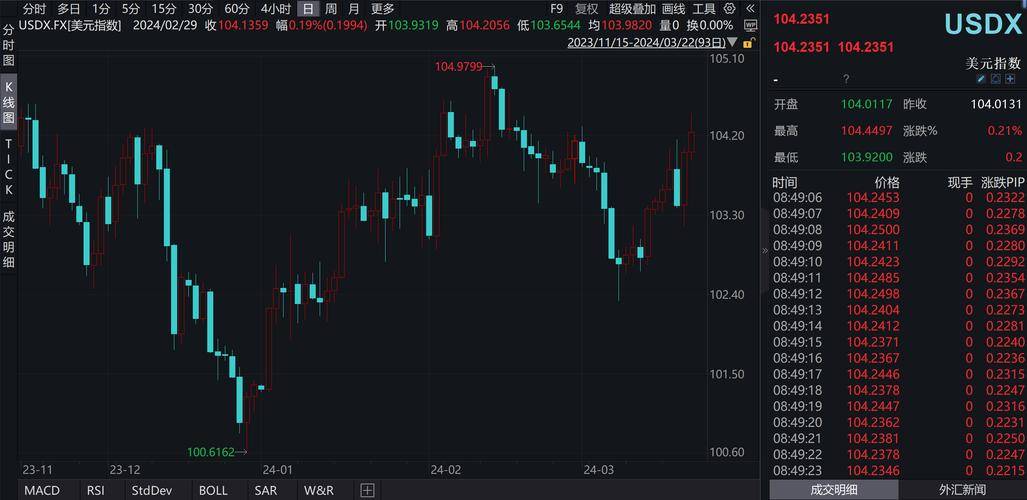
美元指数跌破99关口是近期金融市场的一个重要事件。这一变动背后隐藏着诸多经济因素,也将对全球经济和金融市场带来深远影响,引起广泛 关注和讨论。 走势情况:近期美元指数持续下探,最终跌破了99关口。这一走势并非偶然,是一系列因素交织的结果。从技术层面看,美元指数已出现多日下 跌趋势,市场上看空美元的力量逐步增强。从更宏观角度,它与美国的经济数据表现、货币政策预期等息息相关。 未来展望:美元指数后市走向充满不确定性。若美国经济数据改善、货币政策转向,美元指数可能止跌回升。但如果经济持续疲软,货币政策维 持宽松,美元可能进一步走弱。投资者和企业需密切关注市场动态,做好风险管理。 你认为美元指数未来一段时间会回升还是继续下跌?不妨点赞、分享文章并在评论区交流看法。 汇率市场:美元指数下跌直接影响到各国货币与美元的汇率。一些新兴市场货币趁势反弹,在一定程度上缓解了本币贬值压力。对于进出口企业 而言,这会影响到它们的成本和利润。出口型企业可能因本币升值而面临订单减少的困境,进口型企业则因货币购买力增强而降低采购成本。 商品市场:美元与大宗商品价格通常呈反向关系。随着美元指数跌破99,黄金、原油等大宗商品价格往往会上涨。以 ...

WTO首席经济学家谈关税:到底什么作用?是否影响贸易失衡?
第一财经· 2025-04-12 01:51
2025.04. 12 当地时间11日,WTO首席经济学家奥萨(Ralph Ossa)发表长篇文章对关税进行解释,并对关税同 通胀、汇率以及贸易失衡之间的关系一一作答。 "关税的核心很简单:提高进口商品的国内价格。但关税的影响会以复杂的方式波及整个经济——改 变价格、工资、汇率和贸易模式。当各国政府重新审视这一强有力的杠杆时,了解其中的经济机制就 显得尤为重要。"奥萨表示。 他表示,"在关税重回贸易政策议程之际,在经济学中,关税不仅仅是增加收入或保护国内产业的工 具,它还是一种政策杠杆,具有广泛的、往往是意想不到的后果。" 奥萨称,"它们在短期内的吸引力可能会掩盖其对通货膨胀、竞争力和国际合作造成的长期代价。在 贸易紧张局势日益加剧的今天,清醒地看待这些利弊得失比以往任何时候都更加重要。" 近期,世贸组织(WTO)发布声明称,最近(美方)一系列政策宣布将对全球贸易和经济增长前景 产生重大影响。WTO初步分析表明,"目前的措施,加上今年年初以来出台的措施,可能导致今年全 球商品贸易量整体萎缩约1%,较之前预测下调近四个百分点。" 本文字数:2267,阅读时长大约4分钟 导读 :当前一个热门问题是关税是否会影响贸 ...
3月外汇储备数据传递的信号:贸易环境是短期影响汇率的核心因素
ZHESHANG SECURITIES· 2025-04-08 12:58
Group 1: Foreign Exchange Reserves - In March, China's official foreign exchange reserves reached $32,406.65 billion, an increase of $13.441 billion month-on-month, primarily driven by exchange rate factors[1] - The positive contribution from exchange rates was significant, with the dollar index declining by 3.13% from the end of February, impacting reserves positively by approximately $60.625 billion[2] - The valuation effect negatively impacted reserves by about $4.73 billion due to falling European bond prices, leading to a net effect of approximately $55.901 billion on reserves[2] Group 2: Trade Environment and Currency Fluctuations - The short-term trade environment is identified as a core factor influencing exchange rates, with expectations of increased two-way volatility[3] - If trade tensions escalate with other major countries, they may devalue their currencies against the dollar, which could lead to a passive appreciation of the RMB[3] - Conversely, if major countries make concessions in trade negotiations, external pressures on China may increase, expanding the depreciation space for the RMB[3] Group 3: Gold Reserves - As of the end of March, gold reserves stood at 7.37 million ounces, marking the fifth consecutive month of increases[4] - Gold reserves now account for 6.4% of total foreign exchange reserves, with expectations for further increases in this ratio[4] - Short-term outlook suggests a potential slight decline in gold prices due to unmet U.S. gold tariff expectations, but a long-term forecast predicts new highs by 2025 driven by central bank purchases[4]
国泰君安期货黑色与建材原木周度报告-2025-04-06
Guo Tai Jun An Qi Huo· 2025-04-06 09:33
Report Summary Investment Rating The report does not provide an investment rating for the industry. Core Viewpoints The report analyzes the supply, demand, inventory, and price trends of logs in the market. It shows that the supply of New Zealand logs is relatively stable, with a certain number of ships departing and arriving in March and April. The demand in some ports has increased slightly, while the overall inventory has decreased slightly. The spot prices of some log varieties have declined, and the shipping and exchange rate factors have also shown certain fluctuations. Section Summaries 1. Overview - **Spot price trends**: For the mainstream deliverable 3.9 - meter 30 + radiata pine, the Shandong market quoted 790 yuan/cubic meter, unchanged from last week, and the Jiangsu market quoted 785 yuan/cubic meter, down 20 yuan/cubic meter from last week. Other varieties also showed different price changes [4]. - **Supply**: As of March 30, there were 51 ships departing from New Zealand in March, 44 of which were bound for China and 7 for South Korea with reduced loads. It is estimated that 1870,000 cubic meters will arrive in March [4][7]. - **Demand and inventory**: As of the week of March 28, the daily average shipment volume of Lanshan Port was 2.39 million cubic meters (a week - on - week increase of 0.23 million cubic meters), and that of Taicang Port was 1.49 million cubic meters (a week - on - week increase of 0.19 million cubic meters). The total inventory of the four major ports was 2.5006 billion cubic meters, a slight decrease of 2.76 million cubic meters from the previous week [5][12]. - **Other factors**: The Baltic Dry Index fell again this week. As of the week of April 4, the BDI recorded 1489 points, down 113 points (-7.1%) from last week. The exchange rate of the US dollar against the RMB and the New Zealand dollar also changed [5][56]. 2. Supply - As of March 30, 51 ships departed from New Zealand in March, with 44 going to China and 7 to South Korea with reduced loads. It is estimated that 21 ships will arrive in March and 30 in April, with an expected arrival volume of 1.87 million cubic meters in March. A detailed list of ship schedules is provided [7]. 3. Demand and Inventory - **Demand**: As of the week of March 28, the daily average shipment volume of Lanshan Port was 2.39 million cubic meters (a week - on - week increase of 0.23 million cubic meters), and that of Taicang Port was 1.49 million cubic meters (a week - on - week increase of 0.19 million cubic meters) [5][12]. - **Inventory**: The inventory of Lanshan Port was about 1.2748 billion cubic meters (a week - on - week increase of 2.2 million cubic meters, +1.8%), Taicang Port was about 606,400 cubic meters (a week - on - week decrease of 50,000 cubic meters, -0.08%), Xinminzhou was about 329,500 cubic meters (a week - on - week decrease of 505,000 cubic meters), and Jiangdu Port was about 289,900 cubic meters (a week - on - week increase of 140,000 cubic meters). The total inventory of the four major ports decreased slightly [5][12]. 4. Market Trends - As of April 3, the closing price of the main contract LG2507 was 829 yuan/cubic meter, down 0.5% from last week. The market continued to fluctuate weakly, and the fundamentals maintained a weak supply - demand pattern. The monthly spreads tended to narrow [15]. 5. Price and Spreads - **Spot price**: The prices of various log varieties in Shandong and Jiangsu markets showed different degrees of decline compared with previous periods [19][21]. - **Regional spreads**: The report shows the price spreads of different log varieties between Shandong and Jiangsu regions through charts [22][23][29]. - **Species and specification spreads**: The price spreads between different species and specifications of logs in the Shandong market are presented [41][43][45]. 6. Other - **Shipping and exchange rates**: The Baltic Dry Index fell, and the exchange rates of the US dollar against the RMB and the New Zealand dollar changed. The shipping and exchange rate factors are presented in a table [55][56].
