
金融强国

Search documents
喜娜AI速递:昨夜今晨财经热点要闻|2025年12月4日
Xin Lang Cai Jing· 2025-12-03 22:13
Group 1 - The EU plans to ban Russian natural gas imports by the fall of 2027, aiming to enhance energy security and reshape the global energy landscape [2][7] - The successful launch of the Zhuque-3 rocket by Blue Arrow Aerospace marks a significant advancement in China's commercial space sector, despite a setback in the rocket's recovery process [2][7] - The Chinese government emphasizes the goal of building a financial powerhouse, focusing on six core elements and the establishment of a modern financial system [2][7] Group 2 - The State Council approved the Yangtze River Delta land use plan for 2023-2035, which aims to optimize spatial layout and promote high-quality regional development [3][8] - Nationwide measures are being implemented to stabilize the real estate market, including legal penalties for negative commentary and incentives for homebuyers [3][8] - The cryptocurrency market has shown signs of stabilization after recent volatility, with a shift in trader sentiment towards optimism [9] Group 3 - The Indian rupee has fallen against the dollar, and the stock market has declined due to the lack of a trade agreement with the U.S., leading to increased trade deficits [4][9] - Wanlong Optoelectronics is planning a significant asset restructuring to acquire control of Zhongkong Information, which could enhance its competitive position in the smart transportation sector [4][9] - Foreign investment banks are optimistic about the A-share market in 2026, with expected earnings growth revisions and target index increases [4][9] Group 4 - U.S. Treasury yields have retreated, impacting the dollar and gold prices, with market participants awaiting key employment data to gauge economic conditions [5][10]
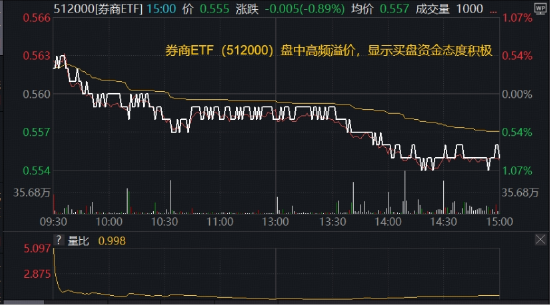
年线失而复得,买点已现?顶流券商ETF(512000)放量溢价,近4日“暴力吸金”8.5亿元,领跑同类!
Xin Lang Cai Jing· 2025-12-03 12:03
Core Viewpoint - The brokerage sector is experiencing a downturn, with the brokerage ETF (512000) showing a decline and underperforming compared to major indices, despite some positive fundamentals in the industry [1][5][7]. Group 1: Market Performance - On December 3, major indices collectively fell, with the brokerage sector opening high but closing lower, resulting in most brokerage stocks in the red [1][10]. - The brokerage ETF (512000) closed down 0.89%, with a trading volume of 870 million yuan, indicating increased market activity despite the price drop [1][10]. - Year-to-date, the brokerage sector has underperformed, with the brokerage ETF tracking a cumulative decline of 1.74%, ranking second to last among all Shenwan first-level industries [5][14]. Group 2: Fund Flows and Investor Sentiment - The brokerage ETF (512000) saw a net inflow of 250 million yuan yesterday, with a total of 850 million yuan in net inflows over the past four days, leading among 14 similar ETFs [5][14]. - The current market focus on short-term trading pressures may overlook the significant recovery in various brokerage business areas, including investment banking and asset management [7][15]. Group 3: Industry Fundamentals - The third-quarter report indicates that the 49 listed brokerages in the index achieved revenue of 428.2 billion yuan, a year-on-year increase of 41.62%, and a net profit of 182.5 billion yuan, up 61.6% [7][16]. - The current price-to-book ratio (PB) for the index is 1.45, which is at a low point historically, suggesting potential for valuation recovery [7][16]. - The brokerage industry is undergoing significant supply-side reforms and functional transformations, with a clearer market structure emerging between leading and smaller brokerages [7][16]. Group 4: Future Outlook - Analysts suggest that the brokerage sector's valuation is reasonable but still low, indicating potential for growth in profitability and valuation in the future [7][16]. - Policies aimed at stabilizing growth and the stock market are expected to positively influence the brokerage sector, with an optimistic outlook for fundamental improvements [8][16]. - The brokerage ETF (512000) is highlighted as an efficient investment tool, providing exposure to both leading and smaller brokerages, with its fund size surpassing 40 billion yuan for the first time [8][17].

建设金融强国最新部署
清华金融评论· 2025-12-03 02:02
Core Viewpoint - The article emphasizes the importance of accelerating the construction of a financial power as a strategic goal set by the Chinese government, which is essential for achieving high-quality development and ensuring financial security during the 14th Five-Year Plan period [4][5][6]. Group 1: Significance of Building a Financial Power - Accelerating the construction of a financial power is crucial for the comprehensive modernization of the socialist state, as finance is the lifeblood of the national economy and a key component of national competitiveness [5]. - The construction of a financial power is necessary for promoting high-quality development, which is the primary task during the 14th Five-Year Plan period [6]. - Financial security is integral to national security, and the absence of a financial crisis in China over the past four decades has contributed significantly to economic growth and social stability [7]. Group 2: Theoretical and Practical Requirements - Building a financial power is a pioneering endeavor that requires a systematic, innovative, and practical approach, guided by Xi Jinping's thoughts on socialism with Chinese characteristics [8]. - Six key financial elements are essential for a financial power, including a strong currency, a robust central bank, powerful financial institutions, an international financial center, effective financial regulation, and a talented workforce [8]. - The path to building a financial power must align with China's unique characteristics and adhere to the principles established by the Communist Party [9]. Group 3: Key Tasks and Measures - Continuous improvement of the central bank system is necessary, including the establishment of a dual-pillar monetary policy framework and a comprehensive macro-prudential management system [12]. - Financial services must be enhanced to support major strategies and key areas, such as technological self-reliance and green transformation [13]. - The development of a healthy and stable capital market is essential, focusing on inclusivity and adaptability to new industries and technologies [14]. - Financial institutions and infrastructure must be optimized to ensure effective service to the real economy and enhance governance [15]. - The construction of an international financial center, particularly in Shanghai, is a priority to enhance global competitiveness [16]. - Regulatory capabilities must be improved to ensure comprehensive oversight of financial activities and enhance risk management [17]. - Strengthening financial legal frameworks is crucial to maintain national financial security and ensure compliance with laws [18].

锚定金融强国目标 以证券力量护航“十五五”高质量发展 访中信建投证券股份有限公司党委副书记、总经理金剑华
Jin Rong Shi Bao· 2025-12-03 02:02
"十五五"时期是基本实现社会主义现代化的关键时期。随着党的二十届四中全会审议通过"十五五"规划 建议,清晰的战略路径已然铺就。在这一历史进程中,金融血脉如何更精准地服务实体经济,资本市场 如何更高效地赋能新质生产力,成为关系全局的重要议题。 在战略方向上,"十五五"规划建议提出"加快建设金融强国",证券行业需立足资本市场枢纽定位,推动 科技、资本与产业高效循环,为实体经济提供更加精准有效的金融服务。 "截至2025年10月末,中信建投(601066)证券累计服务国家级专精特新及制造业单项冠军企业超2100 家,'小巨人'IPO保荐数量稳居市场前列,北交所IPO保荐数量及承销金额持续领先。未来,我们还将继 续加大投入,为新质生产力发展贡献更大力量。"正值中信建投证券股份有限公司(以下简称"中信建投 证券")成立20周年之际,《金融时报》独家专访了中信建投证券股份有限公司党委副书记、总经理金 剑华。这份服务科技创新的高质量"成绩单",是中信建投证券过往成果的总概括,也是未来继续深耕科 创金融、服务国家战略决心的体现。 在功能定位上,"十五五"规划建议提出"积极发展股权、债券等直接融资,稳步发展期货、衍生品和资 产 ...

奋楫“十五五”,资本与国策共创
Sou Hu Cai Jing· 2025-12-03 01:52
Core Insights - The focus of national development is shifting from "quantitative recovery" post-pandemic to "qualitative leap" in the "15th Five-Year Plan" [1] - The "15th Five-Year Plan" emphasizes "high-level technological self-reliance" and aims for a dual goal of "effective qualitative improvement and reasonable quantitative growth" [5][11] Group 1: Economic and Industrial Strategy - The national strategy is entering a new cycle centered on innovation efficiency, industrial structure, and regional collaboration, marking a shift from "policy following" to "system co-creation" [4] - The plan aims to build a modern industrial system with advanced manufacturing as the backbone, focusing on future industries like quantum technology, biomanufacturing, and hydrogen energy [11] - The transition from "incremental manufacturing" to "efficiency manufacturing" indicates a shift in focus from merely increasing production to optimizing resource allocation [12] Group 2: Investment Opportunities - Hard technology investment, including semiconductors and advanced materials, is positioned as a foundational logic for "systematic breakthroughs" [10] - Investment institutions are encouraged to engage in pre-financing and result transformation for national technology tasks, fostering capital co-creation [10] - The emphasis on "entrepreneurial investment + risk-sharing mechanisms" presents opportunities for investment firms to participate in national innovation initiatives [10] Group 3: Green Development - The "15th Five-Year Plan" elevates green development from a secondary goal to a structural institution, influencing all industrial allocations [17] - The integration of green issues into financial and market mechanisms signifies a shift in perspective, making green development a capital issue [17] - Sustainable investment opportunities in green infrastructure and carbon asset management are expected to grow [20] Group 4: Consumer and Market Dynamics - The plan positions consumption upgrade as a core driver of economic structural transformation, moving from recovery to quality enhancement [22] - The "silver economy" is recognized as a significant industrial opportunity, transforming aging issues into growth engines [22][25] - Investment opportunities in healthcare, elder care, and technology-assisted living are anticipated to rise due to demographic shifts [25] Group 5: Regional Development - The focus of regional policy is shifting from "development gradient" to "structural coordination," promoting a unified market and efficient resource allocation [27] - Investment institutions are encouraged to collaborate with local guiding funds to strengthen project foundations and facilitate new industry development in less developed regions [30] Group 6: Financial Market Reforms - The "15th Five-Year Plan" emphasizes structural improvements in capital markets, transitioning from a focus on financing to a comprehensive investment-funding-exit cycle [32] - Direct investment institutions are identified as key players in building a strong financial nation, with multiple exit pathways being developed [35] - The plan aims to enhance the inclusivity and adaptability of capital market systems, promoting direct financing methods [31] Strategic Summary - The "15th Five-Year Plan" outlines new engines for China's economic growth, including technological innovation and green transformation, while establishing a more inclusive capital market system [36] - Investment institutions are encouraged to align their strategies with national planning, leveraging professional judgment to identify promising sectors and companies for investment [36]

锚定金融强国目标 以证券力量护航“十五五”高质量发展
Jin Rong Shi Bao· 2025-12-03 01:24
"十五五"时期是基本实现社会主义现代化的关键时期。随着党的二十届四中全会审议通过"十五 五"规划建议,清晰的战略路径已然铺就。在这一历史进程中,金融血脉如何更精准地服务实体经济, 资本市场如何更高效地赋能新质生产力,成为关系全局的重要议题。 "截至2025年10月末,中信建投证券累计服务国家级专精特新及制造业单项冠军企业超2100家,'小 巨人'IPO保荐数量稳居市场前列,北交所IPO保荐数量及承销金额持续领先。未来,我们还将继续加大 投入,为新质生产力发展贡献更大力量。"正值中信建投证券股份有限公司(以下简称"中信建投证 券")成立20周年之际,《金融时报》独家专访了中信建投证券股份有限公司党委副书记、总经理金剑 华。这份服务科技创新的高质量"成绩单",是中信建投证券过往成果的总概括,也是未来继续深耕科创 金融、服务国家战略决心的体现。 围绕证券行业如何理解并践行"十五五"规划建议的战略指引,在加快建设金融强国的目标下证券公 司如何找准定位并系统发力,以及服务新质生产力将如何重塑行业发展模式、核心能力与价值创造方式 等关键问题,金剑华对记者系统阐述了他的思考。 《金融时报》记者:结合当前国内外发展环境,您认 ...

中央金融办副主任王江在人民日报撰文:加快建设金融强国
Ren Min Ri Bao· 2025-12-03 00:06
Core Viewpoint - The construction of a financial power is a strategic goal set by the Chinese government, emphasizing the importance of a robust financial system for national modernization and development [1][2]. Group 1: Significance of Building a Financial Power - Accelerating the construction of a financial power is crucial for achieving socialist modernization and national rejuvenation, as finance is integral to the economy and national competitiveness [2]. - The development of a financial power is essential for promoting high-quality development, which is a key theme for the "14th Five-Year Plan" period [3]. - Financial security is a vital component of national security, and building a financial power is necessary to mitigate risks and ensure long-term stability [4]. Group 2: Theoretical and Practical Requirements - The construction of a financial power is characterized by six key financial elements, including a strong currency, central bank, financial institutions, international financial center, regulatory framework, and talent pool [5]. - The path to building a financial power must align with China's unique conditions and follow the principles established by the Communist Party [6][7]. - Establishing a modern financial system is a critical task, requiring a comprehensive approach to financial regulation, market structure, and product diversity [8]. Group 3: Key Tasks and Measures for the "14th Five-Year Plan" - Continuous improvement of the central bank system is necessary, focusing on a dual-pillar framework for monetary and macro-prudential policies [9]. - Financial services must be enhanced to support major strategies and sectors, including technology independence and rural revitalization [10]. - Promoting the healthy development of capital markets is essential, with a focus on long-term investment and support for innovative industries [11]. - Optimizing the financial institution and infrastructure system is crucial for effective service to the real economy [12]. - Accelerating the establishment of an international financial center, particularly in Shanghai, is a priority for enhancing global competitiveness [13]. - Strengthening financial regulatory capabilities is vital for comprehensive oversight and risk management [14].
中央金融办:加快建设金融强国 促进资本市场健康稳定发展
Ren Min Ri Bao· 2025-12-02 23:29
Core Viewpoint - The construction of a financial power is a strategic goal set by the Chinese government, emphasizing the importance of a robust financial system for national modernization and economic development [1][2]. Group 1: Significance of Building a Financial Power - Accelerating the construction of a financial power is crucial for achieving socialist modernization and national rejuvenation, as finance is integral to the economy and national competitiveness [2]. - The development of a financial power is essential for promoting high-quality development, requiring a supportive financial environment and services for key strategic areas [3]. - Financial security is a vital component of national security, necessitating the enhancement of financial strength and risk management capabilities to prevent systemic risks [4]. Group 2: Theoretical and Practical Requirements - Building a financial power is characterized by six key financial elements, including a strong currency, central bank, financial institutions, international financial center, regulatory framework, and talent pool [5]. - The path to a financial power must align with China's unique characteristics, emphasizing the need for a financial system that reflects national conditions and diverges from Western models [6]. - Constructing a modern financial system involves multiple tasks, including financial regulation, market structure, institutional frameworks, and product diversity, requiring a systematic approach [7]. Group 3: Key Tasks and Measures for the 14th Five-Year Plan - Continuous improvement of the central bank system is necessary, focusing on a dual-pillar framework for monetary and macro-prudential policies to ensure liquidity and economic stability [8]. - Financial services must align with the strategic needs of high-quality development, enhancing support for technology innovation and sustainable finance [9]. - Promoting the healthy development of capital markets is essential, with a focus on inclusivity and adaptability to new industries and technologies [10]. - Optimizing the financial institution and infrastructure system is critical, ensuring that institutions focus on their core missions and effectively serve the real economy [11]. - Accelerating the construction of an international financial center, particularly in Shanghai, is a priority to enhance global competitiveness and facilitate cross-border transactions [12]. - Strengthening financial regulatory capabilities is vital, ensuring comprehensive oversight and early risk detection mechanisms [13]. - Enhancing financial legal frameworks is necessary to support the development of the financial sector and ensure compliance with regulations [14].
人民日报:加快建设金融强国
Ren Min Ri Bao· 2025-12-02 23:27
Core Viewpoint - The article emphasizes the importance of accelerating the construction of a financial power as a strategic goal set by the Chinese government, which is essential for achieving high-quality financial development and supporting the overall modernization of the country [1][15]. Group 1: Significance of Building a Financial Power - Accelerating the construction of a financial power is crucial for the comprehensive modernization of the socialist country, as finance is the lifeblood of the national economy and a key component of national competitiveness [2][16]. - The construction of a financial power is necessary for promoting high-quality development, which is the primary task during the "14th Five-Year Plan" period [3][17]. - Financial security is integral to national security, and the absence of financial crises in China over the past 40 years highlights the importance of a robust financial system [4][18]. Group 2: Theoretical and Practical Requirements - Building a financial power is a pioneering endeavor that requires a systematic, innovative, and practical approach, guided by Xi Jinping's thoughts on socialism with Chinese characteristics [5][19]. - Six key financial elements are essential for a financial power, including a strong currency, a powerful central bank, robust financial institutions, an international financial center, effective financial regulation, and a talented workforce [6][19]. - The path to building a financial power must align with China's unique characteristics and experiences, distinguishing it from Western financial models [7][20]. Group 3: Key Tasks and Measures - Continuous improvement of the central bank system is necessary, including a dual-pillar framework for monetary policy and macro-prudential management [9][23]. - Financial services must be enhanced to support major strategies, key areas, and weak links, particularly in technology independence and green transformation [10][24]. - The health and stability of capital markets must be promoted by improving institutional inclusiveness and adaptability to new industries and technologies [11][25]. - Financial institutions and infrastructure must be optimized to ensure effective service to the real economy and enhance governance [12][26]. - The construction of an international financial center in Shanghai should be accelerated, enhancing its global competitiveness and supporting the development of a cross-border payment system [13][27]. - Financial regulatory capabilities must be improved to ensure comprehensive oversight and early risk detection [14][28].
深入学习贯彻四中全会精神 在新征程上展现期货行业新担当
Qi Huo Ri Bao Wang· 2025-12-02 15:19
Core Viewpoint - The 20th Central Committee's Fourth Plenary Session emphasizes the importance of strengthening the financial sector as part of China's modernization and national rejuvenation strategy, with a focus on the development of the futures market as a key component of the modern financial system [1][2]. Group 1: Strategic Planning and Development Goals - The "15th Five-Year Plan" outlines strategic goals for China's development, aiming to reach the level of a moderately developed country by 2035, with a focus on building a modern industrial system and promoting high-level technological self-reliance [3][4]. - The plan highlights the need for steady development of futures, derivatives, and asset securitization, positioning the futures market as integral to national strategy and future economic stability [3][7]. Group 2: Role of Futures Market in Economic Stability - The futures market is recognized for its role in price discovery, risk management, and resource allocation, which are essential for supporting the real economy amid complex external challenges [4][5]. - Macro-yuan Futures aims to enhance service quality in futures and derivatives, contributing to the stability of the real economy and the construction of a financial powerhouse [2][5]. Group 3: Innovation and Service Models - Macro-yuan Futures has developed a unique service model that integrates standardized systems, professional manuals, and scenario-based applications, enhancing client service and risk management capabilities [5][6]. - The company actively promotes the use of futures and options among small and medium-sized enterprises, providing risk management services and reducing transaction fees significantly [5][6]. Group 4: Compliance and Risk Management - The "15th Five-Year Plan" calls for comprehensive financial regulation and risk management, emphasizing the need for futures companies to strengthen compliance and risk management frameworks [9]. - Futures companies are encouraged to embed risk management tools into key operational processes of enterprises, enhancing their ability to manage market price fluctuations effectively [9].