
智能家居

Search documents
小米集团发布2025年第三季度财报:净利大增超80%,汽车业务首次实现单季盈利
Xin Hua Wang· 2025-11-19 07:11
Core Viewpoint - Xiaomi Group continues to demonstrate strong growth in Q3 2025, with significant increases in revenue and net profit, marking a historic high for the company [1][2]. Financial Performance - Q3 revenue reached 113.1 billion yuan, a year-on-year increase of 22.3%, marking the fourth consecutive quarter exceeding 100 billion yuan [1]. - Adjusted net profit for the quarter was 11.3 billion yuan, a substantial year-on-year increase of 80.9%, achieving a historic high [1]. Automotive and New Business Growth - Xiaomi's automotive division achieved profitability for the first time in a single quarter, delivering over 100,000 new vehicles and generating an operating profit of 700 million yuan [2]. - The smartphone and AIoT segment generated revenue of 84.1 billion yuan, with smartphone revenue at 46 billion yuan and IoT and lifestyle products revenue at 27.6 billion yuan, reflecting a year-on-year growth of 5.6% [2]. Smartphone Market Performance - Xiaomi's global smartphone shipment reached 43.3 million units in Q3, marking nine consecutive quarters of year-on-year growth [3]. - The company aims for a total smartphone shipment target of 170 million units in 2025 [3]. R&D Investment and Innovation - R&D investment in the first three quarters reached 23.5 billion yuan, with Q3 investment alone at 9.1 billion yuan, a year-on-year increase of 52.1%, setting a new record [4]. - Xiaomi launched the Xiaomi-MiMo-Audio voice open-source model and upgraded its operating system to enhance user experience across its ecosystem [4]. Manufacturing and Production Capacity - The completion of the smart home appliance factory in Wuhan enhances Xiaomi's manufacturing capabilities, supporting high-end product production with a planned annual capacity of 7 million air conditioners [5]. - Xiaomi has established a comprehensive smart manufacturing system covering smartphones, automobiles, and smart home appliances, solidifying its leading position in the smart manufacturing sector [5].

力鼎光电跌2.00%,成交额2930.86万元,主力资金净流入3.43万元
Xin Lang Cai Jing· 2025-11-19 06:07
Core Viewpoint - The stock of Liding Optoelectronics has experienced fluctuations, with a year-to-date increase of 53.66% but a recent decline in the short term, indicating potential volatility in the market [1][2]. Financial Performance - For the period from January to September 2025, Liding Optoelectronics achieved a revenue of 617 million yuan, representing a year-on-year growth of 35.63% [2]. - The net profit attributable to the parent company for the same period was 216 million yuan, showing an impressive year-on-year increase of 86.62% [2]. Stock Market Activity - As of November 19, Liding Optoelectronics' stock price was 26.43 yuan per share, with a market capitalization of 10.854 billion yuan [1]. - The stock has seen a trading volume of 29.3086 million yuan on the same day, with a turnover rate of 0.27% [1]. - The company has appeared on the "Dragon and Tiger List" six times this year, with the most recent occurrence on July 21 [1]. Shareholder Information - As of September 30, 2025, the number of shareholders for Liding Optoelectronics increased by 27.75% to 14,300 [2]. - The average number of circulating shares per shareholder decreased by 21.73% to 28,503 shares [2]. - The top ten circulating shareholders include Hong Kong Central Clearing Limited, which increased its holdings by 6.2441 million shares [3]. Dividend Distribution - Since its A-share listing, Liding Optoelectronics has distributed a total of 548 million yuan in dividends, with 438 million yuan distributed over the past three years [3].

协创数据跌2.01%,成交额6.58亿元,主力资金净流出429.79万元
Xin Lang Cai Jing· 2025-11-19 05:49
Core Viewpoint - The stock of Xiechuang Data has experienced fluctuations, with a year-to-date increase of 89.57% but a recent decline in the last five and twenty trading days [1] Company Overview - Xiechuang Data Technology Co., Ltd. is located in Shenzhen, Guangdong, and was established on November 18, 2005, with its IPO on July 27, 2020 [1] - The company specializes in the research, production, and sales of IoT smart terminals and data storage devices, continuously adapting to technological changes and market trends [1] - The revenue composition includes: data storage devices (37.11%), intelligent computing products and services (24.69%), IoT smart terminals (17.70%), server and peripheral remanufacturing (16.88%), and others (3.62%) [1] Financial Performance - For the period from January to September 2025, Xiechuang Data achieved a revenue of 8.331 billion yuan, representing a year-on-year growth of 54.43%, and a net profit attributable to shareholders of 698 million yuan, up 25.30% year-on-year [2] - The company has distributed a total of 139 million yuan in dividends since its A-share listing, with 114 million yuan distributed over the past three years [2] Shareholder Structure - As of September 30, 2025, the number of shareholders increased by 19.23% to 35,000, while the average circulating shares per person decreased by 15.75% to 9,830 shares [2] - Major shareholders include Hong Kong Central Clearing Limited, which increased its holdings by 3.1041 million shares, and E Fund's ChiNext ETF, which decreased its holdings by 734,900 shares [3]

好太太跌2.02%,成交额2934.47万元,主力资金净流出156.27万元
Xin Lang Zheng Quan· 2025-11-19 05:30
Core Viewpoint - The stock of Guangdong Haotaitai Technology Group Co., Ltd. has experienced fluctuations, with a recent decline in share price and significant changes in trading volume and shareholder structure [1][2]. Group 1: Stock Performance - On November 19, the stock price of Haotaitai dropped by 2.02%, reaching 19.84 CNY per share, with a trading volume of 29.34 million CNY and a turnover rate of 0.36%, resulting in a total market capitalization of 7.98 billion CNY [1]. - Year-to-date, the stock has increased by 22.02%, but it has seen declines of 2.94% over the last five trading days, 8.78% over the last 20 days, and 11.23% over the last 60 days [1]. - The company has appeared on the "Dragon and Tiger List" five times this year, with the most recent appearance on September 29, where it recorded a net buy of -34.11 million CNY [1]. Group 2: Company Overview - Haotaitai, established on January 5, 2005, and listed on December 1, 2017, is located in Guangzhou, China, focusing on the research, manufacturing, and sales of smart drying and security products [2]. - The main revenue composition includes smart home products (84.03%), drying racks (10.73%), and other products (5.24%) [2]. - The company belongs to the light industry manufacturing sector, specifically in home products, and is associated with concepts such as C2M, small-cap stocks, artificial intelligence, and smart home technology [2]. Group 3: Financial Performance - For the period from January to September 2025, Haotaitai reported operating revenue of 1.059 billion CNY, a year-on-year decrease of 0.91%, and a net profit attributable to shareholders of 143 million CNY, down 24.79% year-on-year [2]. - The company has distributed a total of 745 million CNY in dividends since its A-share listing, with 282 million CNY distributed over the past three years [3]. - As of September 30, 2025, the number of shareholders increased by 72.90% to 12,700, while the average circulating shares per person decreased by 42.16% to 31,778 shares [2][3].

万和电气跌2.01%,成交额1637.54万元,主力资金净流出134.59万元
Xin Lang Cai Jing· 2025-11-19 02:06
Core Viewpoint - Wanhe Electric's stock price has experienced fluctuations, with a recent decline of 2.01% and a year-to-date increase of 12.61% [1][2]. Group 1: Stock Performance - As of November 19, Wanhe Electric's stock price is 11.24 yuan per share, with a market capitalization of 8.358 billion yuan [1]. - The stock has seen a decline of 2.68% over the last five trading days, 5.55% over the last 20 days, and 10.94% over the last 60 days [2]. Group 2: Financial Performance - For the period from January to September 2025, Wanhe Electric achieved a revenue of 5.524 billion yuan, representing a year-on-year growth of 5.54%, and a net profit attributable to shareholders of 479 million yuan, also reflecting a growth of 5.57% [2]. - The company has distributed a total of 3.205 billion yuan in dividends since its A-share listing, with 932 million yuan distributed over the last three years [3]. Group 3: Shareholder Information - As of September 30, 2025, the number of shareholders for Wanhe Electric is 18,900, an increase of 20.40% from the previous period, with an average of 34,968 circulating shares per shareholder, a decrease of 16.95% [2]. - The top ten circulating shareholders include notable entities such as Hong Kong Central Clearing Limited and Chuangjin Hexin Zhongzheng Dividend Low Volatility Index A, with changes in their holdings noted [3].

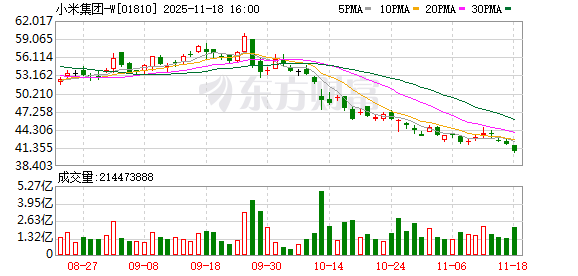
小米前三季度经调净利已超去年总额 汽车业务首季盈利
Xin Jing Bao· 2025-11-18 12:57
Core Insights - Xiaomi Group reported Q3 revenue of 113.1 billion yuan, a year-on-year increase of 22.3%, marking the fourth consecutive quarter of exceeding 100 billion yuan [2] - Adjusted net profit reached 11.3 billion yuan, up 80.9% year-on-year, setting a new historical high [2] - The smart electric vehicle and AI innovation business segment generated revenue of 29 billion yuan, with a year-on-year increase of over 199% [2] Financial Performance - For the first three quarters, total revenue reached 340.4 billion yuan, nearing last year's total, with adjusted net profit of 32.8 billion yuan, surpassing last year's total [3] - Smartphone business showed steady growth with global shipments of 43.3 million units, achieving year-on-year growth for nine consecutive quarters [3] - Internet services revenue in Q3 was 9.4 billion yuan, a year-on-year increase of 10.8%, with a gross margin of 76.9% [5] Business Segments - The smartphone and AIoT segment generated revenue of 84.1 billion yuan, with smartphone revenue at 46 billion yuan [3] - The IoT and lifestyle consumer products segment grew steadily, with Q3 revenue of 27.6 billion yuan, a year-on-year increase of 5.6% [3] - Xiaomi's AIoT platform connected over 1 billion IoT devices, with users having five or more connected devices reaching 21.6 million, a year-on-year increase of 26.1% [3] Electric Vehicle Development - Xiaomi's electric vehicle segment achieved significant breakthroughs, with Q3 revenue reaching 29 billion yuan [6] - The first SUV model, Xiaomi YU7, launched on June 26, received over 200,000 pre-orders within three minutes [6] - In Q3, Xiaomi delivered over 100,000 vehicles, setting a new quarterly record, with total deliveries exceeding 260,000 units for the year [7] R&D Investment - Xiaomi's R&D investment for the first three quarters reached 23.5 billion yuan, with Q3 investment at 9.1 billion yuan, a year-on-year increase of 52.1% [8] - The company aims to invest over 30 billion yuan in R&D this year, focusing on core technologies such as chips and systems to build competitive barriers [8]

卢伟冰:预计明年小米汽车毛利率可能较今年有所下滑
Feng Huang Wang· 2025-11-18 11:58
Core Viewpoint - Xiaomi's recent performance shows significant growth in smartphone sales and IoT revenue, while also highlighting challenges in the automotive sector due to market competition and policy changes [1] Smartphone Sales - Xiaomi's 17 series achieved over 1 million units sold within 5 days of launch, with cumulative sales exceeding 2 million by early November, indicating a faster sales pace compared to the previous generation [1] - During the Double Eleven shopping festival, the Xiaomi 17 Pro Max became the best-selling smartphone in both sales volume and revenue in the price segment above 6000 yuan, being the only domestic model competing with the iPhone [1] IoT Business - In Q3, Xiaomi's IoT revenue reached 27.6 billion yuan, marking a year-on-year growth of 5.6%, with a gross margin increase to 23.9%, maintaining growth for seven consecutive quarters [1] - The gross margin and average selling price of the home appliance segment have both improved, with the company focusing on innovation rather than price wars to drive demand [1] - Xiaomi's home appliance business has significant overseas potential, having entered Southeast Asia and Europe this year, with plans for further expansion next year [1] AI Initiatives - Over the past year, Xiaomi has released various AI models, including language, multimodal, and voice models, and has open-sourced the smart home exploration project Xiaomi Miloco in November [1] - The total R&D investment for the year has reached 23.5 billion yuan, with one-quarter allocated to AI, exceeding initial expectations [1] Automotive Business - Xiaomi's automotive business is expected to maintain stability in Q4, with a projected annual delivery target of 350,000 vehicles [1] - However, challenges are anticipated in 2026 due to changes in vehicle purchase tax policies and increased market competition, with expectations of a decline in automotive gross margins next year compared to this year [1]
小米集团(01810) - 2025 Q3 - 电话会议演示
2025-11-18 11:30
Financial Performance - Group revenue reached RMB 113.1 billion, a YoY increase of 22.3%[11] - Gross profit margin increased to 22.9%, up 2.5 percentage points YoY[11] - Adjusted net profit reached RMB 11.3 billion, a significant YoY increase of 80.9%[11] - Smart EV, AI and other new initiatives revenue reached RMB 29.0 billion, a substantial YoY increase of 199.2%[11] Smartphone and AIoT Business - Global smartphone shipments ranked among the top 3 for 21 consecutive quarters, with a market share of 13.6%[14] - Premium smartphone sales in Chinese Mainland increased to 24.1% of total smartphone units sold, a YoY increase of 4.1 percentage points[14] - IoT and lifestyle products revenue reached RMB 27.6 billion, up 5.6% YoY[85] Smart EV Initiatives - Delivered 108,796 Smart Electric Vehicles, representing a YoY increase of 173.4%[18] - Smart EV sales revenue reached RMB 28.3 billion, up 197.9% YoY[89] User Growth and AI - Global MAU reached 741.7 million[21] - Number of connected devices reached 1,035.5 million[26] R&D Investment - R&D expenses reached RMB 9.1 billion in Q3 2025[31]
金牌家居涨2.23%,成交额8518.75万元,主力资金净流出92.74万元
Xin Lang Cai Jing· 2025-11-18 05:57
Core Viewpoint - Jinpai Home's stock price has shown a positive trend with a year-to-date increase of 9.06%, indicating a recovery in market sentiment despite a decline in revenue and net profit [2]. Group 1: Stock Performance - On November 18, Jinpai Home's stock rose by 2.23%, reaching 22.49 CNY per share, with a trading volume of 85.19 million CNY and a turnover rate of 2.49%, resulting in a total market capitalization of 3.469 billion CNY [1]. - The stock has increased by 9.33% over the last five trading days, 11.83% over the last 20 days, and 9.07% over the last 60 days [2]. Group 2: Financial Performance - For the period from January to September 2025, Jinpai Home reported a revenue of 2.368 billion CNY, a year-on-year decrease of 2.01%, and a net profit attributable to shareholders of 64.71 million CNY, down 45.87% year-on-year [2]. - The company's main business revenue composition includes: overall kitchen cabinets (52.84%), overall wardrobes (37.73%), wooden doors (8.11%), and others (1.31%) [2]. Group 3: Shareholder and Dividend Information - Since its A-share listing, Jinpai Home has distributed a total of 737 million CNY in dividends, with 299 million CNY distributed over the past three years [3]. - As of September 30, 2025, the number of shareholders decreased by 9.66% to 9,750, while the average circulating shares per person increased by 10.70% to 15,821 shares [2][3].

美国关税成本激增超10倍,沙发出海先锋敏华控股面临利润挑战
Guan Cha Zhe Wang· 2025-11-18 02:25
Core Viewpoint - Despite being an early mover in overseas markets, the parent company of "Chivas" sofas, Minhua Holdings, is experiencing revenue pressure as reflected in its latest semi-annual financial report for the fiscal year 2025/2026, showing a decline in total revenue and challenges from global economic conditions [1] Financial Performance - Total revenue for the first half of the fiscal year reached HKD 8.241 billion, a year-on-year decrease of 2.7% [1] - Gross profit was HKD 3.25 billion, showing a slight decline of 0.91% year-on-year [1] - Net profit increased slightly to HKD 1.206 billion, with a year-on-year growth of approximately 1% despite the revenue decline [1] Market Challenges - The company faces multiple pressures including global economic slowdown, rising trade protectionism, and a slowdown in consumer recovery in China [1] - The domestic market revenue declined by 6% to HKD 4.74 billion, marking the largest drop among all markets [2] - The number of dealer stores decreased to 7,040, a net reduction of 327 stores since March [2] Strategic Adjustments - The reduction in store numbers is expected to improve operational efficiency in the long term, although it may impact short-term sales [2] - The company is adjusting its store layout strategy to enhance foot traffic, conversion rates, and sales [2] - Management believes that the domestic sofa retail market has reached a bottom, with signs of improvement in sales revenue [2] Overseas Market Performance - North America remains a core overseas market, with revenue reaching HKD 2.16 billion, a slight increase of 0.3% [3] - Revenue from other regions including Indonesia, India, Australia, and South Korea grew significantly by 22.6% to HKD 400 million [3] - Overall overseas revenue reached HKD 3.303 billion, an increase from HKD 3.257 billion year-on-year [3] Product Strategy and Innovations - The company has optimized its product structure, enhancing competitiveness in overseas markets through the sale of iron frames and smart furniture components [4] - This segment has high added value and aligns with overseas market trends, helping to offset declines in traditional sofa exports [4] - A subsidiary, Ruimai Technology, is seeking to list on the New Third Board, focusing on the fast-growing segment of functional sofa frames [4] Impact of Tariffs - The imposition of tariffs by the U.S. on Vietnam has significantly increased the cost of exports to the U.S., with tariffs rising from HKD 6.651 million to HKD 78.826 million, a year-on-year increase of 1,085.2% [4] - The share of tariff costs in total revenue has increased from 0.1% to 1%, highlighting the impact of tariff changes on the company's performance [4]
