碳中和

Search documents
绿色甲醇-航运脱碳与低碳原料的双重机遇
2026-01-29 02:43
Summary of Key Points from Conference Call on Green Methanol Industry Overview - The conference call discusses the green methanol industry, particularly its application in the shipping sector driven by IMO and EU policies aimed at significantly reducing carbon emissions by 2030 [1][4][5]. Core Insights and Arguments - **Green Methanol as a Fuel**: Green methanol can reduce carbon emissions by 65% compared to traditional heavy oil over its lifecycle, making it suitable for maritime, road transport, and shipping industries [2]. - **Cost Comparison**: Currently, green methanol vessels are 20% more expensive than traditional heavy oil vessels. However, as carbon prices rise and domestic refueling prices decrease, green methanol's economic viability is expected to improve [6]. - **Production Costs**: Different production methods for green methanol have varying costs. The highest cost method is CO2 capture, exceeding 4,000 RMB/ton, while biomass gasification and other methods range from 3,000 to 3,500 RMB/ton [7]. - **Policy Support**: The current policy environment is favorable for green methanol development, with the IMO aiming for a 40% reduction in carbon intensity and a 20% reduction in total greenhouse gas emissions by 2030 [4][5]. Company-Specific Insights - **CIMC Enric**: The company is highlighted as a key player benefiting from the shipping industry's transition to environmentally friendly solutions, with expected annual net profit increases of 1-2% and a growth rate close to 10% [1][8]. - **Production Capacity**: CIMC Enric has launched a 50,000-ton biomass methanol project with a 90% utilization rate and plans to expand capacity to 350,000-450,000 tons, including projects in Zhanjiang and Hainan [1][9]. - **Hydrogen Business**: The company is expected to enter a growth phase in its hydrogen business starting in 2025, leveraging synergies with its main operations [10]. Additional Important Content - **Investment Recommendations**: Besides CIMC Enric, other companies such as Jiazhe New Energy, China Tianying, FJ Technology, and Goldwind Technology are recommended for their potential in the green methanol sector [13]. - **Cash Flow and Shareholder Returns**: The company has strong cash flow with a dividend payout ratio of around 50%, indicating limited downside risk and significant upside potential [12]. - **Overall Industry Outlook**: The green methanol sector is expected to see increased demand not only for shipping fuel but also for chemical raw materials, supported by strong government backing [14]. This summary encapsulates the critical insights from the conference call regarding the green methanol industry and specific company developments, highlighting both opportunities and challenges in the sector.

逯新红:深化中韩经贸合作共促互利共赢
Jing Ji Ri Bao· 2026-01-29 00:54
Group 1 - The core viewpoint emphasizes the importance of the stable development of China-South Korea relations for the well-being of both nations and regional peace, especially in the context of global economic recovery challenges [1] - China has been South Korea's largest trading partner for 21 consecutive years, with bilateral trade consistently exceeding $300 billion, highlighting the economic complementarity and potential for deeper cooperation [1] - The two countries should enhance practical cooperation in various sectors, such as semiconductors and electric vehicles, to avoid zero-sum thinking and foster collaborative development [1] Group 2 - Emerging fields like artificial intelligence, green industries, and digital economy are identified as key areas for future cooperation between China and South Korea, leveraging each country's strengths [2] - The two nations are encouraged to strengthen policy dialogue and establish joint laboratories or innovation parks to facilitate technological collaboration and joint investment, particularly in green transformation [2] - Continued institutional openness and the implementation of trade agreements like RCEP and the advancement of the China-South Korea Free Trade Agreement are crucial for promoting regional economic integration [2] Group 3 - Both countries bear significant responsibility for maintaining regional peace and stability in Northeast Asia and should work together to uphold the outcomes of World War II and promote genuine multilateralism [3] - There is a call for enhanced cooperation in addressing global challenges such as climate change, public health, and disaster prevention, which can empower broader regional cooperation and development [3]
并购破局 罗曼股份:以AI与算电融合谋新篇
Shang Hai Zheng Quan Bao· 2026-01-29 00:11
Core Viewpoint - Roman Holdings is leveraging strategic acquisitions and technological integration to expand its market presence and embrace AI, aiming for significant growth in the coming years [1] Group 1: Company Strategy and Acquisitions - Roman Holdings has made two key acquisitions to transition into new markets, including the purchase of AIDC for AI computing solutions and Holovis for immersive experience design [1] - The company aims to create synergies between its existing landscape lighting business and the new acquisitions, focusing on "good tracks, good companies, and strong synergy" in its selection process [1] - The acquisition of Holovis has enabled Roman Holdings to penetrate international markets and attract high-quality clients, enhancing its competitive edge [1] Group 2: Integration and Value Creation - The integration phase post-acquisition is crucial for optimizing operations and enhancing competitiveness, with a focus on cost reduction and resource sharing [1] - Roman Holdings employs a dual strategy of respecting the management styles of acquired companies while leveraging its supply chain to reduce operational costs [1] - The company anticipates that the integration of AIDC will enhance its AI applications and optimize its digital entertainment offerings [1] Group 3: Financial Projections and Performance - Roman Holdings projects a profit of 180 million to 200 million yuan in 2025, with a net profit of 50 million to 60 million yuan, marking a turnaround from previous losses [1] - The company is set to fully integrate AIDC into its financial reports, positioning it as a key support for AI application scenarios [1] Group 4: Embracing AI and Future Directions - Roman Holdings plans to fully embrace AI as a core strategy, focusing on two main areas: AI integration in urban tourism and smart city applications, and the synergy between energy and computing [1] - The company aims to build a global operational system and enhance project delivery capabilities, ensuring high-quality project outcomes [1] - The upcoming "15th Five-Year Plan" period will see Roman Holdings accelerate its new energy system construction, providing green energy solutions for data centers and computing facilities [2]

深化中韩经贸合作共促互利共赢
Jing Ji Ri Bao· 2026-01-28 21:59
Group 1 - The global economic recovery faces challenges, and the healthy development of China-South Korea relations is crucial for the well-being of both nations and regional peace [1] - China has been South Korea's largest trading partner for 21 consecutive years, with bilateral trade consistently exceeding $300 billion [1] - Both countries should deepen practical cooperation in industries such as semiconductors and electric vehicles, avoiding zero-sum thinking and fostering collaborative development [1] Group 2 - Emerging fields such as artificial intelligence, green industries, and digital economy are important directions for future China-South Korea cooperation [2] - China excels in digital technology and renewable energy, while South Korea has strengths in information technology and environmental science, suggesting potential for joint innovation and investment [2] - Continued institutional openness and the implementation of trade agreements like RCEP and the China-South Korea Free Trade Agreement are essential for regional economic integration [2] Group 3 - Both countries bear significant responsibility for maintaining regional peace and stability in Northeast Asia and should work together to uphold multilateralism and international trade order [3] - Cooperation in addressing global challenges such as climate change and public health is vital for promoting broader regional development [3]
212亿!三大化工新材料巨头,联手
DT新材料· 2026-01-28 16:04
Core Viewpoint - The three major Japanese chemical companies, Asahi Kasei, Mitsui Chemicals, and Mitsubishi Chemical, are investing 21.2 billion yen (approximately 9.63 billion RMB) to shut down existing ethylene facilities and establish bio-based olefin production facilities, marking a strategic shift towards decarbonization and optimization of production capacity [4][5][11]. Group 1: Investment and Project Overview - The investment of 21.2 billion yen includes a maximum subsidy application of 10.4 billion yen, aimed at managing ethylene production facilities in western Japan [9]. - The project will consolidate ethylene production from the Kurashiki plant to the Osaka plant, reducing production capacity from 915,000 tons/year to 455,000 tons/year, effectively cutting nearly 500,000 tons of capacity [8][9]. - The new facilities will utilize Asahi Kasei's Revolefin™ technology to convert bioethanol into ethylene and propylene, with commercial production expected to start in the fiscal year 2034 [8][11]. Group 2: Industry Context and Trends - Japan's ethylene operating rate has fallen below 80%, indicating a significant reduction in oil-based ethylene production capacity, which is further pressured by carbon neutrality goals [12]. - The bio-based olefins market is seen as a growing trend, with the global ethylene market projected to reach $185.5 billion (approximately 1288.3 billion RMB) by 2024 [14]. - The project is expected to reduce CO2 emissions by 506,000 tons annually, equivalent to the emissions from nearly 110,000 cars [15]. Group 3: Competitive Landscape - Global competitors like Braskem are leading in bio-based ethylene production, with Braskem's bio-based polyethylene brand holding a 29% market share [16]. - Other countries, including India and South Korea, are also accelerating their bio-based projects, indicating a competitive race in the bio-based olefins sector [16][17]. - Chinese companies are exploring unique pathways in bio-based olefins, with Sinopec successfully producing bio-based polypropylene, demonstrating market demand for green products [17][21]. Group 4: Technical Insights - Ethanol dehydration is the mainstream method for producing bio-based ethylene due to its mature technology and high product purity, allowing direct substitution for oil-based ethylene [20]. - The chemical formula for ethanol dehydration indicates that 1 ton of ethanol can produce a maximum of 0.608 tons of ethylene, highlighting the cost implications of using ethanol as a raw material [22]. Group 5: Future Implications - The investment by Japan's chemical giants signifies a critical shift towards low-carbon markets, with bio-based olefins representing a significant growth opportunity in the global chemical industry [11][20]. - The potential for bio-based olefins to capture even 5% of the ethylene market could translate into a multi-billion dollar industry, particularly in China, which is the largest consumer of ethylene [20][21].


风光并网装机规模首超18亿千瓦,装机超火电3亿千瓦
第一财经· 2026-01-28 15:43
Core Viewpoint - Under the "carbon peak and carbon neutrality" strategic goals, China's renewable energy development has achieved a historic breakthrough, with wind and solar installed capacity reaching an all-time high [3]. Group 1: Installed Capacity Growth - As of the end of 2025, the total installed power generation capacity in China reached 3.89 billion kilowatts, a year-on-year increase of 16.1% [3]. - The cumulative installed capacity of wind and solar power exceeded 1.84 billion kilowatts, accounting for 47.3% of the total, marking the first time it surpassed thermal power by over 300 million kilowatts [4][6]. - Solar power generation capacity reached 1.2 billion kilowatts, with a year-on-year growth of 35.4%, while wind power capacity reached 640 million kilowatts, growing by 22.9% [3]. Group 2: Annual New Installations - In 2025, new solar power installations amounted to 315.07 GW, and new wind power installations reached 119.33 GW, both setting new records [6]. - The annual new installed capacity of wind and solar has shown a stepwise increase over the past four years, with 2025 seeing an addition of 43 million kilowatts [5]. Group 3: Policy and Market Position - China has positioned renewable energy development at the core of its energy transition, establishing a development path focused on "wind and solar as the main sources, with multi-energy complementarity" [6]. - The country has implemented several policy documents, including the "14th Five-Year Plan for Renewable Energy Development," to promote rapid development and reduce reliance on fossil fuels [6][7]. - China has been the world's largest market for wind and solar power for several consecutive years, with 80% of new installations since the 14th Five-Year Plan contributed by renewable energy [7].
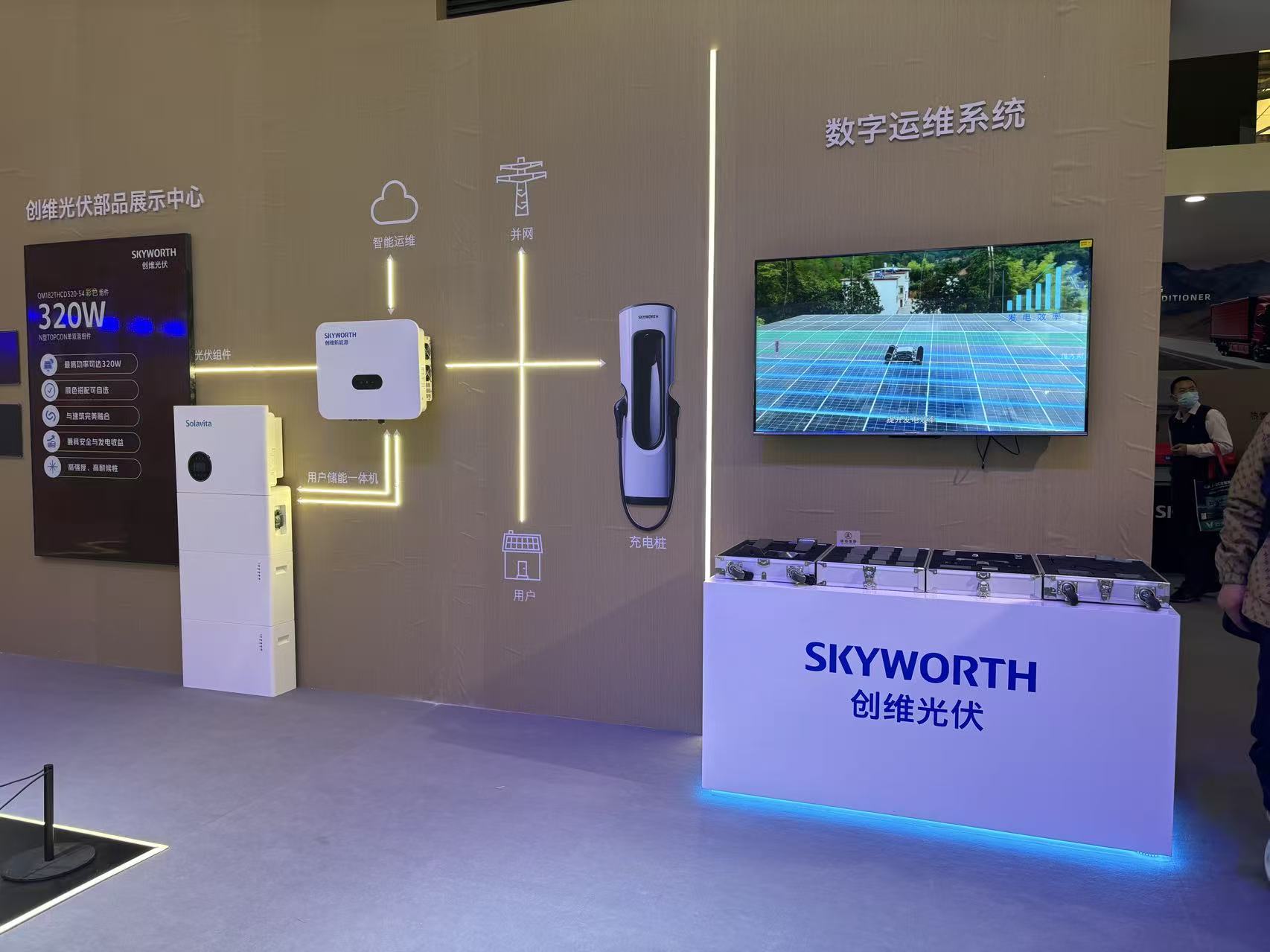
家电龙头布局新能源四五年后谋质变,“下半场”才刚开始
第一财经· 2026-01-28 12:25
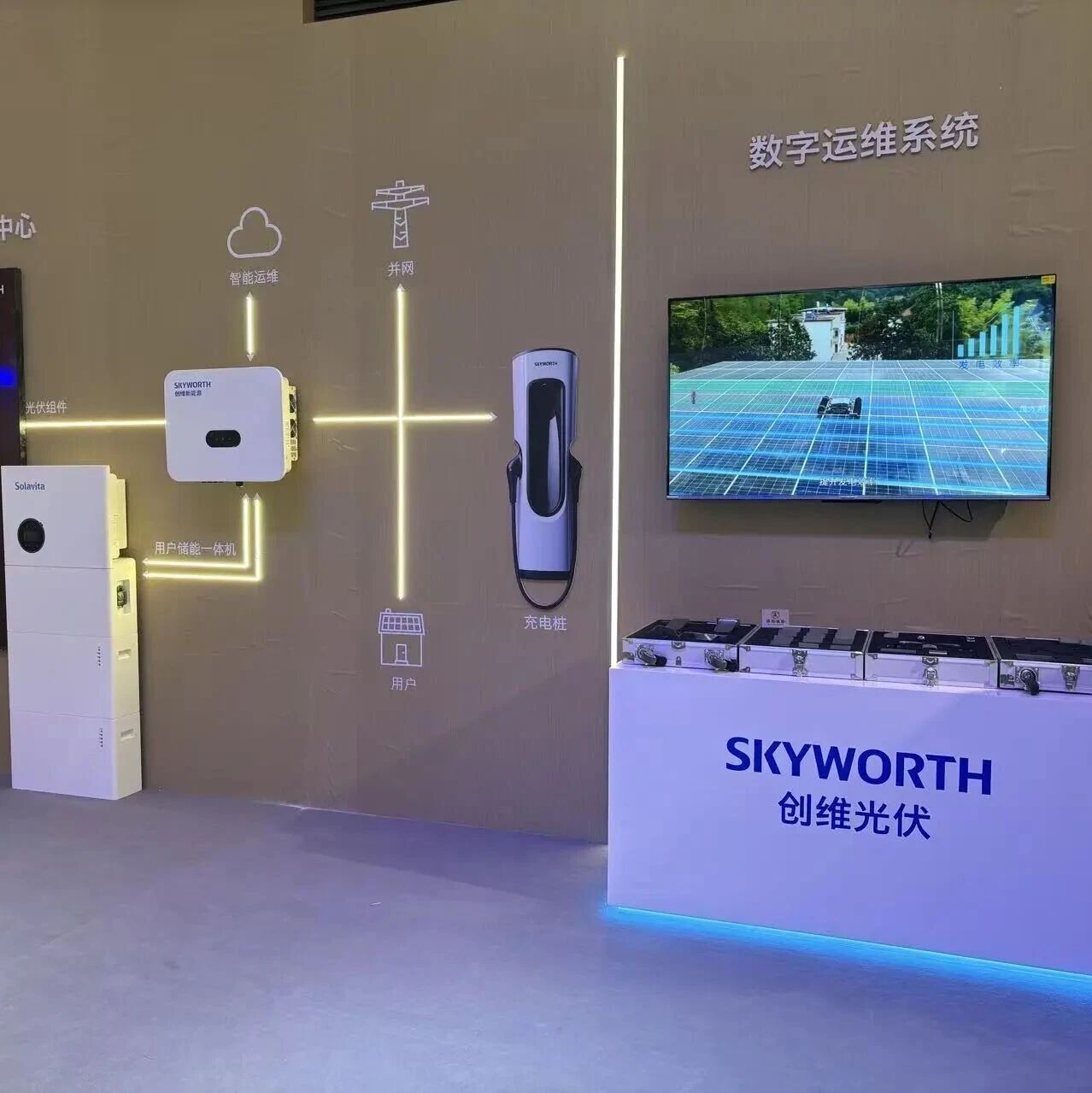
Core Viewpoint - Leading home appliance companies are deepening their investments in the trillion-yuan new energy sector as traditional markets mature and growth slows, with new energy businesses becoming significant growth drivers for these companies [3][4][8]. Group 1: Company Developments - Skyworth Group plans to delist and spin off its solar business, with expectations that solar revenue will surpass TV revenue by 2025, driven by a 53.5% year-on-year growth in solar revenue to 13.836 billion yuan in the first half of 2025 [4]. - Midea Group has established a new energy division and aims to integrate solar, storage, and heat pump technologies, with annual revenue from its new energy business reaching approximately 10 billion yuan [5]. - TCL's subsidiary, TCL Zhonghuan, reported revenues of 21.57 billion yuan in the first three quarters of the previous year and is investing in new energy to enhance its product offerings [6]. - Haier New Energy recently secured over 1 billion yuan in Series B funding and aims to create an AI-driven energy internet ecosystem [6]. Group 2: Market Trends and Challenges - The Chinese home appliance market is expected to see a decline in retail sales by 6.7% in 2026, highlighting the need for companies to pivot towards new energy for growth [8]. - The competition in the solar and storage sectors is intensifying, with companies facing challenges in profitability despite the potential for significant market expansion [10][11]. - The shift towards new energy is seen as a "second growth curve" for these companies, with a focus on integrating new energy solutions into smart home and manufacturing sectors [9][10]. Group 3: Future Outlook - Companies like Gree Electric are expanding into silicon carbide chip production to enhance energy efficiency in their products, with plans to mass-produce these chips by 2026 [9]. - The energy landscape is evolving, with expectations that by 2030, renewable energy will account for approximately 30% of total power generation in China [8]. - The transition from hardware sales to operational capabilities in the storage sector is crucial for maintaining competitive advantages as market dynamics shift [11].



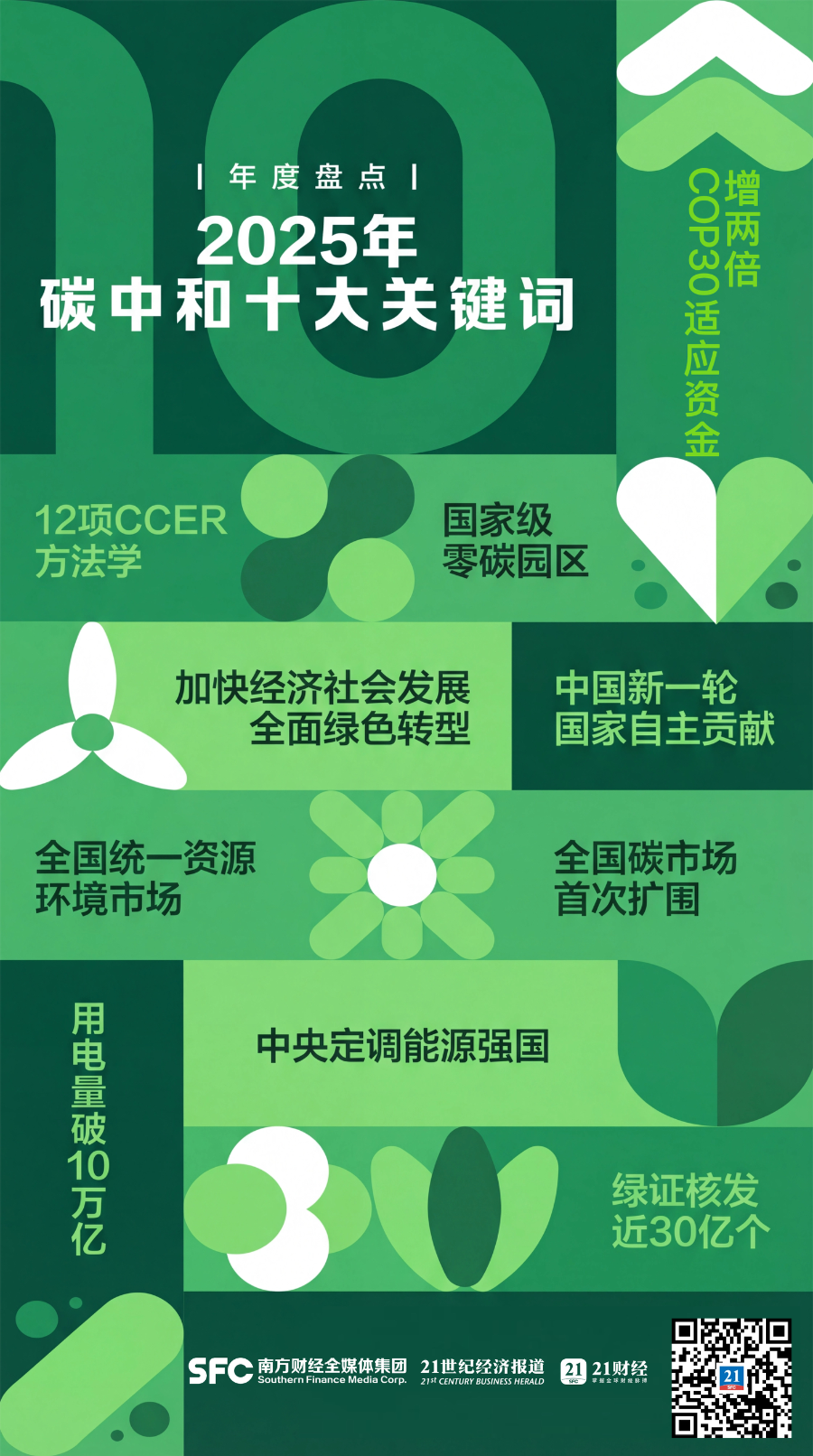
能源强国、新NDC……速览2025年碳中和十大关键词
2 1 Shi Ji Jing Ji Bao Dao· 2026-01-28 09:49
Group 1 - The core viewpoint of the articles emphasizes China's commitment to accelerating a comprehensive green transformation in its economy and society, with a focus on achieving carbon neutrality by 2035 [1][4][5] - The 20th Central Committee of the Communist Party of China has set "accelerating comprehensive green transformation" as a core task for the 14th Five-Year Plan, highlighting the importance of ecological security and green development [4][5] - Key mechanisms for carbon neutrality have made significant progress, including the expansion of the national carbon market to cover steel, cement, and aluminum industries, and the establishment of national zero-carbon parks [1][6][11][13] Group 2 - China's new round of Nationally Determined Contributions (NDC) aims for a 7%-10% reduction in greenhouse gas emissions by 2035, with non-fossil energy consumption reaching over 30% of total energy consumption [6][10] - The national unified resource and environmental market is being developed to enhance market efficiency and promote the marketization of resource and environmental factors [7][8] - The total electricity consumption in China surpassed 10 trillion kilowatt-hours in 2025, marking a significant milestone and reflecting the resilience and vitality of the economy [9][10] Group 3 - The energy power strategy emphasizes energy security, green transformation, and technological self-reliance, with a focus on seven key tasks for energy work in 2026 [10][11] - The first batch of national zero-carbon parks has been established, with 52 parks across various regions, focusing on low-energy, low-pollution, and high-value-added industries [11][12] - The national carbon market has expanded to include three major high-energy-consuming industries, significantly increasing the coverage of carbon emissions [13][15] Group 4 - The issuance of green certificates reached nearly 3 billion in 2025, with international recognition from the RE100 initiative, enhancing the credibility and market demand for Chinese green certificates [16][17] - Twelve new CCER methodologies were implemented in 2025, focusing on key areas for voluntary emission reductions, which is expected to activate the voluntary carbon market [18][19] - The COP30 conference resulted in a commitment from wealthy nations to double funding for climate change adaptation by 2035, although the omission of fossil fuel references in the final text raised concerns [20][21]
2025年纯电动汽车注册量增长近25% 英国加速普及电动汽车
Ren Min Ri Bao· 2026-01-28 08:00
Group 1 - The core viewpoint of the articles highlights the significant growth in electric vehicle (EV) registrations in the UK, projected to exceed 473,000 units by 2025, representing a nearly 25% year-on-year increase and accounting for approximately 23% of total new car registrations [1] - The UK government has initiated a total of £650 million in EV subsidies starting July 2025, with an additional £1.3 billion announced in December to further expand the subsidy program and £200 million allocated for accelerating nationwide charging infrastructure [1] - The subsidy program is structured into two tiers, with the highest tier offering up to £3,750 for vehicles with higher environmental ratings, while the second tier provides £1,500, applicable only to new EVs priced below £37,000 [1] Group 2 - The UK government plans to invest £200 million in the installation of new charging points, enhancing existing street charging facilities, particularly for consumers without private parking spaces, to reduce their charging costs [2] - Approximately 87,000 charging points currently exist in the UK, with the new investment aimed at constructing thousands of additional charging stations [2] - The UK Transport Secretary emphasized that subsidizing EV sales is an investment in the nation's future, which could lead to an increase in high-quality manufacturing jobs [2]
家电龙头布局新能源四五年后谋质变,“下半场”才刚开始
Di Yi Cai Jing· 2026-01-28 07:31
Core Viewpoint - The renewable energy business, including photovoltaic and energy storage, is gradually becoming a new growth point for leading companies that originated from the home appliance industry, but its scale and profitability still need improvement [1][3]. Group 1: Company Developments - Skyworth Group plans to delist and spin off its photovoltaic business, with expectations that its photovoltaic revenue will exceed that of its traditional TV business by 2025 [4]. - Midea Group has established a new energy division and launched its electric heavy truck charging pile business, aiming to integrate photovoltaic, energy storage, and charging solutions [5]. - TCL has begun investing in a new energy project to enhance its photovoltaic and battery business, following its acquisition of TCL Zhonghuan [6]. - Haier New Energy has secured over 1 billion yuan in Series B financing and aims to create an AI-driven energy internet ecosystem [6]. - Hisense Group is expanding its energy production and storage capabilities through acquisitions [7]. Group 2: Market Context and Challenges - The home appliance market is maturing, leading companies to pivot towards renewable energy as a "second growth curve" amid declining sales in traditional sectors [8]. - The Chinese home appliance retail market is projected to decline by 6.7% in 2026, highlighting the urgency for companies to diversify into renewable energy [8]. - The renewable energy sector is highly competitive, with companies facing challenges in profitability and market saturation [10][11]. Group 3: Future Outlook - Skyworth's future growth is expected to focus on overseas markets and energy storage solutions, with ongoing projects in Thailand and Italy [4]. - Midea's new energy business is projected to reach an annual revenue of around 10 billion yuan, but it still lags behind industry leaders [5]. - The competition in the energy storage market is shifting from hardware costs to operational capabilities, indicating that the next phase for home appliance companies in the renewable sector is just beginning [11].