
结构性货币政策工具

Search documents
上半年辽宁省社会融资规模增加2793亿元
Sou Hu Cai Jing· 2025-08-02 01:45
Group 1 - The total social financing scale in Liaoning Province increased by 279.3 billion yuan in the first half of the year, the highest for the same period in nearly a decade [1] - The issuance of RMB loans to the real economy reached 182.8 billion yuan, providing strong financial support for the three-year action plan for comprehensive revitalization in Liaoning [1] - By the end of June, the balance of RMB loans in Liaoning Province reached 5.36 trillion yuan, an increase of 167.3 billion yuan from the beginning of the year, with a year-on-year increase of 130.1 billion yuan [1] Group 2 - The balance of technology loans in the province reached 821.78 billion yuan, with an increase of 65.27 billion yuan [2] - Green loan balance stood at 666.98 billion yuan, accounting for 12.4% of total loans [2] - The balance of inclusive micro loans reached 473.1 billion yuan, a year-on-year increase of 21.5%, with new inclusive micro loans of 56.8 billion yuan in the first half of the year [2]
上半年我省社会融资规模增加2793亿元
Liao Ning Ri Bao· 2025-08-02 00:12
Group 1 - The total social financing scale in Liaoning Province increased by 279.3 billion RMB in the first half of the year, marking the highest increase for the same period in nearly a decade [1] - Loans to the real economy amounted to 182.8 billion RMB, providing strong financial support for the comprehensive revitalization of Liaoning [1] - By the end of June, the balance of RMB loans in Liaoning's financial institutions reached 5.36 trillion RMB, an increase of 167.3 billion RMB from the beginning of the year, with a year-on-year increase of 130.1 billion RMB [1] Group 2 - The balance of technology loans in the province reached 821.78 billion RMB, with an increase of 65.27 billion RMB [2] - Green loans amounted to 666.98 billion RMB, accounting for 12.4% of total loans [2] - The balance of inclusive micro loans reached 473.1 billion RMB, a year-on-year increase of 21.5%, with new inclusive micro loans of 56.8 billion RMB in the first half of the year [2]
央行定调下半年货币政策!
Jin Rong Shi Bao· 2025-08-01 15:19
Group 1 - The People's Bank of China emphasizes the implementation of a moderately loose monetary policy to support technological innovation, boost consumption, assist small and micro enterprises, and stabilize foreign trade, aiming for high-quality economic development in the second half of 2025 [1] - The meeting aligns with the Central Political Bureau's recent decisions, indicating a continued focus on maintaining liquidity and guiding financial institutions to ensure reasonable credit growth, matching social financing scale and money supply growth with economic growth and price level expectations [1] - The macroeconomic adjustments in the first half of 2025 included increased monetary policy flexibility to respond to potential tariff impacts and stimulate domestic demand, with a focus on enhancing the effectiveness and foresight of policy implementation [1] Group 2 - Industry experts predict stable growth in financial volume in the second half of the year, supported by a rich toolbox of liquidity management tools from the central bank, which will allow for more efficient and precise liquidity management [2] - Structural monetary policy tools are expected to play a crucial role, with significant emphasis placed on these tools in the central bank's recent policy announcements, aiming to address structural issues and enhance overall effectiveness [2] - The first half of 2025 saw a characteristic of "total growth and structural optimization" in credit, with a need for effective execution of monetary policy measures to improve transmission and implementation effects [3]
贵州省上半年新发放企业贷款加权平均利率同比下降45个基点
Xin Hua Cai Jing· 2025-08-01 14:11
Core Insights - The average weighted interest rate for new corporate loans in Guizhou Province is approximately 3.65%, a decrease of 45 basis points year-on-year [1] - The People's Bank of China (PBOC) Guizhou branch is implementing a moderately loose monetary policy to create a favorable financial environment for high-quality economic development [1] - The PBOC has reduced the reserve requirement ratio by 0.5 percentage points, releasing approximately 2.02 billion yuan in long-term available funds [1] - The average weighted interest rate for new personal housing loans is about 3.25%, down 53 basis points year-on-year [1] - A total of 154.76 billion yuan has been injected into the province through monetary policy tools by the end of June [2] Monetary Policy Implementation - The PBOC is utilizing various monetary policy tools to support economic growth, focusing on sectors such as technological innovation, consumption expansion, and support for small and micro enterprises [1] - Funds amounting to 79.08 billion yuan have been allocated through agricultural and small enterprise re-loans and rediscounts [2] - An additional 75.68 billion yuan has been directed towards technological innovation, technical transformation, carbon reduction support tools, and supplementary mortgage loans [2]
野村解读政治局会议:经济前景更乐观,政策重心转向落地
Zhi Tong Cai Jing· 2025-07-31 22:57
Group 1 - The core viewpoint of the article indicates that the Chinese government has adopted a more optimistic stance on economic growth and the easing of Sino-U.S. trade tensions, as reflected in the Politburo's recent meeting outcomes [1][2] - The Politburo's attitude towards the economic growth outlook has improved compared to the April meeting, with a notable reduction in concerns regarding the Sino-U.S. trade conflict [2][3] - The upcoming Fourth Plenary Session in October will focus on formulating the "15th Five-Year Plan," which is expected to shape future economic policies [1] Group 2 - The meeting emphasized the need for detailed implementation of macroeconomic policies, suggesting a shift from introducing new policies to enhancing the effectiveness of existing ones [4] - There is a reduced urgency for large-scale stimulus measures in key sectors, with a focus on developing new growth points in service consumption and supporting goods consumption [5][6] - The government remains cautious regarding local government debt issues, emphasizing the need to prevent the accumulation of new hidden debts while addressing existing debt challenges [6] Group 3 - The tone regarding "anti-involution" actions has softened, with the Politburo opting for a more general approach to addressing disorderly competition rather than specific measures to eliminate outdated capacity [3][4] - The recent trade negotiations between China and the U.S. have led to a more moderate stance on export support, reflecting a decrease in urgency following the potential extension of the tariff truce [6] - The meeting did not mention any plans for additional funding for the vehicle trade-in program, indicating a limited scope for new consumer incentives [5][6]
中央政治局会议透露哪些经济信号?
Sou Hu Cai Jing· 2025-07-31 14:25
Group 1: Economic Policy Focus - The central government emphasizes maintaining policy continuity and stability while enhancing flexibility and foresight in economic policies for the second half of the year [2][5] - Key areas of focus include stabilizing employment, enterprises, markets, and expectations, as well as implementing more proactive fiscal policies and moderately loose monetary policies [2][5] - The government aims to effectively release domestic demand potential and implement actions to boost consumption, while also ensuring the stability of foreign trade and investment [2][5] Group 2: Structural Support for Small and Micro Enterprises - Monetary policy will increasingly focus on small and micro enterprises, with specific measures such as re-loans, targeted reserve requirement ratio cuts, and expansion of inclusive small and micro loan support tools [5][6] - The government plans to accelerate the issuance and utilization of government bonds to improve funding efficiency, which is crucial for supporting local governments and ensuring basic livelihood protections [5][6] Group 3: Consumption and Service Sector Growth - The government aims to release domestic demand potential and cultivate new growth points in service consumption, with a focus on improving consumer confidence and expanding consumption demand [8][9] - Recent data shows a decline in consumer spending growth, indicating the need for further measures to stimulate consumption, particularly in the service sector [8][9] Group 4: Market Competition and Regulation - The meeting highlights the importance of optimizing market competition order and addressing disorderly competition among enterprises, marking a significant shift in regulatory focus [11][13] - The government is committed to promoting a unified national market and addressing issues such as low-price competition and local protectionism to foster a fair business environment [11][13]


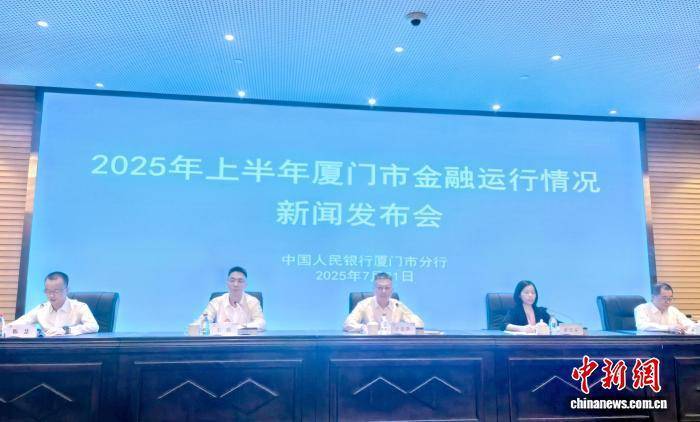
上半年厦门金融业持续提升服务实体经济质效
Sou Hu Cai Jing· 2025-07-31 12:41
Core Viewpoint - The financial performance of Xiamen in the first half of the year shows steady growth and an optimized credit structure, significantly contributing to the high-quality development of the local economy [1][3]. Financial Performance - Xiamen's total financial volume has steadily increased, with a notable optimization in the credit structure [1][3]. - The implementation of a comprehensive monetary policy by the People's Bank of China in May has positively impacted Xiamen's financial landscape [3]. Credit Structure Optimization - Manufacturing loans have maintained rapid growth, while real estate loans have shown signs of recovery [3]. - There has been a continuous and rapid increase in technology loans, alongside strengthened support for green industries [3]. - Long-term operating loans for individual businesses and small micro-enterprises have increased year-on-year, demonstrating targeted financial support for microeconomic entities [3]. Policy Implementation - A total of 26.5 billion RMB in agricultural and small business re-loans and rediscounts were implemented in Xiamen during the first half of the year [3]. - Various policy tools, including technology innovation loans and carbon reduction support tools, have led to approximately 23 billion RMB in bank loans being issued [3]. Cross-Border Financial Services - Xiamen's cross-border RMB settlement volume reached 216.1 billion RMB, with 188 billion RMB related to the real economy, ranking first in Fujian Province [4]. - Over 1,054 quality enterprises benefited from trade and investment facilitation policies, and more than 1,200 small and micro enterprises received credit support exceeding 24 billion RMB [4]. Conclusion - The financial sector in Xiamen has focused on total growth and structural optimization, enhancing the quality of service to the real economy and laying a solid financial foundation for continued economic recovery in the second half of the year [4].
如何理解“宏观政策要持续发力、适时加力”?
Jing Ji Guan Cha Bao· 2025-07-31 10:25
会议指出,宏观政策要持续发力、适时加力。要落实落细更加积极的财政政策和适度宽松的货币政策, 充分释放政策效应。加快政府债券发行使用,提高资金使用效率。兜牢基层"三保"底线。货币政策要保 持流动性充裕,促进社会综合融资成本下行。用好各项结构性货币政策工具,加力支持科技创新、提振 消费、小微企业、稳定外贸等。支持经济大省发挥挑大梁作用。强化宏观政策取向一致性。 "宏观政策要持续发力、适时加力",并且强调,"落实落细宏观政策各项措施"。中共中央政治局召开会 议传递了怎么样的信号? (原标题:如何理解"宏观政策要持续发力、适时加力"?) 7月30日,中共中央政治局召开会议,分析研究当前经济形势,部署下半年经济工作。 会议强调,做好下半年经济工作,要坚持以习近平新时代中国特色社会主义思想为指导,坚持稳中求进 工作总基调,完整准确全面贯彻新发展理念,加快构建新发展格局,保持政策连续性稳定性,增强灵活 性预见性,着力稳就业、稳企业、稳市场、稳预期,有力促进国内国际双循环,努力完成全年经济社会 发展目标任务,实现"十四五"圆满收官。 从货币政策来看,王运金认为,下半年货币政策将保持适度宽松基调,加大调控强度,通过逆回购、 M ...
政治局会议锚定下半年,释放重要信号
Hua Xia Shi Bao· 2025-07-31 00:09
Group 1 - The July Politburo meeting reviewed the economic performance in the first half of the year and outlined precise plans for the second half, emphasizing the need for macro policies to continue to exert force and be appropriately strengthened [1][2] - The meeting highlighted the importance of maintaining a stable and continuous policy approach while enhancing flexibility and foresight to adapt to internal and external changes [2][3] - Specific measures include accelerating government bond issuance, improving fund utilization efficiency, and ensuring the "three guarantees" at the grassroots level [3][4] Group 2 - Monetary policy is a crucial component of macro policy, with a focus on maintaining ample liquidity and reducing the overall financing costs in society [4][6] - In the first half of the year, significant reductions in reserve requirements and interest rates were implemented, leading to lower average interest rates for both corporate and personal loans [4][6] - There is potential for further monetary easing in the second half, including possible interest rate cuts and adjustments to the loan market quotation rate (LPR) [4][6] Group 3 - Structural monetary policy tools are essential for targeted support, particularly for technology innovation, consumption stimulation, small and micro enterprises, and stabilizing foreign trade [5][6] - The central bank announced an increase in the quota for re-loans aimed at technology innovation and small enterprises, indicating a commitment to enhancing credit support in these areas [6][7] - The meeting also emphasized the need to optimize market competition and regulate chaotic business practices, which may impact industrial prices and corporate profits [7]
宏观政策将持续发力适时加力
Zhong Guo Zheng Quan Bao· 2025-07-30 21:08
● 本报记者 彭扬 连润 广开首席产业研究院首席金融研究员王运金分析,预计有关部门下半年将继续落实好此前已出台的各项 政策措施,如超长期特别国债发行与使用、"两重"建设、"两新"工作、新型政策性金融工具等,增强政 策持续性,充分释放政策效应。 财政部部长蓝佛安7月30日表示,加快发行和使用超长期特别国债、地方政府专项债券,尽早形成实物 工作量。发挥财政资金引导和带动效应,推动各项政策效能不断释放。加大稳就业政策实施力度,有力 实施稳岗返还、税费减免、就业补贴等政策,强化重点群体就业保障。 保持流动性合理充裕 关于货币政策,会议指出,货币政策要保持流动性充裕,促进社会综合融资成本下行。用好各项结构性 货币政策工具,加力支持科技创新、提振消费、小微企业、稳定外贸等。 7月30日,中共中央政治局召开会议,分析研究了当前经济形势,部署下半年经济工作。 专家表示,有关部门下半年将继续落实好此前已出台的各项政策措施,增强政策的持续性,充分释放政 策效应。根据国内外经济形势变化,宏观政策将持续发力适时加力,持续巩固经济回升向好势头。 加快政府债券发行使用 会议指出,宏观政策要持续发力、适时加力。要落实落细更加积极的财政政策 ...