通用人工智能

Search documents
微软和OpenAI签署新协议深化合作
Xin Hua She· 2025-10-29 08:25
Core Points - Microsoft and OpenAI have signed a new final agreement to strengthen their partnership and lay the foundation for long-term success [1] - Microsoft supports OpenAI's board in forming a Public Benefit Corporation (PBC) and completing a capital restructuring, with an estimated investment valuation of approximately $135 billion for Microsoft’s stake in OpenAI [1] - OpenAI remains a key partner for Microsoft in frontier model collaboration, with Microsoft retaining exclusive intellectual property rights and exclusive access to the Azure API until the achievement of Artificial General Intelligence (AGI) [1] Agreement Details - An independent expert committee will verify the achievement of AGI once OpenAI announces it [1] - Microsoft's intellectual property rights do not cover OpenAI's consumer hardware, allowing OpenAI to collaborate with third parties on certain products [1] - Microsoft can independently or collaborate with third parties to develop AGI, and the revenue-sharing agreement will remain in effect until AGI is verified by the independent committee [1] Additional Procurement - OpenAI has signed an additional procurement agreement for Microsoft Azure services valued at $250 billion, although OpenAI will no longer prioritize Microsoft as its computing power supplier [1]

1.4万亿投资、GPT-6、IPO进程,奥特曼回应“新OpenAI”的一切:1小时实录精华版
3 6 Ke· 2025-10-29 07:02
Core Insights - OpenAI has completed a significant restructuring, laying the groundwork for an initial public offering (IPO) that could raise substantial funds to support its extensive computational and research initiatives [2][6][47] - The new structure maintains control by a nonprofit board, OpenAI Foundation, which holds 26% of the for-profit entity, OpenAI Group PBC, valued at approximately $1.3 trillion based on a recent $500 billion valuation [2][5] - Microsoft has become the largest shareholder with about 27% ownership, valued at approximately $135 billion, and has entered into a new agreement with OpenAI for additional Azure cloud services [5][6] Financial Structure - The restructuring converts previous investments into common equity, removing potential profit caps for investors while ensuring nonprofit oversight on critical governance matters [2][5] - OpenAI employees and early investors collectively hold about 26% equity, valued at around $1.3 billion, while future financing rounds will allocate 15% and 4% equity to new investors [5] - The company anticipates cash consumption exceeding $115 billion by 2029, driving the need for public market fundraising [6] Strategic Goals - OpenAI's CEO, Sam Altman, emphasized the importance of the restructuring as a pivotal event of the year, transitioning from a limited liability company (LLC) to a public benefit corporation (PBC) while retaining nonprofit control [7][25] - The company aims to develop a high-level AI research assistant by September next year and achieve fully automated AI researchers by March 2028 [12][36] - OpenAI's research focuses on deep learning technologies, with expectations of achieving superintelligence within a decade [10][11] Infrastructure and Product Development - OpenAI plans to build a robust infrastructure, committing over $1.4 trillion in financial responsibilities, with an initial focus on AI applications in healthcare [23][27] - The company is transitioning towards a platform model, allowing third-party developers to create applications based on OpenAI's technology [21][23] - OpenAI aims to produce 1 gigawatt of computing capacity weekly, with a target cost of approximately $20 billion per gigawatt over a five-year equipment lifecycle [24] Safety and Ethical Considerations - OpenAI is prioritizing safety and alignment in AI development, focusing on value alignment, goal alignment, reliability, adversarial robustness, and system safety [13][17] - The organization is committed to building an ecosystem for AI resilience, addressing potential risks associated with advanced AI technologies [28][30] - Altman highlighted the need for strong privacy protections as AI becomes a foundational platform in people's lives [23]


OpenAI完成资本重组,微软大股东地位巩固,持股27%
3 6 Ke· 2025-10-28 23:58
Core Insights - OpenAI has completed a capital restructuring, reinforcing its non-profit status while maintaining control over its for-profit entity, now named OpenAI Group PBC, which is valued at approximately $130 billion [1][2] - The OpenAI Foundation, the non-profit arm, holds 26% of the for-profit entity, while current and former employees and investors own 47% [1] - Microsoft has invested over $13 billion in OpenAI and now holds a stake valued at $135 billion in the public benefit company, representing about 27% of its shares on a fully diluted basis [1][2] Capital Structure Restructuring - The non-profit organization has been renamed OpenAI Foundation and now controls the for-profit entity, which has become a public benefit corporation [1][4] - The restructuring allows the foundation to access significant resources directly, with an initial commitment of $25 billion aimed at accelerating breakthroughs in health and AI resilience [2][3] - The foundation will receive additional ownership as the for-profit entity reaches valuation milestones [2][4] Mission and Focus Areas - OpenAI's mission remains to ensure that general artificial intelligence benefits all of humanity, with efforts being made through both commercial and foundation avenues [2][4] - The foundation will focus on two primary areas: health and disease treatment, and practical AI resilience solutions [2][3] Partnership with Microsoft - OpenAI has signed a new agreement with Microsoft, committing to purchase $250 billion worth of Azure cloud services [7][10] - The agreement extends Microsoft's intellectual property rights related to OpenAI models and products until 2032, including rights post-general AI achievement [7][8] - OpenAI can now independently or collaboratively develop certain products with third parties, while Microsoft retains exclusive rights to Azure API usage [9][10] Future Directions - The collaboration aims to address challenges and opportunities presented by advancements in AI, ensuring that technology serves collective interests [5][6] - OpenAI is now able to release open-source weight models that meet capability standards [11]
Altman公布OpenAI“小目标”:基础设施一年要投1万亿,2028年实现全自动“AI研究员”
Hua Er Jie Jian Wen· 2025-10-28 22:17
Core Insights - OpenAI has completed a controversial restructuring to become a profit-oriented organization, with a significant infrastructure investment plan aiming for $1 trillion annually [1][5] - The company has committed approximately $1.4 trillion for infrastructure, equating to about 30 GW of data center capacity, with plans to add capacity at a rate of 1 GW per week [1][2] - OpenAI's new profit-oriented entity is now called OpenAI Group PBC, with a valuation of approximately $130 billion, while the non-profit arm has been renamed OpenAI Foundation [5] Infrastructure Investment Plan - OpenAI's infrastructure expansion plan involves deploying the committed $1.4 trillion over the coming years, clarifying previous announcements regarding partnerships with chipmakers and data center providers [2] - The company aims to achieve a weekly capacity increase of 1 GW, although challenges remain in reaching this target [2] - To support this capital expenditure, OpenAI needs to significantly increase its revenue, targeting annual revenues in the range of several hundred billion dollars [2] AI Research Capability Timeline - OpenAI has set an ambitious timeline for AI research capabilities, expecting to develop intern-level research assistants by September 2026 and fully automated "true AI researchers" by 2028 [3] - The chief scientist described these AI researchers as systems capable of independently completing large research projects, with a belief that deep learning systems could reach superintelligence within a decade [3] - Key strategies for achieving these goals include continuous algorithm innovation and significantly expanding "test-time computation" [3] Restructuring Completion and Microsoft Agreement - The restructuring of OpenAI has been finalized after over a year of negotiations, with the non-profit foundation holding approximately 26% of the profit-oriented entity [5] - A new agreement with Microsoft has been established, resulting in a decrease in Microsoft's ownership stake from 32.5% to approximately 27%, with a valuation of about $135 billion [5] - The new agreement clarifies previous ambiguities regarding Microsoft's rights to OpenAI's technology upon the realization of AGI (Artificial General Intelligence) [6]
OpenAI,重大变化!微软成大赢家
Mei Ri Jing Ji Xin Wen· 2025-10-28 16:40
Group 1 - Microsoft and OpenAI have signed a new agreement to support the establishment and capital restructuring of OpenAI's for-profit entity, OpenAI Group PBC [1] - Microsoft currently holds an investment stake of approximately $135 billion in OpenAI's for-profit division, translating to about 27% on a fully diluted basis, and 32.5% without considering recent funding rounds [1] - Following the announcement, Microsoft's stock price rose over 4% in pre-market trading and more than 3% after opening, pushing its market capitalization above $4 trillion [1] Group 2 - OpenAI will purchase $250 billion worth of Microsoft Azure cloud services, and in return, Microsoft will no longer have priority rights to provide computing services to OpenAI [2] - OpenAI will have the ability to co-develop products with third parties, but API products will remain exclusive to Azure, while non-API products can be deployed on any cloud platform [2] - Microsoft retains the right to independently research and develop AGI (Artificial General Intelligence) or collaborate with third parties [2] Group 3 - Since its founding in 2015, OpenAI has operated as a non-profit organization, facing funding and resource challenges after Elon Musk's exit in 2018 [3] - To attract more investment, OpenAI established a for-profit subsidiary, "OpenAI LP," in 2019, under the non-profit organization to raise funds and attract talent [3] - OpenAI received a $1 billion investment from Microsoft, which included cash and Azure cloud resources, with an agreement for OpenAI to migrate its services to Microsoft Azure, making Microsoft its exclusive cloud provider [3]
刚刚,OpenAI股改完成,非营利主体更名
量子位· 2025-10-28 14:24
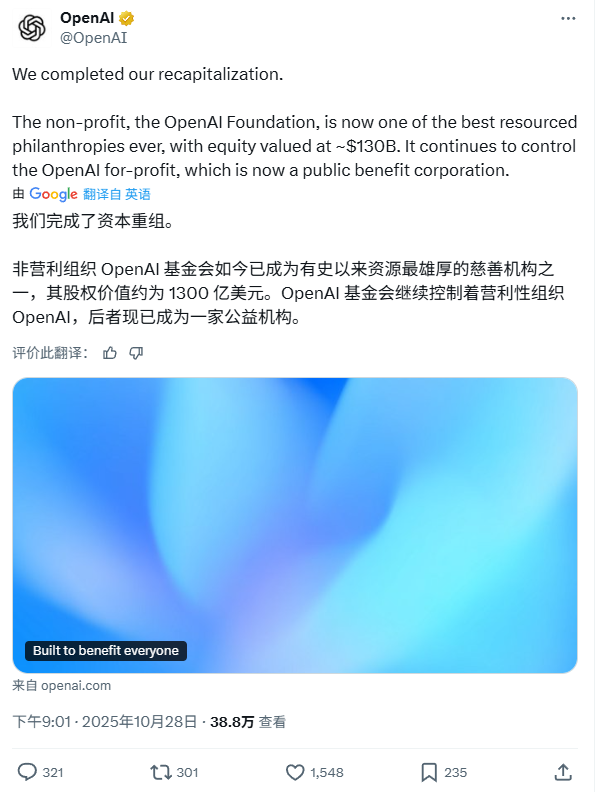
Core Viewpoint - OpenAI has completed a capital structure restructuring, paving the way for its potential IPO and the successful receipt of a $22.5 billion investment from SoftBank [2][4]. Group 1: Capital Structure and Ownership - OpenAI's nonprofit entity has been renamed to OpenAI Foundation, which retains a 26% stake in the for-profit entity, currently valued at approximately $130 billion [4]. - Employees and investors hold 47% of the shares, while Microsoft owns 32.5% of the for-profit entity [5][6]. - Following the restructuring, OpenAI Foundation will receive additional ownership as the for-profit entity reaches valuation milestones [13]. Group 2: Mission and Funding Initiatives - OpenAI's mission remains to ensure that artificial general intelligence (AGI) benefits all of humanity, a commitment that has persisted since its founding in 2015 [10][11]. - The OpenAI Foundation plans to invest $25 billion in two key areas: health and disease cures, and AI resilience technology solutions [14][15]. - The foundation will utilize funds from a $50 million "human-centered AI fund" and recommendations from a nonprofit committee to support these initiatives [16]. Group 3: Market Reaction and Future Engagement - Microsoft shares rose by 3.5% in pre-market trading following the announcement [7]. - OpenAI's leadership, including Sam Altman and Chief Scientist Jakub Pachocki, will host a live session to discuss the future of OpenAI [24].
微软:获OpenAI27%股权,OpenAI投2500亿购服务
Sou Hu Cai Jing· 2025-10-28 14:15
Core Insights - Microsoft and OpenAI have finalized a new agreement, granting Microsoft a 27% stake in OpenAI valued at approximately $135 billion [1] - The agreement allows Microsoft to utilize OpenAI's technology, including the general artificial intelligence benchmark model, until 2032 [1] - OpenAI has committed to an additional investment of $250 billion in Azure services as part of the agreement [1] Summary by Categories Company Developments - Microsoft secures a 27% equity stake in OpenAI, valued at around $135 billion [1] - OpenAI will provide Microsoft access to its technology until 2032, enhancing Microsoft's AI capabilities [1] Financial Commitments - OpenAI pledges to invest an additional $250 billion in Azure services, indicating a strong partnership and commitment to cloud infrastructure [1] Strategic Changes - Microsoft loses its preferential purchasing rights for OpenAI's computing power, which may impact its operational strategy [1]
LSTM之父Jürgen再突破,「赫胥黎-哥德尔机」让AI学会自己进化
机器之心· 2025-10-28 06:29
编辑:冷猫、陈陈 实现通用人工智能的一大终极目标就是创建能够自我学习,自我改进的人工智能体。 这个目标已经是老生常谈了。其实在 2003 年,能够自我改进的智能体的理论模型就已经由著名的「现代 AI 之父」Jürgen Schmidhuber 提出,称为哥德尔机。 哥德尔机是一种自我改进型通用智能系统理论模型,设计灵感来自于哥德尔(Kurt Gödel)的不完备性定理。它的核心思想是:机器能够像数学家一样,通过形式 证明自身程序的改进在长期内将带来更高收益,然后安全地修改自己。 机器之心报道 Jürgen Schmidhuber 是一名德国计算机科学家,以人工智能、深度学习和人工神经网络领域的成就而知名,现任达勒・莫尔人工智能研究所(IDSIA)联合主任, 阿卜杜拉国王科技大学人工智能研究院院长。 1997 年,Jürgen Schmidhuber 发表了长短期记忆网络(LSTM)论文。2011 年,Jürgen Schmidhuber 在 IDSIA 的团队 GPU 上实现了卷积神经网络(CNN)的显著加 速,这种方法基于杨立昆等人早期提出的 CNN 设计 ,已成为计算机视觉领域的核心。 通俗来说,就是一个 ...

余承东,重要职务更新
Shang Hai Zheng Quan Bao· 2025-10-26 13:54
Core Insights - Huawei has appointed Yu Chengdong as the head of the Product Investment Review Board (IRB), a move personally signed off by Ren Zhengfei, indicating a strategic focus on resource allocation and project approval [5] - The primary mission of Yu Chengdong in this role is to lead Huawei in the critical battle for artificial intelligence (AI) and to achieve a global leading position in the field [5] - Huawei's internal analysis suggests that the elevation of AI within the company reflects its growing importance, as highlighted in the "Smart World 2035" report predicting significant advancements in AI and smart technologies by 2035 [5] - Huawei is actively recruiting top global AI talent to build a world-class AI team and develop leading large models, aiming to reach the pinnacle of Artificial General Intelligence (AGI) [8] Recruitment and Opportunities - The recruitment announcement emphasizes that all future visions are conservative, and AGI will represent a revolutionary leap beyond current expectations [8] - New recruits will have the opportunity to work on diverse business scenarios, including Harmony OS, smart terminals, intelligent driving, and cloud computing, alongside award-winning experts [8] - Yu Chengdong has publicly encouraged young, talented individuals passionate about AI to join Huawei in creating the world's strongest AI team [8]

特斯拉AI负责人首次揭秘FSD自动驾驶方法论:为什么我们选择端到端?
Hua Er Jie Jian Wen· 2025-10-26 05:58
Core Argument - Tesla is transforming autonomous driving into a pure AI problem using an "end-to-end" neural network approach, moving away from the traditional modular method that separates perception, prediction, and planning, which they find cumbersome and limited in scalability [1][11]. Group 1: End-to-End Approach - The end-to-end AI model allows the system to directly process pixel data and output driving commands, enabling overall optimization of the entire system [1][11]. - Tesla believes that learning human values from data is easier than encoding them into rules, which is a significant advantage of the end-to-end approach [11][15]. Group 2: Handling Human-Like Decisions - The AI can learn to navigate complex driving scenarios, such as deciding whether to drive through a puddle or into oncoming traffic, by analyzing vast amounts of human driving data [2][15]. - The system can differentiate between groups of animals with different intentions, showcasing its ability to understand "latent intentions" that are difficult to convey in modular systems [3][16]. Group 3: Data Processing and Challenges - Tesla's Full Self-Driving (FSD) system processes up to 2 billion input data points per second, condensing this information into two commands: steering and acceleration [4][20]. - The company leverages a massive data pool, equivalent to 500 years of driving time generated daily by its fleet, to train the AI effectively [22][24]. Group 4: Predictive Capabilities - The AI demonstrates remarkable predictive abilities, such as anticipating a potential collision five seconds before it occurs, which is a level of foresight that traditional systems struggle to achieve [5][24]. Group 5: Interpretability and Evaluation - To address the challenges of debugging the end-to-end model, Tesla outputs interpretable intermediate results alongside driving commands [6][26]. - The company has developed a "neural world simulator" to evaluate the FSD system under various scenarios, allowing for extensive testing and performance assessment [6][37]. Group 6: Technological Versatility - The technology stack developed for FSD is not limited to vehicles; it can also be applied to Tesla's humanoid robot, Optimus, demonstrating its versatility [8][45].