中长期资金入市

Search documents
扩大委托投资规模、推动长周期考核 基本养老保险基金为资本市场注入稳定“长钱”
Zheng Quan Ri Bao· 2025-07-23 17:17
Core Viewpoint - The Ministry of Human Resources and Social Security (HRSS) is promoting the expansion of the entrusted investment scale of the basic pension insurance fund, which is expected to inject stable long-term capital into the capital market [1][2]. Group 1: Investment Scale and Opportunities - The entrusted investment scale of the basic pension insurance fund currently represents only 26.83% of the total fund balance, indicating significant room for growth in future investments [2][3]. - The basic pension insurance fund's investment operation scale reached 2.55 trillion yuan by the end of June, reflecting a year-on-year growth of 34.21% [3]. - Increasing the entrusted investment scale can provide the capital market with trillions of yuan in long-term funds, enhancing market stability and supporting sustainable economic development [3][4]. Group 2: Long-Cycle Assessment Mechanism - The implementation of a long-cycle assessment mechanism is a key focus of the recent policy initiatives, aiming to establish three-year and five-year assessment periods for various funds, including public funds and pension funds [4][5]. - The establishment of long-cycle assessments is expected to reduce market volatility and align long-term capital with investment strategies, thereby improving the overall investment environment [6][7]. - The HRSS has already initiated measures to enhance the long-term assessment of pension funds, which is seen as a step towards promoting value investment and achieving the preservation and appreciation of pension fund assets [6][7]. Group 3: Policy Measures and Market Impact - Recent policy measures from various financial authorities, including the Central Huijin Investment Co. and the National Financial Regulatory Administration, have aimed to inject liquidity into the stock market and encourage long-term investments [8][9]. - The policies have been positively received by market participants, boosting market confidence and promoting the long-term stability of the capital market [8][9]. - Key strategies for attracting long-term capital include optimizing market structure, enhancing the quality of listed companies, and strengthening investor return and protection mechanisms [9].
沪指3600点拉锯战,上攻动能几何?
21世纪经济报道· 2025-07-23 15:23
Market Performance - The A-share market has shown strong momentum, with the Shanghai Composite Index rising from a low of 3040.69 points on April 7 to over 3600 points within approximately 70 trading days, indicating robust market dynamics [3] - As of July 23, the Shanghai Composite Index closed at 3582.30 points, with a slight increase of 0.01% for the day, despite a significant drop during the afternoon session [1] - The trading volume in the Shanghai and Shenzhen markets reached 1.86 trillion yuan, a decrease of 28.4 billion yuan compared to the previous trading day, with over 4000 stocks declining and more than 1200 stocks rising [1] Sector Performance - Among the 31 first-level sectors, 18 sectors have seen an increase of over 10% in the past 120 trading days, with steel, non-ferrous metals, and pharmaceutical sectors leading with gains of 21.79%, 21.65%, and 20.55% respectively [3] - The average stock price increase in the A-share market has exceeded 30% since last October, with over 4000 stocks surpassing their previous highs, and 405 stocks doubling in value [3] Funding and Policy Support - The financing balance in the A-share market has been on the rise, reaching 1.93 trillion yuan as of July 22, the highest level in nearly four months [4] - Regulatory bodies are actively promoting long-term capital inflows into the market, with recent guidelines aimed at enhancing the investment of commercial insurance funds and various pension funds [5] - The market sentiment remains optimistic due to abundant liquidity and favorable policy expectations, with a notable shift towards technology sectors benefiting from industry and policy support [5] Economic Indicators - Recent economic data has exceeded expectations, with consumption contributing 52% to economic growth, reinforcing confidence in the capital market [8] - Analysts suggest that the current market conditions may lead to a stronger-than-expected performance in the A-share market in the second half of the year [7][8] Risk and Valuation Concerns - There are concerns regarding the accumulation of risks in the financing market, particularly for companies with valuations exceeding 15 PE without matching growth [7] - The presence of historical trapped positions around the 3600-point mark may lead to volatility if the market cannot maintain its upward momentum [7]


中国人寿召开上半年工作会议:有力落实中长期资金入市要求
news flash· 2025-07-23 11:59
7月23日,中国人寿(601628)在京召开2025年上半年经营管理工作会议。会议信息显示,上半年,中 国人寿切实发挥主体主责作用,有力落实中长期资金入市要求,为资本市场健康发展保驾护航。会议围 绕下半年工作对多个方面重点部署:一是大力发展普惠、养老金融。二是加强资产负债联动管理。三是 稳步推动销售渠道转型升级。四是加快建设康养生态体系。五是强化数字化赋能与应用。六是切实做好 消费者权益保护。七是牢牢守住风险防控底线。(人民财讯) ...

财政部最新发布,事关中长期资金入市!
FOFWEEKLY· 2025-07-16 10:09
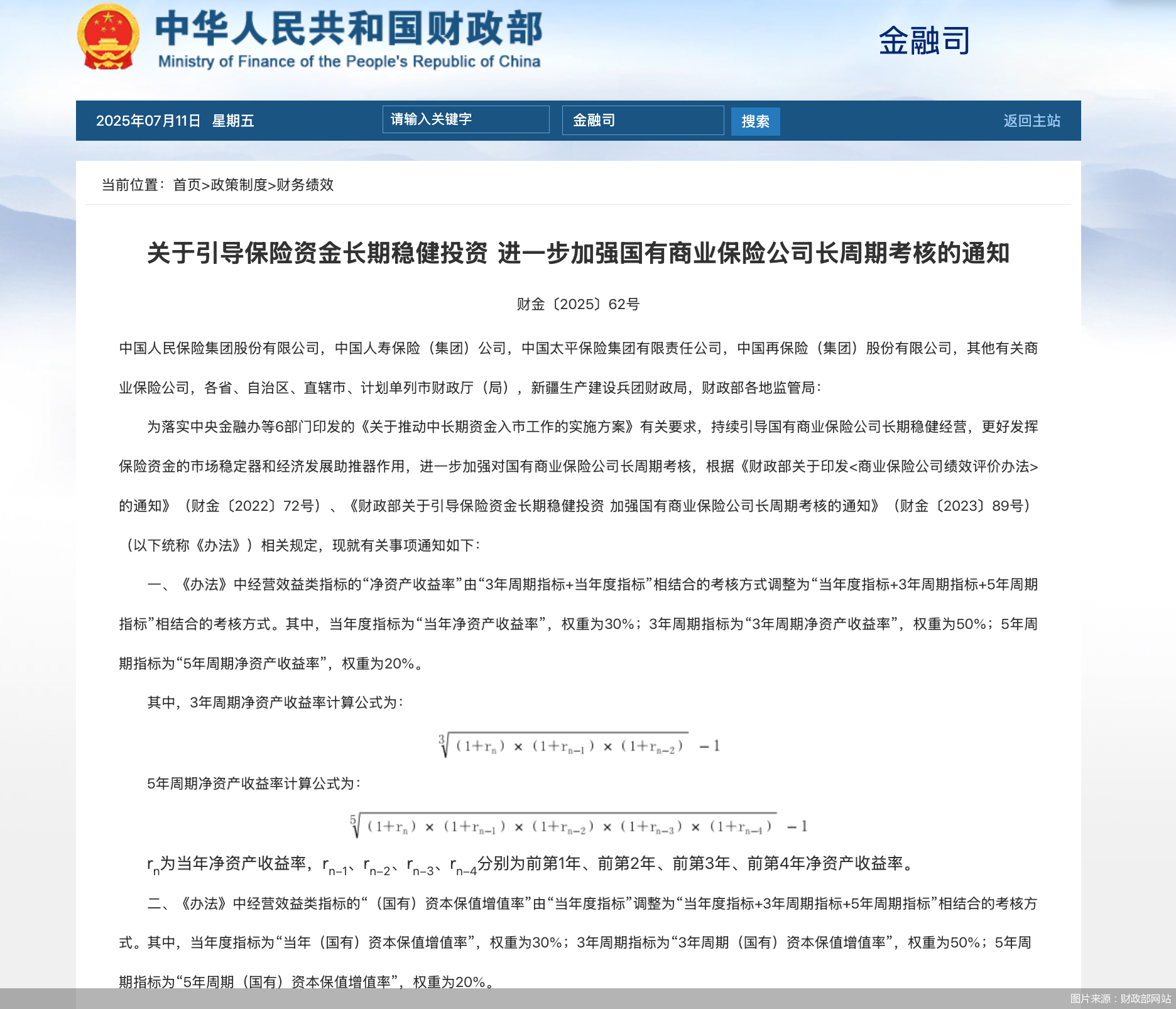
Core Viewpoint - The article discusses the implementation of new regulations aimed at enhancing the long-term stability and performance of state-owned commercial insurance companies in China, emphasizing the importance of effective asset-liability management and investment strategies to support economic development [1][3]. Group 1: Regulatory Changes - The assessment method for the "net asset return rate" has been adjusted from a combination of "3-year cycle indicator + current year indicator" to "current year indicator + 3-year cycle indicator + 5-year cycle indicator," with respective weights of 30%, 50%, and 20% [2]. - The evaluation of the "capital preservation and appreciation rate" has also shifted from a current year indicator to a combination of current year, 3-year cycle, and 5-year cycle indicators, maintaining the same weight distribution [2]. Group 2: Asset-Liability Management - State-owned commercial insurance companies are required to enhance their asset-liability management, focusing on matching the structure, cost-benefit, and cash flow of assets and liabilities [3]. - Companies should optimize asset allocation and determine appropriate equity investment ratios to balance investment returns and risks, aiming for stable growth in owners' equity and preservation of state financial capital [3]. Group 3: Investment Strategy - Emphasis is placed on prudent management, long-term investment, value investment, and stable investment practices, alongside the development of internal long-term assessment mechanisms [3]. - Companies are encouraged to identify high-quality investment targets that offer stable returns, manageable risks, and potential for appreciation, thereby enhancing long-term stable returns [3]. - There is a call for improved investment management capabilities, including strict adherence to internal investment management systems and comprehensive risk assessment processes [3].

保险业态观察(六):险企长周期考核全面落地,引导中长期资金持续入市
Donghai Securities· 2025-07-15 06:22
Investment Rating - The industry investment rating is "Overweight," indicating that the industry index is expected to outperform the CSI 300 index by 10% or more over the next six months [8]. Core Insights - The report highlights the acceleration in the approval of virtual asset trading licenses for brokerages, suggesting a positive impact on sales momentum driven by adjustments in preset interest rates [5]. - The implementation of long-term performance evaluations for state-owned insurance companies is expected to guide long-term capital into the market, enhancing the stability and growth of insurance funds [5]. - The report emphasizes the need for insurance companies to shift from a trading-oriented approach to a more allocation-focused strategy, driven by new accounting standards and regulatory changes [5]. Summary by Sections Investment Highlights - The Ministry of Finance issued a notice on July 11, 2025, to guide insurance funds towards long-term stable investments, emphasizing the importance of long-term performance evaluations [5]. - The new evaluation framework includes a 70% weight on long-term performance metrics, reducing the impact of short-term market fluctuations [5]. - As of Q1 2025, the balance of funds utilized in the insurance industry was 37.84 trillion yuan, with equity asset allocation at only 20.1%, indicating room for growth in this area [5][7]. Regulatory Policies - A series of regulatory documents have been issued to promote long-term capital market participation, including guidelines for three-year performance evaluations for various funds [6]. - The adjustments in performance evaluation criteria aim to enhance the focus on long-term capital preservation and growth for state-owned insurance companies [6]. Investment Recommendations - The report suggests continued attention to the life insurance sector's capacity improvement and the release of demand following increased awareness of insurance needs [5]. - It is recommended to focus on large listed insurance companies with strong competitive advantages, as the sector is currently undervalued [5].
银行理财当好耐心资本
Jin Rong Shi Bao· 2025-07-15 01:40
Core Insights - The bank wealth management market has shown characteristics of scale expansion and structural optimization in the first half of the year, with bank wealth management companies accelerating their entry into patient capital under policy support [1][2] - Bank wealth management companies play a crucial role as key institutional investors in guiding medium- and long-term funds into the market, acting as a "fund reservoir" and "market stabilizer" [1][2] - The government has emphasized the importance of cultivating patient capital and long-term investment, encouraging bank wealth management and trust funds to actively participate in the capital market [2][3] Group 1: Market Dynamics - The bank wealth management market has reached a historical high, surpassing pre-redemption levels for the first time, with expectations for moderate growth in the second half of the year [6] - Policies aimed at boosting the capital market have been rapidly introduced, enhancing the participation of various long-term funds and significantly boosting market confidence [2][6] Group 2: Investment Strategies - Bank wealth management companies are diversifying their investment methods, including direct investments in equity assets through private placements and purchasing preferred stocks [4][5] - The shift from passive outsourcing to proactive investment strategies has been noted, with bank wealth management companies increasingly participating in equity investments through venture capital funds [5] Group 3: Future Directions - There is a need for bank wealth management companies to enhance product innovation and develop differentiated equity products to cater to various risk preferences [7] - Strengthening self-research capabilities and optimizing product structures are essential for bank wealth management companies to continue supporting and guiding more medium- and long-term funds into the market [7]
《关于引导保险资金长期稳健投资,进一步加强国有商业保险公司长周期考核的通知》点评:长周期考核落地,险资入市再迎政策支持
Shenwan Hongyuan Securities· 2025-07-13 05:20
Investment Rating - The report maintains an "Overweight" rating for the insurance sector, indicating a positive outlook for the industry compared to the overall market performance [3][4]. Core Insights - The recent policy from the Ministry of Finance aims to support long-term investments by insurance companies, addressing the mismatch between long-term investment strategies and short-term performance evaluations [3]. - The report highlights that as of the end of Q1 2025, the total investment balance of insurance funds in stocks and securities investment funds reached 4.46 trillion yuan, accounting for 12.8% of the total, which is an increase of 937.2 billion yuan from Q2 2023 [4]. - The focus is on enhancing the asset-liability management of insurance companies, with a shift towards profitability and sustainability rather than merely expanding scale [5]. Summary by Sections Policy Impact - The new policy encourages insurance companies to adopt longer evaluation periods for performance, with a significant weight on multi-year metrics [3]. - The adjustments in performance evaluation metrics aim to align the investment strategies of insurance companies with the long-term nature of their capital [3]. Market Dynamics - The report notes that the insurance sector has faced challenges such as increased volatility in profits and net assets, but recent regulatory measures have effectively addressed these issues [4]. - The anticipated further reduction in preset interest rates in Q3 is expected to optimize the cost of new liabilities for insurance companies [5]. Investment Recommendations - The report recommends focusing on key players in the insurance sector, including New China Life, China Life (H), China Pacific Insurance, and others, due to their favorable fundamentals and market conditions [5].




【非银】长周期考核权重升至70%,利好险资加大入市力度——《进一步加强国有商业保险公司长周期考核的通知》点评(王一峰/黄怡婷)
光大证券研究· 2025-07-12 13:27
Core Viewpoint - The article discusses the recent policy changes by the Ministry of Finance aimed at guiding insurance funds towards long-term stable investments, enhancing the performance evaluation of state-owned commercial insurance companies over longer periods [2][4]. Group 1: Background - The policy environment for "long money long investment" has been optimized, with a focus on promoting the entry of medium- and long-term funds into the market. Recent measures have been introduced to address the bottlenecks in long-term investment by insurance funds [3][4]. - A series of targeted measures have been implemented this year, including increasing the proportion and stability of commercial insurance funds' investments in A-shares and expanding the range and scale of long-term stock investment pilot institutions [3][4]. Group 2: Policy Changes - The new notification adjusts the assessment of "net asset return rate" from an annual basis to a combination of a 3-year cycle (50% weight) and the annual indicator (50% weight), promoting long-term stable operations [5]. - The assessment of "capital preservation and appreciation rate" has also been changed to a combination of annual, 3-year, and 5-year indicators, with weights of 30%, 50%, and 20% respectively, aligning with the changes made to the "net asset return rate" [6]. Group 3: Impact - The long-cycle assessment system is expected to facilitate the entry of insurance funds into the market, allowing long-term capital to smooth out short-term market fluctuations and increase market participation [7]. - In a low-interest-rate environment, the overall investment yield of insurance funds has been declining, making it essential to increase equity investment ratios to enhance investment yield elasticity and mitigate pressure on interest rate spreads [7].

《进一步加强国有商业保险公司长周期考核的通知》点评:长周期考核权重升至70%,利好险资加大入市力度
EBSCN· 2025-07-12 07:18
Investment Rating - The report maintains an "Overweight" rating for the non-bank financial sector [1]. Core Insights - The recent notification from the Ministry of Finance emphasizes the importance of long-term assessments for state-owned commercial insurance companies, aiming to enhance their stable operation and increase their market participation [1][3]. - The adjustment in the assessment criteria for net asset return rates and capital preservation rates aims to encourage long-term investment strategies among insurance companies [3][4]. - The report highlights that the long-cycle assessment will help alleviate the impact of short-term market fluctuations on performance, thereby increasing the willingness of insurance funds to enter the market [8][9]. Summary by Sections Background - The regulatory environment is being optimized to promote long-term investments, with a series of measures introduced to address the barriers faced by insurance funds in making long-term investments [2]. - Key measures include increasing the A-share investment ratio and stability of commercial insurance funds, as well as simplifying the regulatory ratios for equity assets [2]. Content - The assessment weight for the 3-5 year cycle has been raised to 70%, with the new evaluation method combining annual, 3-year, and 5-year indicators [3][4]. - The notification introduces a new assessment requirement for the preservation and appreciation rate of state-owned capital, aligning it with the assessment method for net asset return rates [4]. Impact - The long-cycle assessment system is expected to facilitate the entry of insurance funds into the market, particularly in a low-interest-rate environment, which has been squeezing profit margins for insurance companies [8][9]. - Increasing the proportion of equity investments is anticipated to enhance the investment yield elasticity for insurance companies, thereby providing a buffer against interest margin losses [9]. Investment Recommendations - The report suggests that despite potential pressures on new business growth, the ongoing optimization of product structures and the increase in floating income products will support the net profit value (NBV) [15]. - It recommends specific insurance stocks that are likely to benefit from these trends, including New China Life Insurance, China Life Insurance, and China Pacific Insurance [15].
国有商业保险公司长周期考核机制迎重磅更新,如何影响A股市场
Bei Jing Shang Bao· 2025-07-11 15:14
Core Viewpoint - The Ministry of Finance has issued a notification to enhance the long-cycle assessment mechanism for state-owned commercial insurance companies, emphasizing the establishment of a three-year assessment framework to promote stable long-term investments [1][10][11]. Group 1: Long-Cycle Assessment Mechanism - The new assessment mechanism increases the weight of long-cycle evaluations for net asset return rate and capital preservation and appreciation rate to 70% over three and five years [1][11]. - The assessment will now include a combination of annual, three-year, and five-year indicators for net asset return rate, with respective weights of 30%, 50%, and 20% [11][12]. - The adjustment aims to reduce the impact of market volatility on annual performance evaluations, encouraging long-term, value-oriented, and stable investments [11][12]. Group 2: Impact on Investment Behavior - The long-cycle assessment is expected to shift investment decisions from short-term profit-seeking to long-term stable layouts, enhancing rationality and coherence in investment behavior [13]. - It is anticipated that the new mechanism will increase the proportion of equity investments by insurance funds, optimizing the structure of capital market investors and reducing speculative behavior [13][14]. - The focus on long-term investments will direct insurance funds towards industries aligned with national strategies, providing stable funding for technological innovation and industrial upgrades [13][14]. Group 3: Industry Response and Future Outlook - Major state-owned insurance companies have expressed support for the notification, indicating it will help them leverage their long-term capital advantages and increase equity investment ratios [14][18]. - The insurance sector is expected to see a significant increase in A-share investment ratios, with predictions suggesting it could rise to over 15% by 2025, potentially injecting substantial liquidity into the market [16][17]. - The notification encourages insurance companies to adopt a long-term perspective in asset appreciation and return, aligning with the industry's high-quality development trends [17][18].