
供应链金融

Search documents
财务公司供应链金融不断进阶
Jin Rong Shi Bao· 2025-05-21 01:40
Core Insights - Supply chain finance is becoming a key driver for enhancing the quality and efficiency of financial services to the real economy, supported by digital technology and industry collaboration [1][4] - Recent regulations emphasize the importance of optimizing and upgrading supply chains, particularly in manufacturing and critical sectors, to enhance resilience and competitiveness [1][6] Group 1: Industry Trends - Financial companies are increasingly focusing on supply chain finance, not only in traditional areas like bill acceptance and discounting but also in innovative models and technology empowerment [1][2] - The financial company sector is projected to issue 2.3774 million loans totaling 5.42 trillion yuan in 2024, with short-term loans at 1.85 trillion yuan and medium to long-term loans at 1.96 trillion yuan [2] - Supply chain finance serves as a reflection of the efficiency of capital flow within the industry chain, helping financial companies identify weak points in capital allocation and risk management [2][3] Group 2: Product Innovation - China Railway Construction Corporation's financial subsidiary has launched innovative supply chain finance products like "Supply Payment Loan" and "War Procurement Loan," which address specific funding challenges within the supply chain [3] - These products aim to enhance the efficiency of capital use within the group and provide tailored financial support to upstream and downstream enterprises [3] Group 3: Digital Transformation - Financial companies are adopting a three-in-one service system combining internal banking, supply chain finance, and treasury management to enhance financial service efficiency [5] - The "Chudao Cloud Chain" platform developed by Hubei Jiaotong Financial Company has achieved an asset on-chain scale of 15 billion yuan and a financing scale of 12.8 billion yuan, with a financing conversion rate of 85% [5] - The industry is accelerating its digital transformation, leveraging technologies like big data and blockchain to create intelligent risk control models and efficient capital flow platforms [6]

深耕供应链金融 赋能产业协同发展
Jin Rong Shi Bao· 2025-05-21 01:40
轰鸣的车间,机械手精准抓取零件组装成崭新设备;热闹的商业街,小餐馆飘出饭菜香,老板麻利地给 外卖骑手递上打包盒——这些鲜活的生产和交易场景,就是实体经济发展生动的写照。 实体经济是经济发展的根基,关乎就业民生与技术创新,从田间耕作到工厂生产,支撑着社会运转与国 家发展。 金融是国民经济的血脉。今年3月,国务院办公厅印发《关于做好金融"五篇大文章"的指导意见》指 出,"坚持金融服务实体经济的根本宗旨""提升金融服务能力,优化资金供给结构,切实加强对重大战 略、重点领域和薄弱环节的优质金融服务"。 如何更好地服务实体经济?当下,供应链金融在促进产业与金融的良性循环、助力金融资源精准流向实 体企业、缓解中小企业融资压力方面起到重要作用。 那么,信托公司是否可以开展供应链金融相关业务?信托公司开展了哪些实践? 发挥独特优势 近日,中国人民银行联合金融监管总局、最高人民法院、国家发展改革委、商务部、市场监管总局共同 印发《关于规范供应链金融业务引导供应链信息服务机构更好服务中小企业融资有关事宜的通知》,旨 在强化供应链金融业务规范,提升金融服务实体经济质效。 在业内专家看来,除了为供应链上企业提供服务,供应链金融还将推 ...
银行业促进低成本资金迅速、精准流向小微企业
Zheng Quan Ri Bao· 2025-05-18 14:15
Core Viewpoint - The establishment of a financing coordination mechanism by the National Financial Regulatory Administration aims to address the long-standing financing difficulties faced by small and micro enterprises, facilitating the rapid and precise flow of low-cost funds to these businesses [1] Group 1: Financing Coordination Mechanism - The financing coordination mechanism has led to over 67 million business visits and the issuance of loans amounting to 12.6 trillion yuan, with approximately one-third being credit loans [1] - The mechanism is designed to deepen support for small and micro enterprises, ensuring that low-cost funds reach them quickly and accurately [1] Group 2: Optimizing Credit Supply - The banking sector is implementing the financing coordination mechanism by accurately assessing the operational status and financing needs of small and micro enterprises, aiming for loan growth rates for these enterprises to exceed the average growth rate of all loans [2] - Banks are focusing on optimizing credit structures by increasing the proportion of first-time loans, renewals, and credit loans to alleviate financing difficulties for small and micro enterprises [2] - Innovative credit loan products are being developed to assess credit status based on various data points, such as tax data and transaction flows, especially for enterprises lacking collateral [2] Group 3: Reducing Financing Costs - Banks are closely monitoring changes in the Loan Prime Rate (LPR) to timely pass on interest rate benefits to small and micro enterprises while ensuring controllable funding costs [4] - Internal processes are being simplified to improve loan approval efficiency, with financial technology being utilized to create intelligent approval systems that streamline the loan application process [4] - Specialized service teams and hotlines are established to provide timely support to small and micro enterprises during the loan consultation and application process [4]
“联链通”平台融资5000万元 助力湖北绿叶变“金叶”
Sou Hu Cai Jing· 2025-05-17 01:07
湖北日报全媒记者 胡弦 通讯员 张延 张诗洋 石颖颖 曾经的茶叶企业,大多面临3个月的回款周期,存货周转周期将近7个月。想发展,只能以时间换空间,慢慢熬。 为了迅速让绿叶变"金叶",近日,湖北联投集团旗下"联链通"平台围绕绿茶、红茶及菊花等茶饮原料采购、生产加工、销售等相关场景,以湖北楚茶科技集 团为核心企业,以链上企业诉求为出发点,积极提供一揽子融资解决方案,累计落地业务规模超5000万元。 茶企资金压力大影响发展 湖北楚茶科技集团有限公司成立于2016年,是一家专注新式茶饮生产加工的国家高新技术企业,业务覆盖杯茶、袋泡茶等多元品类,以及自动售茶机、新零 售等前沿领域。 "联链通"平台巧降融资成本 为切实解决产业供应链上企业融资难、融资贵等问题,联投资本成立了供应链协同创新工作专班,旨在围绕"联链通"平台,在产业链场景探索、供应链金融 产品创新、供应链资产搜集等多个方面进行研究和实践。 联投资本产融公司业务负责人孙涛介绍,去年下半年,工作专班发现湖北茶产业分布广、产业链上下游企业和从业人员多,茶产业存在源头中小茶叶种植及 贸易企业分布较广、中大型茶叶加工企业购买原料资金短缺及下游客户回款周期长等发展痛点。 ...


南京农行:延链拓路,精绘普惠金融“工笔画”
Jiang Nan Shi Bao· 2025-05-14 15:55
Core Viewpoint - Inclusive finance is crucial for the development of enterprises and the overall modernization strategy, reflecting the commitment of financial institutions to national strategies and social welfare [2] Group 1: Policy and Strategy - The State Council issued guidelines in March to enhance a multi-level, widely covered, and sustainable inclusive financial system [2] - Agricultural Bank of China Nanjing Branch aligns with national policies, prioritizing high-quality development of inclusive finance and focusing on key strategic areas [2] Group 2: Financial Services Innovation - The bank has developed a specialized credit service evaluation system for technology enterprises, allowing a storage technology company to secure a credit limit of 10 million yuan [3] - Nanjing Agricultural Bank has shifted from traditional credit assessment methods to a more comprehensive evaluation based on future growth potential [3][4] Group 3: Digital Transformation - The bank is accelerating its digital transformation in inclusive finance, implementing standardized online credit products to enhance service efficiency [4] - The establishment of "Inclusive e-Station" facilitates loan applications and enhances customer interaction, ensuring timely financial services [5] Group 4: Supply Chain Financing - Nanjing Agricultural Bank extends its inclusive financial services to small and micro enterprises within supply chains, addressing information asymmetry [7] - The bank has developed a range of supply chain financing products, including "Order Pool Financing," which significantly improves funding efficiency [9] Group 5: Customer-Centric Approach - The bank exemplifies a customer-centric approach by providing urgent services, such as traveling across provinces to meet clients' needs [10] - This commitment to service is reflected in the bank's ability to respond quickly to clients' financial requirements, ensuring timely support [10] Group 6: Support for Technological Innovation - The bank is focused on supporting high-tech enterprises by offering tailored financial solutions that address their unique funding challenges [13] - By combining intellectual property pledges and fixed asset mortgages, the bank provides significant loans to technology firms, facilitating their growth [13][14]

拟配售引入战略股东,新业务拓展有望加速
Soochow Securities· 2025-05-14 02:25
Investment Rating - The report maintains a "Buy" rating for the company [7] Core Insights - The company plans to introduce strategic shareholders through a placement, which is expected to accelerate new business development [7] - The placement involves the issuance of up to 17,480,000 shares, representing approximately 1.77% of the company's existing share capital, with expected proceeds of around HKD 209.59 million [7] - The strategic partnership with Jingtai Technology and "Jiao Ge Peng You" is anticipated to enhance the company's new business expansion, leveraging AI technology and e-commerce synergies [7] Financial Projections - Total revenue is projected to grow from HKD 976.22 million in 2024 to HKD 1,658.05 million by 2027, reflecting a compound annual growth rate (CAGR) of approximately 17.51% [7][8] - Net profit attributable to shareholders is expected to increase from HKD 380.18 million in 2024 to HKD 849.83 million in 2027, with a CAGR of about 23.30% [7][8] - The earnings per share (EPS) is forecasted to rise from HKD 0.38 in 2024 to HKD 0.86 in 2027 [7][8] Market Data - The closing price of the stock is HKD 13.42, with a market capitalization of approximately HKD 12,275.28 million [5] - The price-to-earnings (P/E) ratio is projected to decrease from 32.16 in 2024 to 14.39 in 2027, indicating improving valuation metrics [7][8] Strategic Use of Proceeds - The net proceeds from the placement will primarily be used to accelerate the expansion of platform technology services, focusing on innovative sectors such as e-commerce, AI applications, and robotics [7] - Increased investment in research and development is planned, particularly for the "Sheng Yi Tong Cloud Platform" and AI application commercialization [7]
金融赋能 广元经济高质量发展跑出“加速度”
Si Chuan Ri Bao· 2025-05-13 21:39
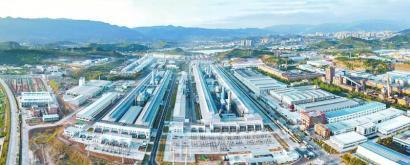
Core Viewpoint - The financial support initiatives in Guangyuan are aimed at promoting high-quality economic development, with a focus on key industries, green finance, and the private economy, resulting in significant project financing agreements and growth in the aluminum industry [2][3]. Financial Support for Industry - Guangyuan has established a 5 billion yuan fund for aluminum-based new materials and issued 800 million yuan in micro-debt, providing 19.3 billion yuan in financing support over the past three years, with an expected output value of 41.9 billion yuan in 2024, representing a 30% year-on-year increase [3]. - The collaboration between local banks has enabled companies like Sichuan TCL Haineng Environmental Technology Co., Ltd. to secure long-term loans, enhancing production efficiency by 85% through digital transformation projects [3]. Green Finance Development - Guangyuan has created a supply chain finance model for the aluminum industry, providing 13.5 billion yuan in financing through 55 transactions for 25 companies, and has issued 990 million yuan in low-carbon transformation loans [4]. - The city has implemented various policies to guide green finance development, including the establishment of a green enterprise database and the creation of green financial products, achieving an annual growth rate of over 40% in green loans [5]. Wind Energy Projects - The Bank of China Guangyuan Branch has supported wind energy projects with a total credit of 2.056 billion yuan, facilitating the construction of seven wind farms with a total installed capacity of 443.1 MW, generating 1.2 billion kWh of electricity [6]. Support for Small and Micro Enterprises - Guangyuan has established a provincial-level inclusive financial service center, facilitating 504 billion yuan in financing through various online platforms and providing comprehensive financial services to small and micro enterprises [7]. - The city has formed "financing difficulty tackling teams" to address specific financing issues faced by businesses, successfully reducing loan interest rates and providing timely support to struggling enterprises [8].
上海票据交易所发布重要通知!涉及这些关键要点→
Jin Rong Shi Bao· 2025-05-13 03:30
Group 1 - The supply chain finance sector is experiencing growth in 2024, with an improved financing environment for small and medium-sized enterprises (SMEs) in China, despite traditional challenges such as fund occupation and accounts receivable delays [1] - The implementation of the "Notice on Regulating Supply Chain Finance Business" starting June 15, 2025, outlines 21 key tasks aimed at guiding the development of the industry, including the promotion of timely payments by core supply chain enterprises [2] - The Shanghai Commercial Paper Exchange has issued a notification detailing ten specific requirements for the reporting of accounts receivable electronic voucher business information, ensuring orderly progress in subsequent information reporting [2] Group 2 - The notification emphasizes that various financial institutions, including policy banks and foreign banks, must adhere to the reporting requirements for accounts receivable electronic voucher business information [3] - Reporting institutions are required to submit their accounts receivable electronic voucher business information directly to the Shanghai Commercial Paper Exchange and are prohibited from delegating this task to others [3] - Institutions and related parties must avoid making false or misleading claims regarding the reporting of accounts receivable electronic voucher business information to enterprises [3]
河北邢台:金融“活水”润泽民营经济
Zhong Guo Qing Nian Bao· 2025-05-13 03:21
Core Insights - The article highlights the significant role of financial support in enhancing the operational capacity and sales performance of private enterprises in Hebei province, particularly the Ruiheng Children's Toy Factory, which saw a 50% increase in production capacity and a rise in monthly sales from 800,000 to 1,500,000 yuan due to a 3 million yuan loan from China Construction Bank [1] Financial Support for Private Enterprises - The total loan balance for private enterprises in Xingtai reached 329.52 billion yuan by the end of February, marking a year-on-year growth of 17.05% [2] - Xingtai's financial institutions are increasingly directing resources towards private enterprises, focusing on sectors such as technological innovation, green low-carbon initiatives, and local specialty industries [2] Customized Financial Solutions - Xingtai has organized various bank-enterprise matchmaking events to address financing challenges faced by small and micro enterprises, allowing banks to tailor financing solutions to specific needs [2] - Hebei Deyuquan Dairy Co., Ltd. received a 20 million yuan loan within a week to support its expansion plans [2] Support for County-Level Industrial Clusters - The Xingtai government is facilitating collaboration between financial institutions and key counties to support the development of county-level industrial clusters, with a loan balance of 81.35 billion yuan for these clusters, reflecting a year-on-year increase of 29.83% [3] - Financial institutions are integrating deeply with industrial chains, as demonstrated by the Agricultural Bank of China providing a 48 million yuan loan for equipment purchase and additional credit support for related enterprises [3] Interest Rate Trends - Xingtai's financial institutions are working to lower loan interest rates, with the average interest rate for new corporate loans at 4.41% and for new inclusive small and micro enterprise loans at 4.45%, both showing a decrease compared to the previous year [4]
40万亿供应链金融市场迎新规 直击哪些行业潜规则?
Zhong Guo Jing Ying Bao· 2025-05-12 10:41
Core Viewpoint - The new regulations on supply chain finance in China aim to enhance the protection of small and medium-sized enterprises (SMEs) and improve the overall health of the supply chain finance ecosystem, effective from June 15, 2025 [1][2]. Summary by Relevant Sections Regulatory Changes - The People's Bank of China, along with several regulatory bodies, has issued new guidelines that officially include accounts receivable electronic vouchers into the regulatory framework, which is expected to foster industry development and innovation [2][3]. - The new regulations signal a shift towards "de-financialization" of supply chain finance platforms, emphasizing their role as information platforms rather than credit platforms, which will promote healthier development of third-party platforms [2][3]. Risk Management - The new regulations introduce a comprehensive credit risk management system, including monitoring of all debts of core enterprises and addressing risks associated with bill circulation [3][4]. - The regulations replace the previous cash flow indicators with a focus on the financial condition of enterprises as a risk warning metric, aiming to create a more robust credit risk prevention framework [3][4]. Payment Practices - The regulations address the issue of delayed payments to SMEs by core enterprises, mandating timely payments and prohibiting unreasonable payment terms or the abuse of non-cash payment methods to extend payment periods [5][6]. - The maximum payment period for accounts receivable electronic vouchers is set at six months, with a maximum of one year [5][6]. Fee Structures - The new guidelines regulate the charging practices of core enterprises and supply chain information service providers, ensuring that fees related to accounts receivable confirmation are reasonable and transparent [6][7]. - Core enterprises are prohibited from charging SMEs under the guise of accounts receivable confirmation and must clearly define and publicize their service fee standards [6][7].