反垄断

Search documents
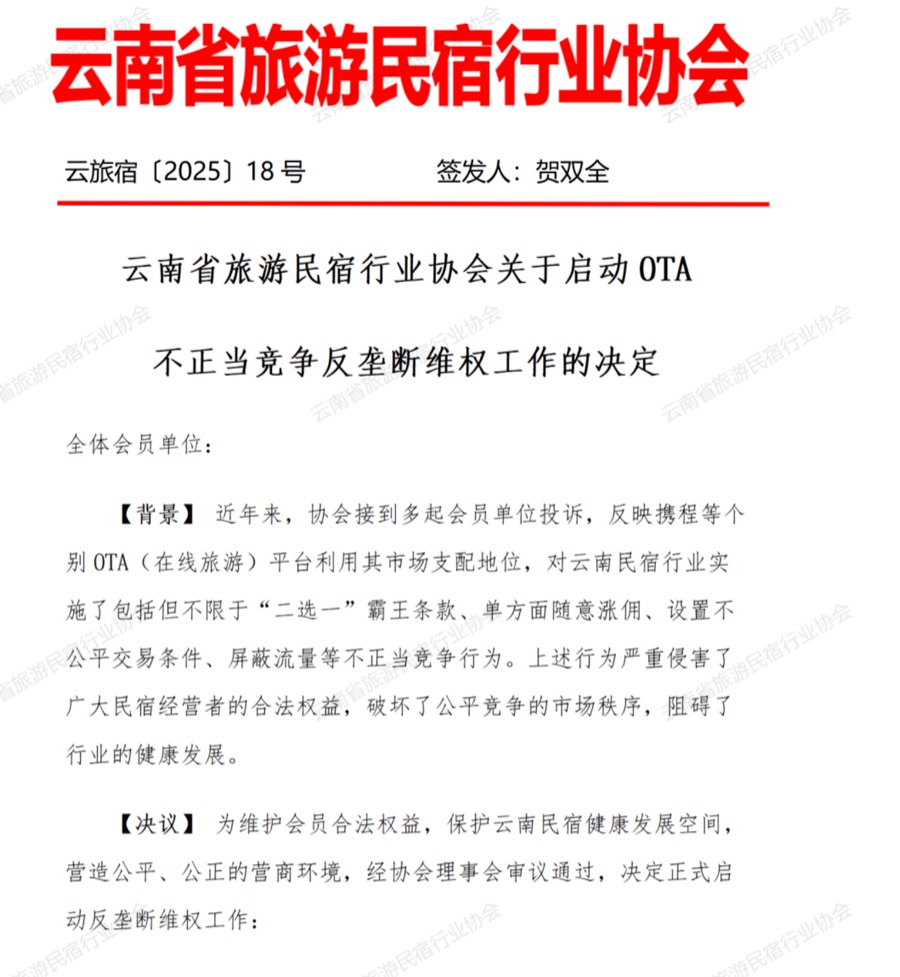
云南民宿协会直播回应对在线旅游平台启动反垄断维权工作:平台在挣整个行业的“血汗钱”
Xin Lang Cai Jing· 2025-12-12 15:26
Core Viewpoint - The Yunnan Provincial Tourism Homestay Industry Association has initiated collective legal action against online travel platforms (OTAs) like Ctrip for alleged abuse of market dominance, raising concerns about unfair competition practices in the homestay industry [1][4]. Group 1: Allegations Against OTAs - The association has received multiple complaints from its members regarding OTAs using their market power to impose unfair practices, including "choose one from two" clauses, arbitrary commission increases, unfair trading conditions, and traffic blocking [1][4]. - These practices are said to severely infringe on the legitimate rights of homestay operators, disrupt fair market competition, and hinder the healthy development of the industry [1][4]. Group 2: Association's Response and Actions - The association's president, He Shuangquan, emphasized the need for fair competition and criticized the notion that platforms should dictate which apps users must use or force homestays to align with specific platforms [1][4]. - The first step in their action plan involves collecting evidence from affected homestays to support a collective lawsuit to be submitted to the market supervision administration [1][4]. Group 3: Commission and Fee Concerns - He Shuangquan noted that while commissions typically range from 8% to 15%, hidden platform fees can lead to total commission rates as high as 30% to 40%, raising questions about the market and profit space for homestays [1][4]. - The president pointed out that the revenue generated by homestays is often viewed as a source of income for the platforms, resulting in platforms earning more than the service providers themselves, which he described as "blood money" [1][4].



大疆与影石的供应链之战
经济观察报· 2025-12-12 13:54
Core Viewpoint - The article discusses the competitive tension between two companies, DJI and Insta360, highlighting the supply chain exclusivity and market strategies that have emerged as a result of their rivalry [2][5][30]. Supply Chain Exclusivity - Insta360's founder revealed that several core suppliers have faced pressure to not collaborate with Insta360, indicating a trend of exclusivity in the supply chain where suppliers must choose between working with DJI or Insta360 [2][8]. - The exclusivity has escalated, with suppliers being explicitly instructed to cease any cooperation with Insta360, impacting their ability to source critical components [9][10]. - The primary area affected by this exclusivity is the optical lens module sector, where suppliers are increasingly pressured to align with DJI due to its dominant market position [11][17]. Sales Channel Conflicts - The competition has extended to sales channels, with reports of physical store signs for Insta360 being forcibly removed due to pressure from DJI's distributors [4][19]. - A specific incident involved a store owner who invested significantly in renovations only to be informed of a ban on selling Insta360 products due to a "hidden directive" from DJI [24][25]. - The article notes that DJI has been actively working to secure exclusive sales agreements with retailers, limiting the presence of competing brands like Insta360 in key retail spaces [26][27]. Supplier Concerns - Suppliers are caught in a dilemma, as many rely heavily on DJI for revenue, with some reporting that losing DJI as a client could lead to significant revenue declines [14][15]. - The article highlights that while some suppliers are willing to support Insta360, they are cautious due to the potential financial repercussions of losing DJI's business [12][13]. - The competitive landscape is further complicated by the fact that many suppliers do not face capacity constraints, making the choice between DJI and Insta360 a strategic rather than a necessity-driven decision [15]. Market Dynamics and Responses - Insta360 has been proactive in developing alternative supply chain strategies to mitigate the impact of exclusivity, including diversifying its supplier base and fostering relationships with willing partners [30]. - The article suggests that the ongoing competition may ultimately drive innovation and growth within the industry, as companies adapt to the challenges posed by exclusivity [30][31]. - The legal implications of such exclusivity practices are also discussed, with experts weighing in on the potential antitrust concerns surrounding DJI's market behavior [31].


美股盘前丨美股指期货涨跌不一 博通美股盘前跌超6%
Di Yi Cai Jing· 2025-12-12 13:35
Company News - Tesla's U.S. sales in November fell to a nearly four-year low, with the low-cost models failing to reverse the decline [1] - Oracle's stock dropped 1% in pre-market trading, following a nearly 11% decline in the previous trading session [1] - Apple overturned some court orders in the Epic antitrust case [1] - Broadcom's stock fell over 6% in pre-market trading, as the company's earnings report revealed a backlog of $73 billion in AI product orders [1]
大片来了:特朗普女婿入局7600亿华纳“截胡”战
阿尔法工场研究院· 2025-12-12 11:32
Core Viewpoint - The article discusses the significant merger between Netflix and Warner Bros. Discovery, which has raised concerns about market competition and potential antitrust issues, particularly due to the combined market share in the streaming sector [6][10][12]. Group 1: Merger Details - Netflix announced an $82.7 billion acquisition of Warner Bros. Discovery's core assets, including HBO and HBO Max, with a combination of stock and cash, while also taking on approximately $10.7 billion in debt [6]. - Paramount Skydance, led by David Ellison, proposed a competing cash offer of $108.4 billion for Warner Bros. Discovery, which includes a broader asset package [7][8]. - The merger, if successful, would represent the largest global merger in nearly a decade, prompting immediate reactions from high-level stakeholders [7][12]. Group 2: Antitrust Concerns - The merger could lead to Netflix and HBO Max controlling 33% of the U.S. streaming market, exceeding the 30% threshold that raises antitrust concerns according to U.S. regulatory guidelines [11][12]. - The potential consolidation of such a significant market share could be interpreted as a substantial reduction in competition, which may lead to regulatory pushback [12]. Group 3: Strategic Implications - The acquisition of Warner Bros. Discovery's assets is seen as crucial for Paramount Skydance to enhance its market position, as it currently lacks a leading streaming platform [15]. - The article highlights the importance of content ownership in the media industry, suggesting that the ability to leverage high-quality intellectual property is vital for competitive advantage [12][24]. Group 4: Industry Context - The article notes the trend of Silicon Valley companies entering Hollywood, with Amazon's acquisition of MGM being a recent example, indicating a shift in the media landscape [25][29]. - The competition for valuable content and streaming capabilities is intensifying, as evidenced by the aggressive bidding strategies employed by both Netflix and Paramount Skydance [29].



特朗普插手华纳兄弟交易 挑战行政权力边界
Xin Lang Cai Jing· 2025-12-12 09:24
Core Viewpoint - The intervention of former President Trump in the proposed sale of Warner Bros. Discovery has created unprecedented uncertainty in the competition between Netflix and Paramount Global for key Hollywood assets [2][11]. Group 1: Trump's Intervention - Trump's involvement is unusual, especially given his personal conflicts of interest, as he has suggested including CNN in the sale to influence its reporting [3][12]. - Trump's son-in-law, Jared Kushner, has previously raised funds for Paramount's CEO, David Ellison, indicating a network of personal connections influencing the deal [3][12]. - The traditional regulatory approval process led by the U.S. Department of Justice is being overshadowed by political considerations, complicating the transaction for executives and shareholders [3][12]. Group 2: Legal and Regulatory Implications - Experts highlight that Trump's actions could blur the lines between personal interests and government oversight of market concentration, potentially jeopardizing the deal and complicating regulatory reviews [4][13]. - State attorneys general may initiate antitrust lawsuits based on Trump's comments, which could challenge any federal approvals of the transaction [8][17]. - The involvement of Middle Eastern funding in Paramount's $24 billion acquisition bid may attract scrutiny under strict EU foreign subsidy rules [8][17]. Group 3: Historical Context - Direct presidential intervention in corporate mergers is rare, with historical examples including Theodore Roosevelt and Lyndon Johnson, indicating a precedent for political influence in business transactions [9][18]. - The political landscape surrounding mergers has evolved, with Trump's presidency exemplifying a shift towards greater executive influence over corporate decisions [4][13].

胡晓炼:市场竞争的核心内涵是反垄断和反不正当竞争
Mei Ri Jing Ji Xin Wen· 2025-12-12 07:30
每经讯:12月11日至13日,由每日经济新闻与海南国际经济发展局联合主办的2025第十四届上市公司发 展年会暨海南自贸港开放机遇交流大会系列活动在海口举行。中国国际经济交流中心副理事长、中国进 出口银行原董事长胡晓炼12日发表主旨演讲时表示,市场竞争的主体只有在公平竞争环境下才能够更好 地发展,市场竞争的议题不仅要从国有和非国有企业的角度来看,更要看到它的核心内涵是反垄断和反 不正当竞争。因此,海南自由贸易港要创造公平竞争的市场环境,也需要从这两个方面入手。 (文章来源:每日经济新闻) ...
谷歌搜索结果偏袒自家服务 恐遭欧盟罚款
Ge Long Hui· 2025-12-12 06:58
Core Viewpoint - Google is expected to face fines from the EU antitrust regulators next year due to insufficient compliance with regulations that prohibit favoring its own services and products in search results [1] Group 1: Regulatory Actions - The EU has accused Google of favoring its own services in Google Shopping, Google Hotels, and Google Flights, which has led to conflicts with vertical search engines and various industries such as hotels, airlines, restaurants, and transportation [1] - Since the EU's accusations in March, Google has made several adjustments to its search results, with the latest changes occurring in October, but these adjustments still do not meet the requirements of the Digital Markets Act [1] - Fines for violating this regulation could reach up to 10% of the company's global annual revenue [1] Group 2: International Relations - The potential penalties for Google may provoke anger in the United States, which has criticized the EU's landmark laws as targeting American tech companies, although the EU denies these claims [1]

云南民宿协会对携程等OTA平台启动反垄断维权
21世纪经济报道· 2025-12-12 03:35
Core Viewpoint - The Yunnan Provincial Tourism Homestay Industry Association has initiated collective legal action against online travel agencies (OTAs) like Ctrip for alleged abuse of market dominance, including unfair competition practices that harm the rights of homestay operators [1][3]. Group 1: Allegations Against OTAs - The association has received multiple complaints from its members regarding OTAs using their market power to impose "choose one from two" clauses, arbitrary commission increases, unfair trading conditions, and traffic blocking, which severely infringe on the rights of homestay operators [1][3]. - The association has engaged a law firm to collect evidence and analyze the situation, calling for members to provide relevant documentation such as contract terms and communication records [1][3]. Group 2: Investigation and Legal Actions - The association's president emphasized that the investigation is not solely targeting a specific OTA but addressing a broader issue that may involve misunderstandings or mismanagement by regional OTA staff [3][4]. - The law firm confirmed the engagement and highlighted the importance of collective action, stating that if widespread issues are confirmed, it could lead to fundamental changes in regulations [4]. Group 3: Previous Regulatory Actions - In August, the Guizhou Provincial Market Supervision Administration held discussions with Ctrip and other travel platforms regarding potential violations, including "choose one from two" practices and price manipulation [4]. - In September, the Zhengzhou Market Supervision Bureau issued a corrective notice to Ctrip for violating e-commerce laws and engaging in unreasonable restrictions on platform operators [4].

苹果(AAPL.US)与Epic拉锯战上诉失败 禁止27%佣金但准许知识产权费
Zhi Tong Cai Jing· 2025-12-12 02:09
Core Viewpoint - Apple Inc. has faced a setback in its legal battle against a ruling that found it in contempt of court, but it has gained an opportunity to defend its practice of charging developers fees for transactions outside the App Store [1][2]. Group 1: Legal Proceedings - A federal appeals court upheld a previous ruling that Apple had willfully disobeyed a judge's order regarding its monopolistic practices under California law [1][2]. - The court indicated that the lower court had overstepped by prohibiting all commissions, suggesting that Apple is entitled to some compensation for the use of its intellectual property by developers [1][2]. Group 2: Financial Implications - Apple generates billions annually from digital sales commissions in its App Store, with estimates suggesting it earned $10 billion from its U.S. App Store in 2024 [2]. - The company has facilitated over $400 billion in developer sales in 2024, although it does not separately report App Store revenue [2]. Group 3: Ongoing Disputes - The legal dispute, initiated by Epic Games over competition in the App Store, has been ongoing for over five years, with Apple previously allowing developers to direct users to cheaper payment options but imposing a new 27% commission on such transactions [2][3].

云南民宿协会对在线旅游平台启动反垄断维权工作 会长:不是针对某一平台 但对携程反馈较多
2 1 Shi Ji Jing Ji Bao Dao· 2025-12-12 01:36
Core Viewpoint - The Yunnan Provincial Tourism Homestay Industry Association has initiated collective legal action against online travel agencies (OTAs) like Ctrip for alleged abuse of market dominance, including unfair competition practices that harm the rights of homestay operators [1][2]. Group 1: Allegations Against OTAs - The association has received multiple complaints from its members regarding Ctrip and other OTAs using their market power to impose "choose one from two" clauses, unilaterally increasing commissions, setting unfair trading conditions, and blocking traffic [1][2]. - The association's president highlighted that complaints were particularly concentrated against Ctrip during the peak tourist seasons in August and September [2]. Group 2: Legal Actions and Investigations - The association has engaged Shanghai Jintiancheng (Kunming) Law Firm to assist in evidence collection and legal analysis, calling on members to provide relevant documentation [1][3]. - The designated lawyer confirmed that the investigation is not specifically targeting Ctrip but is focused on a broader issue of unfair practices within the industry [3]. Group 3: Regulatory Context - In August, the Guizhou Provincial Market Supervision Administration had already raised concerns with Ctrip and other travel platforms regarding similar issues, including "choose one from two" practices and price manipulation [3]. - In September, the Zhengzhou Market Supervision Administration issued a corrective notice to Ctrip for violating e-commerce laws and engaging in unreasonable restrictions on platform operators [4]. Group 4: Industry Dynamics - The conflict between OTAs and small merchants is not new, with previous allegations against Ctrip dating back to 2021, when a hotel platform accused it of market abuse [4]. - As of the latest update, Ctrip has not responded to the allegations made by the Yunnan Provincial Tourism Homestay Industry Association [5].