红利策略

Search documents
最近红利策略燃爆了,高调背后是声东击西!
Sou Hu Cai Jing· 2025-07-14 14:46
Group 1 - The banking sector has seen a significant rise, with the China Securities Banking Index increasing by 16.54% year-to-date, marking a nearly ten-year high [1] - Major state-owned banks have reached historical stock price records, while regional banks like Chengdu Bank have experienced nearly 100% growth [1] - The market sentiment suggests that many investors feel they have missed out on these opportunities [1] Group 2 - The current market environment is characterized by a focus on high-dividend stocks, but only a few have performed well, leading to a mixed performance across the sector [3] - A key strategy in a bull market is to "timely switch stocks" rather than "blindly hold stocks," as the former can lead to better investment outcomes [3] - Investors are advised to focus on institutional attitudes rather than market hype surrounding dividend strategies [3] Group 3 - Investors should not focus on the popularity of stocks, as hot sectors may be overbought while cold sectors could be on the verge of a breakout [6] - Short-term price fluctuations do not necessarily indicate long-term trends, and stock price levels do not determine future performance [6] - An example of "Zitian Technology" illustrates that despite a short-term surge, the lack of institutional support led to significant losses for investors [5][10] Group 4 - The analysis of institutional trading characteristics shows that stocks with sustained institutional involvement, like "Ruifeng High Materials," are more likely to be solid investment choices [12] - The banking sector was previously underweighted by public funds, with only 3.49% allocation, but has recently attracted significant long-term capital from insurance and social security funds [13] - The market often completes key transitions before the majority of investors realize the changes, indicating the importance of being proactive in investment strategies [13]

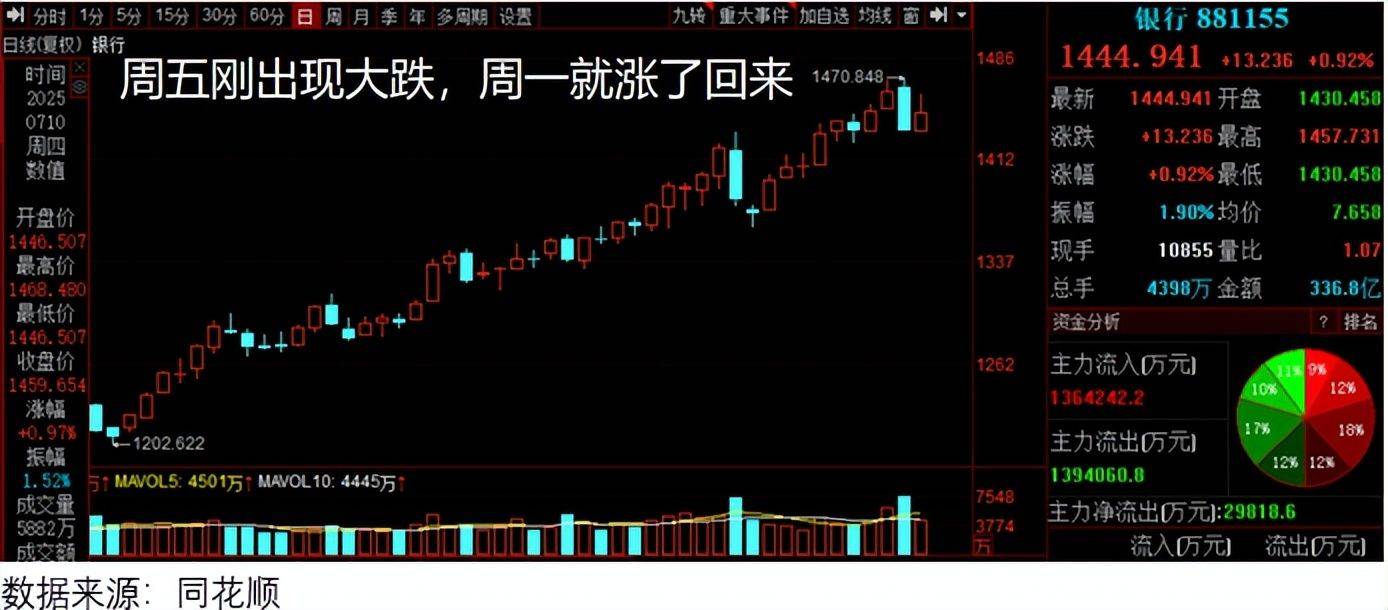
银行股燃爆红利基金!增配逻辑猛抬头,公募低配或渐成历史
券商中国· 2025-07-14 04:36
Core Viewpoint - The banking sector is becoming a popular choice for public funds due to favorable changes in funding, policy, sentiment, and fundamentals, with the China Securities Banking Index rising 16.54% this year, marking a ten-year high [1][7]. Group 1: Fund Dynamics and Market Sentiment - The collective rise of dividend assets, represented by bank stocks, reflects a growing value investment atmosphere in the market, with major banks reaching historical highs [2][3]. - The demand for dividend-themed funds has surged, leading to a rapid increase in the launch of various dividend funds by public funds, indicating strong institutional interest [2][9]. - The shift in public fund allocations towards bank stocks is driven by the need for stable returns amid global uncertainties and the increasing appeal of low-valuation, high-dividend assets [8][9]. Group 2: Performance and Investment Strategies - Bank stocks have outperformed expectations, with Chengdu Bank's stock price increasing by 98% since January 2024, contributing significantly to the performance of many funds [3][4]. - The long-standing 工银金融地产基金 has seen substantial returns over the past three years, highlighting the resurgence of traditional funds focusing on bank stocks [3][4]. - Fund managers are increasingly adjusting their portfolios to include more bank stocks, reflecting a strategic shift towards undervalued assets [5][6]. Group 3: Regulatory and Market Conditions - Recent regulatory changes have prompted public funds to reassess their allocations, with a noted underweight in bank stocks compared to major indices [4][9]. - The ongoing asset shortage and low interest rates are driving insurance companies to invest in dividend assets, further supporting the banking sector's appeal [9][10]. - The introduction of policies encouraging insurance funds to invest a significant portion of new premiums in A-shares is expected to inject substantial long-term capital into the market [9][10].

红利也往香江去
远川投资评论· 2025-07-14 02:37
Core Viewpoint - Insurance capital has been actively acquiring shares in listed companies, with 19 instances recorded in the first half of 2025, indicating a strong demand for stable investment opportunities [1][2]. Group 1: Investment Trends - The companies favored by insurance capital are primarily in sectors such as banking, environmental protection, transportation, and public utilities, characterized by low valuations and substantial dividend payouts [2][10]. - The shift in investment strategy reflects a broader trend of long-term funds moving from fixed-income assets to equity markets due to declining long-term interest rates [7][10]. - High dividend stocks are regaining investor attention as they provide stable cash flow and lower price volatility compared to other equity assets [7][10]. Group 2: Dividend Strategy - The diversity of dividend strategies is evident, with companies opting for either high dividend payouts or more cost-effective dividend distributions [3][4]. - High dividend-paying companies are typically found in mature industries, where growth opportunities are limited, leading to a focus on returning profits to shareholders [5][10]. - The China Securities Dividend Index, which tracks the top 100 high dividend stocks in A-shares, currently shows an overall dividend yield of approximately 5.5%, significantly higher than the 10-year government bond yield of 1.67% [9][10]. Group 3: Central Enterprises and Market Dynamics - Insurance capital is increasingly targeting Hong Kong-listed central enterprises, which exhibit stable earnings and high dividend yields [16][21]. - The valuation of Hong Kong stocks has historically been lower than that of A-shares, making them more attractive from a dividend yield perspective [17][18]. - The Hong Kong Central Enterprise Dividend ETF (513910) has a dividend yield of 7.94%, even after accounting for a 20% dividend tax, outperforming similar A-share assets [21][28]. Group 4: Policy and Management Improvements - Recent improvements in the management efficiency of central enterprises, driven by policies such as the inclusion of cash dividends in market value management metrics, have led to a systematic revaluation of these companies [27][28]. - The proportion of institutional investors in central enterprises has increased by 3 percentage points year-on-year in the first quarter of 2025, indicating growing confidence in these entities [26]. Group 5: Strategic Insights - The investment behavior of insurance capital mirrors that of Berkshire Hathaway, focusing on stable, high-dividend yielding assets that are essential to the economy [31][33]. - The Hong Kong Central Enterprise Dividend ETF (513910) is positioned as an optimal choice for investors seeking to benefit from both dividend income and the potential gains from central enterprise reforms [34].

A股上市银行密集分红,银行ETF指数(512730)涨势不断,周线斩获十连阳
Xin Lang Cai Jing· 2025-07-14 02:34
Group 1 - The China Banking Index (399986) increased by 0.46% as of July 14, 2025, with notable gains from several banks including Minsheng Bank (2.25%) and Guiyang Bank (2.19%) [1] - As of July 13, 2024, 35 out of 42 A-share listed banks have completed their annual dividend distribution, including major state-owned banks and several joint-stock banks [1] - Guosheng Securities anticipates that expansionary policies aimed at stabilizing the economy and promoting consumption will accelerate, benefiting the banking sector and potentially leading to alpha opportunities in cyclical stocks [1] Group 2 - The Bank ETF Index closely tracks the China Banking Index and serves as an analytical tool for investors, categorizing securities into various industry levels [2] - As of June 30, 2025, the top ten weighted stocks in the China Banking Index accounted for 65.64% of the index, with major banks like China Merchants Bank and Industrial and Commercial Bank of China among them [2]





高胜率+低估值凸显配置价值,富国中证800自由现金流ETF联接今日发行
Quan Jing Wang· 2025-07-14 01:47
Group 1 - The core viewpoint emphasizes the increasing importance of intrinsic quality and risk resilience of companies in the context of macroeconomic uncertainty and ongoing overseas risks, with free cash flow being a key indicator of true profitability and financial health [1] - The newly launched fund, the FTFT China Securities 800 Free Cash Flow ETF Fund, aims to provide investors with an efficient tool to capitalize on policy dividends in the "anti-involution" era by investing in quality cash flow assets [1] - Free cash flow, defined as the cash generated from operating activities minus capital expenditures, reflects a company's ability to distribute cash to investors or for strategic decisions, indicating higher profitability quality and stronger risk resilience [1] Group 2 - Historical performance shows that indices like the CSI 300 Free Cash Flow, CSI 500 Free Cash Flow, and CSI 800 Free Cash Flow have outperformed the CSI Dividend Index since December 31, 2013 [2] - The FTFT China Securities 800 Free Cash Flow ETF Fund closely tracks the 800 cash flow index, focusing on 50 "cash cow" companies with sufficient free cash flow, excluding financial and real estate sectors [2] - The index has a significant large-cap style, with over 60% of its constituent companies having a market capitalization exceeding 100 billion, and over 70% exceeding 50 billion [2] Group 3 - The underlying quality of the index contributes to its long-term viability, with the 800 cash flow total return index achieving over 90% historical annual win rate, only declining in 2018, and has recorded positive returns for six consecutive years since 2019 [3] - Current economic fundamentals suggest that the 800 cash flow index may benefit from policies aimed at expanding domestic demand, particularly in cyclical sectors [3] - The current price-to-earnings ratio (TTM) of the 800 cash flow index is 10.31, which is relatively low historically, providing a substantial margin of safety compared to other major indices [3]
跌破面值也坚持分红!公募行业频现闪电派现,月月分红成常态
券商中国· 2025-07-13 23:25
Core Viewpoint - The competition in the public fund industry has intensified, particularly in the area of fund dividends, with strategies like "flash dividends" and "monthly dividends" becoming commonplace [1][2]. Group 1: Fund Dividend Trends - Flash dividends and monthly dividends are becoming standard practices in the public fund industry, with some funds distributing dividends even when not required by their contracts [2][4]. - Certain funds have announced dividends despite having minimal distributable profits, highlighting a trend where dividends are used as a marketing strategy to attract investors [5][6]. Group 2: Marketing and Investment Strategies - Fund dividends are increasingly viewed as a key marketing strategy for public funds, prompting fund managers to adapt their stock selection philosophies to meet the growing demand for dividends [3][8]. - The phenomenon of "dividend wars" is emerging, where funds distribute dividends based on contractual obligations rather than actual profits, indicating the competitive nature of the market [6][7]. Group 3: Impact on Fund Management - The trend of high-frequency dividends is pushing fund managers to focus on value investing and stable income-generating assets, which may lead to a shift in investment strategies towards undervalued dividend-paying stocks [8][9]. - Fund managers are now tasked with identifying companies that can provide sustainable high dividend yields, emphasizing the importance of reliable cash flow and strong corporate governance [8][9].

银行股再度刷屏 基金增配逻辑持续演绎
Zheng Quan Shi Bao· 2025-07-13 17:29
Core Viewpoint - The banking sector is becoming a popular choice for public funds as they shift towards dividend-themed funds amid a backdrop of significant market activity and low allocation in this sector [1][2]. Group 1: Dividend Strategy and Market Performance - The banking stocks, particularly the four major state-owned banks, have seen significant price increases, with some reaching historical highs due to the effectiveness of low valuation and high dividend strategies [2]. - Chengdu Bank, heavily weighted in over 100 funds, has experienced a cumulative increase of 98% from January 2024 to July 11, 2025, outperforming many tech stocks and attracting attention from top fund managers [2]. Group 2: Fund Allocation and Research Activities - Public funds have a current allocation of approximately 3.49% in the banking sector, which is underweight by 9.99 percentage points compared to the CSI 300 index and 6.99 percentage points compared to the CSI 800 index [3]. - Recent fund research activities have focused on banks that were previously underweighted, indicating a potential shift in investment strategy [3][4]. Group 3: Institutional Investment Trends - Insurance companies and large institutional investors are increasingly turning to dividend assets like banking stocks due to rising demand for stable returns amid global uncertainties [5][6]. - The banking sector's current price-to-book ratio is 0.72, below the global average, and its dividend yield is significantly higher than government bond yields, making it attractive for long-term investors [6]. Group 4: Future Outlook - The combination of low interest rates, accounting changes, and policy guidance is expected to further enhance the appeal of dividend strategies, with insurance funds likely to become a significant source of new capital in the stock market [6].

更加注重持有人体验 公募基金频现密集分红
Zheng Quan Shi Bao· 2025-07-13 17:24
Group 1 - The public fund industry is experiencing intense competition in the area of fund dividends, with practices like "lightning dividends" and monthly dividends becoming the norm [1][2] - Some funds are implementing dividends even when they are not required to do so by their contracts, and some are distributing dividends despite significant losses [1][3] - The trend of frequent dividends is seen as a marketing strategy to attract investors, prompting fund managers to upgrade their stock selection and focus on undervalued dividend assets [1][4] Group 2 - Recent announcements indicate that several funds are implementing cash dividends shortly after their establishment, with some funds even distributing dividends multiple times within a month [2][3] - The practice of distributing dividends despite being in a loss position is noted, with some funds continuing to pay dividends while having negative distributable profits [3][4] - The emphasis on dividends is pushing fund managers to adopt value-oriented investment strategies, focusing on companies that can generate stable cash flows and maintain healthy balance sheets [4][5]
本周聚焦:上半年有多少ETF资金流入银行板块?
GOLDEN SUN SECURITIES· 2025-07-13 14:40
Investment Rating - The report does not explicitly provide an investment rating for the banking sector Core Insights - In the first half of 2025, the banking sector saw a total net inflow of 122 billion yuan from ETFs, with significant contributions from the CSI 300 ETF (89 billion yuan) and dividend ETFs (32 billion yuan) [2] - The report highlights that while short-term impacts from tariff policies may affect exports, long-term expansionary policies aimed at stabilizing the economy are expected to benefit the banking sector [3] - Specific banks such as Ningbo Bank, Postal Savings Bank, and China Merchants Bank are recommended for their cyclical growth potential, while Shanghai Bank and Jiangsu Bank are noted for their dividend strategies [3] Summary by Sections ETF Fund Inflows - The total net inflow into the banking sector from ETFs in the first half of 2025 was 122 billion yuan, with the CSI 300 ETF being the largest contributor [2] - The banking ETF alone saw a net inflow of 35 billion yuan, while the dividend ETF contributed 52 billion yuan [1][2] Market Trends - The report indicates a slowdown in overall ETF inflows compared to the previous year, with a notable peak in April 2025 [1] - The banking sector's performance is expected to improve due to supportive policies aimed at economic recovery [3] Key Data Tracking - The average trading volume for stocks reached 14,962.78 billion yuan, reflecting an increase from the previous week [4] - The balance of margin financing and securities lending increased by 0.78% to 1.87 trillion yuan [7] Interest Rates and Debt Issuance - The issuance of interbank certificates of deposit reached 4,264.30 billion yuan, with an average interest rate of 1.61% [8] - Local government special bond issuance totaled 63.985 billion yuan, with a cumulative issuance of 22,275.22 billion yuan since the beginning of the year [8] Sector Performance - The banking sector's performance is tracked against the CSI 300 index, with fluctuations noted in the sector's growth [5] - The report includes various charts detailing the performance of individual banks and their respective contributions to ETF inflows [11][16]




保险行业点评:“1+3+5”长周期考核背后的深意
Minsheng Securities· 2025-07-13 08:24
Investment Rating - The report maintains a "Recommended" rating for the insurance sector, indicating an expected relative increase of over 15% compared to the benchmark index within the next 12 months [13]. Core Insights - The Ministry of Finance issued a notification on July 11, 2025, to guide insurance funds towards long-term stable investments, introducing a new performance evaluation system for state-owned commercial insurance companies [3][4]. - The new evaluation model, termed "1+3+5," emphasizes long-term investment by adjusting key performance indicators, including the capital preservation and appreciation rate and return on equity (ROE) [3][4]. - The adjusted ROE now combines assessments over one year, three years, and five years, with respective weights of 30%, 50%, and 20% [4]. - The capital preservation and appreciation rate has also shifted to a similar "1+3+5" model, with weights of 50%, 30%, and 20% for the respective periods [4]. - The notification aims to enhance asset-liability management and increase stable long-term returns, with a focus on absolute return strategies rather than relative performance [5]. Summary by Sections Performance Evaluation Adjustments - The performance evaluation system for state-owned insurance companies now includes a combination of one-year, three-year, and five-year assessments for both ROE and capital preservation rates, promoting a long-term investment perspective [4][11]. Investment Strategy Implications - The new guidelines are expected to lead insurance companies to prioritize absolute returns, combining active and passive management strategies, and increasing the importance of dividend and low-cost, high-liquidity strategies [5]. - The long-term capital influx into the market is anticipated to stabilize the equity market, with insurance companies likely to increase their equity investment ratios and benefit from capital gains as the equity market develops [6]. Recommendations - The report suggests that insurance companies should enhance their equity investments to improve investment flexibility and mitigate potential "spread loss" pressures, thereby improving asset-liability matching capabilities [6].