跨境支付

Search documents
*ST仁东(002647) - 002647*ST仁东投资者关系管理信息20250919
2025-09-19 09:40
Group 1: Financial Performance - In the first half of 2025, the company achieved revenue of 405 million, a year-on-year decrease of 39.66% [1] - The net profit attributable to shareholders was 347 million, representing a year-on-year increase of 406.00%, marking a turnaround from losses [1] Group 2: Restructuring Impact - The restructuring process has resolved historical debt issues and significantly optimized the asset-liability structure [2] - Strategic investors, including China Credit Capital and other strong investors, have been introduced to support sustainable development [2] Group 3: Business Development - The company is actively developing a second growth curve alongside its primary payment business, having established several subsidiaries focused on technology [2][6] - The main business remains third-party payment services post-restructuring [4][5] Group 4: Regulatory and Licensing Matters - The company is in close communication with regulatory authorities regarding the renewal of its payment license, with ongoing efforts to expedite the process [3][5] - The subsidiary, Heli Bao, is actively pushing for the renewal of its payment license, with updates to be disclosed in official announcements [5] Group 5: Future Strategies - The company plans to explore opportunities in stablecoins and cross-border payment solutions, aligning with industry trends and regulatory frameworks [3][5] - The strategic vision includes leveraging AI to enhance payment services and create a comprehensive smart technology ecosystem [6]

港股异动 | 中国儒意(00136)尾盘涨超6% 公司已战略性投资多个蓝海赛道 有望形成新增长极
智通财经网· 2025-09-19 07:37
Core Viewpoint - China Ruyi (00136) is experiencing a significant stock price increase, attributed to strategic acquisitions and investments aimed at enhancing its gaming and entertainment capabilities [1] Company Summary - China Ruyi's stock rose over 6% towards the end of trading, with a current price of 2.89 HKD and a trading volume of 418 million HKD [1] - The company plans to acquire 100% of ByteDance's Youai Interactive, 30% of Tencent's Yonghang Technology, and 30% of Kuaiqian, while also investing in 52Toys, which will strengthen its self-developed and publishing capabilities in gaming [1] - The acquisitions will help China Ruyi form new growth drivers and strategically position itself in emerging sectors such as IP derivatives, cross-border payments, and digital RMB [1] Industry Summary - The film industry is expected to recover steadily by 2025, enhancing the competitive advantage and market share of quality film leaders [1] - The orderly launch of gaming projects is anticipated to contribute to performance elasticity, while the streaming service, Pumpkin Film, is expected to generate incremental revenue in the film channel [1] - AI technology is projected to reduce costs and improve efficiency in the film industry [1] - Revenue projections for China Ruyi are estimated at 4.84 billion CNY and 5.89 billion CNY for 2025 and 2026, respectively, with year-on-year growth rates of 32% and 22% [1] - Net profit forecasts for the same years are 1.64 billion CNY and 2.03 billion CNY [1]
中国儒意尾盘涨超6% 公司已战略性投资多个蓝海赛道 有望形成新增长极
Zhi Tong Cai Jing· 2025-09-19 07:37
Group 1 - The core viewpoint of the article highlights the significant stock price increase of China Ruyi (00136), which rose over 6% towards the end of trading, with a current price of 2.89 HKD and a trading volume of 418 million HKD [1] - Guohai Securities reports that China Ruyi will acquire 100% of the shares of Youai Interactive Entertainment, a subsidiary of ByteDance, and 30% of shares from both Yonghang Technology, a Tencent subsidiary, and Kuaiqian, along with an investment in 52Toys, enhancing its game self-research and publishing capabilities [1] - The strategic acquisitions are expected to create new growth drivers for the company, focusing on IP derivatives, cross-border payments, and digital RMB, which are considered blue ocean markets [1] Group 2 - Tianfeng Securities indicates that the film industry is expected to recover steadily by 2025, which will enhance the competitive advantages and market share of quality film leaders [1] - The orderly launch of game projects is anticipated to contribute to performance elasticity, while the streaming service, Pumpkin Film, is expected to generate additional revenue from the film channel [1] - AI in film production is projected to reduce costs and increase efficiency, with revenue forecasts for China Ruyi at 4.84 billion and 5.89 billion CNY for 2025 and 2026 respectively, representing year-on-year growth rates of 32% and 22% [1]
宇信科技跌2.07%,成交额2.99亿元,主力资金净流出5869.91万元
Xin Lang Cai Jing· 2025-09-19 05:51
Company Overview - Yuxin Technology's stock price decreased by 2.07% on September 19, closing at 25.02 CNY per share, with a total market capitalization of 17.616 billion CNY [1] - The company was established on October 19, 2006, and went public on November 7, 2018 [1] - Yuxin Technology primarily provides IT solutions to financial institutions, with 84.94% of its revenue coming from banking IT solutions [1] Financial Performance - For the first half of 2025, Yuxin Technology reported a revenue of 1.415 billion CNY, a year-on-year decrease of 5.01%, while net profit attributable to shareholders increased by 35.26% to 220 million CNY [2] - The company has distributed a total of 808 million CNY in dividends since its A-share listing, with 415 million CNY distributed in the last three years [3] Shareholder Information - As of September 10, 2025, the number of shareholders decreased to 79,600, with an average of 8,835 circulating shares per shareholder, an increase of 4.16% [2] - The top ten circulating shareholders include Hong Kong Central Clearing Limited and Southern CSI 1000 ETF, with notable changes in holdings among other institutional investors [3] Market Activity - Yuxin Technology's stock has increased by 29.87% year-to-date, but has seen declines of 3.21% over the last five trading days and 10.03% over the last 20 days [1] - The net outflow of main funds was 58.6991 million CNY, with significant selling pressure observed [1]

信雅达跌2.04%,成交额2.04亿元,主力资金净流出3221.14万元
Xin Lang Cai Jing· 2025-09-19 05:51
Company Overview - Xinyada Technology Co., Ltd. is located in Hangzhou, Zhejiang Province, established on July 22, 1996, and listed on November 1, 2002. The main business involves software technology development and consulting services [1]. - The revenue composition of the company is as follows: IT industry 99.30%, environmental protection industry 0.65%, and other business income 0.05% [1]. Financial Performance - For the first half of 2025, Xinyada achieved operating revenue of 861 million yuan, representing a year-on-year growth of 11.24%. The net profit attributable to the parent company was -52.635 million yuan, with a year-on-year increase of 9.76% [2]. - Since its A-share listing, Xinyada has distributed a total of 826 million yuan in dividends, with 143 million yuan distributed in the last three years [3]. Stock Performance - As of September 19, Xinyada's stock price decreased by 2.04%, trading at 16.83 yuan per share, with a total market capitalization of 7.848 billion yuan [1]. - Year-to-date, Xinyada's stock price has increased by 34.50%, but it has seen a decline of 7.32% over the last five trading days and 14.48% over the last 20 days [1]. Shareholder Information - As of June 30, 2025, the number of shareholders increased by 13.50% to 67,300, with an average of 6,797 circulating shares per person, a decrease of 11.89% [2]. - Among the top ten circulating shareholders, Hong Kong Central Clearing Limited is the fifth largest, holding 4.3874 million shares, an increase of 92,000 shares compared to the previous period [3].

流动性宽松+增量资金涌入,高盛:维持A股超配!资金重点关注金融科技,百亿ETF(159851)大举吸金
Xin Lang Ji Jin· 2025-09-19 05:30
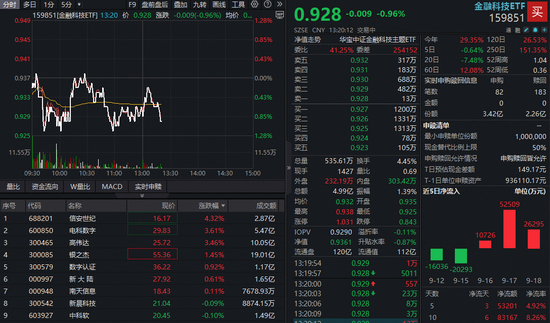
Market Overview - A-shares experienced a volume contraction and consolidation on September 19, with a focus on opportunities in the fintech sector as funds showed interest during declines [1] - The China Securities Financial Technology Theme Index fell over 1% during the day, with several constituent stocks declining, including Hengbao Co., which dropped over 5% [1] - Conversely, stocks like Electric Science Digital and Xin'an Century saw gains of over 2% [1] ETF Performance - The fintech ETF (159851), which has a scale exceeding 10 billion, saw a drop of over 1% during trading, with real-time transactions amounting to 500 million yuan, reflecting a slight decrease in volume [1] - Despite the drop, the fintech ETF received a net subscription of over 100 million units, accumulating nearly 900 million yuan in inflows over the previous three days [1] Investment Sentiment - Goldman Sachs maintains an overweight rating on A-shares and H-shares, predicting potential upside of 8% and 3% respectively over the next 12 months, and recommends investors to buy on dips, focusing on themes like "Top Ten Private Enterprises in China," AI, and shareholder returns [2][3] - The current market conditions are favorable for an upward trend, supported by liquidity and fundamental factors, with expected earnings growth in major indices remaining in the mid-to-high single digits [3] Liquidity and Capital Flow - There is a net inflow of global capital into the A-share market, with household savings increasingly moving into capital markets, creating a continuous source of incremental funds [3] - The recent interest rate cuts by the Federal Reserve are expected to enhance global liquidity, benefiting the A-share technology growth sector [3] Fintech Sector Dynamics - The fintech sector is highlighted as having significant elasticity and is expected to benefit from improved liquidity, with internet brokerage fundamentals anticipated to continue improving [4] - The sector is also experiencing a "technology innovation bull market," with AI, cross-border payments, and big data emerging as new growth points for fintech companies [5] - The fintech ETF (159851) has a scale exceeding 10 billion yuan, with an average daily trading volume of over 1.4 billion yuan in the past month, indicating strong liquidity and market interest [5]

报告显示中国—东盟人民币跨境收付金额稳步增长
Zhong Guo Xin Wen Wang· 2025-09-18 12:13
Core Insights - The 2025 China-ASEAN Financial Cooperation and Development Forum highlighted a significant increase in the use of the Chinese yuan in ASEAN countries, with a projected cross-border payment amount of RMB 89,024.7 billion in 2024, marking a year-on-year growth of 50.74%, the fastest in three years [1][3]. Group 1: Cross-Border Payment Developments - ASEAN countries have consistently maintained a leading position in the use of the Chinese yuan for cross-border transactions [3]. - The bilateral use of local currencies between China and ASEAN has made notable progress across various sectors, including deepening monetary cooperation and expanding the coverage of cross-border clearing and settlement networks [3][4]. - The China Payment System (CIPS) reported a year-on-year increase of 41.6% in the number of cross-border yuan transactions and a 95.6% increase in transaction amounts with ASEAN countries [3]. Group 2: Strategic Initiatives and Collaborations - The People's Bank of China (PBOC) is committed to enhancing cross-border payment cooperation with ASEAN nations, focusing on improving CIPS infrastructure and promoting the interoperability of cross-border retail payments [4]. - New projects such as the "Hui Xiao Er" cross-border financial service platform and the North Bay Digital RMB service platform were launched during the forum, indicating a push towards innovative financial solutions [4].

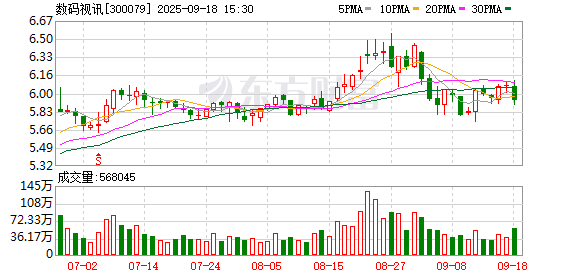
数码视讯:公司拥有互联网支付牌照及电视支付牌照,支付公司目前已接入跨境CIPS系统
Mei Ri Jing Ji Xin Wen· 2025-09-18 08:56
Core Viewpoint - The company is actively advancing its layout in data assets, digital currency, and cross-border payment sectors, leveraging its technological capabilities in various fields [2]. Group 1: Technological Capabilities - The company possesses a digital security system framework, low-latency transmission, ultra-high-definition encoding, 5G video applications, blockchain applications, and smart contracts [2]. - These technologies are expected to positively impact the development of electronic IDs, biometric identification, privacy encryption, and recognition modules, as well as facilitate the construction of data exchanges [2]. Group 2: Payment Licenses and Systems - The company holds internet payment and television payment licenses, indicating its compliance and capability in the payment sector [2]. - The payment company has currently integrated with the cross-border CIPS system, enhancing its operational capabilities in international transactions [2].

2025年深圳跨境电商展览会开幕
Nan Fang Ri Bao Wang Luo Ban· 2025-09-18 08:16
Core Insights - The 2025 Shenzhen Cross-Border E-Commerce Expo opened on September 17, attracting over 1,500 exhibitors from around the world [1] - The exhibition covers 14 major categories of quality suppliers, cross-border e-commerce platforms, and professional service providers [1] - The total exhibition area reached 80,000 square meters, showcasing a comprehensive range of resources across the entire cross-border e-commerce industry chain [1] Industry Activities - During the expo, over 100 high-quality concurrent events will be held, featuring experts from cross-border e-commerce platforms, corporate representatives, and industry leaders [1] - The events will include keynote speeches, roundtable discussions, and practical case sharing, focusing on industry trends, marketing innovations, overseas strategies, and cross-border payment issues [1]
全球首个“合规”离岸人民币稳定币亮相,来自“哈萨克斯坦持牌机构”Anchor X
Hua Er Jie Jian Wen· 2025-09-18 08:13
Core Insights - AnchorX has launched AxCNH, the world's first offshore RMB stablecoin with regulatory approval, aimed at facilitating cross-border transactions [1][2] - The stablecoin is designed to enhance cross-border payment and trade settlement for offshore Chinese enterprises [2] - AxCNH has been tested on the Conflux blockchain and will be listed on the licensed cryptocurrency exchange ATAIX in Kazakhstan, initially available only to professional investors [3] Group 1: Product Launch and Purpose - AnchorX has officially announced the issuance of AxCNH in Hong Kong, marking a significant milestone in the stablecoin market [1] - The primary goal of AxCNH is to provide a new payment settlement tool for cross-border transactions, particularly for Chinese enterprises operating offshore [2] Group 2: Partnerships and Applications - AnchorX has signed memorandums of understanding with several companies, including major players like Zoomlion and Lenovo, to explore applications of AxCNH in cross-border payments, trade settlements, and digital asset transactions [2] - The collaboration with Zoomlion is particularly noteworthy, as the company reported overseas revenue of 23.4 billion RMB in 2024, accounting for over 50% of its total revenue [2] Group 3: Trading and Accessibility - AxCNH will be listed on the ATAIX exchange, offering trading pairs with KZT (Kazakhstani Tenge) and USDT [3] - Currently, trading of AxCNH is restricted to professional clients, reflecting a cautious approach to market entry [3]