
出口管制

Search documents
两部门:对重量能量密度大于等于300Wh/kg的可充放电锂离子电池等物项实施出口管制
Jing Ji Guan Cha Wang· 2025-10-09 16:18
Core Viewpoint - The Ministry of Commerce and the General Administration of Customs of China announced export controls on lithium batteries and artificial graphite anode materials, effective from November 8, 2025 [2] Group 1: Export Control Details - Export controls will apply to rechargeable lithium-ion batteries with an energy density of 300Wh/kg or greater, including battery cells and packs [2] - The controls also encompass equipment used for manufacturing rechargeable lithium-ion batteries and related anode materials [2] - The announcement includes an update to the "Export Control List of Dual-Use Items of the People's Republic of China" [2]

这家公司的,拥有建设“灯塔工厂”的小模型!| 1009 张博划重点
Hu Xiu· 2025-10-09 15:02
Core Viewpoint - The Chinese government has expanded export controls on superhard materials, certain rare earth equipment, and lithium battery components, indicating a strategic move to strengthen domestic industry competitiveness and control over critical technologies [2][3]. Group 1: Export Control Scope - The scope of export controls has widened to include dual-use items requiring export licenses, particularly those involving rare earth materials and technologies used in military applications [3]. - Specific items under control include artificial diamond micro-powder, rare earth production equipment, and lithium negative electrode materials [2][3]. Group 2: Focus on Key Areas - Export applications related to military, lethal weapons, and terrorism are generally not permitted, highlighting the government's focus on national security [3]. - The announcement emphasizes controls on technologies related to chip manufacturing and artificial intelligence, particularly for processes involving 14nm logic chips and 256-layer storage chips [3]. Group 3: Technology Control - Export controls now explicitly cover rare earth mining, smelting, and recycling technologies, extending to the assembly, debugging, maintenance, and upgrading of related production lines [4]. - The controls include not just the products but also technical data such as design blueprints and process specifications, indicating a comprehensive approach to safeguarding advanced manufacturing capabilities [4]. Group 4: Industry Impact - The tightening of export controls is expected to significantly impact the rare earth industry, particularly in the deep processing of magnetic materials, ensuring that high-value processes remain within China [4]. - Key companies in this sector include Guangsheng Nonferrous, China Rare Earth, and Northern Rare Earth, with notable players in the magnetic materials field such as Zhenghai Magnetic Materials and Ningbo Yunsheng [4].


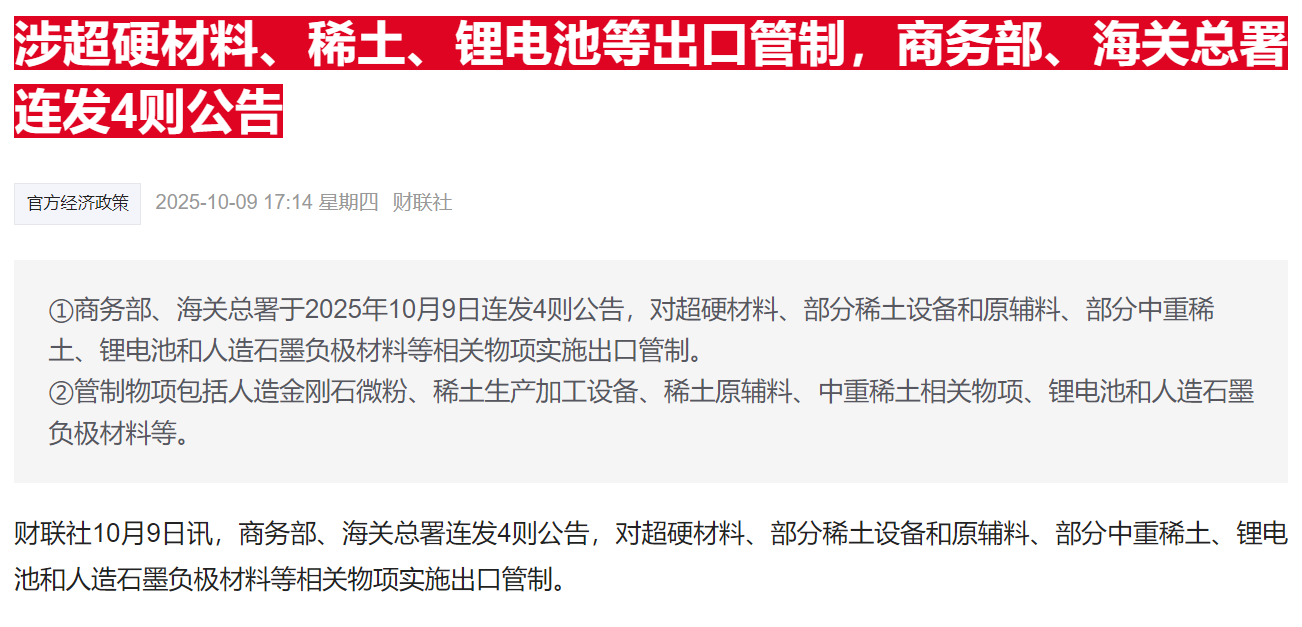
商务部、海关总署连发4则公告
Zheng Quan Shi Bao· 2025-10-09 14:05
Core Points - The Ministry of Commerce and the General Administration of Customs announced export controls on superhard materials, rare earth equipment and raw materials, heavy rare earths, lithium batteries, and artificial graphite anode materials, effective from November 8, 2025 [22][27] - The export control measures are in accordance with the Export Control Law of the People's Republic of China and are aimed at maintaining national security and fulfilling international non-proliferation obligations [22][27] Group 1: Superhard Materials - Export controls will be implemented on artificial diamond micro-powder with an average particle size less than or equal to 50 μm and artificial diamond single crystals with an average particle size greater than 50 μm and less than or equal to 500 μm [1] - Specific characteristics for controlled items include diamond wire saws and diamond grinding wheels with defined parameters such as wire diameter and average particle size [1][2] Group 2: Rare Earth Equipment and Raw Materials - Export controls will apply to various rare earth production and processing equipment, including centrifuge extraction equipment and ion-type rare earth ore intelligent continuous impurity removal equipment [3][4] - The announcement includes detailed specifications for controlled items such as roasting kilns, extraction tanks, and various types of furnaces used in rare earth processing [3][4][5] Group 3: Heavy Rare Earths - Export controls will be placed on materials related to holmium, erbium, thulium, europium, and ytterbium, including metals, alloys, compounds, and various forms of target materials [11][12][13][14][15][16][17][18][19][20] - The controlled items encompass a wide range of applications, including magnetic materials and crystal materials [11][12][13][14][15][16][17][20] Group 4: Lithium Batteries and Graphite Anode Materials - Export controls will be enforced on rechargeable lithium-ion batteries with a weight energy density greater than or equal to 300 Wh/kg, along with equipment used in their manufacturing [22][23] - Specific controls will also apply to positive electrode materials, including lithium iron phosphate and ternary precursor materials, as well as artificial and natural graphite anode materials [22][25][26]
总量月报第3期:关注政策宽松带来的交易机会-20251009
Western Securities· 2025-10-09 12:57
spsf 总量月报 关注政策宽松带来的交易机会 总量月报第 3 期 50%关联方规则是美国出口管制趋严的又一体现,未来还需警惕高科技行业 的制裁风险、关税风险和以"国家安全"为名的 232 调查。 我们认为,"关联方规则"将对特定地区(如俄罗斯等国家)和高科技行业 (半导体、航空航天、人工智能和其他军民两用技术等高科技行业的公司) 产生较大影响。 固定收益:配置价值凸显,交易关注超跌反弹 今年以来,财政政策较为积极,9-12 月财政赤字仍有 1.5 万亿元同比扩张空 间,年内可能不会追加预算赤字。但是财政部表示将"提前下达部分 2026 年新增地方政府债务限额,靠前使用化债额度",财政政策力度有可能进一 步加大。和财政政策相比,货币政策更加灵活。4 季度货币政策有可能再次 宽松,10 月底 11 月初可能出现降息降准的时间窗口。 国内政策:预告重要会议,后续政策可期 9 月国家政策延续了 7 月中央政治局会议"落实落细"的方向,在宏观经济 及产业政策方面持续发力。尤为值得重视的是,9 月中央政治局会议公布了 二十届四中全会召开时间,"十五五"规划精神呼之欲出。 海外政策:解读 BIS 50%关联方规则——"严 ...
重磅!商务部、海关总署连发4则公告
Zheng Quan Shi Bao Wang· 2025-10-09 11:56
Group 1 - The Ministry of Commerce and the General Administration of Customs announced export controls on superhard materials, rare earth equipment and raw materials, heavy rare earths, lithium batteries, and artificial graphite anode materials, effective from November 8, 2025 [42] - The export controls are based on the Export Control Law of the People's Republic of China and are aimed at maintaining national security and fulfilling international non-proliferation obligations [42] - The controlled items include artificial diamond powders, single crystals, diamond wire saws, diamond grinding wheels, and various rare earth production and processing equipment [2][6][19] Group 2 - Specific items under control include artificial diamond micro-powders with an average particle size less than or equal to 50 μm, and single crystals with an average particle size between 50 μm and 500 μm [2] - Rare earth production equipment includes centrifuge extraction devices, ion-type rare earth ore intelligent continuous impurity removal equipment with a daily processing capacity of at least 5000 m³, and various types of furnaces and reactors [7][8][19] - Lithium battery-related items include rechargeable lithium-ion batteries with a weight energy density of at least 300 Wh/kg and equipment used for manufacturing these batteries [31][35] Group 3 - The announcement emphasizes that the controlled items have significant dual-use attributes, and the measures are in line with international practices [42] - The Chinese government is open to maintaining stable global supply chains and will review legitimate export applications for approval [42] - The updated export control list will be published simultaneously with the implementation of these measures [5][18][41]
商务部、海关总署,连发4条重要公告
第一财经· 2025-10-09 11:06
Core Viewpoint - The Ministry of Commerce and the General Administration of Customs of China announced the implementation of export control measures on certain dual-use items, including rare earth materials, lithium batteries, and artificial graphite anode materials, effective from November 8, 2025. This action aims to safeguard national security and fulfill international obligations regarding non-proliferation [1][2][3]. Group 1: Export Control Items - The export control measures will cover various items, including: - Rare earth elements such as holmium, erbium, thulium, europium, and ytterbium, along with their alloys and compounds [3][5][7][9][11][13][15][19][21][23][25][27][29][31][33][35][37][39][41][43][45][47][49]. - Lithium batteries with a weight energy density of 300 Wh/kg or higher, and equipment used for manufacturing these batteries [19][20][22][24][26][28]. - Artificial diamond materials, including micro-powders and specific types of diamond saws and grinding wheels [31][32][34][36][38][40][42][44]. Group 2: Compliance and Application Process - Exporters must apply for permission from the Ministry of Commerce for the export of controlled items, ensuring the authenticity of the goods and compliance with the regulations [16][27][50]. - The customs declaration must clearly indicate whether the items are dual-use and include the relevant export control codes [16][50].
本轮5000亿政策性金融工具有望撬动5万亿项目总投资|宏观晚6点
Sou Hu Cai Jing· 2025-10-09 11:01
Group 1: Central Bank Operations - The People's Bank of China conducted a buyout reverse repurchase operation of 1.1 trillion yuan to maintain ample liquidity in the banking system [1] Group 2: Export Controls on Rare Earths - The Ministry of Commerce announced export controls on certain rare earth items and related technologies, requiring permits for the export of technologies related to rare earth mining, smelting, and recycling [2] Group 3: Resumption of Direct Flights - China and India are set to resume direct flights by the end of October this year [3]
商务部 海关总署公告2025年第56号 公布对部分稀土设备和原辅料相关物项实施出口管制的决定
Shang Wu Bu Wang Zhan· 2025-10-09 10:42
Core Viewpoint The announcement by the Ministry of Commerce and the General Administration of Customs of China outlines new export controls on specific rare earth production and processing equipment to safeguard national security and fulfill international non-proliferation obligations. The measures will take effect on November 8, 2025, and require exporters to apply for licenses for the controlled items. Group 1: Export Control Items - The export control list includes various types of rare earth production and processing equipment, such as centrifugal extraction devices and ion-type rare earth mineral continuous removal equipment with a daily leaching liquid capacity of at least 5000 m³ [1][2]. - Specific equipment characteristics are detailed, including roasting kilns with dimensions ranging from Φ1.8×20 m to Φ4.6×80 m and reaction temperatures not exceeding 850 ℃ [2][3]. - Additional controlled items include extraction tanks, ion adsorption devices, and various types of reactors and furnaces used in rare earth processing [3][4][5]. Group 2: Compliance Requirements - Exporters must apply for licenses in accordance with the Export Control Law and the Two-way Control Regulations for Dual-use Items, ensuring the authenticity of the goods being exported [11][12]. - The customs declaration must clearly indicate whether the items are controlled, with specific codes noted for dual-use items, and any items that are not controlled but closely resemble controlled items must also be properly annotated [11][12]. - The announcement emphasizes the importance of accurate and complete reporting of item specifications to avoid customs questioning, which could delay the release of exported goods [11].
商务部 海关总署公告2025年第58号 公布对锂电池和人造石墨负极材料相关物项实施出口管制的决定
Shang Wu Bu Wang Zhan· 2025-10-09 10:42
Core Viewpoint - The announcement by the Ministry of Commerce and the General Administration of Customs of China outlines new export controls on specific items related to lithium batteries and their components, effective from November 8, 2025, to safeguard national security and fulfill international obligations [9]. Group 1: Lithium Battery-Related Items - Export controls are imposed on rechargeable lithium-ion batteries with a weight energy density of 300 Wh/kg or greater, including cells and battery packs [1]. - Equipment used for manufacturing rechargeable lithium-ion batteries, such as winding machines, stacking machines, and liquid injection machines, is also subject to export controls [2]. - Technologies for producing controlled lithium-ion battery items are included in the export restrictions [2]. Group 2: Cathode Materials - Export controls apply to lithium iron phosphate cathode materials with a packing density of 2.5 g/cm3 or greater and a specific capacity of 156 mAh/g or greater [3]. - Precursor materials for ternary cathodes, including nickel-cobalt-manganese hydroxide and nickel-cobalt-aluminum hydroxide, are also regulated [4]. - Lithium-rich manganese-based cathode materials are included in the export control list [5]. Group 3: Anode Materials - Export controls are established for artificial graphite anode materials and mixed anode materials made from artificial and natural graphite [10]. - Equipment for producing graphite anode materials, such as granulation and graphitization equipment, is subject to export restrictions [10]. Group 4: Export Compliance Requirements - Exporters must apply for licenses from the Ministry of Commerce for the controlled items and ensure the authenticity of the declared goods [8]. - Customs will question the completeness and accuracy of the reported information, and goods will not be released during the questioning period if there are doubts about the authenticity [8].
商务部 海关总署公告2025年第55号 公布对超硬材料相关物项实施出口管制的决定
Shang Wu Bu Wang Zhan· 2025-10-09 10:42
Core Points - The announcement from the Ministry of Commerce and the General Administration of Customs implements export controls on specific artificial diamond products to safeguard national security and fulfill international non-proliferation obligations [1][5] - The export controls will take effect on November 8, 2025, and the list of controlled dual-use items will be updated accordingly [4] Group 1: Export Controlled Items - The following items are subject to export controls: - Artificial diamond micro-powder with an average particle size less than or equal to 50 μm [1] - Artificial diamond single crystals with an average particle size greater than 50 μm and less than or equal to 500 μm, excluding those used for decorative purposes [1] - Artificial diamond wire saws with specific characteristics, including a wire diameter less than or equal to 45 μm and a breaking tensile strength less than or equal to 16 N [2] - Artificial diamond grinding wheels with defined hardness and particle size specifications [3] Group 2: Export Procedures - Exporters must apply for permission from the Ministry of Commerce for the controlled items and are responsible for the authenticity of the declared goods [3] - Exporters must clearly indicate on the customs declaration whether the items are controlled dual-use items and provide relevant codes [3]