
AI推理

Search documents
解读英伟达的最新GPU路线图
半导体行业观察· 2025-03-20 01:19
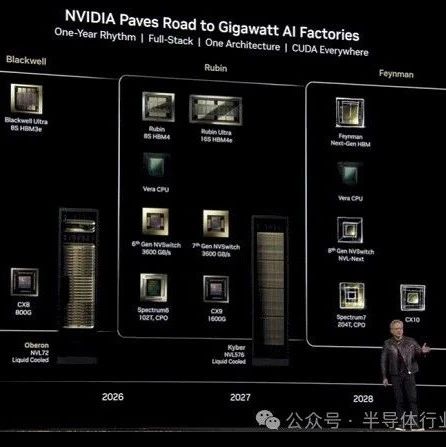
Core Viewpoint - High-tech companies consistently develop roadmaps to mitigate risks associated with technology planning and adoption, especially in the semiconductor industry, where performance and capacity limitations can hinder business operations [1][2]. Group 1: Nvidia's Roadmap - Nvidia has established an extensive roadmap that includes GPU, CPU, and networking technologies, aimed at addressing the growing demands of AI training and inference [3][5]. - The roadmap indicates that the "Blackwell" B300 GPU will enhance memory capacity by 50% and increase FP4 performance to 150 petaflops, compared to previous models [7][11]. - The upcoming "Vera" CV100 Arm processor is expected to feature 88 custom Arm cores, doubling the NVLink C2C connection speed to 1.8 TB/s, enhancing overall system performance [8][12]. Group 2: Future Developments - The "Rubin" R100 GPU will offer 288 GB of HBM4 memory and a bandwidth increase of 62.5% to 13 TB/s, significantly improving performance for AI workloads [9][10]. - By 2027, the "Rubin Ultra" GPU is projected to achieve 100 petaflops of FP4 performance, with a memory capacity of 1 TB, indicating substantial advancements in processing power [14][15]. - The VR300 NVL576 system, set for release in 2027, is anticipated to deliver 21 times the performance of current systems, with a total bandwidth of 4.6 PB/s [17][18]. Group 3: Networking and Connectivity - The ConnectX-8 SmartNIC will operate at 800 Gb/s, doubling the speed of its predecessor, enhancing network capabilities for data-intensive applications [8]. - The NVSwitch 7 ports are expected to double bandwidth to 7.2 TB/s, facilitating faster data transfer between GPUs and CPUs [18]. Group 4: Market Implications - Nvidia's roadmap serves as a strategic tool to reassure customers and investors of its commitment to innovation and performance, especially as competitors develop their own AI accelerators [2][4]. - The increasing complexity of semiconductor manufacturing and the need for advanced networking solutions highlight the competitive landscape in the AI and high-performance computing sectors [1][4].


英伟达GTC Keynote直击
2025-03-19 15:31
Summary of Key Points from the Conference Call Company and Industry Overview - The conference call primarily discusses **NVIDIA** and its developments in the **data center** and **AI** sectors, particularly in relation to the **GTC conference** held in March 2025. Core Insights and Arguments - **Data Center Product Launch Delays**: NVIDIA's data center products in Japan are delayed, with the first generation expected in 2026 instead of 2025, and the HBM configuration is lower than anticipated, with 12 layers instead of the expected 16 layers and a capacity of 288GB [2][3] - **Rubin Architecture**: The Rubin architecture is set to launch in 2026, featuring a significant performance upgrade with the second generation expected in 2027, which will double the performance [3][4] - **CPO Technology**: The Co-Packaged Optics (CPO) technology aims to enhance data transmission speeds and will be introduced with new products like Spectrum X and Quantum X [6] - **Small Computing Projects**: NVIDIA is focusing on small computing projects like DGX BasePOD and DGX Station, targeting developers with high AI computing capabilities [7] - **Pre-trained Models and Compute Demand**: The rapid growth of pre-trained models has led to a tenfold increase in model size annually, significantly driving up compute demand, which has resulted in a doubling of CSP capital expenditures over the past two years [9][10] - **Inference Stage Importance**: The conference emphasized the significance of the inference stage, with NVIDIA aiming to reduce AI inference costs through hardware and software innovations [11][12] - **Capital Expenditure Growth**: North America's top five tech companies are expected to increase capital expenditures by 30% in 2025 compared to 2024, nearly doubling from 2023 [16] - **Impact of TSMC's Capacity**: TSMC's increased capacity is projected to affect NVIDIA's GGB200 and GB300 shipment volumes, which are expected to decline from 40,000 units to between 25,000 and 30,000 units [17][20] Additional Important Insights - **Hardware Changes**: The GB200 and GB300 models show significant changes in HBM usage, with GB300 increasing from 8 layers to 12 layers, and a rise in power consumption [15] - **Market Performance**: Chinese tech stocks have outperformed U.S. tech stocks, indicating a potential shift in market dynamics [13] - **Future Product Releases**: NVIDIA's product roadmap includes significant advancements in GPU architecture, with the potential to influence the entire industry chain [14] This summary encapsulates the critical developments and insights shared during the conference call, highlighting NVIDIA's strategic direction and the broader implications for the tech industry.
深度解读黄仁勋GTC演讲:全方位“为推理优化”,“买越多、省越多”,英伟达才是最便宜!
硬AI· 2025-03-19 06:03
Core Viewpoint - Nvidia's innovations in AI inference technologies, including the introduction of inference Token expansion, inference stack, Dynamo technology, and Co-Packaged Optics (CPO), are expected to significantly reduce the total cost of ownership for AI systems, thereby solidifying Nvidia's leading position in the global AI ecosystem [2][4][68]. Group 1: Inference Token Expansion - The rapid advancement of AI models has accelerated, with improvements in the last six months surpassing those of the previous six months. This trend is driven by three expansion laws: pre-training, post-training, and inference-time expansion [8]. - Nvidia aims to achieve a 35-fold improvement in inference cost efficiency, supporting model training and deployment [10]. - As AI costs decrease, the demand for AI capabilities is expected to increase, demonstrating the classic example of Jevons Paradox [10][11]. Group 2: Innovations in Hardware and Software - Nvidia's new mathematical rules introduced by CEO Jensen Huang include metrics for FLOPs sparsity, bidirectional bandwidth measurement, and a new method for counting GPU chips based on the number of chips in a package [15][16]. - The Blackwell Ultra B300 and Rubin series showcase significant performance improvements, with the B300 achieving over 50% enhancement in FP4 FLOPs density and maintaining an 8 TB/s bandwidth [20][26]. - The introduction of the inference stack and Dynamo technology is expected to greatly enhance inference throughput and efficiency, with improvements in smart routing, GPU planning, and communication algorithms [53][56]. Group 3: Co-Packaged Optics (CPO) Technology - CPO technology is anticipated to significantly lower power consumption and improve network scalability by allowing for a flatter network structure, which can lead to up to 12% power savings in large deployments [75][76]. - Nvidia's CPO solutions are expected to enhance the number of GPUs that can be interconnected, paving the way for networks exceeding 576 GPUs [77]. Group 4: Cost Reduction and Market Position - Nvidia's advancements have led to a performance increase of 68 times and a cost reduction of 87% compared to previous generations, with the Rubin series projected to achieve a 900-fold performance increase and a 99.97% cost reduction [69]. - The overall trend indicates that as Nvidia continues to innovate, it will maintain a competitive edge over rivals, reinforcing its position as a leader in the AI hardware market [80].

速递|从训练到推理:AI芯片市场格局大洗牌,Nvidia的统治或有巨大不确定性
Z Finance· 2025-03-14 11:39
Core Viewpoint - Nvidia's dominance in the AI chip market is being challenged by emerging competitors like DeepSeek, as the focus shifts from training to inference in AI computing demands [1][2]. Group 1: Market Dynamics - The AI chip market is experiencing a shift from training to inference, with new models like DeepSeek's R1 consuming more computational resources during inference requests [2]. - Major tech companies and startups are developing custom processors to disrupt Nvidia's market position, indicating a growing competitive landscape [2][5]. - Morgan Stanley analysts predict that over 75% of power and computing demand in U.S. data centers will be directed towards inference in the coming years, suggesting a significant market transition [3]. Group 2: Financial Projections - Barclays analysts estimate that capital expenditure on "frontier AI" for inference will surpass that for training, increasing from $122.6 billion in 2025 to $208.2 billion in 2026 [4]. - By 2028, Nvidia's competitors are expected to capture nearly $200 billion in chip spending for inference, as Nvidia may only meet 50% of the inference computing demand in the long term [5]. Group 3: Nvidia's Strategy - Nvidia's CEO asserts that the company's chips are equally powerful for both inference and training, targeting new market opportunities with their latest Blackwell chip designed for inference tasks [6][7]. - The cost of using specific AI levels has decreased significantly, with estimates suggesting a tenfold reduction in costs every 12 months, leading to increased usage [7]. - Nvidia claims its inference performance has improved by 200 times over the past two years, with millions of users accessing AI products through its GPUs [8]. Group 4: Competitive Landscape - Unlike Nvidia's general-purpose GPUs, inference accelerators perform best when optimized for specific AI models, which may pose risks for startups betting on the wrong AI architectures [9]. - The industry is expected to see the emergence of complex silicon hybrids, as companies seek flexibility to adapt to changing model architectures [10].
英伟达电话会全记录,黄仁勋都说了什么?
华尔街见闻· 2025-02-27 11:09
Core Viewpoint - Nvidia's CEO Jensen Huang expressed excitement about the potential demand for AI inference, which is expected to far exceed current large language models (LLMs), potentially requiring millions of times more computing power [1][5]. Group 1: AI Inference and Demand - The demand for inference will significantly increase, especially for long-thought inference AI models, which may require several orders of magnitude more computing power than pre-training [5]. - Nvidia's Blackwell architecture is designed for inference AI, improving inference performance by 25 times compared to Hopper while reducing costs by 20 times [6][34]. - The DeepSeek-R1 inference model has generated global enthusiasm and is an outstanding innovation, being open-sourced as a world-class inference AI model [1]. Group 2: Financial Performance and Projections - Nvidia reported record revenue of $39.3 billion for the fourth quarter, a 12% quarter-over-quarter increase and a 78% year-over-year increase, exceeding expectations [32]. - The data center revenue for fiscal year 2025 is projected to be $115.2 billion, doubling from the previous fiscal year [32]. - Nvidia's CFO Colette Kress expects profit margins to improve once Blackwell production increases, with margins projected to be in the mid-70% range by the end of 2025 [2][11]. Group 3: Product Development and Supply Chain - The supply chain issues related to the Blackwell series chips have been fully resolved, allowing for the next training and subsequent product development to proceed without hindrance [1]. - Blackwell Ultra is planned for release in the second half of 2025, featuring improvements in networking, memory, and processors [16][60]. - Nvidia's production involves 350 factories and 1.5 million components, achieving $11 billion in revenue last quarter [8][53]. Group 4: Market Dynamics and Growth Areas - The global demand for AI technology remains strong, with the Chinese market's revenue remaining stable [20][68]. - Emerging fields such as enterprise AI, agent AI, and physical AI are expected to drive long-term demand growth [14][24]. - Nvidia's full-stack AI solutions will support enterprises throughout the entire AI workflow, from pre-training to inference [25]. Group 5: Infrastructure and Future Outlook - The current AI infrastructure is still utilizing various Nvidia products, with a gradual update expected as AI technology evolves [26][27]. - Nvidia's CUDA platform ensures compatibility across different generations of GPUs, facilitating a flexible update process [28]. - The company anticipates significant growth in data center and gaming businesses in the first quarter, driven by strong demand for Blackwell [44].
兴证海外TMT英伟达FY25Q4业绩会纪要
2025-02-27 01:29
会议时间: 2025 年 2 月 26 日(北京时间) 注:以下材料仅为公开资料整理,不涉及分析师的研究观点和投资建议,记录和翻译可能产 生误差,仅供参考,如有异议,请联系删除。 FY4Q25(截至 2025/1/26): - blackwell 专门为 AI 推理设计 blackwelll superchargers 推理模型,与 H100 相比,token 吞吐 量提升 25 倍,成本下降 20 倍 | | | Revenue by Market Platform | | | | | --- | --- | --- | --- | --- | --- | | ($ in millions) | Q4 FY25 | Q3 FY25 | Q4 FY24 | Q/Q | Y/Y | | Data Center | $35,580 | $30,771 | $18.404 | Up 16% | Up 93% | | Compute | 32,556 | 27,644 | 15.073 | Up 18% | Up 116% | | Networking | 3,024 | 3,127 | 3.331 | Down 3 ...
英伟达 和预期的数一模一样
小熊跑的快· 2025-02-26 23:17
Core Viewpoint - The company reported strong financial results for Q4 2025, with revenue reaching $39.3 billion, a 12% quarter-over-quarter increase and a 78% year-over-year increase, leading to an annual revenue of $130.5 billion, up 114% [1] Group 1: Financial Performance - Q4 data center revenue was $35.6 billion, marking a record high with a 16% quarter-over-quarter increase and a 93% year-over-year increase, driven by the release of the Blackwell architecture and expansion of Hopper 200 [2] - Q4 gaming revenue was $2.5 billion, down 22% quarter-over-quarter and 11% year-over-year, but annual revenue reached $11.4 billion, up 9% [2] - Professional visualization revenue for Q4 was $511 million, with a 5% quarter-over-quarter increase and a 10% year-over-year increase, totaling $1.9 billion for the year, up 21% [2] - Automotive revenue reached a record $570 million in Q4, with a 27% quarter-over-quarter increase and a 103% year-over-year increase, totaling $1.7 billion for the year, up 55% [2] Group 2: Product and Technology Developments - The Blackwell architecture contributed $11 billion in revenue for the quarter, emphasizing its impact on performance and cost efficiency in AI inference workloads [3] - The company launched a cluster of 100,000 GPU instances for inference and model customization, catering to the growing demand for AI applications across various industries [3] - The AI inference platform supports large-scale datasets, particularly in finance, healthcare, and retail, addressing the need for efficient processing [3] Group 3: Future Outlook - The company expects Q1 2026 total revenue to reach $43 billion, with a 2% quarter-over-quarter increase, and gross margin projected between 70.6% and 71% [3] - Operating expenses are anticipated to rise to a median of $3 billion for the year, with a Q1 expected tax rate of 17% [4] - Shareholder returns will include stock buybacks and cash dividends totaling $8.1 billion for the fiscal year [4]
TMT行业周报(2月第2周):DeepSeek引领国内推理侧行情-20250319
Century Securities· 2025-02-17 08:11
Investment Rating - The report does not explicitly state an investment rating for the industry Core Insights - The TMT sector outperformed the CSI 300 index, with significant gains driven by the release of DeepSeek's models, particularly in the computer and media sub-sectors [3][4] - DeepSeek's V3 and R1 models are reshaping the competitive landscape of AI large models, potentially leading to breakthroughs in vertical application scenarios such as AI healthcare, education, and finance [3][4] - The rapid user growth of DeepSeek, reaching 22.15 million daily active users within 20 days of launch, indicates a surge in demand for inference capabilities, which is expected to drive growth in computing power requirements [3][4] Market Weekly Review - The TMT sector saw significant weekly gains, with the computer industry leading at 22.29%, followed by media at 17.43% and electronics at 6.43% [3][4] - Notable stock performances included Qingyun Technology with a 208.19% increase and Light Media with a 264.43% increase [3][4] Industry News and Key Company Announcements Important Industry Events - The report highlights several key events in the AI sector, including the launch of new models by major companies and significant user growth for DeepSeek [15][17] - The AI technology exhibition in Dubai and the AI action summit in Paris are noted as important gatherings for industry leaders [16][17] Industry News - DeepSeek's rapid user growth and the introduction of new models are expected to enhance the competitive dynamics in the AI market [17][21] - The report mentions various companies, including JD Cloud and Huawei, integrating DeepSeek's models into their services, indicating a trend towards broader adoption of AI technologies [17][21] Company Announcements - Several companies, including Kingsoft and Cloud Tianyi, are reported to be integrating DeepSeek's models into their products, showcasing the growing influence of DeepSeek in the industry [34][36] - The report also notes that DeepSeek's API services are being adopted by various cloud service providers, further expanding its market reach [34][36]