中长期资金入市

Search documents
★引入源头活水 持续稳定和活跃资本市场
Zheng Quan Shi Bao· 2025-07-03 01:56
Group 1 - The recent meeting of the Central Political Bureau emphasized the need to "continuously stabilize and activate the capital market," reflecting a more proactive policy stance compared to previous statements focused solely on stability [1][2] - The capital market's strategic position in the overall economy has been significantly elevated, with the stock market serving as an economic "barometer" crucial for improving market expectations and boosting investor confidence [1][2] - The meeting indicates a commitment to institutional reforms aimed at consolidating the foundations for a stable and active capital market, with expectations for accelerated reforms in the investment and financing mechanisms [1][2] Group 2 - Various market participants, including the Central Huijin Investment Ltd. and national social security funds, have actively engaged in stabilizing the A-share market through substantial buybacks and investments, demonstrating the effectiveness of policy tools and mechanisms [2] - The concept of an "active capital market" suggests a need for increased market activity while maintaining stability, aligning with the broader goal of high-quality capital market development [2][3] - Future efforts by the China Securities Regulatory Commission will focus on removing barriers for long-term funds, such as social security and insurance funds, to enter the market, thereby enhancing liquidity and market vitality [2][3] Group 3 - An active capital market can lower financing costs and improve capital allocation efficiency, better serving the real economy, with future policies likely to encourage mergers and acquisitions and optimize trading mechanisms [3] - Recommendations include optimizing the listing and financing systems for quality technology companies, enhancing strategic reserves for market stability, and promoting active mergers and acquisitions to improve the quality of listed companies [3] - The Central Political Bureau's continuation of a moderately loose monetary policy and the potential for timely adjustments in reserve requirements and interest rates signal an expected improvement in market liquidity and risk resilience [4]
★金融政策打出组合拳 释放稳市场稳预期强烈信号
Zheng Quan Shi Bao· 2025-07-03 01:56
Group 1 - The core viewpoint of the news is the announcement of a comprehensive financial policy package by the People's Bank of China, the National Financial Regulatory Administration, and the China Securities Regulatory Commission to stabilize the market and expectations [1] - The implementation of a moderately loose monetary policy includes a 0.5 percentage point reduction in the reserve requirement ratio, aimed at enhancing liquidity and credit supply in specific sectors [1][2] - The reduction in the reserve requirement ratio for auto finance and financial leasing companies from 5% to 0% is expected to lower their funding costs and improve credit supply capabilities [2] Group 2 - The People's Bank of China has introduced measures to lower policy interest rates, including a 0.1 percentage point reduction in the 7-day reverse repurchase rate, which is expected to lead to a similar decrease in the Loan Prime Rate (LPR) [2] - The central bank's support for capital markets includes optimizing two monetary policy tools with a total quota of 800 billion yuan, allowing for more flexible use of funds [3] - The Central Huijin Investment Company is emphasized as a key player in maintaining capital market stability, with the central bank providing sufficient support for its operations [3] Group 3 - The expansion of pilot programs for insurance funds to invest long-term is set to inject an additional 60 billion yuan into the market, alongside adjustments to solvency regulations to encourage more stock investments [4] - The focus on increasing the scale and proportion of long-term funds entering the market is highlighted, with initiatives to promote high-quality development of public funds [4] - The roadmap for capital market reforms includes measures to enhance the stability and adaptability of the market, with a focus on supporting technological innovation and improving the investment environment for foreign entities [5]
★上交所:更大力度"引长钱" 为稳市场稳预期提供支持
Zheng Quan Shi Bao· 2025-07-03 01:56
Group 1 - The core viewpoint of the articles emphasizes the importance of long-term capital investment in stabilizing the market and boosting investor confidence, particularly through the role of ETFs [1][2] - The Shanghai Stock Exchange recently held a training session focused on the entry of equity funds from commercial bank wealth management companies into the market, guided by a policy document from six ministries [1] - As of the end of Q1 2025, the total scale of bank wealth management products is projected to reach 29.14 trillion yuan, reflecting a year-on-year increase of 9.41% [1] Group 2 - Bank wealth management companies are committed to enhancing their equity investment capabilities and increasing their allocation to equity assets, aligning with the "long money long investment" policy [1][2] - The domestic ETF market is experiencing robust growth, with index-based investments becoming a significant trend due to their advantages in risk diversification, transparency, and ease of trading [1] - The Shanghai Stock Exchange plans to deepen its investment services and innovate financing mechanisms to attract long-term capital, supporting market stability and expectations [2]
★在更深层次打通中长期资金入市卡点堵点 促进"长钱长投"机制进一步优化
Zhong Guo Zheng Quan Bao· 2025-07-03 01:56
Core Insights - China Pacific Insurance launched a private equity fund with a target size of 20 billion yuan, emphasizing long-term investment strategies [1][2] - China Chengtong's investment in three ETFs signals confidence in the long-term value of state-owned enterprises [1][2] - The approval of the first batch of new floating fee rate funds indicates a shift towards performance-based fee structures [3][4] Group 1: Long-term Capital Inflow - There is an increasing trend of long-term capital inflow into the capital market, with social security funds, enterprise annuities, and insurance funds showing significant investment activity [1][2] - The total net purchase of A-shares by long-term funds has exceeded 200 billion yuan this year, indicating a positive cycle of capital inflow and market stability [2][5] Group 2: Policy and Regulatory Developments - The China Securities Regulatory Commission (CSRC) has introduced a floating management fee mechanism linked to fund performance, encouraging long-term investment behavior [3][4] - Recent regulatory changes allow private equity funds to shorten lock-up periods for shares, enhancing liquidity and investment efficiency [4][5] Group 3: Future Outlook - The ongoing implementation of policies aimed at promoting long-term capital participation is expected to optimize the investment environment for insurance and pension funds [5] - There is potential for further increases in the equity investment ratio of insurance funds, as regulatory limits remain significantly below current levels [5]

【热点话题】以高水平法治实践推动资本市场高质量发展
Zheng Quan Shi Bao· 2025-06-30 18:17
Core Viewpoint - The recent policies and regulations aim to enhance the legal framework and regulatory environment of China's capital market, focusing on risk prevention, strong supervision, and promoting high-quality development [1][2][3]. Group 1: Legal and Regulatory Framework - The 20th National Congress emphasized the need for a coordinated investment and financing capital market, highlighting the importance of risk prevention and regulatory strength [1]. - The new "National Nine Articles" require a focus on strong regulation and risk prevention to promote high-quality development in the capital market [1][2]. - Recent measures have been introduced to support the long-term development of technology companies, with over 90% of companies listed on the Sci-Tech Innovation Board and the Growth Enterprise Market being tech firms [2]. Group 2: Market Stability and Investor Confidence - The introduction of guidelines to encourage long-term capital investment aims to create a stable market environment, addressing the historical volatility of the capital market [3]. - The implementation of policies such as the "Guidance on Promoting Long-term Capital Investment" and the "Action Plan for High-Quality Development of Index Investment" is designed to enhance market stability [3]. - Regulatory measures are being strengthened to support investor returns through dividends and share buybacks, fostering confidence among retail investors [3]. Group 3: Corporate Governance and Compliance - The new regulations focus on improving the share reduction rules for major shareholders to enhance corporate governance and protect investor interests [4]. - Stricter entry requirements for public offerings and enhanced responsibilities for intermediaries are being enforced to ensure market integrity [4]. - The introduction of a comprehensive system for monitoring and penalizing misconduct, including insider trading and market manipulation, is crucial for maintaining market fairness [5]. Group 4: Legal Enforcement and Investor Protection - The new "National Nine Articles" propose a multi-faceted approach to increase accountability for securities violations, including administrative, civil, and criminal penalties [5]. - Collaborative efforts between judicial and regulatory bodies aim to improve the efficiency of legal processes related to securities violations [5][9]. - Innovative dispute resolution mechanisms, such as judicial mediation and arbitration, are being promoted to enhance investor protection and resolve conflicts effectively [9]. Group 5: Future Directions and Challenges - The upcoming "14th Five-Year Plan" period will focus on addressing persistent issues in the capital market, such as shareholder misconduct and regulatory enforcement [7]. - There is a need for continuous improvement of laws and regulations, particularly in the areas of derivative trading and cross-market supervision [8]. - The promotion of a culture of compliance and investor education is essential to mitigate risks associated with market manipulation and fraud [8].
第二批保险资金长期投资试点正式开投,三批试点金额合计2220亿
Huan Qiu Wang· 2025-06-29 04:06
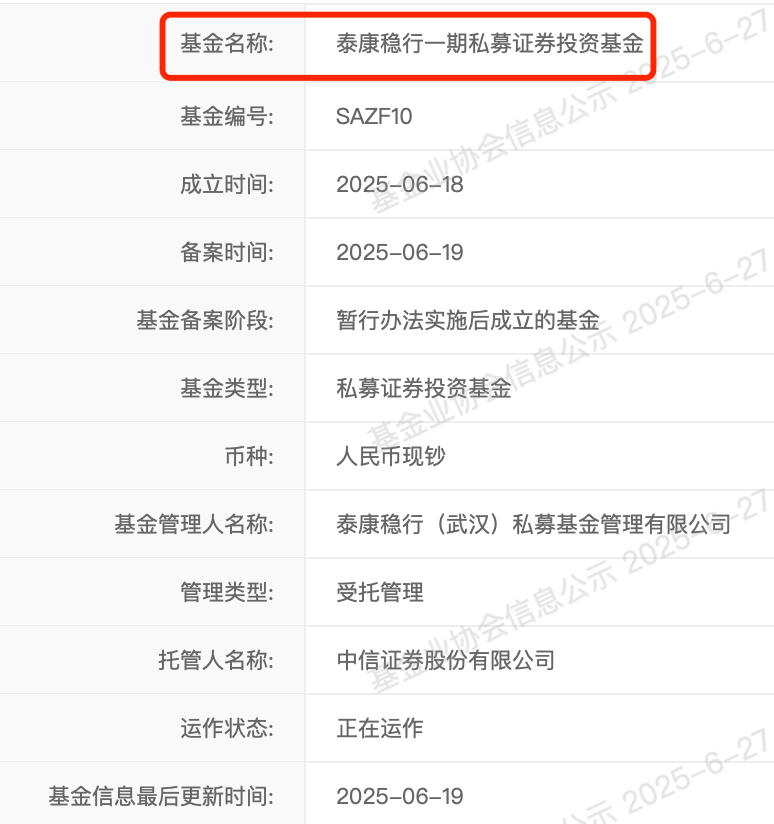
Group 1 - The second batch of insurance fund long-term investment pilot projects has officially commenced, with Taikang Asset being the first institution to announce its investment [1] - Taikang Stable Growth Fund, established by Taikang Asset, has a total approved amount of 12 billion yuan for long-term investments, aimed at optimizing asset-liability matching and enhancing capital market stability [2][3] - The investment strategy focuses on three main areas: high-dividend assets, industrial upgrade dividends, and counter-cyclical investment, promoting a long-term value investment approach [3] Group 2 - The total amount for the second and third batches of pilot projects has reached 222 billion yuan, with multiple insurance companies actively participating [4] - The long-term investment pilot is expected to alleviate profit volatility for insurance companies and enhance equity investments, contributing to a stable interaction between insurance funds and capital markets [4]

股指期货2025年中策略报告:稳中有进,开启慢牛-20250627
Yin He Qi Huo· 2025-06-27 05:15
银河研究 金融期货研发报告 金融期货年报 2025 年 6 月 27 日 稳中有进 开启慢牛 ——股指期货 2025 年中策略报告 报告摘要: 2025 上半年市场两次经受住了考验,分别在政策预期、资金支撑下实现探底反弹,形 成快跌慢涨的慢牛走势,底部不断抬高。 一行一局一会两度联合新闻发布会,坚强有力的表态表明管理层稳定股市的信心和决 心,下半年政策环境持续稳定,股指也将表现稳定。 市场利率不断下行,理财资金不断转向高股息资产为股市营造良好的市场环境,推动中 长期资金入市的政策指向使保险资金股票投资不断提速,汇金等央企增持又使市场增添信 心,资金面整体稳中有增。 宏观经济数据和上市公司业绩同样保持平稳,进而使估值下有支撑,股指慢牛表现即有 基本面又有资金面的助力,预计下半年将继续震荡上行。 股指期货成交持仓略有增长,受多方因素影响贴水有所加大,为期指多头带来较好的投 资机会,在风险合理控制的情况下,可能为投资者取得超额收益。 风险因素:国内经济增长不及预期,地缘政治因素 研究员:孙锋 期货从业证号: F0211891 投资咨询从业证号: Z000567 :sunfeng@chinastock.com.cn ...
推动“长钱长投”!官方“账本”披露
Jin Rong Shi Bao· 2025-06-26 03:52
Group 1 - The core viewpoint of the news is the significant growth and performance of enterprise annuity funds in China, with a focus on long-term investment strategies and the shift to a three-year cumulative performance assessment [1][2][3] Group 2 - As of the end of Q1 2025, there are 168,200 enterprises with enterprise annuities, covering 32.91 million employees, with total fund accumulation reaching 3.73 trillion yuan and net investment assets at 3.70 trillion yuan [1] - The three-year cumulative return for enterprise annuity funds is reported at 7.46%, with an annualized average of 2.43% [4] - The adjustment in performance assessment to a three-year cumulative basis aligns with the guidelines for promoting long-term capital market investments, aiming to enhance the value investment approach and improve long-term returns [1][2][3] Group 3 - The investment management landscape includes 22 institutions managing 5,713 annuity portfolios, with total assets amounting to 3.67 trillion yuan [4] - Fixed income assets account for 529.30 billion yuan with a three-year cumulative return of 10.54%, while equity-related assets total 3.17 trillion yuan with a return of 7.06% [4] - The average scale of individual portfolios has shown steady growth, increasing from 502 million yuan in Q1 2022 to 628 million yuan by Q1 2025 [4] Group 4 - There is a notable performance differentiation among investment management institutions, with some achieving returns exceeding 12% while others reported negative returns [5][6] - The current equity investment ratio of enterprise annuity funds in A-shares is approximately 14%, indicating significant room for growth towards the 40% cap on equity investments [6]
政策催化,券商板块价值重估?
Xin Lang Ji Jin· 2025-06-25 13:22
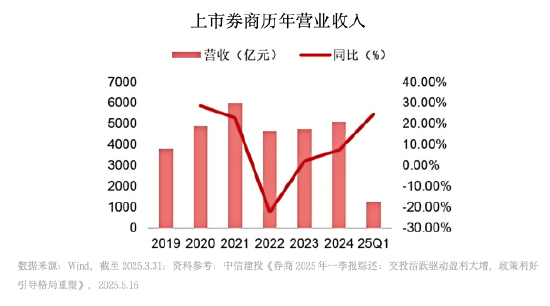
Group 1 - The core viewpoint of the article highlights the recent recovery of the brokerage sector due to favorable policies, particularly the implementation of the "1+6" reform measures in the Sci-Tech Innovation Board, which are expected to benefit the securities industry [1][2] - The "1+6" reform includes the establishment of a growth layer for the Sci-Tech Innovation Board and six innovative measures aimed at enhancing the adaptability of the system to better serve technological innovation and new productive forces [1] - Analysts believe that the relaxation of IPO regulations on the Sci-Tech Innovation Board will positively impact brokerage firms' investment banking and private equity direct investment businesses [1] Group 2 - The brokerage sector is expected to experience strong performance recovery from 2024 to the first quarter of 2025, with 42 listed brokerages projected to achieve a total revenue of 508.847 billion yuan, a year-on-year increase of 7.32%, and a net profit of 147.835 billion yuan, a year-on-year increase of 15.88% [3] - In the first quarter of 2025, listed brokerages are expected to report revenues of 125.930 billion yuan, a year-on-year increase of 24.60%, and a net profit of 52.183 billion yuan, a year-on-year increase of 83.48% [3] - The favorable policies are anticipated to expand the growth space for the securities industry, with increased market stability and improved investment ecology creating a more favorable environment for brokerage firms' proprietary businesses [6] Group 3 - The current valuation of the securities industry is believed to have adjusted to a reasonable level, with the securities II (Shenwan) industry index's price-to-earnings ratio (TTM) and price-to-book ratio (LF) at 19.81 times and 1.31 times, respectively, positioning at the 33rd and 48th percentiles over the past five years [6] - Institutional holdings indicate a significant underweight in the financial sector, with the non-bank sector underweight by 9.48% relative to the CSI 300 index, and the brokerage sector underweight by 6.25%, suggesting potential reallocation opportunities for public funds [6] - Historical experience shows that during an upward cycle in the A-share market, the brokerage sector often becomes a core focus due to increased trading activity, improved brokerage income, and enhanced proprietary business performance [6]
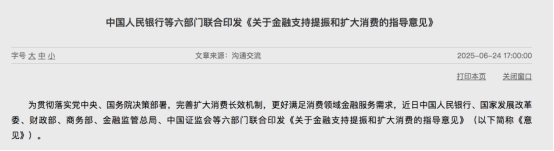
六部门联合印发金融支持消费指导意见 提出19项重点举措
Huan Qiu Wang· 2025-06-25 01:27
Group 1 - The core viewpoint of the article is the issuance of guidelines by six Chinese government departments to enhance and expand consumption through financial support, focusing on 19 key measures across six major areas [1][2][3] Group 2 - The guidelines emphasize the importance of strengthening consumer capacity and fostering demand, aiming to stabilize consumption expectations and enhance support for the real economy [2] - Financial institutions are encouraged to innovate and optimize credit products, particularly for the consumer sector, with a focus on first loans, renewals, credit loans, and medium to long-term loans [2] - A special re-lending facility of 500 billion yuan is established to support loans in key service consumption areas, allowing eligible financial institutions to apply for re-lending based on 100% of the loan principal [2] - The guidelines promote financial support for key consumption sectors, including wholesale and retail, catering, and elder care services, while also encouraging the development of new consumption models such as digital and green consumption [3] - Financial institutions are urged to engage with major projects in the consumption sector, including cultural and tourism facilities, healthcare, and infrastructure, to innovate financing models and optimize loan approval processes [3] - The guidelines aim to enhance payment convenience by improving payment services across various consumption scenarios, including cash, cards, mobile payments, and digital currency, while also focusing on the needs of elderly and foreign consumers [3]