
太空算力

Search documents
重回4000,超级赛道攻势延续
Ge Long Hui· 2026-01-05 12:44
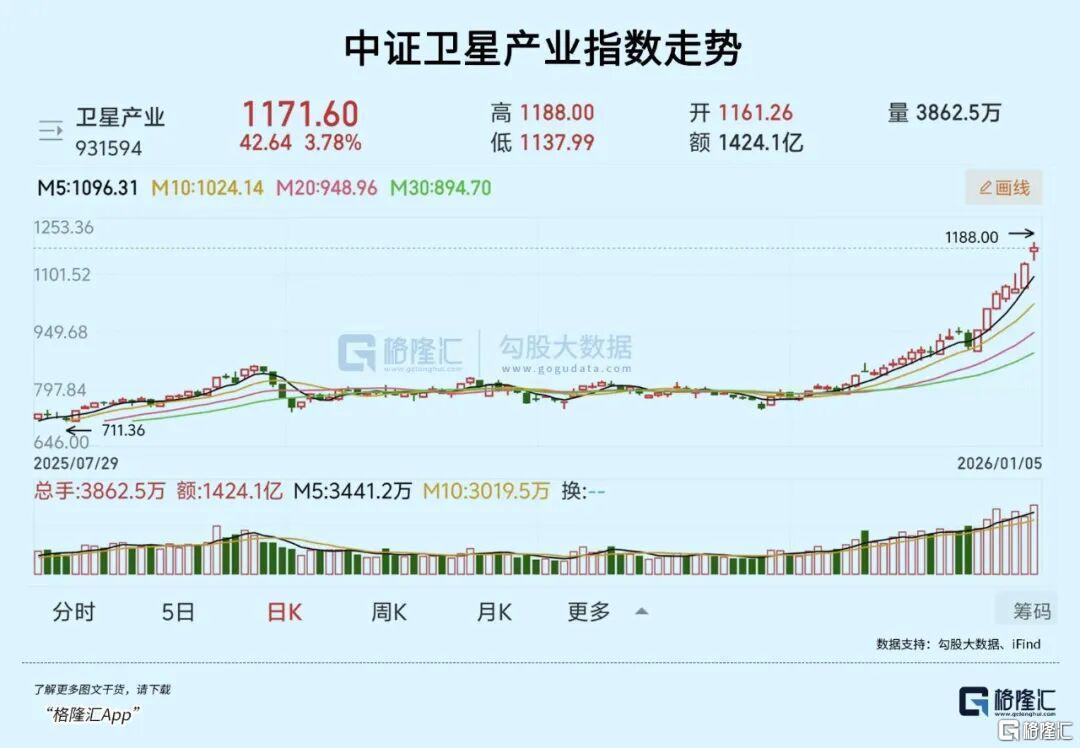
Group 1 - The A-share market opened positively in 2026, with the Shanghai Composite Index rising over 1% and the ChiNext Index increasing by more than 2%, driven by gains in technology, finance, and cyclical sectors [1][2] - The commercial aerospace sector is transitioning from a speculative concept to a core engine for national competition and economic transformation, with significant growth observed in the satellite internet segment [1][12] - The satellite industry ETF (159218) saw a substantial increase of 3.78%, with a record net inflow of 2.11 million shares, indicating strong investor interest in China's shift from experimental exploration to industrialized production [1][10][13] Group 2 - The brain-computer interface sector is experiencing a surge, with companies like Neuralink planning large-scale production in 2026, and the market is projected to grow to approximately $12.4 billion by 2034, with a compound annual growth rate of 17% [7][8] - The insurance sector showed robust performance, with total premium income reaching 57.63 billion yuan in the first eleven months of 2025, marking a year-on-year growth of 7.6% [10] - The commercial aerospace sector is expected to accelerate in 2026, with multiple rocket launches and the involvement of private companies, indicating a shift towards a dual-driven model of state-owned and private enterprises [12][19] Group 3 - The Chinese satellite internet industry is entering a practical phase, with significant advancements in satellite launches and the establishment of a competitive landscape against global players like SpaceX [16][19] - The anticipated breakthroughs in rocket manufacturing and the reduction of launch costs are expected to stimulate demand for satellite launches, making commercial aerospace economically viable [21][22] - The satellite industry ETF (159218) is positioned to capture the growth across the entire satellite value chain, with a focus on companies involved in satellite manufacturing, launch services, and downstream applications [24][26] Group 4 - 2026 is projected to be a pivotal year for China's commercial aerospace sector, with policy support, technological advancements, and capital market dynamics converging to create significant investment opportunities [29] - The development of "space infrastructure" is becoming increasingly important, with rocket launch capabilities and satellite constellations being likened to traditional infrastructure such as railways and ports [23][29] - The ETF investment approach is recommended for investors to participate in the aerospace sector's growth, given the complexities and high volatility associated with individual stocks [24]

旋极信息:子公司北京旋极伏羲大数据技术有限公司目前不涉及太空算力领域相关业务
Zheng Quan Ri Bao Zhi Sheng· 2026-01-05 11:36
(编辑 王雪儿) 证券日报网讯 1月5日,旋极信息在互动平台回答投资者提问时表示,公司子公司北京旋极伏羲大数据 技术有限公司目前不涉及太空算力领域相关业务。旋极伏羲利用GeoSOT全球剖分网格编码等核心技 术,可对陆、海、空、天等地球空间多域数据进行高效的组织管理和应用,为测绘、导航、气象、海 洋、遥感、减灾、公安等不同行业提供完整的大数据应用一体化解决方案。 ...

重回4000!超级赛道攻势延续
Ge Long Hui· 2026-01-05 10:56
(原标题:重回4000!超级赛道攻势延续) 2026年第一个交易日,A股马上迎来了开门红。沪指拉升涨超1%,时隔34个交易日,盘中重回4000点;创业板指涨超2%,科技股、金融、周期板 块纷纷上涨。 随着"新质生产力"从政策概念走向产业落地,商业航天已不再是遥不可及的题材炒作,而是正在成长为大国博弈与经济转型的硬核引擎。 2025年见证了国防军工板块的强势复苏,尤其是涵盖卫星互联网的商业航天细分赛道,在年末更是呈现出加速上攻的态势。 元旦回来赛道延续攻势,卫星产业ETF(159218)跟踪的标的指数大涨3.78%,盘中资金抢筹积极,净流入量直接创下单日新高。 这种超额收益的背后,是资金对中国航天从"试验探索"迈向"工业化量产"这一历史性跨越的敏锐捕捉。 01 2026,开门红 板块题材上,脑机接口、保险、半导体、商业航天、创新药、游戏、有色金属板块涨幅居前;海南自贸区、旅游及酒店、银行、跨境支付、猪肉 板块跌幅居前。 具体来看,脑机接口板块早盘掀起涨停潮,倍益康30cm涨停,三博脑科、美好医疗、翔宇医疗等超20股涨停。 据报道,马斯克近日在社交媒体上表示,其脑机接口公司Neuralink将于2026年开始对脑 ...
重回4000!超级赛道攻势延续
格隆汇APP· 2026-01-05 10:08
Core Viewpoint - The article emphasizes that 2026 will be a pivotal year for China's commercial aerospace sector, transitioning from "quantitative change" to "qualitative change" due to policy support, technological breakthroughs, and capital market momentum [42][43]. Group 1: Market Performance and Trends - On the first trading day of 2026, A-shares experienced a strong opening, with the Shanghai Composite Index rising over 1% and the ChiNext Index increasing by more than 2% [2]. - The satellite industry ETF (159218) saw a significant increase of 3.78%, with a net inflow of 211 million shares, marking a new single-day high [5][18]. - The insurance sector also showed strong performance, with major companies reaching historical highs and total premium income in the insurance industry growing by 7.6% year-on-year [15][17]. Group 2: Commercial Aerospace Developments - The commercial aerospace sector is transitioning from "experimental exploration" to "industrial mass production," becoming a core engine for national competition and economic transformation [3][6]. - In 2025, the satellite internet sector entered a phase of accelerated networking and industrialization, with multiple commercial rocket launches planned [20][24]. - The number of satellite launches in 2026 is expected to increase significantly, with private commercial rocket companies playing a crucial role in meeting high-frequency launch demands [21][26]. Group 3: Investment Opportunities - The commercial aerospace sector is projected to have a compound annual growth rate of 17%, with the global brain-computer interface market expected to reach approximately $12.4 billion by 2034 [14]. - The article suggests that the satellite industry ETF (159218) is a stable and efficient investment tool, covering the entire satellite industry chain and focusing on companies with high revenue from satellite-related businesses [36][40]. - The anticipated breakthroughs in rocket manufacturing and the reduction of launch costs are expected to significantly boost downstream demand for commercial aerospace services [30][31]. Group 4: Challenges and Considerations - The commercial aerospace industry faces challenges such as high volatility and technical uncertainties, making direct investment in individual stocks risky for ordinary investors [34]. - The complexity of the industry supply chain, from materials to satellite applications, complicates the timing of investments [35].






旋极信息(300324.SZ):子公司北京旋极伏羲大数据技术有限公司目前不涉及太空算力领域相关业务
Ge Long Hui· 2026-01-05 04:07
格隆汇1月5日丨旋极信息(300324.SZ)在投资者互动平台表示,公司子公司北京旋极伏羲大数据技术有 限公司目前不涉及太空算力领域相关业务。旋极伏羲利用GeoSOT全球剖分网格编码等核心技术,可对 陆、海、空、天等地球空间多域数据进行高效的组织管理和应用,为测绘、导航、气象、海洋、遥感、 减灾、公安等不同行业提供完整的大数据应用一体化解决方案。 ...
旋极信息:公司子公司北京旋极伏羲大数据技术有限公司目前不涉及太空算力领域相关业务
Mei Ri Jing Ji Xin Wen· 2026-01-05 03:51
(记者 王瀚黎) 每经AI快讯,有投资者在投资者互动平台提问:请问子公司北京旋极伏羲大数据技术有限公司是否可 以运用到太空算力领域等方向? 旋极信息(300324.SZ)1月5日在投资者互动平台表示,公司子公司北京旋极伏羲大数据技术有限公司 目前不涉及太空算力领域相关业务。旋极伏羲利用GeoSOT全球剖分网格编码等核心技术,可对陆、 海、空、天等地球空间多域数据进行高效的组织管理和应用,为测绘、导航、气象、海洋、遥感、减 灾、公安等不同行业提供完整的大数据应用一体化解决方案。 ...
军工本周观点:把握火箭核心主线,探寻卫星弹性空间-20260104
Huafu Securities· 2026-01-04 15:35
Investment Rating - The report maintains a "stronger than the market" rating for the defense and military industry [8] Core Viewpoints - The core investment logic for commercial aerospace is to grasp the core line of rockets and explore the elastic space of satellites [45][46] - The aerospace sector is expected to perform well, driven by the strong performance of its constituent stocks [19][25] Summary by Sections Market Review - The Shenwan Military Industry Index (801740) rose by 3.05% from December 29 to December 31, while the CSI 300 Index fell by 0.59%, resulting in an excess return of 3.64 percentage points [19][20] - Since 2025, the Shenwan Military Industry Index has increased by 34.3%, outperforming the CSI 300 Index, which rose by 17.66% [20] - The aerospace sector showed strong performance, primarily due to the good performance of Aerospace Electronics [25] Rocket Sector - Both capacity and computing power are strategic high points that major countries are competing for, with China's 14th Five-Year Plan emphasizing the importance of becoming a "space power" [46] - In 2025, China is expected to conduct 92 rocket launches, while SpaceX is projected to conduct 167 launches [46] - The capital closed-loop logic indicates that domestic private rocket companies are expected to go public, enhancing their manufacturing capabilities and supporting a robust global supply chain [47] Satellite Sector - Large-scale rocket launches will accelerate the deployment of a significant number of networked satellites, with plans to launch over 38,000 satellites by major Chinese constellations [48] - The competition for space computing power between China and the U.S. is expected to expand the overall commercial aerospace market [48][50] - The trend of integrating "communication and computing" will lead to larger satellite sizes to support greater data transmission [50] Financial and Valuation Aspects - As of December 31, the TTM price-to-earnings ratio for the Shenwan Military Industry Index is 75.92, indicating a high configuration significance given the strong recovery expectations for the industry in 2026 [51] - Passive funds experienced a net outflow of 2.592 billion yuan during the week, but the expectation of strong demand recovery in the military industry is likely to lead to a return of net inflows [31][36] Recommended Companies - Rocket Sector: Western Materials, Feiwo Technology, Aerospace Power, Aerospace Intelligence [52] - Satellite Sector: Aerospace Electronics, Lens Technology, West Measurement Testing, Guangwei Composite, Tongyu Communication, Zhenyou Technology, Aerospace Hanyu [52] - Fusion Energy: Guoguang Electric, Lianchuang Optoelectronics, Hezhuan Intelligent, Wangzi New Materials, Xuguang Electronics, Aike Saibo, Yongding Co., Ltd., Hangyang Co., Ltd., Jingye Intelligent, Weiteng Electric, New Wind Light, Parker New Materials, Hongwei Technology [52]
商业航天的投资逻辑
2026-01-04 15:35
Summary of Commercial Aerospace Conference Call Industry Overview - The focus of the conference call is on the **commercial aerospace industry** in China, highlighting its strategic importance and growth potential in the coming years [4][5][6]. Key Points and Arguments 1. **Timing for Investment**: The commercial aerospace industry is at a pivotal moment due to the successful launch of the Zhuque-3 rocket in December 2025, which has established reliable transportation capabilities, breaking the previous capacity bottleneck [4]. 2. **Strategic Importance**: The Chinese government has elevated commercial aerospace to a strategic emerging industry due to urgent geopolitical security needs and the necessity to fill technological gaps [5][6]. 3. **Rocket Development**: Key upcoming events include the first flights of several large-capacity reusable rockets, such as Long March 10A and Zhuque-3, expected between late 2025 and mid-2026 [4]. 4. **Market Demand**: The demand for satellite launches is projected to surge, with estimates of over 600 launches by 2030, a 30-fold increase from 2024, driven by the need to deploy thousands of satellites [8][10]. 5. **Cost Competitiveness**: The cost of launching rockets in China is significantly lower than in the U.S. For instance, the Zhuque-3's launch cost is approximately 130 to 150 million RMB, while SpaceX's Falcon 9, even after reuse, costs around 150 million RMB [10][11]. 6. **Technological Bottlenecks**: The primary bottleneck in the industry is the development of liquid rocket engines, which are crucial for achieving cost-effective and reusable launch capabilities [11][12]. 7. **Investment Opportunities**: Companies involved in the supply chain for rocket engines, such as Srey New Materials and Fevo Technology, are expected to benefit significantly from the growth in the commercial aerospace sector [9][10]. Additional Important Insights 1. **Global Competition**: The U.S. and China are in a race to advance their commercial rocket technologies, with China adopting a strategy of "leapfrogging" by using next-generation liquid oxygen-methane fuels [7][17]. 2. **Satellite Market Growth**: The satellite market is expected to grow rapidly, with a focus on high-value payloads and advanced technologies such as phased array antennas and laser communication systems [18][19]. 3. **Future Trends**: The development of "space computing" is anticipated to become a significant trend, with potential applications in military and civilian sectors, emphasizing the strategic importance of rocket launch capabilities [20][21]. 4. **Key Players**: Notable companies in the Chinese commercial aerospace sector include China Aerospace Science and Technology Corporation and various private firms focusing on rocket manufacturing and satellite technology [22][23]. Conclusion The commercial aerospace industry in China is poised for explosive growth, driven by technological advancements, strategic government support, and increasing global demand for satellite launches. Investors should closely monitor developments in rocket technology, cost competitiveness, and the evolving satellite market to identify potential opportunities.
商用航天奠定太空算力基础-太空光伏迎来重要发展机遇
2026-01-04 15:35
Summary of Key Points from the Conference Call Industry Overview - The conference call focused on the commercial aerospace sector, particularly the opportunities in space photovoltaics, which are expected to see significant development due to advancements in technology and cost reductions in satellite launches [3][4]. Core Insights and Arguments - **Investment Opportunities**: The commercial aerospace sector, especially space photovoltaics, presents substantial investment opportunities. The foundation of space computing has been established through reusable rockets and mass satellite manufacturing technologies, significantly lowering launch and satellite costs [3]. - **Cost Reduction**: Companies like SpaceX and China's Zhuque-3 are driving down the cost of launching individual satellites, enhancing the economic feasibility of space computing. It is anticipated that 100 GW of space data centers could be added annually over the next 4-5 years [3][4]. - **Global Initiatives**: - SpaceX plans to integrate communication and computing through its Starlink V3 satellites. - China aims to expand its "Starry Plan" satellite count to 2,800 by 2030, supporting the development of a global integrated computing network [3][4]. - **Technological Advancements**: The commercialization of space photovoltaics is accelerating due to technological iterations and cost optimizations. Silicon solar cells are currently more cost-effective than gallium arsenide cells, with prices around 50 RMB per watt for silicon and 70 RMB per watt for perovskite tandem cells [4]. - **Market Demand**: The AIGC market is increasing demand for stable and reliable power solutions in space. The projected construction of 100 GW of data centers annually indicates a trillion-level market potential for photovoltaic development [4]. Companies with Strategic Layouts - Several companies are making forward-looking investments in the commercial aerospace and space photovoltaic sectors: - **Junda Co., Ltd.**: Engaged in strategic partnerships to advance perovskite technology for space applications [5][6]. - **Dongfang Risheng**: Has delivered small batches of HJT cells, suitable for space environments [8]. - **Tuorui New Energy**: Signed supply contracts with satellite companies, establishing a clear foundation in satellite battery supply [8]. - **Mianyang Intelligent**: Laid out HJT production lines with promising lab efficiency [8]. - Other companies like Jin Feng Technology and Shuangliang Energy are also involved in the industry chain through various means [8]. Emerging Trends in New Energy - **Focus Areas**: In the new energy sector, AIDC power and solid-state batteries are highlighted as key investment areas. The 800V DC architecture is expected to be a significant variable by 2026, with solid-state transformers and high-power PSUs being critical components [9]. - **Storage Market Growth**: By December 2025, Inner Mongolia's energy storage grid connection is projected to reach 10.7 GW, totaling 45 GWh. The global energy storage capacity is expected to exceed 400 GW in 2026, with a year-on-year growth rate exceeding 50% [11]. Conclusion - The commercial aerospace and space photovoltaic sectors are poised for significant growth driven by technological advancements and strategic investments. Companies that are proactively positioning themselves in these areas are likely to benefit from the expanding market opportunities.
钧达股份:瞄准太空光伏赛道 卡位先发优势打开全新增量空间
Zheng Quan Shi Bao Wang· 2026-01-04 13:14
12月31日,A股迎来年度最后一个交易日,商业航天概念再度强势走高。催化因素来自政策与产业双重 利好:12月30日,海南省航天领导小组会议在海口召开,明确提出要抢抓商业航天发展(000547)战略 机遇期,加快培育"向天图强"的新质生产力;12月26日,上交所发布《发行上市审核规则适用指引第9 号》,首次细化商业火箭企业适用科创板第五套上市标准,为商业航天企业打通资本市场通道。 更深层的逻辑正在形成。多家券商年度策略会纪要指出,当前商业航天的投资主线已从早期的基础设施 叙事,转向以"太空算力"为核心的新范式——即通过低轨卫星搭载AI芯片,实现星上智能处理,从而缓 解地面数据中心的能源瓶颈。这一闭环不仅提升了商业航天的经济可行性,也使其成为2026年科技投资 的核心主线之一。 在此背景下,市场关注焦点正从火箭、卫星整机制造,向上游高价值核心元器件(如高效能源系统)和下 游应用场景延伸。而光伏,尤其是具备超高能量密度与轻量化特性的钙钛矿电池,正成为支撑"太空算 力"落地的关键技术路径。 近日,光伏电池龙头企业钧达股份(002865)(002865.SZ)宣布与尚翼光电签署战略合作协议,共同推 进钙钛矿电池在太空能 ...
