
低税率

Search documents
海南封关政策红利全解析:零关税、低个税、投资准入放宽、跨境资金自由、创业扶持……
Mei Ri Jing Ji Xin Wen· 2025-12-17 11:19
Core Viewpoint - The Hainan Free Trade Port will officially start its full island closure operation on December 18, 2025, marking a significant milestone in China's reform and opening-up process, with policies aimed at higher levels of openness to the world [3][4]. Policy Changes - The closure operation represents a systematic and institutional upgrade, significantly enhancing the "zero tariff" level, optimizing processing and value-added tax exemptions, improving the investment environment, and facilitating entry and exit from Hainan [4]. - The "zero tariff" policy will expand from 1,900 tax items to approximately 6,600 tax items, covering about 74% of all product tax items, an increase of nearly 53 percentage points compared to before the closure [9][13]. Tax Incentives - The low tax rate policy, known as the "two 15%" policy, allows qualifying enterprises to be taxed at a reduced rate of 15% on corporate income tax, significantly lowering operational costs [14]. - Individuals classified as high-end or urgently needed talents working in Hainan can also benefit from personal income tax reductions, with any income tax burden exceeding 15% being exempted [19][21]. Comparison with Other Free Trade Ports - Hainan Free Trade Port differs from other international free trade ports like Singapore and Dubai by remaining within China's customs territory, allowing for domestic circulation of goods and easier access for mainland residents [23][24]. - Hainan's unique advantages include its vast market potential, being the largest free trade port globally at 33,900 square kilometers, and a focus on developing a modern industrial system centered on tourism, modern services, high-tech industries, and tropical agriculture [23][24]. Industry Development Focus - Post-closure, Hainan will prioritize the development of tourism, modern services, high-tech industries, and tropical agriculture, while also enhancing high-end shopping, healthcare, and international education sectors [26]. - The digital economy is expected to be a key industry, supported by significant infrastructure developments, including the establishment of the largest data center in Hainan and the world's first commercial underwater data center [27].


国台办:海南自贸港将给台商台企带来更多机遇和利好
Zhong Guo Xin Wen Wang· 2025-12-17 05:48
国台办:海南自贸港将给台商台企带来更多机遇和利好 中新网12月17日电 国务院台办17日举行例行新闻发布会。会上,有记者问:12月18日,海南自贸港将 正式启动全岛封关运作,这是大陆坚定不移扩大高水平对外开放、推动建设开放型世界经济的标志性举 措,受到台商台企高度关注。请问将给台商台企带来哪些机遇和利好? 发言人朱凤莲表示,2025年12月18日起,海南自由贸易港将正式启动全岛封关运作。这是大陆坚定不移 扩大高水平对外开放、推动建设开放型世界经济的标志性举措。 广告等商务合作,请点击这里 本文为转载内容,授权事宜请联系原著作权人 中新经纬版权所有,未经书面授权,任何单位及个人不得转载、摘编或以其它方式使用。 关注中新经纬微信公众号(微信搜索"中新经纬"或"jwview"),看更多精彩财经资讯。 封关后,海南自贸港将全面实施"一线放开、二线管住、岛内自由"的特殊监管模式,以"零关税、低税 率、简税制"为核心的税收优惠政策将充分释放红利,既能降低企业生产成本,增强发展活力,又能提 升消费供给质量,打造国际旅游消费中心。同时,贸易管理更加宽松便利,监管模式更加精准高效,一 系列涉及贸易自由、投资便利、金融开放等方面 ...
海南明日封关 对河南有啥影响?
Sou Hu Cai Jing· 2025-12-17 00:10
Group 1 - The official launch of the Hainan Free Trade Port's island-wide customs closure is set for December 18, which will create a special customs supervision area with liberalized policies characterized by "open on one line, controlled on another, and free within the island" [2] - The implementation of "zero tariffs, low tax rates, and simplified tax systems" will significantly expand the range of eligible products and reduce barriers for enterprises, covering approximately 74% of product tax categories, particularly benefiting key industries such as pharmaceuticals and high-end food processing [3] - The "Double 15%" tax incentive policy will allow qualifying enterprises and core talents to enjoy a 15% income tax reduction, which is a core attraction of Hainan's free trade port policies [3] Group 2 - After the customs closure, most imported goods, including production equipment, raw materials, and daily consumer goods, will be exempt from tariffs, VAT, and consumption tax, lowering import costs and enhancing trade freedom for enterprises [4] - Hainan is positioned to serve as an offshore trade center, allowing companies to directly sell imported goods from Africa to European clients while managing all trade services in Hainan [4][5] - The interaction between logistics hubs in Hainan and Henan will enhance resource allocation capabilities, with practical examples of logistics operations already underway, such as the transportation of fertilizer raw materials from Henan to Hainan [6]
海南本周封关!120万家企业已前往淘金,哪些行业最能挣钱?
Yang Zi Wan Bao Wang· 2025-12-16 13:12
Core Insights - Hainan Free Trade Port will officially enter a new phase of full island closure on December 18, 2025, implementing a customs supervision special area with liberalization policies characterized by "one line open, one line controlled, and free movement within the island" [4] Group 1: Economic Impact - As of December 9, 2025, Hainan has 3.6645 million existing business entities, with nearly 50% of the 1.21 million enterprises belonging to the wholesale and retail sector, accounting for 46.29% [1] - The closure will significantly reduce trade costs for businesses, attract investments, and provide residents with cheaper access to imported goods, increasing employment and entrepreneurial opportunities [6] - The wholesale and retail sector has seen the largest growth in business entities, with increases of 328.04%, followed by cultural, sports, and entertainment industries at 264.61%, and scientific research and technical services at 238.66% compared to 2020 [5] Group 2: Policy Changes - A series of regulatory documents will be implemented upon the full closure, including tax policies for goods entering and exiting the island, and a list of prohibited and restricted goods [4] - The zero-tariff policy will expand to approximately 6,600 tax items, covering about 74% of all goods, which is an increase of nearly 53% compared to before the closure [7] - The new policies will allow for the sale of various domestic products in duty-free shops, including clothing, ceramics, and electronics, with tax exemptions on these items [7] Group 3: Sectoral Opportunities - Industries such as import-export trade, international shipping, and logistics will directly benefit from customs facilitation and tax incentives [6] - High-value industries like high-end manufacturing, biomedicine, and green technology are expected to gain from the zero-tariff and low-tax policies, presenting significant market opportunities [6] - The concentration of A-share listed companies in Haikou exceeds 80%, indicating a strong local economic presence [5]

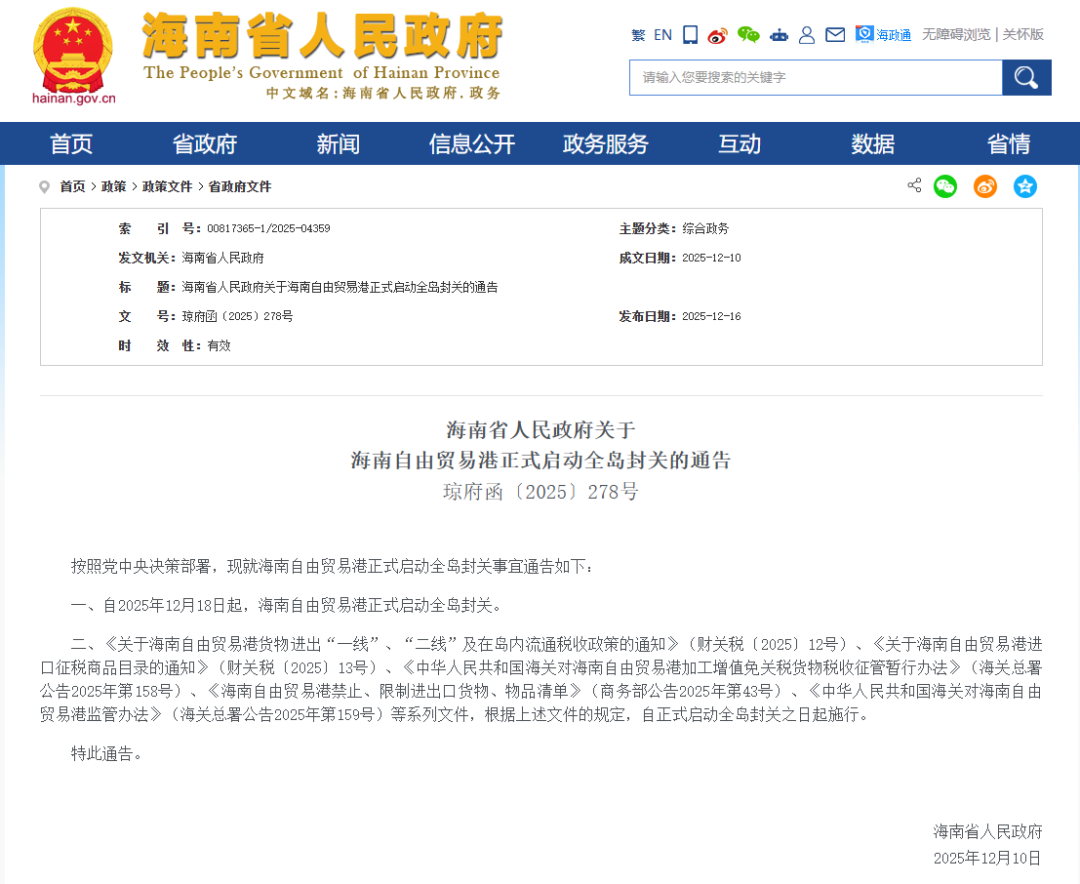
按照党中央决策部署,海南官宣:全岛封关
Mei Ri Jing Ji Xin Wen· 2025-12-16 04:30
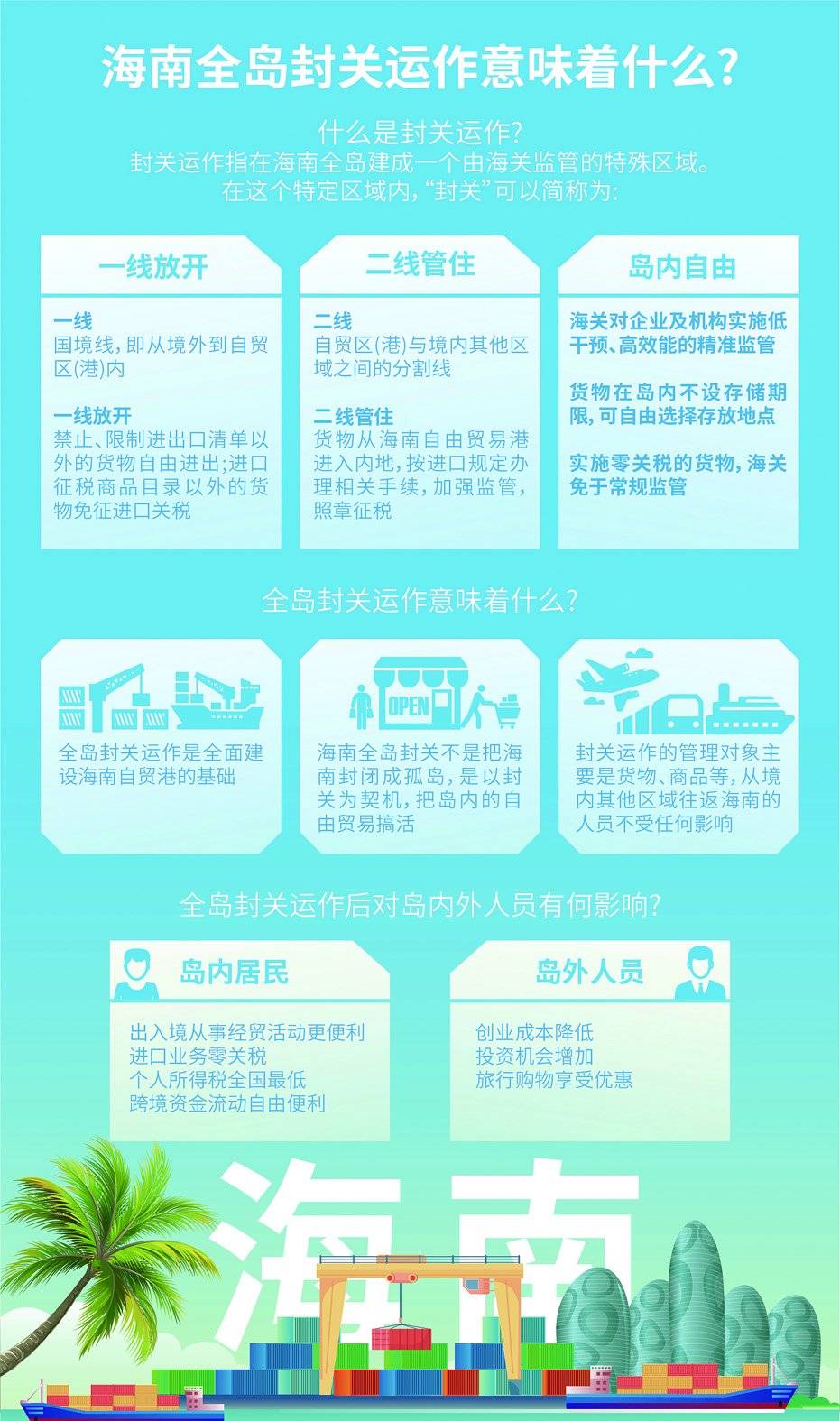
每经编辑|程鹏 12月16日,海南省人民政府发布《关于海南自由贸易港正式启动全岛封关的通告》。 按照党中央决策部署,现就海南自由贸易港正式启动全岛封关事宜通告如下: 一、自2025年12月18日起,海南自由贸易港正式启动全岛封关。 二、《关于海南自由贸易港货物进出"一线""二线"及在岛内流通税收政策的通知》(财关税〔2025〕12号)、《关于海南自由贸易港进口征税商品目录的 通知》(财关税〔2025〕13号)、《中华人民共和国海关对海南自由贸易港加工增值免关税货物税收征管暂行办法》(海关总署公告2025年第158号)、 《海南自由贸易港禁止、限制进出口货物、物品清单》(商务部公告2025年第43号)、《中华人民共和国海关对海南自由贸易港监管办法》(海关总署公 告2025年第159号)等系列文件,根据上述文件的规定,自正式启动全岛封关之日起施行。 有些网友疑惑,明明是"进一步扩大开放",为何叫"封关"?封关的目的是什么?封关后去海南,需要办理通行证吗?企业和居民如何享受便利? 什么是封关? 封关"封"的又是什么? 其实,封关不是封岛,而是指将海南岛全岛建成一个海关监管特殊区域,实施以"'一线'放开、'二线'管住 ...
海南官宣“全岛封关”
第一财经· 2025-12-16 03:15
Core Viewpoint - The official announcement from the Hainan Provincial Government states that the Hainan Free Trade Port will officially start its full island customs closure on December 18, 2025, which aims to create a special customs supervision area with liberalized policies [1][3]. Summary by Sections Customs Closure Definition and Purpose - The term "customs closure" refers to establishing Hainan Island as a special customs supervision area, implementing a policy characterized by "one line" being open, "two lines" being controlled, and free circulation within the island [3]. - The "one line" refers to the border from overseas to the free trade zone, while the "two lines" refer to the division between the free trade zone and other domestic areas [3]. Taxation Policies and Benefits - After the customs closure, many goods can enter Hainan with zero tariffs, but there will be a list of prohibited and restricted items, as well as a negative list for imported goods that are exempt from tariffs [4]. - The zero-tariff policy will cover approximately 74% of product categories, benefiting key industries such as pharmaceuticals and high-end food processing [6]. - A dual 15% tax incentive policy will be implemented for eligible enterprises and core talents, making the tax environment more attractive [6]. Impact on Tourism and Trade - The customs closure is expected to significantly boost tourism and consumer spending in Hainan, with most goods and all personnel still managed under current regulations, meaning no additional permits are required for travel [6][7]. - The strategic goal is to position Hainan as a key trade hub between China and ASEAN, leveraging its unique high-level open policies [8]. Future Development and Policy Implementation - Hainan aims to become a strategic hub for economic cooperation with ASEAN, with specific measures in place for establishing headquarters for investment [8]. - The focus will be on accelerating the implementation of core policies, improving efficiency, and enhancing the legal environment to attract more investment [9]. - The development of modern high-tech industries, tourism, and various service sectors will be prioritized, with an emphasis on reducing the negative list for cross-border service trade to increase investment appeal [9].
海南封关运作倒计时 中国开放新棋局落子有声
Sou Hu Cai Jing· 2025-12-12 19:29
Core Viewpoint - The establishment of the Hainan Free Trade Port marks a significant transformation for Hainan, enhancing its role in China's high-level opening-up strategy and creating a new global link for trade and investment [7][8]. Group 1: Policy Implementation - The Hainan Free Trade Port will officially start its full island closure operation on December 18, which is a crucial step in establishing a policy system for the free trade port [7]. - The policy framework includes "one line" for open access to international markets, "two lines" for controlled access to the mainland, and "island freedom" for internal circulation [9]. - The initial establishment of the policy system aims for a focus on trade and investment facilitation, with a target to mature by 2035 [8]. Group 2: Economic Impact - The zero-tariff policy is a key feature of the Hainan Free Trade Port, expanding the range of zero-tariff goods from 1,900 to approximately 6,600 items, covering about 74% of all goods [10]. - The processing time for importing seafood has been significantly reduced from three days to two hours, enhancing profit margins for businesses [7]. - The new personal income tax policy in Hainan offers lower rates compared to the mainland, making it an attractive destination for talent [11][12]. Group 3: Business Opportunities - Companies like Zhengda (Hainan) Xinglong Coffee are already benefiting from the zero-tariff policy, with a projected 20% profit increase from exporting coffee to Australia [8]. - The free trade port is expected to serve as a "converter" between the Chinese mainland and global markets, testing high-standard international trade rules [12]. - The enhanced duty-free shopping experience in Hainan is attracting consumers, with significant discounts on luxury goods compared to mainland prices [7].
海南产经新观察:全岛封关为“全球南方”企业提供哪些机遇?
Zhong Guo Xin Wen Wang· 2025-11-25 02:16
Core Viewpoint - The full island closure of Hainan Free Trade Port is a significant milestone that will provide extensive development opportunities for "Global South" enterprises, marking China's commitment to high-level opening-up and the construction of an open world economy [1][4]. Group 1: Opportunities for Global South Enterprises - The full island closure will allow "Global South" enterprises to either provide high-quality products or services to Hainan or invest in establishing entities within Hainan to operate in the Chinese market [1]. - The cost control and policy expectations are the primary concerns for enterprises looking to benefit from the new opportunities presented by the Hainan Free Trade Port [1]. Group 2: Tax Policies and Benefits - The tax system in Hainan Free Trade Port will significantly reduce costs for enterprises, with the "zero tariff" policy expanding from over 1,900 items to 6,637 items, increasing the zero-tariff level from 21% to 74% [2]. - The "zero tariff" policy includes not only import tariffs but also value-added tax and consumption tax, which is a notable difference from many free trade agreements signed by "Global South" countries [2]. - Enterprises importing production equipment typically pay around 5% to 10% in tariffs; however, importing from Hainan Free Trade Port allows for a total tax savings of approximately 20% [2]. Group 3: Low Tax Rate Policies - Hainan Free Trade Port offers a preferential corporate income tax rate of 15% for qualifying enterprises, compared to the standard 25% in China, and a personal income tax rate of 15% with no industry restrictions [3]. - The 15% corporate income tax applies to encouraged industries such as biomedicine and offshore wind power, while high-demand talent across all sectors can benefit from the personal income tax rate [3]. - Enterprises can combine the benefits of "zero tariffs" and "low tax rates," enhancing their profitability and operational efficiency [3].
商贸零售行业跟踪周报:海南自贸港封关落地推进中,自贸港政策全梳理-20251123
Soochow Securities· 2025-11-23 07:32
Investment Rating - The report maintains an "Overweight" rating for the retail industry [1]. Core Insights - The Hainan Free Trade Port has entered the final 30-day sprint phase for its full closure operation, which began on November 18. The port optimization and "second-line" regulatory facility construction are nearing completion, with the expectation of achieving a regulatory framework of "first-line opening, second-line management, and island-wide freedom" [4][9]. - The policy framework post-closure focuses on "zero tariffs, low tax rates, and simplified tax systems." Approximately 6,600 products will benefit from zero tariffs, covering most production equipment and raw materials, allowing companies to save about 20% on import tax costs. Additionally, encouraged industries will enjoy a 15% corporate income tax rate, significantly reducing operational costs [10]. - The adjustment of the duty-free shopping policy for departing island travelers was implemented on November 11, which has led to a 28.52% year-on-year increase in duty-free sales amounting to 1.325 billion yuan as of November 17 [10]. Summary by Sections Industry Viewpoint - The report highlights the operational upgrade of port management as a critical step towards establishing a high-level free trade port system, facilitating the free flow of various elements within Hainan [9]. Market Review - For the week of November 17 to November 21, the retail index decreased by 7.24%, while the overall market indices also experienced declines, with the Shanghai Composite Index down by 3.90% [12]. Company Valuation Table - The report includes a valuation table for various companies, indicating that companies like China Duty Free Group, Wangfujing, and Hainan Airport are expected to benefit from the duty-free shopping policy adjustments [11][19].



赵晋平:以封关为契机推进高水平开放
Jing Ji Ri Bao· 2025-11-10 00:10
Core Viewpoint - The establishment of the Hainan Free Trade Port (FTP) represents China's commitment to high-level opening-up and global trade cooperation, with a focus on creating a customs supervision special area for the entire island, characterized by a "zero tariff" trade system and a unique "one line" and "two lines" policy framework [1][2]. Group 1: Hainan FTP Overview - Hainan FTP aims to implement a customs supervision special area with a "zero tariff" policy, showcasing China's determination to expand high-level openness amid a complex international economic environment [1]. - The FTP's design draws on successful management experiences from international free trade zones like Singapore and Dubai, with a significant distinction being that Hainan is not a separate customs area, necessitating the establishment of a "two-line" system [2]. Group 2: Key Tasks for Hainan FTP Development - The first priority is to enhance the openness of the modern service industry, which is crucial for increasing the global influence of Hainan's pillar industries and fostering new competitive advantages in service trade [3]. - The second task involves gradually increasing the level of liberalization for "one line" policies, expanding the range of "zero tariff" goods from 1,900 to approximately 6,600 items, thereby reducing the taxable and specially managed imports to below 26% [4]. - The third focus is on innovating "two line" regulatory policies to prevent "zero tariff" goods from impacting the inland market while ensuring smooth economic connections between Hainan and the mainland [5]. - The fourth task is to advance tax system reforms, emphasizing "zero tariff, low tax rates, and simplified tax systems" to enhance investor expectations and attract domestic and foreign enterprises [6][7].