供应链转移

Search documents
Canalys:2025年第二季度美国智能手机出货量同比增长1%
Zhi Tong Cai Jing· 2025-07-29 08:44
Core Insights - The U.S. smartphone market is experiencing a shift in production and supply chain dynamics, with a significant decrease in the share of smartphones assembled in China and a corresponding increase in production in India [1][4][6]. Group 1: Market Trends - In Q2 2025, U.S. smartphone shipments are projected to grow by 1% year-on-year, driven by manufacturers preemptively stocking inventory due to tariff concerns [1][6]. - The share of smartphones assembled in China has dropped from 61% in Q2 2024 to 25% in Q2 2025, with India capturing a substantial portion of this market [1][4]. - "Made in India" smartphones saw a remarkable 240% year-on-year increase in shipments, now accounting for 44% of U.S. smartphone imports, up from 13% in Q2 2024 [1]. Group 2: Company Performance - iPhone shipments fell by 11% year-on-year to 13.3 million units in Q2 2025, following a strong 25% growth in Q1 [3]. - Samsung's shipments surged by 38% year-on-year to 8.3 million units, benefiting from strong performance in the Galaxy A series [3][6]. - Motorola's shipments grew by 2% year-on-year to 3.2 million units, while Google and TCL experienced contrasting trends, with Google up 13% to 800,000 units and TCL down 23% to 700,000 units [3][6]. Group 3: Supply Chain and Production Strategies - Apple is accelerating its supply chain shift to India, prioritizing Indian production for the U.S. market amid ongoing trade uncertainties [4]. - Other manufacturers like Samsung and Motorola are also increasing their production capacity in India, but at a slower pace compared to Apple [4]. - Manufacturers are maintaining high inventory levels to mitigate potential tariff impacts, with Apple and Samsung notably increasing their stock in Q2 2025 [6]. Group 4: Market Dynamics for Smaller Brands - The attractiveness of the U.S. market for smaller brands is diminishing due to rising localization requirements and uncertain tariff policies, exemplified by HMD's decision to scale back its U.S. operations [8]. - The top three manufacturers dominate over 90% of the market share, leaving limited opportunities for smaller players [8][9]. - Brands like OnePlus and Nothing are attempting to bypass carrier channels to expand their market presence, but their shipment volumes remain limited [8][9].


2025年第二季度,美国智能手机市场增长1%,印度制造崛起,关税风险下出货量稳步增长
Canalys· 2025-07-29 08:33
Core Insights - The article highlights a significant shift in the U.S. smartphone market, with India emerging as the primary production hub for smartphones aimed at the U.S. market due to increasing uncertainties in U.S.-China trade relations [2][3] - Smartphone shipments in the U.S. are projected to grow by 1% year-on-year in Q2 2025, despite a notable decline in iPhone shipments and strong growth for Samsung [1][4] Shipment Data Summary - In Q2 2025, iPhone shipments fell by 11% to 13.3 million units, while Samsung's shipments increased by 38% to 8.3 million units [1][7] - Motorola's shipments grew by 2% to 3.2 million units, Google saw a 13% increase to 800,000 units, and TCL experienced a 23% decline to 700,000 units [1][7] Supply Chain and Inventory Management - Manufacturers are preemptively increasing inventory levels to mitigate potential tariff impacts, with Apple and Samsung notably raising their stock levels in anticipation of possible tariffs [3][4] - Despite high inventory levels, overall market demand remains weak, indicating a growing gap between shipments and actual sales [4] Market Dynamics and Challenges - The article discusses the increasing difficulty for small and medium-sized brands to establish a foothold in the U.S. market, as over 90% of market share is dominated by the top three manufacturers [5][6] - Companies like HMD are scaling back their U.S. operations, highlighting the challenges faced by smaller players in the current market environment [5][6]


乐观情绪提振亚太股市,东南亚多国二季度GDP好于预期
Sou Hu Cai Jing· 2025-07-27 23:39
Group 1: Market Performance - The Asia-Pacific stock markets experienced a broad increase driven by optimistic market sentiment, with Japan's Nikkei 225 index reaching a historical high, rising 4.11% or 1637.12 points to close at 41456.23 points [1] - Southeast Asian markets mostly rose, with notable increases in Vietnam's Ho Chi Minh Index, which rose 2.41% or 36.09 points, closing at 1533.37 points, and Indonesia's Jakarta Composite Index, which rose 3.17% or 231.58 points, closing at 7543.5 points [1] Group 2: Trade Agreements and Economic Impact - The U.S. reached a trade agreement with Japan, where Japan will invest $550 billion in the U.S., and the U.S. will impose a 15% tariff on certain Japanese imports [1] - On the same day, the U.S. also reached agreements with the Philippines and Indonesia, with the Philippines facing a 19% tariff while opening its market to the U.S. [3] - Analysts suggest that the short-term market optimism may vary by country, with Indonesia and the Philippines less affected by U.S. tariffs due to lower export dependency [3][4] Group 3: Economic Growth and Forecasts - Southeast Asian countries reported better-than-expected economic growth in Q2, with Vietnam's GDP growing 7.96%, surpassing the expected 6.85% [6] - Despite positive growth, the World Bank downgraded economic forecasts for Southeast Asia, predicting growth rates of 5.8% for Vietnam, 5.3% for the Philippines, and 4.7% for Indonesia [6] - The ASEAN+3 region's economic growth forecast was also lowered to 3.8% for this year, reflecting concerns over external economic pressures [6][7] Group 4: Monetary Policy and Economic Support - Malaysia and Indonesia implemented interest rate cuts in July to support their economies amid a backdrop of declining inflation [7] - The AMRO chief economist indicated that the ASEAN+3 region has the capacity to introduce further stimulus measures due to generally stable fiscal conditions [7] Group 5: Risks to Japan's Economy - Despite the positive sentiment from the U.S.-Japan trade agreement, Japan's economy faces risks, including potential economic slowdown in the U.S. that could impact Japanese exports [8] - Analysts warn that increased tariffs could lead Japanese companies to relocate production closer to the U.S., potentially harming Japan's economic stability [8]
金电科技:传统玩具企业谋上市,“代工”模式并非长久之计?
Zhi Tong Cai Jing· 2025-06-30 11:45
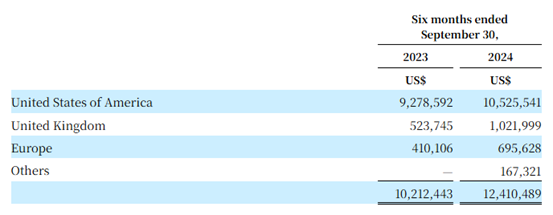
Core Viewpoint - The Chinese toy industry is experiencing a dichotomy, with the rise of trendy toy companies like Pop Mart going global, while traditional toy manufacturers face challenges such as low profit margins, industrial transfer, and shrinking orders [1]. Company Overview - K-Tech Solutions Company Limited, based in Hong Kong, is planning to go public on NASDAQ under the ticker "KMRK," aiming to issue 2 million shares at an estimated price of $4, raising approximately $8 million [1]. - The company has a history dating back to 2010, initially providing plastic toy manufacturing for international brands and now focuses on a diverse range of toy products, including educational toys [1]. Financial Performance - For the fiscal year ending March 31, 2024, K-Tech reported revenues of $17.123 million, a 2.9% increase year-over-year, driven by expanded sales in Europe and the addition of five new clients [2]. - Net profit surged from $247,000 to $928,000 during the same period, attributed to effective cost control and a 38.6% increase in gross profit despite only a slight revenue increase [2]. - In the first half of fiscal 2024, revenues reached approximately $12.41 million, a 21.5% year-over-year increase, primarily due to sales growth in the U.S. and U.K. [2][3]. Market Dynamics - Approximately 90.85% of K-Tech's revenue comes from the U.S., with the top three clients accounting for over 60% of its income, indicating a heavy reliance on the North American market [2]. - The company operates on thin profit margins, with a gross margin fluctuating around 10%, largely due to outsourcing production to a supplier in Guangdong, which constitutes about 85% of its cost of goods sold [3]. Industry Challenges - The U.S.-China tariff conflict poses significant risks, with the U.S. imposing tariffs as high as 145% on Chinese toys, which could severely impact K-Tech's export costs and pricing strategies [5]. - The traditional toy manufacturing sector is particularly vulnerable to these tariffs, as labor-intensive companies face existential threats due to low product value [5]. Strategic Initiatives - K-Tech plans to allocate approximately 60% of the IPO proceeds to invest in or acquire factories in Southeast Asia, 15% for expanding its design and engineering teams, and 10% for obtaining licenses or collaborations [6]. - This strategy aligns with the broader trend of toy companies relocating supply chains to Southeast Asia to mitigate tariff impacts and maintain stable order fulfillment [6]. Future Outlook - The transformation of K-Tech from a cost-arbitrage model to one focused on capability output and brand value is essential for navigating the challenges posed by tariffs [7]. - The company aims to establish a stable growth structure by leveraging technology upgrades and exploring emerging markets, while successfully entering the U.S. market remains a critical focus [7].
高盛:运用细分贸易数据解读中国出口韧性
Goldman Sachs· 2025-06-23 02:30
Investment Rating - The report indicates a positive outlook on China's export resilience, highlighting strong growth in exports, particularly to emerging markets [2][3]. Core Insights - China's exports have demonstrated surprising strength, achieving double-digit growth since Q4 2023, driven by factors such as front-loading of export orders and trade re-routing [2][3][4]. - The report emphasizes the shift of China's export flows from developed markets to emerging markets, particularly ASEAN, which has become a key trading partner [2][3][4]. Summary by Sections Export Growth Dynamics - Real exports from China have shown double-digit year-over-year growth since Q4 2023, with significant contributions from emerging markets [2][3]. - Front-loading of export orders has played a crucial role in maintaining high export levels, particularly in anticipation of US tariffs [5][6]. Trade Patterns and Destinations - Exports to ASEAN accounted for 16% of China's total exports in 2024, surpassing exports to the US, indicating a strategic shift in trade routes [2][3][4]. - The report notes that strong trade growth with major emerging economies has been a significant contributor to China's export strength over the past decade [2][3]. Sectoral Analysis - Exports of vehicles and electrical machinery to emerging markets have risen sharply, driven by supply chain diversification and increasing local demand for electric vehicles [2][3][4]. - The report highlights a transition in China's export product mix from traditional goods to new sectors such as electric vehicles, lithium-ion batteries, and solar cells [26][35]. Impact of US Tariff Policies - US tariff policies have induced front-loading and trade re-routing, which have helped stabilize China's overall export growth despite a decline in US-bound exports [5][6][18]. - The report estimates that cumulative front-loading of US-bound exports during Q4 2024 to Q1 2025 was around 30% of trend-implied monthly export values [5][6]. ASEAN's Role in Trade - The ASEAN-China Free Trade Agreement has significantly reduced tariffs, contributing to the rise in ASEAN-bound exports from China [37]. - Trade data discrepancies suggest potential transshipment of goods through ASEAN to avoid US tariffs, indicating a complex trade dynamic [39][41].
投资人漫游地球丨WAVES新浪潮2025
3 6 Ke· 2025-06-20 06:13
Core Insights - The Chinese venture capital market is at a turning point, characterized by a structural transformation and a need for adaptability to capture opportunities amidst uncertainty [1] - The WAVES 2025 conference gathered top investors and innovators to discuss the future of venture capital in China, focusing on AI, globalization, and value reassessment [1] Group 1: Investment Trends - Investors are increasingly focusing on global markets, with a significant emphasis on understanding local cultures and market dynamics to make informed investment decisions [3][4] - The concept of "going global" is viewed as a natural progression for many entrepreneurs rather than a distinct investment category, emphasizing the importance of the entrepreneur's qualities and strategic vision [4][5] - The rise of Chinese entrepreneurs with strong product capabilities and execution skills is noted, as they adapt to local markets rather than merely exporting products [4][5] Group 2: Supply Chain Dynamics - The discussion highlights the rising costs of manufacturing in China, with labor costs increasing significantly compared to Southeast Asian countries, which presents challenges for maintaining competitive pricing [9][10] - The ongoing trade tensions and tariff policies are influencing supply chain strategies, prompting companies to consider relocating production to countries like Vietnam and Mexico for cost efficiency [10][11] - The need for a diversified supply chain is emphasized, with companies encouraged to adapt to local market conditions and regulations to ensure long-term success [14][15] Group 3: Entrepreneurial Strategies - Early-stage companies are advised to prioritize understanding local market needs and building partnerships with local entities to enhance their chances of success in international markets [20][24] - The importance of execution and adaptability is stressed, with entrepreneurs encouraged to focus on achieving sales milestones and understanding consumer preferences in target markets [27][29] - The cultural traits of Chinese entrepreneurs, such as diligence and adaptability, are seen as key advantages in navigating the complexities of global markets [25][26]

突然,大抛售!三大利空,突袭!
券商中国· 2025-05-28 00:59
Core Viewpoint - The article discusses the recent sell-off of Apple stocks by CalPERS, the largest public pension fund in the U.S., and the potential implications of trade tensions and tariffs on Apple's business outlook [1][3][4]. Group 1: Institutional Investor Actions - CalPERS sold 5.1 million shares of Apple, reducing its holdings to 34.7 million shares, which may indicate declining confidence among large institutional investors [3]. - In contrast, CalPERS increased its stakes in Meta, AMD, and McDonald's by 579,000 shares, 325,000 shares, and 494,000 shares respectively [3]. Group 2: Stock Performance - Apple's stock has seen a continuous decline, with a total drop of over 22% since the beginning of the year, and a market capitalization now at approximately $2.9165 trillion, equivalent to about 20.96 trillion RMB [1][3]. - The stock price fell by more than 11% in Q1 and an additional 12% in Q2 [3]. Group 3: Trade and Tariff Implications - Apple anticipates a loss of approximately $900 million in Q3 due to U.S. tariff policies [4]. - President Trump has threatened a 25% tariff on iPhones manufactured abroad and sold in the U.S., which has led to a significant drop in Apple's stock price [4][7]. - The EU is also considering retaliatory measures against U.S. tech companies, including Apple, due to ongoing trade conflicts [4]. Group 4: Legal and Regulatory Responses - California's Attorney General Rob Bonta is prepared to sue the federal government to protect California-based companies like Apple from Trump's tariff threats [6]. - Bonta has previously led legal challenges against various White House policies, indicating a proactive stance against federal actions that may harm local businesses [6]. Group 5: Market Sentiment and Analyst Opinions - Analyst Dan Ives expressed skepticism about the feasibility of Apple manufacturing iPhones in the U.S., predicting significant costs and time requirements for any potential supply chain shifts [7]. - The potential price of an iPhone manufactured in the U.S. could reach $3,500, which may not be acceptable to the average consumer [7].

鸿海砸15亿美元印度扩厂 将建立显示器模组工厂供应iPhone关键零组件
Jing Ji Ri Bao· 2025-05-23 23:21
Group 1 - Foxconn plans to build a $1.5 billion display module factory near Chennai, India, specifically to supply key components for Apple [1][2] - The new factory is expected to create 14,000 jobs and is strategically located close to an iPhone assembly plant [1] - By 2024, India is projected to account for 18% of global iPhone production, increasing to 32% by 2025 [1] Group 2 - Foxconn's investment reflects Apple's ongoing shift of production focus from mainland China to India, despite U.S. President Trump's criticisms [2] - Foxconn aims to produce 25 to 30 million iPhones in India this year, doubling last year's output [2] - In addition to its Indian operations, Foxconn is a potential bidder for the semiconductor packaging company UTAC, which is being sold by a private equity firm [2]
特朗普撂狠话,苹果盘前跳水
Guan Cha Zhe Wang· 2025-05-23 13:02
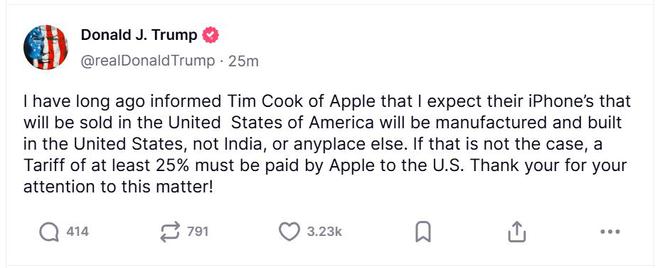
Core Viewpoint - President Trump has threatened Apple to manufacture iPhones in the U.S. instead of India or elsewhere, stating that failure to comply would result in a minimum 25% tariff on the company [1][2]. Group 1: Impact on Apple - Following Trump's statements, Apple's stock price fell by 4% in pre-market trading [2]. - Apple is attempting to avoid tariffs imposed on Chinese-made goods and plans to have its Indian factories supply "most" iPhones for the U.S. market in the coming months [2]. - Apple aims to transfer all production processes for over 60 million iPhones sold in the U.S. to India by the end of next year [2]. Group 2: Supply Chain Dynamics - Apple's supply chain is heavily reliant on China, with approximately 150 out of 187 top suppliers' factories located there [4]. - Currently, less than 5% of iPhone components are manufactured in the U.S., with the majority produced in mainland China, Taiwan, South Korea, and Japan [4]. - The complexity of Apple's global supply chain, which integrates expertise from multiple Asian countries, makes it impractical to shift production back to the U.S. without efficiency losses [4]. Group 3: Trump's Position - Trump has consistently pushed for companies to bring manufacturing jobs back to the U.S., often targeting Apple in his rhetoric [2]. - He expressed dissatisfaction with Apple's plans to expand production in India, emphasizing the need for the company to focus on U.S. manufacturing [2][3]. - Trump's comments reflect a broader strategy to encourage domestic production and reduce reliance on foreign manufacturing [3].
大健云仓20250520
2025-05-20 15:24
Summary of Conference Call for Dajian Cloud Warehouse Industry Overview - The conference call primarily discusses the logistics and warehousing industry, particularly focusing on Dajian Cloud Warehouse and its operations in the context of changing tariffs and market dynamics in the U.S. and Europe [2][4][16]. Key Points and Arguments - **Impact of U.S. Tariffs on Chinese Goods**: The U.S. has increased tariffs on Chinese goods, especially furniture, leading to a surge in domestic inventory demand and rising shipping costs. Retail prices may increase at a ratio of 2:1, meaning for every 10 yuan increase in supply costs, retail prices could rise by 5 yuan [2][5]. - **Dajian Cloud Warehouse's Strategic Position**: Dajian Cloud Warehouse has strategically established production bases in Southeast Asia, which mitigates the impact of tariffs. Approximately 70% of its procurement is from the U.S., and the company has long-term shipping contracts that help alleviate profit pressure from rising shipping costs [2][4][6]. - **Short-term Demand Fluctuations**: The new tariff policies have temporarily increased demand for shipping goods to the U.S., resulting in higher shipping quotes and service revenue. However, the sustainability of this demand is uncertain, as there are no clear signs of acceleration in the U.S. market demand [2][8]. - **Inventory Turnover in U.S. Home Improvement Sector**: The turnover rate of inventory in the U.S. home improvement sector has slowed down, and the second-hand housing market remains weak, indicating a lack of consumer demand [9][10]. - **Manufacturing Cost Comparison**: Manufacturing costs in Vietnam are approximately 20%-30% lower than in China, but the transition of supply chains takes time and cannot be achieved immediately [11]. - **Overseas Warehouse Market Dynamics**: The overseas warehouse market in the U.S. expanded rapidly last year, leading to oversupply. This year, the expansion rate has slowed, but service availability remains high, limiting the potential for price increases [15][14]. - **European Market Growth**: The European market has shown strong demand growth, with a year-on-year increase of approximately 70%-80% in the first quarter. Tariff barriers have prompted some sellers to explore markets in Europe, Japan, and Canada, although entering these markets requires time [3][16]. Other Important Insights - **Customer Behavior Regarding Tariffs**: Customers are responding differently to tariff changes; some are pausing shipments to assess the market, while others continue shipping to capitalize on potential price increases due to inventory shortages [4]. - **Current State of Overseas Warehouses**: Dajian Cloud Warehouse is not in a de-inventory state, as there is still high demand for shipments. Customers are actively shipping within a 90-day window due to uncertainties about future conditions [10]. - **Future of Transshipment Trade**: The development of transshipment trade is still under observation, with no significant trends currently evident [12][13]. - **Operational Flexibility of Dajian Cloud Warehouse**: The company operates an open ecosystem allowing customers to choose various logistics services, enhancing operational flexibility [18]. - **Cost Pressures from FedEx**: The company faces cost pressures from FedEx pricing, particularly during peak seasons, but has seen improvements in gross margins post-peak [19].