
四新经济

Search documents
权威数读|上半年,多种经营主体稳定增长
Xin Hua Wang· 2025-08-12 13:15
"四新" 企业 同比增长6.6% 6 6 6 6 6 6 6 6 世在6月底 全国在册"四新"经济企业 (新技术、新产业、新业态、新模式 ) 2536.1万户 同比增长6.6% 占企业总量的40.2% 权威数读 / 凯信阳 ATA 市场监管总局12日发布的数据显示,今年上半年,民营和外资企业发展势头良好、产业结构进一步 优化、消费领域文化产业亮点突出,多种经营主体均呈现稳定增长势头。跟随这组海报,一起来了解 下。 多种经营主体 | 均呈现稳定增长势头 6 6 十字号 全国新设经营主体1327.8万户 其中,新设企业462.0万户 新设个体工商户862.9万户 新设农民专业合作社2.9万户 权威数读 / 新华社 民营和外资企业 发展势头良好 66956000000 十字号 新设民营企业434.6万户 同比增长4.6% 新设外资企业3.3万户 同比增长4.1% 盃效办成一件事 权威数读 / 部指數 R 产业结构 11 进一步优化 6 6 下未在 第一产业新设经营主体60.1万户 第二产业新设96.5万户 第三产业新设1171.2万户 权威数读 / 凯信息 R 统筹:曹建礼、朱斯哲 制作:刘雅萱 【纠错】 【责任编 ...

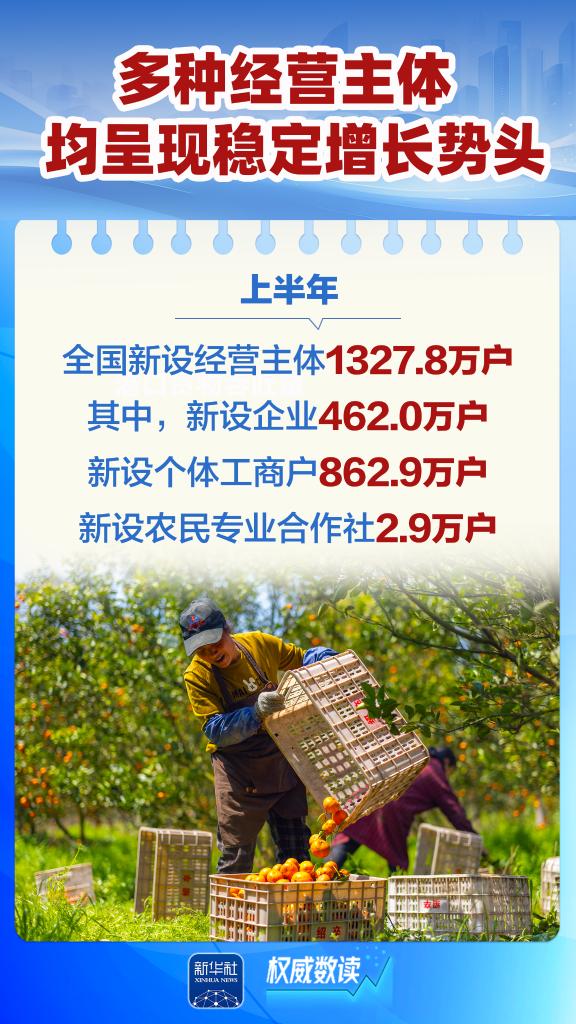
462.0万户、862.9万户、2.9万户……透过重磅数据“数”览多种经营主体活力满格
Yang Shi Wang· 2025-08-12 06:28
Group 1 - The core viewpoint of the news is that the number of newly established business entities in China shows a stable growth trend in the first half of 2025, with a total of 13.278 million new entities registered [1] - Among the new entities, 4.620 million are newly established enterprises, 8.629 million are individual businesses, and 29,000 are new farmers' cooperatives [1] - The growth of various types of business entities indicates a positive economic environment and entrepreneurial activity in the country [1] Group 2 - In the first half of the year, newly established private enterprises reached 4.346 million, representing a year-on-year growth of 4.6% [2] - Newly established foreign enterprises totaled 33,000, with a year-on-year increase of 4.1%, reflecting a favorable trend for enterprises of various ownership types [2] - As of the end of June, there were 25.361 million registered "Four New" (new technology, new industry, new business format, new model) economic enterprises, marking a year-on-year growth of 6.6% and accounting for 40.2% of the total number of enterprises [3] Group 3 - The cultural industry has emerged as a highlight of consumption growth in the first half of the year, with a remarkable growth rate of 17.5% in newly established enterprises in the "cultural, sports, and entertainment" sector [4]
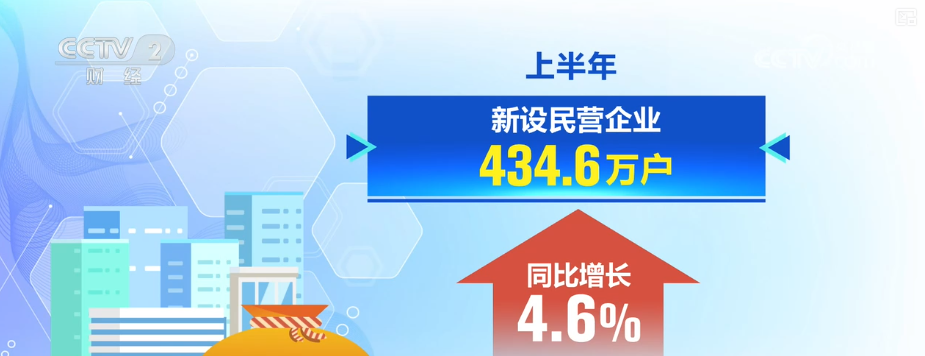
国家市场监督管理总局:上半年全国新设经营主体1327.8万户
智通财经网· 2025-08-12 03:27
Group 1 - The core viewpoint of the articles highlights the stable growth of new business entities in China, with a total of 13.278 million new entities established in the first half of the year, including 4.620 million new enterprises and 8.629 million new individual businesses [1] - The development of private and foreign-funded enterprises is strong, with 4.346 million new private enterprises established, representing a year-on-year growth of 4.6%, and 33,000 new foreign-funded enterprises, with a growth of 4.1% [1] - The industrial structure is further optimized, with 601,000 new entities in the primary industry, 965,000 in the secondary industry, and 11.712 million in the tertiary industry, indicating a shift towards service-oriented sectors [1] Group 2 - The cultural industry has shown significant growth, with a 17.5% increase in new enterprises in the "cultural, sports, and entertainment" sector, making it the fastest-growing sector in the national economy [1] - The market regulatory authorities are focusing on the development needs of business entities, aiming to improve market access and exit systems, and enhance the overall market environment to stimulate the vitality of various business entities [2]
市场监管总局:上半年全国新设经营主体1327.8万户
Zhong Guo Xin Wen Wang· 2025-08-12 03:05
Group 1 - The core viewpoint of the articles highlights the stable growth of new business entities in China, with a total of 13.278 million new entities established in the first half of the year, including 4.620 million new enterprises and 8.629 million new individual businesses [1] - The development of private and foreign-funded enterprises is strong, with 4.346 million new private enterprises established, representing a year-on-year growth of 4.6%, and 33,000 new foreign-funded enterprises, with a growth of 4.1% [1] - The industrial structure is further optimized, with 601,000 new entities in the primary industry, 965,000 in the secondary industry, and 11.712 million in the tertiary industry, indicating a significant focus on service-oriented sectors [1] Group 2 - The cultural industry has shown remarkable growth, with a 17.5% increase in new enterprises in the "cultural, sports, and entertainment" sector, making it the fastest-growing sector in the national economy [1] - The total number of registered "Four New" economic enterprises (new technologies, new industries, new business formats, new models) reached 25.361 million, a year-on-year increase of 6.6%, accounting for 40.2% of the total number of enterprises [1] - The market regulatory authorities are focusing on the development needs of business entities, aiming to improve market access and exit systems, and enhance the overall market environment to stimulate the vitality of various business entities [2]
稳就业在行动丨把就业驿站开在家门口
Jing Ji Ri Bao· 2025-08-11 07:08
Group 1 - Shenzhen is enhancing employment synergy within its modern industrial system by establishing a job-driven mechanism that aligns with new productive forces, focusing on collaborative talent attraction and development [1] - As of May 2023, the "Four New Economies" and major government investment projects in Shenzhen have created a total of 77,300 new jobs [1] - Shenzhen has implemented a dual enhancement plan for key enterprises, improving the coverage rate of public recruitment services to 41.3% and achieving a job matching success rate of over 70% [1] Group 2 - Shenzhen has established 80 standardized employment service stations, hosting over 600 employment service events this year and providing job information over 300,000 times, serving more than 1 million people [2] - The city is actively developing new vocational training standards in collaboration with industry associations and leading enterprises, focusing on new industries and technologies such as artificial intelligence and industrial internet [2] - Shenzhen has 354 municipal training institutions and 4 national high-skilled talent training bases, facilitating the growth of high-skilled talent through collaboration with major companies like Huawei [3] Group 3 - Shenzhen is accelerating the establishment of a comprehensive innovation ecosystem that integrates basic research, technology development, commercialization, financial support, and talent cultivation [3] - The partnership between Shenzhen Pengcheng Technician College and Huawei aims to create a digital skills talent training demonstration base and a vertical application R&D center for "root" technology [3] - This collaboration exemplifies the integration of education, technology, and talent strategies, effectively addressing the talent needs in high-end industries [3]
把就业驿站开在家门口
Jing Ji Ri Bao· 2025-08-10 21:52
Group 1 - Shenzhen is enhancing its modern industrial system by establishing an employment-driven mechanism that aligns with new productivity, focusing on multi-party collaboration to attract and cultivate talent, creating a positive cycle between employment and industry [1] - As of the end of May this year, the "Four New Economies" and major government investment projects have generated a total of 77,300 new jobs [1] - Shenzhen has implemented a dual improvement plan for key enterprises, enhancing the coverage of public recruitment services to 41.3% and achieving a job matching success rate of over 70% [1] Group 2 - Shenzhen has established 80 standardized employment service stations, hosting over 600 employment service events this year and providing job information over 300,000 times, serving more than 1 million people [2] - The city is actively developing new vocational training standards in collaboration with industry associations and leading enterprises, focusing on new industries and technologies such as artificial intelligence and industrial internet [2] - Shenzhen has 354 municipal training institutions and 4 national high-skilled talent training bases, providing a broad platform for high-skilled talent development [3] Group 3 - Huawei and Shenzhen Pengcheng Technician College have signed an agreement to jointly cultivate digital application-oriented high-skilled talents, establishing a talent skill map and a demonstration base for digital skills [3] - The collaboration between Huawei and the technician college exemplifies the integration of education, technology, and talent strategies, promoting vocational education to better meet the needs of high-end industries [3]
深圳人才磁吸效应显著,深企欣旺达预计今年校招超千人
Nan Fang Du Shi Bao· 2025-07-31 13:37
Group 1 - The "Million Talents Gathering in South Guangdong" initiative aims to bridge the gap between college graduates and employers, addressing the dual challenges of increasing graduate numbers and structural employment issues in Guangdong Province [2] - Since its launch, the initiative has attracted over 1 million recent graduates to work and start businesses in Guangdong, with Shenzhen emerging as a preferred destination due to its strong industrial appeal and growth opportunities [2] - The initiative effectively integrates resources from government, universities, and enterprises, facilitating efficient recruitment and enhancing the quality of talent acquisition [6] Group 2 - Companies like XINWANGDA Electronics are actively participating in campus recruitment, with plans to hire over 1,000 graduates by 2025, focusing on key technical positions in lithium battery development [3][5] - XINWANGDA has invested approximately 13 billion yuan in research and development over the past five years, emphasizing innovation as a core driver of its business model [5] - The demand for high-quality talent is increasing, particularly for specialized and composite skills, as the industry undergoes transformation driven by new technologies and economic models [7][8]

日均诞生7737位老板!“四新”经济成色足!数描粤商地图
Nan Fang Du Shi Bao· 2025-07-30 11:52
Core Insights - Guangdong's registered business entities exceeded 19.7 million by June 2025, with a "boss density" of 110 per square kilometer, marking a significant increase from 91 in 2022 [1][2] - The province's business structure is continuously optimizing, with a ratio of enterprises to individual businesses improving from 0.76:1 in 2023 to 0.78:1 in 2024 [2][3] - The new economy, particularly the "Four New" sectors, accounted for over 41% of new businesses established in 2024, indicating a strong shift towards innovative industries [3][4] Business Entity Growth - Guangdong's total registered business entities reached 19.7 million, maintaining the highest number in the country [2][4] - The average daily increase of new business entities was 7,737 in 2024, showcasing robust entrepreneurial activity [1][2] - The number of newly established enterprises in 2024 was 1.2675 million, a year-on-year growth of 5.26% [3] Economic Structure Optimization - The number of enterprises in Guangdong reached 8.3571 million, while individual businesses totaled 10.6338 million, reflecting a balanced growth in business types [2][3] - The increase in enterprise density per 1,000 people rose to 66, up by 4 from 2023, indicating a growing entrepreneurial environment [2][3] New Economic Drivers - The "Four New" economy saw 522,200 new enterprises established, with significant growth in new energy (25.41%), internet services (17.27%), and modern service sectors (10.58%) [3][4] - The private economy plays a crucial role, with 18.3787 million private entities making up 96.48% of the total, particularly in tech sectors in cities like Shenzhen [3][4] Policy and Environment Support - Policy innovations and cross-border collaborations have enhanced operational efficiency, such as reducing the time for Macau products to enter the mainland by 70% [4] - The business environment has improved significantly, with the time to establish a business reduced from 35 days to within one working day, achieving a 98% online processing rate [4] Employment and Economic Impact - The diverse market entities contribute to job creation and meet various consumer demands, highlighting their role as a cornerstone of Guangdong's economy [5]
汇优质岗位 引人才留深 上半年深圳发放补贴1.44亿元扶持高校毕业生创业
Shen Zhen Shang Bao· 2025-07-28 16:55
Group 1 - The "Million Talents Gathering in South Guangdong" initiative has successfully attracted over 1 million recent college graduates to work and start businesses in Guangdong, particularly in Shenzhen [1] - The initiative includes various measures to encourage companies to hire graduates, such as subsidies for small and micro enterprises that employ recent graduates, with a total of 59.84 million yuan distributed to over 5,236 companies [2] - The city has launched the "Wind and Flowers" annual action plan, which includes ten major actions and 31 measures to support employment and entrepreneurship for college graduates [2] Group 2 - The "Million Talents Gathering in South Guangdong" spring recruitment event in Shanghai featured 751 employers offering 35,000 quality job positions, attracting over 20,000 college students and 390 international students [3] - Shenzhen has introduced the "Pengcheng i-Job" program, linking quality job opportunities to 110 key universities, providing nearly 30,000 job positions to students in the first half of the year [3] - The city has established 80 employment service stations, providing over 1.42 million employment services and collecting more than 357,000 job postings in the first half of the year [4] Group 3 - Shenzhen offers various services for recent graduates, including 15 days of free accommodation to address transitional housing needs, with 47 operational locations and 50,000 units available [4] - The city has implemented a support system for entrepreneurial graduates, providing one-time startup grants and rent subsidies, with 3.2 million yuan distributed to 32,000 applicants in the first half of the year [4][5] - Low-interest, zero-guarantee entrepreneurial loans totaling 223 million yuan have been issued to support recent graduates in starting their businesses [5]

民营经济前景广阔大有可为
Jing Ji Ri Bao· 2025-05-24 13:44
Group 1 - In the first quarter of 2025, 1.979 million new private enterprises were established in China, representing a year-on-year growth of 7.1%, exceeding the average growth rate of the past three years [1] - Among the new enterprises, 836,000 were categorized as "four new" (new technology, new industry, new business format, new model), with internet and modern information technology service enterprises growing the fastest at 18.0% [1] - The implementation of the Private Economy Promotion Law reflects the government's commitment to supporting the development of the private economy, enhancing legal protections and stabilizing expectations for long-term growth [1][4] Group 2 - Recent policies supporting the private economy focus on three main areas: protecting the rights of private enterprises and entrepreneurs, improving market mechanisms to reduce operational costs, and addressing local government overreach that increases transaction costs [2] - The current global environment presents challenges for private enterprises, including risks from de-globalization policies and the need for intelligent production capabilities, particularly affecting small and medium-sized enterprises [2] - Promoting high-quality development of the private economy is essential for competing internationally and advancing modernization in China, necessitating the use of legal frameworks to address development challenges [2] Group 3 - There is a need to accelerate the construction of a market-oriented, law-based, and international business environment to enhance the competitiveness of private enterprises [3] - Developing productive service industries is crucial for improving the global competitiveness of private enterprises, particularly in guiding them to understand industry trends and formulate global strategies [3] - The healthy development of private enterprises and entrepreneurs is interrelated, with each supporting the other's growth and contributing to national and social progress [3]