
多智能体协作

Search documents
0.1$一键Get神仙主页!让科研人不再熬夜秃头的Paper2Page来了
自动驾驶之心· 2025-10-25 16:03
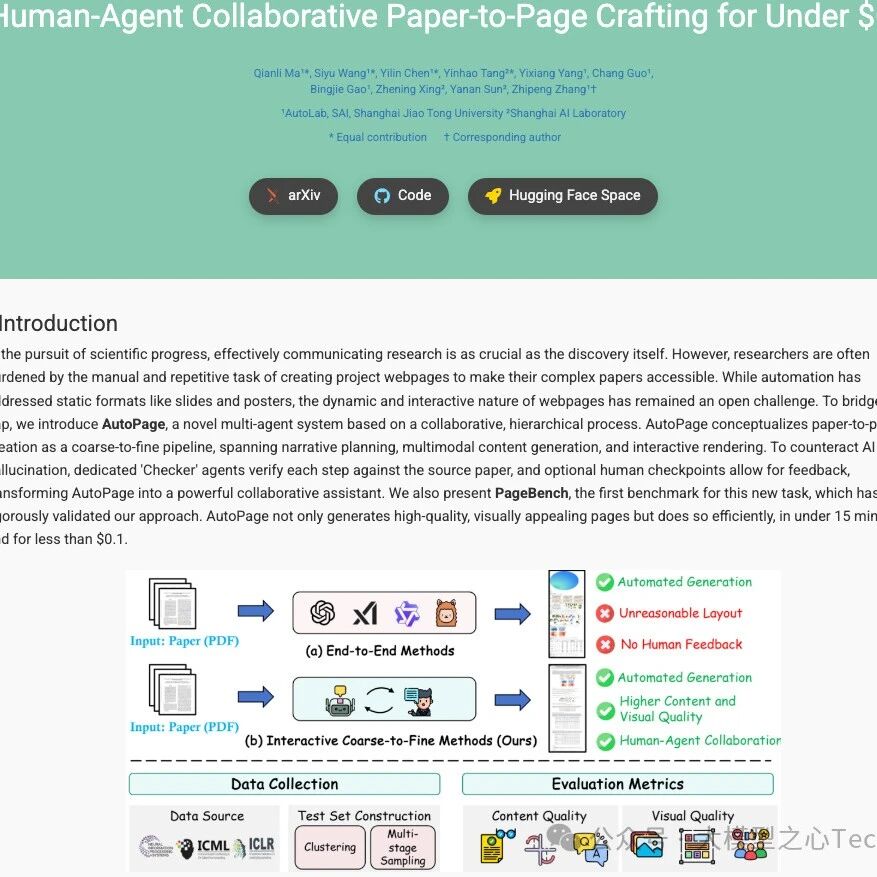
Core Insights - The article discusses the introduction of AutoPage, a multi-agent collaborative framework that automates the transformation of academic papers into high-quality, interactive project webpages, addressing the inefficiencies faced by researchers in showcasing their work [1][14]. Group 1: AutoPage Overview - AutoPage can generate a structured, visually rich, and interactive research homepage from a PDF in under 15 minutes, with a cost of less than $0.1 [2][16]. - The framework consists of multiple intelligent agents that collaborate in a three-step process: narrative planning, multimodal content generation, and interactive page rendering [6][9]. Group 2: Methodology - The "planner" agent analyzes the PDF to create a narrative blueprint, ensuring logical clarity and structural integrity [7]. - The "content generator" agent produces concise text and selects appropriate visuals, while the "checker" agent verifies the accuracy of the content against the original paper [8]. - The "renderer" agent generates the webpage content and style files based on user preferences, allowing for natural language adjustments [9][10]. Group 3: Performance and Quality - AutoPage has been evaluated against over 1500 academic homepages, demonstrating superior performance in content fidelity, visual appeal, and layout compared to models like GPT-4o-mini and Gemini-2.5-Flash [13][16]. - Users have rated AutoPage highly for its coherent content and visually appealing design, indicating a preference for its output over traditional methods [16]. Group 4: Accessibility and Open Source - All code for AutoPage is open-source, allowing users to upload their papers directly and choose from various model APIs, with recommendations for optimal performance [14][16].

报告征集 | 中国金融智能体发展研究与厂商评估报告(2025)
艾瑞咨询· 2025-10-23 00:06
Group 1 - The article emphasizes the dual drivers of policy promotion and market demand in the financial sector's adoption of AI innovations, with over 80% of financial institution leaders showing high interest in intelligent agents [2] - Approximately 65% of financial IT leaders believe that intelligent agents have significantly surpassed the capabilities of process automation robots and virtual assistants, enabling them to handle complex tasks more efficiently [2] - About 63% of financial institution respondents express interest in the value creation potential of intelligent agents in financial services, rather than viewing them merely as efficiency tools [2] Group 2 - The report titled "Research on the Development of Financial Intelligent Agents in China and Vendor Evaluation Report (2025)" aims to provide a comprehensive understanding of market development through systematic research and vendor assessment [3] - The report will utilize numerous case studies and empirical data, along with corporate research and expert interviews, to conduct its analysis [4] - The report is divided into two parts: the first part analyzes the current status and trends of financial intelligent agents in China across various dimensions, while the second part evaluates vendors based on customer feedback and market competitiveness [5] Group 3 - Inclusion in the "iResearch Vendor Insight: Competitiveness Quadrant of Financial Intelligent Agents in China (2025)" can enhance a vendor's brand recognition and industry influence [7] - Analysts will regularly engage in technical exchanges with financial institutions within the iResearch ecosystem, prioritizing recommendations for vendors included in the quadrant [8] - The report will be published on the iResearch official website and WeChat account, along with dissemination through various media channels linked to iResearch [9]

报告征集 | 中国金融智能体发展研究与厂商评估报告(2025)
艾瑞咨询· 2025-10-16 00:07
Group 1 - The core viewpoint of the article emphasizes the dual drive of policy promotion and market demand, leading financial institutions to actively embrace AI innovations for business value growth [2] - Over 80% of financial institution leaders show high concern for intelligent agents, with about 65% of financial IT leaders indicating that intelligent agents have significantly surpassed the capabilities of process automation robots and virtual assistants, enabling them to handle complex tasks more efficiently [2] - Approximately 63% of financial institution respondents express interest in the value creation of intelligent agents in financial business rather than merely as efficiency tools [2] Group 2 - The report titled "Research on the Development of Financial Intelligent Agents in China and Vendor Evaluation Report (2025)" is officially launched by iResearch, aiming to provide a comprehensive understanding of market development for financial institutions and intelligent agent vendors [3] - The report will utilize numerous case studies and empirical data, along with enterprise research and expert interviews, to conduct its analysis [4] - The report is divided into two parts: the first part analyzes the current status and trends of financial intelligent agents in China across dimensions such as industry development, application practices, customer needs, and technology and product capabilities [5] Group 3 - The second part of the report will be based on research and evaluation of financial intelligent agent vendors, integrating feedback from financial institution clients to create the "iResearch Vendor Insight: Competitive Landscape of Financial Intelligent Agent Vendors (2025)" [5] - This evaluation will cover various dimensions including technology and product capabilities, strategic planning, ecosystem development, commercialization ability, and customer reputation [5] - Vendors selected for the "iResearch Vendor Insight" can enhance their brand awareness and industry influence [7]

假期被玩坏了的奥特曼,正在玩弄全世界的算力
Hu Xiu· 2025-10-07 23:25
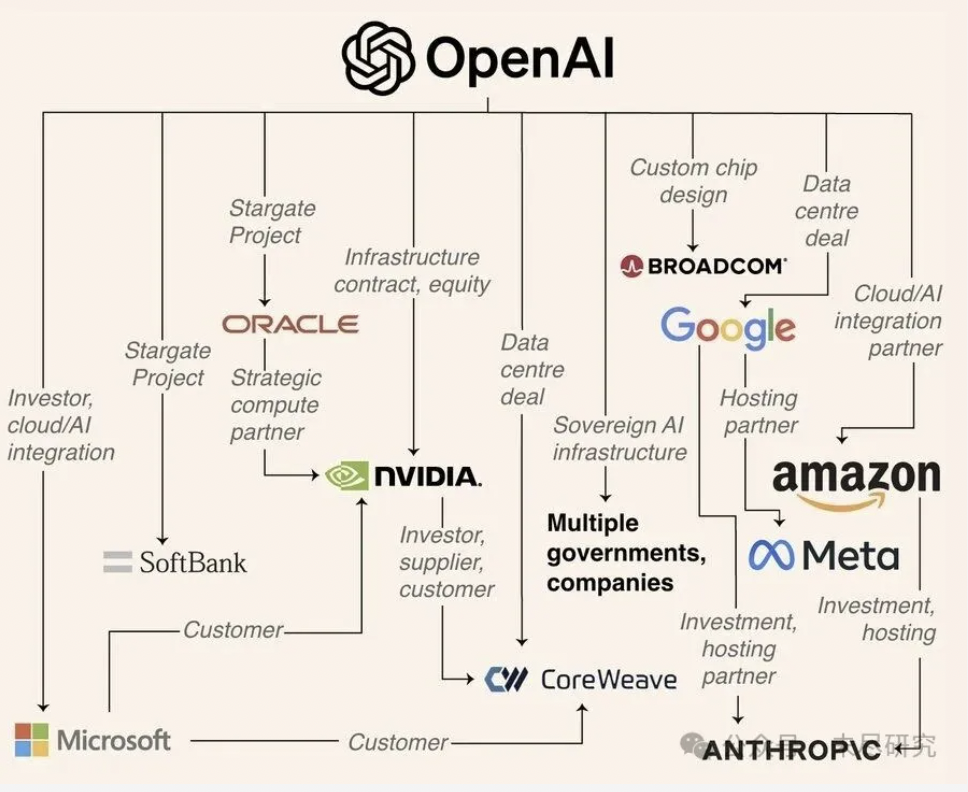
Core Insights - The recent OpenAI DevDay highlighted significant advancements in AI, including the release of ChatGPT Apps SDK, AgentKit, and GPT-5 Codex, indicating the industry's trajectory towards increased API and agent-based services [2][3]. Group 1: OpenAI's Token Consumption - OpenAI's monthly token consumption is projected to reach approximately 1,040 trillion tokens, with API usage accounting for about 25% of this total [4][5]. - The competition between OpenAI and Google is intensifying, as Google's token consumption surged from 480 trillion to 980 trillion tokens within a month [5]. Group 2: User Demographics - ChatGPT currently has around 800 million weekly active users, consuming about 180 trillion tokens weekly, averaging 22.5 thousand tokens per user [6][11]. - The developer ecosystem on OpenAI's platform has doubled in size since 2023, with API token consumption increasing 20 times, indicating a tenfold rise in average token consumption per developer [9][10]. Group 3: Product Developments - The announcement of GPT-5 Pro and the release of GPT-5 Codex, which has seen a tenfold increase in daily usage since August, suggests a growing demand for advanced AI capabilities in sectors like finance, law, and healthcare [12]. - OpenAI's Sora 2 is expected to have a peak GPU demand of approximately 720,000 GPUs, reflecting the increasing computational requirements for AI video generation [21][22]. Group 4: Future Projections - OpenAI aims to scale its data center capacity significantly, targeting 250 GW by 2033, which underscores its ambition to enhance AI processing capabilities [14][23]. - The evolution of AI models, such as Sora 2, is anticipated to drive further advancements in video generation, expanding applications from social media to professional film production [22].
龙湖如何用Agent重塑地产与物业的运营方式?
虎嗅APP· 2025-09-29 00:19
Core Viewpoint - The article emphasizes the transformative role of AI, specifically through the implementation of Agent intelligent systems, in enhancing operational efficiency and decision-making processes within the real estate and property management sectors, particularly for Longfor Group [5][6]. Group 1: AI Implementation and Impact - Longfor Group has integrated AI to address traditional inefficiencies, such as lengthy pricing approval processes that previously took 1-2 weeks, now reduced to a few hours with the use of intelligent agents [5][10]. - The introduction of Agent systems has significantly improved the efficiency of parking lot management, reducing manual audits from 100% to 17%, resulting in an 83% increase in audit efficiency and preventing millions in potential losses annually [15][13]. - The company has developed over 180 digital employees across various scenarios, including pricing models, contract reviews, and risk management, forming a comprehensive digital workforce [6][9]. Group 2: Specific Use Cases - The first successful application of an Agent was in pricing adjustments, where it simulated various pricing scenarios and provided recommendations, thus avoiding potential losses of millions [10][11]. - In property management, the Agent system has automated the identification of abnormal parking lot entries, leading to significant labor cost savings and improved compliance [15][16]. - The contract review process has been enhanced by Agents that automatically identify risks in complex commercial contracts, allowing staff to focus on critical issues [20][17]. Group 3: Challenges and Solutions - The primary challenge in implementing Agent technology is the need for a well-prepared knowledge base within the company, as the complexity of real estate rules and processes requires clear standard operating procedures (SOPs) [21][22]. - Data quality is crucial for the successful deployment of Agents, necessitating a unified digital framework to ensure high-quality data availability [21][22]. - The company has adopted a dual-role team approach, pairing AI product managers with business experts to ensure both technical feasibility and business relevance in project execution [28]. Group 4: Future Directions - Longfor Group plans to expand the use of Agents in internal management, commercial operations, and customer service, focusing on data-driven decision-making and enhanced user experiences [33][34]. - The company is also exploring multi-agent collaboration for complex tasks, demonstrating the potential for creating a virtual employee team that streamlines operations across departments [26][24].


智能体崛起:运营商竞逐下一代数字入口
2 1 Shi Ji Jing Ji Bao Dao· 2025-09-25 12:18
Core Insights - The era of intelligent agents is emerging, with significant potential for development and widespread deployment across various industries [1][3][5] - The future will see a shift from traditional apps to agent-centric services, with predictions that by 2030, the number of agents will surpass that of traditional apps [1][5] - The evolution of intelligent agents is moving towards autonomous collaboration, with a focus on multi-agent cooperation [2][6] Industry Developments - Major telecom operators like China Telecom, China Unicom, and China Mobile are actively developing intelligent agents, with China Telecom creating over 80 industry models and 30 intelligent agents for digital transformation [3][5] - China Unicom is establishing a national AI application pilot base in the medical field and has open-sourced its "Yuanjing Wanwu" intelligent agent development platform [3][5] - The integration of silicon-based and carbon-based innovations is accelerating, leading to a proliferation of intelligent agents that will serve individuals [3] Technical Challenges - Current challenges in intelligent agent technology include high error rates and issues with inter-agent communication [2][7] - The need for effective task allocation and coordination among multiple agents is critical, as well as ensuring result consistency and managing communication overhead [7][8] - Future improvements in intelligent agents will focus on enhancing accuracy and efficiency in handling complex tasks, with a projected doubling of task completion capabilities every seven months [7][8] Support Requirements - Successful multi-agent collaboration requires robust technical architecture, standardized communication protocols, and sufficient computational resources [8] - The establishment of unified communication protocols, such as MCP and A2A, is essential for facilitating information exchange and collaboration among agents [8]

思必驰AI办公本X5系列:以多智能体协作与端侧大模型重塑办公效率
Xi Niu Cai Jing· 2025-09-24 09:52
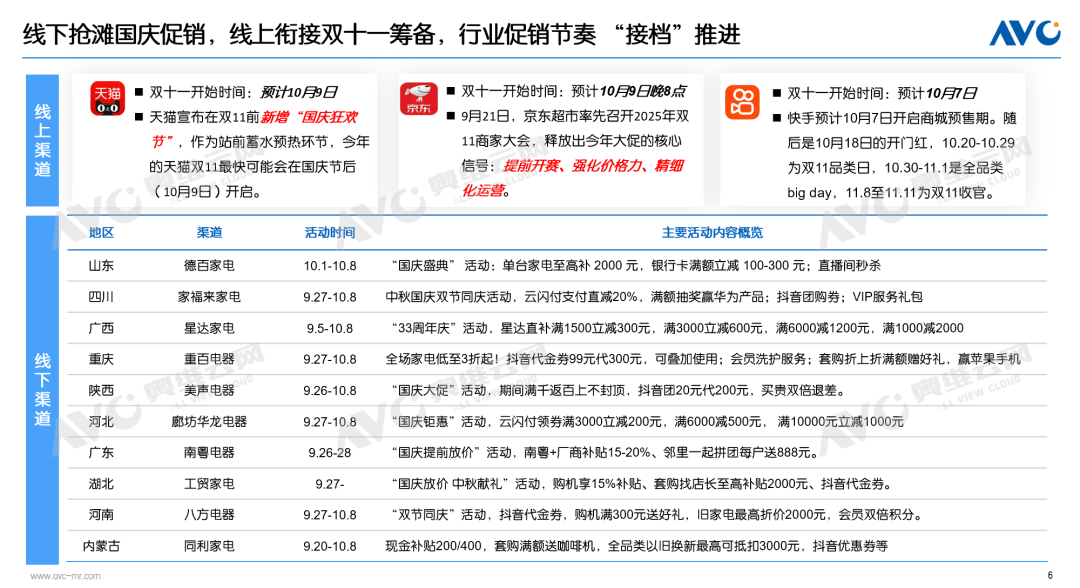
Core Insights - The home appliance industry is entering a critical period of policy effect transition and market demand adjustment in 2025, with overall negative growth becoming a consensus due to the diminishing impact of national subsidies and weak consumer demand [1][6][13] - The promotional rhythm in the industry is tightly connected, with offline channels focusing on the National Day peak season while online platforms prepare for "Double Eleven," leading to differentiated performance across channels [2][10] Policy Impact - The marginal effect of national subsidies is weakening, with retail sales growth for home appliances expected to drop significantly from 23.8% in late 2024 to just 7% by mid-2025 [4][6] - The national subsidy policy has shifted to batch issuance and control, resulting in reduced support for offline channels, which previously benefited from strong subsidy implementation [6][13] Market Performance - The home appliance industry is experiencing negative growth, particularly in traditional categories like refrigerators, washing machines, and air conditioners, with refrigerators expected to see a decline exceeding 20% [6][9] - Online channels are anticipated to outperform offline channels during the promotional periods due to the lower baseline from last year's strong subsidy-driven growth [2][4] Sales Data - For the refrigerator category, online sales volume decreased by 23.8% year-on-year, while offline sales dropped by 20.3%, indicating a significant overall decline in the market [7][9] - Air conditioning sales are projected to decline by 8% in volume and 14.4% in revenue during the "Double Eleven" period, reflecting the ongoing price war and market challenges [8][9] Strategic Recommendations - Companies are advised to focus on retail-driven strategies to accelerate inventory turnover and optimize cash flow, shifting from channel-centric to end-user retail thinking [14] - Emphasis on product structure improvement is recommended to counteract the decline in subsidies by promoting higher value-added products [14] - The industry should leverage the upcoming energy efficiency standard upgrades as an opportunity to launch new products and capture market share [14]
AI办公本是如何弯道超车的?
虎嗅APP· 2025-09-24 09:37
Core Viewpoint - The article discusses how the company, Sibilchi, successfully transitioned from a B2B voice technology provider to a C-end market player with its AI notebook, overcoming skepticism and establishing itself as a significant competitor in the smart office sector [2][5][17]. Group 1: Market Entry and Initial Challenges - Sibilchi had been focused on B2B voice technology for 17 years before entering the C-end market with its first AI notebook, facing skepticism due to established competitors like iFlytek and Huawei [5][10]. - Internal divisions existed within the company regarding the shift to C-end products, with some advocating for continued focus on B2B business [5][6]. Group 2: Product Innovation and User-Centric Approach - The decision to use a flexible color screen instead of the industry-standard e-ink screen was driven by user feedback indicating a need for faster response times in office settings [6][7]. - The first AI notebook, Pro, launched in June 2024, exceeded sales expectations and challenged the notion that B2B companies could not succeed in the C-end market [7][10]. Group 3: Advanced Features and User Feedback - The latest X5 series introduced features like multi-agent collaboration and on-device large models, allowing the AI notebook to evolve from a mere recorder to a decision-making tool [10][11]. - The X5 can operate offline, ensuring data security and privacy, which is crucial for users in sensitive environments [11][12]. Group 4: Target Market and Positioning - Sibilchi's AI notebook is positioned as a professional tool rather than an entertainment device, targeting corporate managers, government users, and professionals who require efficient office solutions [14][17]. - The company aims to redefine the concept of office notebooks, focusing on productivity and user needs rather than competing with consumer tablets [14][17]. Group 5: Market Potential and Future Outlook - The smart office market in China is projected to grow at an annual rate of 15.58%, reaching approximately 176.8 billion yuan by 2025, providing a favorable environment for Sibilchi's growth [17].


苦战七年卷了三代!关于BEV的演进之路:哈工大&清华最新综述
自动驾驶之心· 2025-09-17 23:33
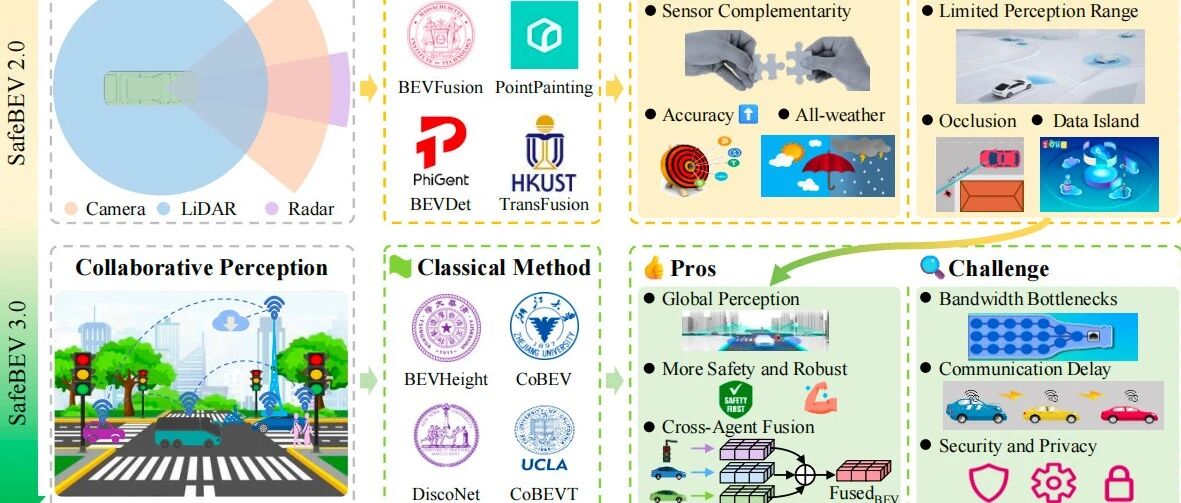
Core Viewpoint - The article discusses the evolution of Bird's Eye View (BEV) perception as a foundational technology for autonomous driving, highlighting its importance in ensuring safety and reliability in complex driving environments [2][4]. Group 1: Essence of BEV Perception - BEV perception is an efficient spatial representation paradigm that projects heterogeneous data from various sensors (like cameras, LiDAR, and radar) into a unified BEV coordinate system, facilitating a consistent structured spatial semantic map [6][12]. - This top-down view significantly reduces the complexity of multi-view and multi-modal data fusion, aiding in the accurate perception and understanding of spatial relationships between objects [6][12]. Group 2: Importance of BEV Perception - With a unified and interpretable spatial representation, BEV perception serves as an ideal foundation for multi-modal fusion and multi-agent collaborative perception in autonomous driving [8][12]. - The integration of heterogeneous sensor data into a common BEV plane allows for seamless alignment and integration, enhancing the efficiency of information sharing between vehicles and infrastructure [8][12]. Group 3: Implementation of BEV Perception - The evolution of safety-oriented BEV perception (SafeBEV) is categorized into three main stages: SafeBEV 1.0 (single-modal vehicle perception), SafeBEV 2.0 (multi-modal vehicle perception), and SafeBEV 3.0 (multi-agent collaborative perception) [12][17]. - Each stage represents advancements in technology and features, addressing the increasing complexity of dynamic traffic scenarios [12][17]. Group 4: SafeBEV 1.0 - Single-Modal Vehicle Perception - This stage utilizes a single sensor (like a camera or LiDAR) for BEV scene understanding, with methods evolving from homography transformations to data-driven BEV modeling [13][19]. - The performance of camera-based methods is sensitive to lighting changes and occlusions, while LiDAR methods face challenges with point cloud sparsity and performance degradation in adverse weather [19][41]. Group 5: SafeBEV 2.0 - Multi-Modal Vehicle Perception - Multi-modal BEV perception integrates data from cameras, LiDAR, and radar to enhance performance and robustness in challenging conditions [42][45]. - Fusion strategies are categorized into five types, including camera-radar, camera-LiDAR, radar-LiDAR, camera-LiDAR-radar, and temporal fusion, each leveraging the complementary characteristics of different sensors [42][45]. Group 6: SafeBEV 3.0 - Multi-Agent Collaborative Perception - The development of Vehicle-to-Everything (V2X) technology enables autonomous vehicles to exchange information and perform joint reasoning, overcoming the limitations of single-agent perception [15][16]. - Collaborative perception aggregates multi-source sensor data in a unified BEV space, facilitating global environmental modeling and enhancing safety navigation in dynamic traffic [15][16]. Group 7: Challenges and Future Directions - The article identifies key challenges in open-world scenarios, such as open-set recognition, large-scale unlabeled data, sensor performance degradation, and communication delays among agents [17]. - Future research directions include the integration of BEV perception with end-to-end autonomous driving systems, embodied intelligence, and large language models [17].
外滩大会速递(1):萨顿提出AI发展新范式,强化学习与多智能体协作成关键
Haitong Securities International· 2025-09-12 02:47
Investment Rating - The report does not explicitly provide an investment rating for the industry or specific companies within it. Core Insights - Richard Sutton proposes that we are entering an "Era of Experience" characterized by autonomous interaction and environmental feedback, emphasizing the need for systems that can create new knowledge through direct interaction with their environments [1][8] - Sutton argues that public fears regarding AI, such as bias and unemployment, are overstated, and that multi-agent cooperation can lead to win-win outcomes [9] - The report highlights the importance of continual learning and meta-learning as key areas for unlocking the potential of reinforcement learning [3][13] Summary by Sections Event - Sutton's presentation at the 2025 INCLUSION Conference outlines a shift from static knowledge transfer to dynamic agent-environment interactions, marking a transition to an "Era of Experience" [1][8] - He identifies reinforcement learning as crucial for this transition, but notes that its full potential is contingent on advancements in continual and meta-learning [1][8] Commentary - The report discusses the shift from "data as experience" to "capability as interaction," suggesting that firms need to develop systems that can actively engage with their environments to generate new knowledge [2][11] - It emphasizes that the real bottleneck in reinforcement learning is not model parameters but the ability to handle time and task sequences, highlighting the need for continual and meta-learning capabilities [3][13] Technical Bottlenecks - The report identifies two main constraints in reinforcement learning: the need for continual learning to avoid catastrophic forgetting and the need for meta-learning to enable rapid adaptation across tasks [3][13] - It suggests that R&D should focus on long-horizon evaluation and the integration of memory mechanisms and planning architectures [3][13] Decentralized Collaboration - The report posits that decentralized collaboration is not only a technical choice but also a governance issue, requiring clear incentives and transparent protocols to function effectively [4][12] - It outlines three foundational institutional requirements for effective decentralized collaboration: open interfaces, cooperation-competition testbeds, and auditability [4][12] Replacement Dynamics - Sutton's view on "replacement" suggests that it will occur at the task level rather than entire job roles, urging organizations to proactively deconstruct tasks and redesign processes for human-AI collaboration [5][15] - The report recommends establishing a human-AI division of labor and reforming performance metrics to focus on collaborative efficiency [5][15]