定制化

Search documents
存储业格局生变,三星地位遭挑战
第一财经· 2025-07-11 14:51
Core Viewpoint - The storage industry is undergoing significant changes driven by the rise of High Bandwidth Memory (HBM), with DDR4 prices increasing and Samsung Electronics experiencing a decline in quarterly profits, indicating a shift in focus towards HBM production [1][4]. Group 1: Market Dynamics - DDR4 prices have surged due to production cuts, while HBM is becoming the focal point of competition in the storage sector, leading manufacturers to shift capacity towards HBM [1][4]. - Samsung Electronics reported a projected sales revenue of 74 trillion KRW (approximately 55.5 billion USD) for Q2 2025, a slight decrease of 0.09% year-on-year, with operating profit dropping by 55.94% to 4.6 trillion KRW (about 3.3 billion USD), marking the lowest level in six quarters [4]. - SK Hynix has gained market share in the DRAM sector, achieving a 36% share in Q1 2023, surpassing Samsung for the first time, and holding a 70% share in the HBM market [4][8]. Group 2: Technological Advancements - The industry is moving towards the development of HBM4, with SK Hynix and Micron completing certifications for their HBM3e products, while Samsung is expected to complete its HBM3e certification by Q3 2025 [5][6]. - HBM technology faces challenges in both front-end and back-end processes, with future developments expected to include increased stacking layers and new manufacturing techniques [9]. Group 3: Customization Trends - The demand for HBM is expected to grow due to the strong AI market, with Nvidia currently consuming 61% of HBM, but this share is projected to decrease as more ASIC suppliers enter the market [8][10]. - Custom HBM solutions are being developed by several IT companies, including Nvidia, Amazon, and Microsoft, with expectations for significant market expansion by 2026 when HBM4 is launched [10][11].

HBM,新大战
半导体行业观察· 2025-07-11 00:58
Core Viewpoint - The article discusses the significant transformation in data centers from a "compute-centric" approach to a "bandwidth-driven" model, highlighting the rise of High Bandwidth Memory (HBM) as a crucial infrastructure for large model computations [1][2]. Group 1: HBM Market Dynamics - HBM has evolved from being a standard component in high-performance AI chips to a strategic focal point in the semiconductor industry, with major players like Samsung, SK Hynix, and Micron viewing it as a key driver for future revenue growth [2][4]. - SK Hynix has established a dominant position in the HBM market, holding approximately 50% market share, with a staggering 70% share in the latest HBM3E products [6][10]. - Samsung is also actively pursuing custom HBM supply agreements with various clients, indicating a competitive landscape among these semiconductor giants [6][10]. Group 2: Customization Trends - Customization of HBM is becoming a necessity, driven by cloud giants seeking tailored AI chips, with SK Hynix already engaging with major clients like NVIDIA and Microsoft for custom HBM solutions [4][5]. - The integration of base die functions into logic chips allows for greater flexibility and control over HBM core chip stacks, optimizing performance, power consumption, and area [7][9]. Group 3: Hybrid Bonding Technology - Hybrid bonding is emerging as a critical technology for future HBM development, addressing challenges posed by traditional soldering techniques as stacking layers increase [12][18]. - Major companies, including Samsung and SK Hynix, are exploring hybrid bonding for their next-generation HBM products, which could lead to significant advancements in performance and efficiency [13][18]. Group 4: Future HBM Innovations - The article outlines the anticipated evolution of HBM technology from HBM4 to HBM8, detailing improvements in bandwidth, capacity, and power efficiency, with HBM8 expected to achieve a bandwidth of 64 TB/s and a capacity of up to 240 GB per module [20][21][27]. - Key innovations include the introduction of 3D integration technologies, advanced cooling methods, and AI-driven design optimizations, which are set to enhance the overall performance and efficiency of HBM systems [29][30]. Group 5: Competitive Landscape - The competition among DRAM manufacturers and bonding equipment suppliers is intensifying, with companies needing to collaborate across various domains to succeed in the evolving HBM market [33]. - The future of HBM technology will likely be shaped by the ability of companies to integrate diverse processes and resources, with the race for dominance in the post-AI era just beginning [33].


光伏&储能逆变器用磁性元器件,前13大企业占据全球71%的市场份额(2024)
QYResearch· 2025-06-30 09:52
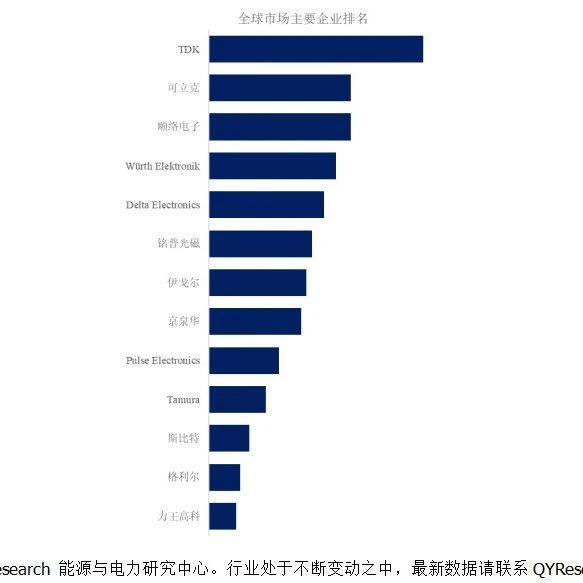
Core Viewpoint - The global market for magnetic components used in photovoltaic (PV) and energy storage (ESS) inverters is projected to reach $3.3 billion by 2031, with a compound annual growth rate (CAGR) of 8.0% in the coming years [1]. Market Overview - The market for magnetic components in PV and ESS inverters is expanding significantly due to the rapid growth of the global photovoltaic and energy storage industries. China, as the largest market for photovoltaic installations, is experiencing a surge in demand for magnetic components [11]. - The top five manufacturers in this market hold approximately 42.0% of the global market share as of 2024 [5]. Technological Requirements - There is an increasing demand for high-performance magnetic components due to the rising efficiency of photovoltaic modules and the growing power requirements of energy storage systems. This necessitates innovations in material selection and manufacturing processes [12][14]. - New magnetic materials, such as nanocrystalline and amorphous alloys, are being adopted to enhance the performance of magnetic components [14]. Development Trends - High performance: Magnetic components are required to have higher precision, stability, and lower losses to meet the operational demands of inverters [14]. - Miniaturization and integration: The trend towards smaller and more integrated magnetic components is driven by space constraints in photovoltaic and energy storage systems, which can improve power density and reduce costs [14]. - Customization: Different applications in photovoltaic and energy storage systems require tailored magnetic components, leading manufacturers to offer customized products and solutions [14].
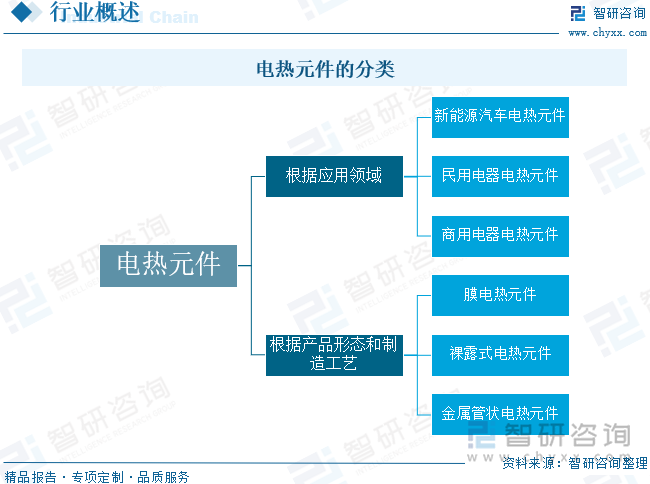
趋势研判!2025年中国电热元件行业发展历程、产业链、市场规模及前景展望:下游应用场景不断丰富,电热元件市场规模持续增长[图]
Chan Ye Xin Xi Wang· 2025-06-14 01:46
Industry Overview - China holds a significant position in the global home appliance industry, being a major producer, consumer, and exporter with a leading industrial support system and technological application level [1][15] - The electric heating element market in China is expected to grow from $3.13 billion in 2017 to $4.294 billion in 2024, with a compound annual growth rate (CAGR) of 4.62% [1][15] - The market is projected to reach $4.496 billion by 2025, driven by the optimistic outlook in the home appliance and new energy markets [1][15] Electric Heating Element Industry Development - The electric heating element industry has evolved through three stages: the budding period, growth period, and explosive period, with significant technological advancements since the 19th century [5][6] - The industry has entered a high-speed development phase in the 21st century, with electric heating elements becoming essential in daily life and industrial production [6] Market Demand and Trends - The demand for electric heating elements is diversifying, leading to a trend towards highly customized products to meet specific industry needs [26] - The electric heating element market is experiencing a shift towards smart technology integration, utilizing IoT and AI for precise temperature control and energy efficiency [24] - Energy-saving innovations are becoming a core focus, with new materials and technologies aimed at reducing energy consumption and enhancing thermal conversion efficiency [25] Key Companies in the Industry - Major companies in the electric heating element sector include Sanhua Intelligent Controls, Dongfang Electric Heating, and Langjin Technology, among others [19][20][22] - Sanhua Intelligent Controls reported a revenue of 27.947 billion yuan in 2024, reflecting a year-on-year growth of 13.8% [20] - Dongfang Electric Heating generated 1.473 billion yuan from new energy equipment manufacturing and 1.14 billion yuan from household appliance components in 2024 [22] Global Market Context - The global electric heating element market has grown from $8.164 billion in 2017 to $10.452 billion in 2024, with a CAGR of 3.59%, and is expected to reach $10.927 billion by 2025 [14] - The industry is characterized by a competitive landscape with North America, Europe, and Asia-Pacific as key regions, where North America and Europe dominate the mid-to-high-end market segments [18]




高端产品赋能行业未来!苏州金龙亮相第八届旅游客运行业发展大会
Jin Tou Wang· 2025-06-09 04:15
Core Insights - The conference highlighted the importance of innovation and quality in the tourism passenger transport industry, emphasizing the need for high-tech, low-energy equipment to enhance service quality and meet the evolving demands of consumers [1][2]. Group 1: Industry Trends - The tourism market is experiencing a shift in consumer demographics, with three main groups emerging: Generation Z seeking immersive experiences, families from the 80s and 90s preferring comfortable and cultural experiences, and the elderly prioritizing quality and age-friendly services [2]. - There is a notable transition in consumer preferences from traditional group tours to customized small groups and free travel, from sightseeing to deep immersion, and from budget travel to quality-focused experiences [2]. Group 2: Company Innovations - Suzhou King Long has been deeply involved in the tourism passenger transport market for over 20 years, showcasing a commitment to innovation and quality through various product launches and technological advancements [1][3]. - The company introduced several star models at the conference, including the new V series, which features customizable seating arrangements and advanced amenities such as high-efficiency electric motors and intelligent thermal management systems [3][4]. Group 3: Product Offerings - The new V series models include options for 9-13 meter vehicles, with a focus on high-end, customized designs suitable for family and small group travel [3]. - The Haige Ruixing model is designed for short-distance passenger transport and features luxury seating, entertainment systems, and a focus on passenger comfort and privacy [3][4]. Group 4: Market Solutions - Suzhou King Long provides comprehensive solutions for the tourism transport sector, covering high-end reception, customized small groups, and smart operations, thereby contributing to the industry's shift towards higher quality and value [4].
SK海力士的隐忧
半导体芯闻· 2025-06-06 10:20
Core Viewpoint - The memory chip market is shifting towards a more customized product approach, focusing on a few core customers and integrating them into an ecosystem [1][2]. Group 1: Market Trends - AI memory chips are becoming more specialized and reliant on a limited number of "locked-in" core customers [1]. - SK Hynix has benefited from the AI boom and is now a major supplier of NVIDIA's high-bandwidth memory (HBM) chips, with the latest HBM4e expected to be used in NVIDIA products starting in 2026 [1]. Group 2: Business Strategy - The new business model emphasizes deep collaboration with specific customers from the initial product development stage, allowing for higher customization flexibility in HBM4e compared to traditional HBM chips [2]. - There is a potential risk in this strategy as it increases dependency on AI clients like NVIDIA; if these clients experience slow growth, SK Hynix may also face a slowdown [2]. - Ensuring that selected customers become leaders in their respective fields is crucial for the success of this new model [2].
2025年中国动力电池抗震支吊架行业产业链、发展现状、竞争格局及未来趋势研判:终端需求引爆场景蓝海,动力电池抗震支吊架行业智能化与性能跃升[图]
Chan Ye Xin Xi Wang· 2025-05-26 01:18
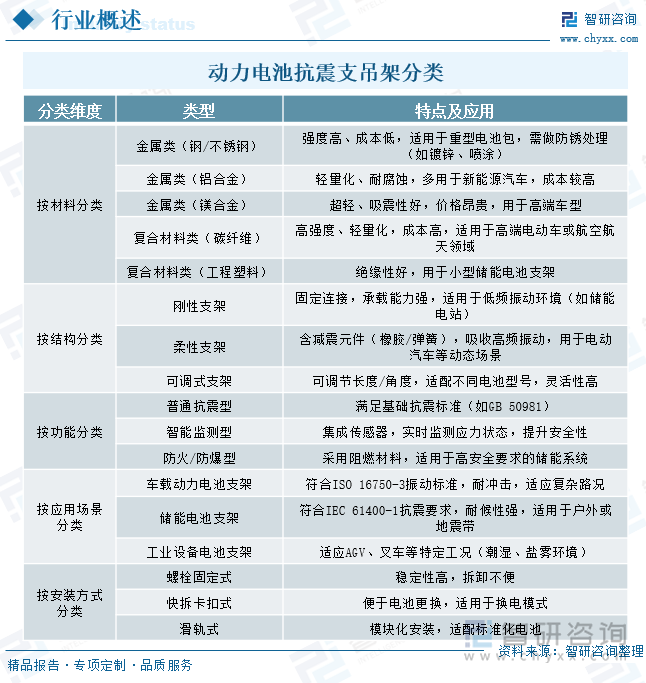
Core Viewpoint - The implementation of mandatory standards such as "General Technical Conditions for Seismic Support and Hangers for Building Mechanical and Electrical Equipment" has expanded the market for seismic support systems in the power battery industry, creating continuous growth opportunities. The Chinese power battery seismic support industry is transitioning from scale expansion to quality improvement, driven by technological innovation and deep market application integration [1][15]. Industry Overview - The power battery seismic support system is designed to ensure the stability and safety of battery systems under seismic conditions. It consists of anchoring components, reinforced hangers, seismic connection components, and diagonal braces [2]. - The industry has developed a complete industrial chain, with upstream focusing on high-end materials like aluminum and magnesium alloys, midstream on design and manufacturing, and downstream applications in energy storage stations and new energy vehicle factories [9][11]. Market Dynamics - The power battery installation volume is expected to reach 130.2 GWh in Q1 2025, with a year-on-year growth of 52.8%, driving the demand for seismic support systems [1][13]. - The market for power battery seismic supports is projected to exceed 15 billion yuan by 2027, reflecting the industry's growth potential [15]. Development History - The industry has evolved through four key stages: the initial phase (2009-2014), standardization phase (2015-2017), rapid growth phase (2018-2020), and the current technology upgrade phase (2021-present) [7]. Competitive Landscape - The industry features a diverse competitive landscape, with traditional seismic companies transitioning, new energy chain companies leading the high-end market, and material and manufacturing companies innovating through lightweight and corrosion-resistant technologies [17][19]. - Key players include Top Group, He Sheng Co., Wen Can Co., and Lian Ying Laser, each focusing on different aspects of the market [2][19]. Future Trends - The industry is shifting from policy-driven to technology-driven and scenario-driven development, with a focus on high-end, customized, and ecological solutions [22]. - Innovations in materials and smart monitoring systems are expected to enhance product performance and reliability, meeting the stringent demands of energy storage and battery swapping scenarios [22][23]. - The industry is moving towards a collaborative ecosystem, integrating upstream material suppliers and downstream service providers to enhance efficiency and sustainability [24].




维峰电子接待19家机构调研,包括华创证券、红华资本、诺安基金等
Jin Rong Jie· 2025-05-23 01:42
Core Insights - The company, Weifeng Electronics, held a research meeting on May 22, 2025, with 19 institutions including Huachuang Securities and Honghua Capital, to discuss its business operations and market conditions in the connector industry [1]. Group 1: Company Overview - The company introduced its basic situation, business layout, and operational performance during the meeting [2]. - The company has over 100,000 reserved part numbers, which are new products that have completed development but are not yet mass-produced, allowing for quick customer response [3]. Group 2: Impact of Tariffs - The company stated that the impact of tariff changes on its current business is minimal, as the direct sales to the U.S. are low. The company plans to focus on expanding its international top-tier clients and optimizing product structure to maintain profitability [4]. Group 3: Capacity Layout - The company has established production bases in Dongguan, Kunshan, and Thailand. The Dongguan base has been operational since last year, the Kunshan base is expected to start production in September this year, and the Thailand base is projected to be operational in the first half of next year. Once fully operational, these bases are expected to generate over 1 billion in revenue [5]. Group 4: Automotive High-Frequency and High-Speed Business - The company has completed the capital increase for its high-frequency and high-speed subsidiary, enhancing its business development in this area. It has developed a full range of products and is set to begin initial mass production this year, having completed validations with multiple vehicle manufacturers and module factories [6]. Group 5: Customization Advantages - The company emphasizes its ability to provide customized solutions, which increases customer loyalty and helps secure long-term projects, making it difficult for competitors to replace its offerings [7].
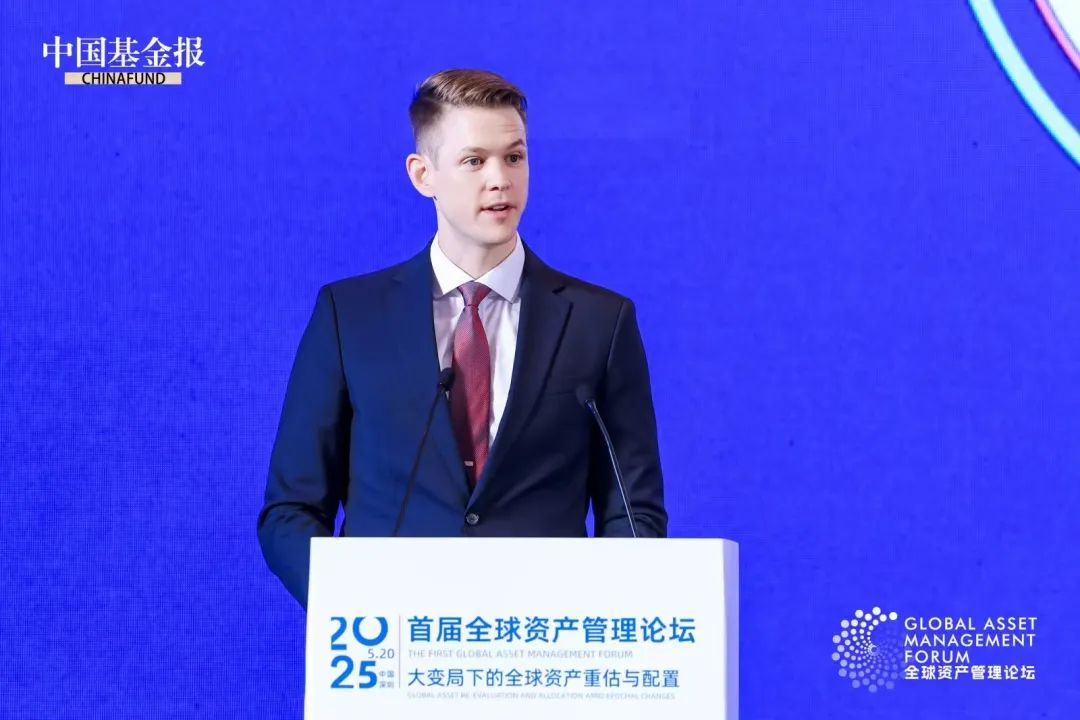
安联投资risklab全球负责人 ,最新发声!
Zhong Guo Ji Jin Bao· 2025-05-21 15:56
Group 1 - The core viewpoint emphasizes that asset allocation is crucial for pension investments, as market timing is unreliable, especially for long-term investments like pensions [1][9][17] - Tim Friederich highlights that pension preservation and growth is a significant challenge for the current generation, and that customized and diversified asset allocation can be powerful tools in pension investment [3][17] - The comparison between European and Chinese pension systems reveals many similarities, particularly in the reliance on public pension systems and the need for reform due to aging populations [6][7][17] Group 2 - The framework for pension investment asset allocation consists of three core components: Strategic Asset Allocation (SAA), Dynamic Asset Allocation (DAA), and Tactical Asset Allocation (TAA) [10][11] - The importance of providing customized pension services is emphasized, as different investors have varying retirement income expectations, investment horizons, and risk tolerances [12][13] - The need for clear communication of complex investment strategies to retail investors is highlighted, ensuring that they can make informed decisions about their pension investments [15][16] Group 3 - The article stresses that appropriate return expectations are essential for maintaining investor engagement in pension plans, and that incorporating global asset classes can enhance diversification and improve risk-adjusted returns [18][17] - The mission of the company is to assist investors in achieving their goals, particularly in the context of developing a diverse pension financial system in China, drawing lessons from European experiences [19][17]