改革攻坚

Search documents
中央经济工作会议:如何定调2026?
Yang Shi Wang· 2025-12-12 00:17
Core Viewpoint - The annual Central Economic Work Conference concluded on December 11, 2025, outlining the economic development direction for 2026, emphasizing stability and progress, quality improvement, and efficiency enhancement [1] Group 1: Economic Policy Direction - The conference clarified the policy orientation for economic work in 2026, focusing on maintaining stability while seeking progress [1] - The emphasis is on domestic demand as the main driver, innovation as a key factor, and reform as a critical challenge [1] Group 2: Key Tasks for 2026 - Eight major tasks for 2026 were identified, highlighting the importance of improving people's livelihoods [1]
(经济观察)明确“路线图” 中央经济工作会议部署八项任务
Zhong Guo Xin Wen Wang· 2025-12-11 15:28
Core Insights - The Central Economic Work Conference outlined eight key tasks for China's economic work in 2026, emphasizing the importance of domestic demand and innovation as primary drivers for economic growth [1][2][3] Group 1: Domestic Demand and Market Development - The first task is to "insist on domestic demand as the main driver and build a strong domestic market," highlighting its significance in the overall economic development strategy [1] - The conference plans to implement actions to boost consumption and optimize policies related to new projects, indicating that expanding domestic demand remains a primary focus for economic work [1] Group 2: Innovation and New Growth Drivers - The second task emphasizes "insisting on innovation-driven development and accelerating the cultivation of new growth drivers," which is seen as crucial for constructing a new development pattern and expanding domestic demand [1][2] - Technological innovation is expected to create new products and consumption demands while reducing costs, thereby increasing supply [1] Group 3: Reform and High-Quality Development - The third task focuses on "insisting on reform to enhance the vitality of high-quality development," which includes deepening reforms and optimizing the business environment to remove institutional barriers [2] - This approach aims to stimulate internal dynamics and facilitate economic circulation [2] Group 4: Open Economy and International Cooperation - The fourth task is to "insist on opening up and promoting win-win cooperation in multiple fields," recognizing the complex changes in the development environment and the need for high-level openness to enhance domestic and international market interactions [2] Group 5: Coordinated Development - The fifth task emphasizes "insisting on coordinated development to promote urban-rural integration and regional linkage," which is essential for achieving a broader and more robust new development pattern [2] Group 6: Green Transformation - The sixth task focuses on "insisting on carbon neutrality as a guiding principle to promote comprehensive green transformation," aligning with the goals of reducing carbon emissions and promoting sustainable growth [2] Group 7: Social Welfare and Stability - The seventh task is to "insist on prioritizing people's livelihoods and strive to do practical things for the public," reiterating the importance of stabilizing employment, businesses, markets, and expectations [2][3] Group 8: Risk Management - The eighth task is to "insist on maintaining a bottom line and actively and prudently resolving risks in key areas," particularly in stabilizing the real estate market and managing local government debt risks [3] - The conference emphasizes a shift in economic policy focus from growth to quality and efficiency, advocating for a coordinated approach to policy implementation [3]
申万宏源:中央经济工作会议的十大亮点
Xin Lang Cai Jing· 2025-12-11 15:03
Core Insights - The 2025 Central Economic Work Conference emphasized five "musts" to address current economic challenges, focusing on potential economic growth and the need for policy support and reform innovation [1][12][23] - The conference highlighted the significant issue of "strong supply and weak demand" in the domestic economy, contrasting with the previous year's focus on demand-side challenges [2][12][24] - The 2025 conference set a general economic growth target for 2026, aiming for stable and reasonable growth without detailing specific indicators, aligning with the "14th Five-Year Plan" goals [2][24] Economic Policy Focus - Fiscal policy will remain "more proactive," with an emphasis on maintaining necessary fiscal deficits and total debt levels, while addressing local fiscal difficulties [3][25][29] - Monetary policy will focus on promoting stable economic growth and reasonable price recovery, with tools like reserve requirement ratio cuts and interest rate reductions being considered [3][25][26] - The conference stressed the importance of integrating existing and new policies to enhance their effectiveness and ensure alignment with current economic goals [4][26] Domestic Demand and Investment - The conference underscored the need to prioritize domestic demand, with plans to implement urban and rural resident income increase programs and stimulate service consumption [5][27][28] - Investment strategies will include increasing central budget investment and optimizing the use of local government special bonds to enhance investment stability in 2026 [5][27][28] Structural Reforms and Green Development - The conference called for deepening the construction of a unified national market and addressing "involution" competition, aiming for a shift from quantity expansion to quality improvement in the economy [5][28][29] - Green and low-carbon initiatives were prioritized, with a commitment to accelerate the development of a new energy system and expand green electricity applications [5][28][29]


明年经济工作怎么干 记住“八个坚持”
Xin Hua She· 2025-12-11 13:30
Core Viewpoint - The Central Economic Work Conference has outlined eight key tasks for economic work in 2026, focusing on domestic demand, innovation, reform, openness, coordinated development, green transformation, improving people's livelihoods, and risk management [1]. Group 1: Domestic Demand and Market Development - Emphasis on maintaining domestic demand as the primary driver and building a strong domestic market [1]. Group 2: Innovation and New Momentum - Focus on innovation-driven growth and accelerating the cultivation of new growth drivers [1]. Group 3: Reform and High-Quality Development - Commitment to tackling reforms to enhance the vitality and momentum for high-quality development [1]. Group 4: Openness and Cooperation - Advocacy for maintaining openness and promoting win-win cooperation across multiple fields [1]. Group 5: Coordinated Development - Support for coordinated development to promote urban-rural integration and regional synergy [1]. Group 6: Green Transformation - Commitment to leading with "dual carbon" goals and promoting comprehensive green transformation [1]. Group 7: Livelihood Improvement - Focus on prioritizing people's livelihoods and striving to address practical issues for the populace [1]. Group 8: Risk Management - Emphasis on safeguarding the bottom line and actively and prudently resolving risks in key areas [1].
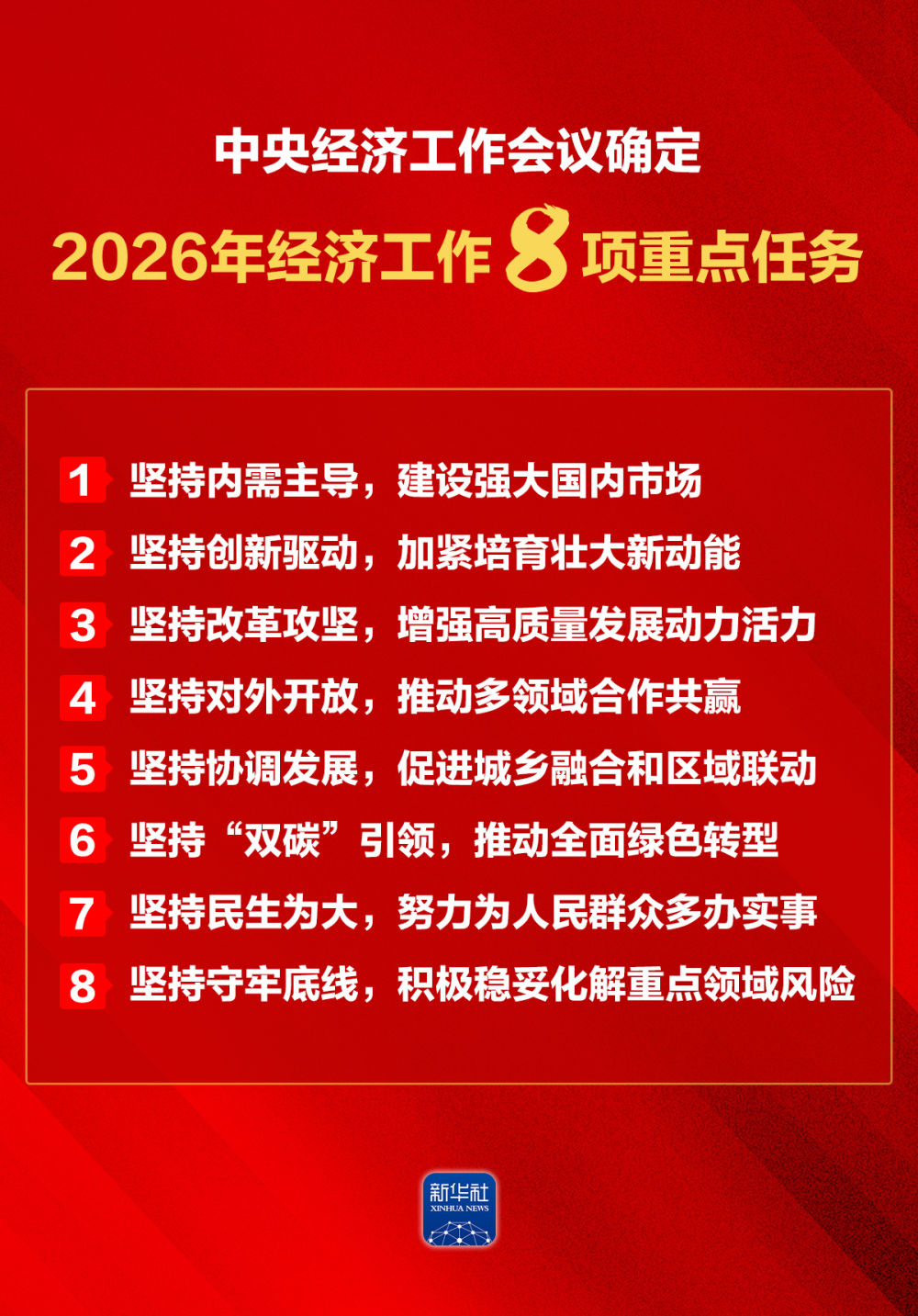
【图解】速览!2026年经济工作八大重点任务
Zhong Guo Jing Ji Wang· 2025-12-11 12:29
Core Viewpoint - The Central Economic Work Conference held on December 10-11 in Beijing outlined eight key tasks for economic work in 2026, focusing on domestic demand, innovation, reform, openness, coordinated development, green transformation, public welfare, and risk management. Group 1: Domestic Demand - Emphasis on leading domestic demand and building a strong domestic market through actions to boost consumption and implement urban and rural income increase plans [1] - Expansion of quality goods and services supply, optimization of "two new" policy implementation, and removal of unreasonable restrictions in the consumption sector to unleash service consumption potential [1][2] - Encouragement of investment stabilization, with an increase in central budget investment scale and optimization of local government special bond usage [1] Group 2: Innovation - Focus on innovation-driven growth by developing a comprehensive plan for education, technology, and talent development [2] - Establishment of international technology innovation centers in key regions such as Beijing, Shanghai, and the Guangdong-Hong Kong-Macau Greater Bay Area [2] - Strengthening the role of enterprises in innovation and improving intellectual property protection in emerging fields [2] Group 3: Reform - Commitment to reform efforts to enhance high-quality development, including the establishment of a unified national market and further deepening state-owned enterprise reforms [3] - Initiatives to clear overdue payments to businesses and promote win-win scenarios for platform enterprises and their operators [3] - Expansion of market-oriented reforms and improvement of the local tax system [3] Group 4: Openness - Promotion of multi-field cooperation and gradual advancement of institutional openness, including the expansion of service sector autonomy and optimization of free trade zone layouts [4] - Encouragement of service exports and development of digital and green trade [4] - Strengthening of foreign investment promotion mechanisms and enhancing overseas service systems [4] Group 5: Coordinated Development - Coordination of urban-rural integration and regional collaboration, focusing on high-quality development in county economies [5] - Maintenance of arable land and food production stability, ensuring reasonable prices for key agricultural products [5] - Support for major economic provinces and enhancement of cooperation among key urban clusters [5] Group 6: Green Transformation - Advancement of energy-saving and carbon reduction initiatives in key industries and the establishment of a new energy system [6] - Strengthening of the national carbon emissions trading market and implementation of comprehensive waste management actions [6] - Promotion of environmental protection initiatives and improvement of disaster response infrastructure [6] Group 7: Public Welfare - Implementation of actions to stabilize employment for key groups such as college graduates and migrant workers, and support for flexible employment [7] - Adjustment of educational resource allocation to increase high school and quality university enrollment [7] - Optimization of drug procurement and deepening of medical insurance payment reforms [7] Group 8: Risk Management - Focus on stabilizing the real estate market with city-specific policies to control inventory and encourage the acquisition of existing housing for social welfare [8]

“八个坚持”!明年经济工作重点任务来了
Zhong Guo Xin Wen Wang· 2025-12-11 12:14
Core Viewpoint - The Central Economic Work Conference held on December 10-11 in Beijing outlined eight key tasks for economic work in the coming year, emphasizing the importance of domestic demand, innovation, reform, and sustainable development. Group 1: Domestic Demand and Market Development - Emphasis on domestic demand as the main driver for economic growth, with plans to implement actions to boost consumption and increase residents' income [1] - Initiatives to expand the supply of quality goods and services, and to optimize the implementation of new policies [1] - Measures to stabilize investment, including increasing central budget investments and optimizing the use of local government special bonds [1] Group 2: Innovation and New Growth Drivers - Focus on innovation-driven development, with plans to enhance education, technology, and talent development [2] - Establishment of international technology innovation centers in key regions such as Beijing, Shanghai, and the Guangdong-Hong Kong-Macau Greater Bay Area [2] - Strengthening the role of enterprises in innovation and improving intellectual property protection in emerging fields [2] Group 3: Reform and High-Quality Development - Commitment to reform efforts to enhance the vitality of high-quality development, including the establishment of a unified national market [2] - Plans to deepen state-owned enterprise reforms and improve regulations supporting the private economy [2] - Initiatives to clear overdue payments to businesses and promote win-win development for platform enterprises and their operators [2] Group 4: Opening Up and International Cooperation - Promotion of multi-field cooperation and gradual expansion of service sector openness [2] - Encouragement of service exports and development of digital and green trade [2] - Efforts to enhance the foreign investment promotion system and support the Belt and Road Initiative [2] Group 5: Coordinated Development and Urban-Rural Integration - Focus on urbanization and rural revitalization, with an emphasis on county-level economic development [3] - Commitment to maintaining food production and stabilizing prices of essential agricultural products [3] - Strengthening coordination among major urban clusters and enhancing cross-administrative cooperation [3] Group 6: Green Transformation and Carbon Neutrality - Initiatives to promote energy efficiency and carbon reduction in key industries [3] - Development of a new energy system and expansion of green electricity applications [3] - Implementation of comprehensive waste management actions and environmental protection measures [3] Group 7: Social Welfare and Employment - Actions to stabilize employment for key groups such as college graduates and migrant workers [4] - Plans to optimize educational resource allocation and increase the supply of quality educational opportunities [4] - Initiatives to enhance healthcare services and support for vulnerable groups [4] Group 8: Risk Management and Financial Stability - Focus on stabilizing the real estate market with tailored measures for different cities [4] - Efforts to reform the housing provident fund system and promote the construction of affordable housing [4] - Strategies to manage local government debt risks and optimize debt restructuring methods [4]
明年经济工作怎么干,记住“八个坚持”
Xin Hua She· 2025-12-11 12:04
Core Viewpoint - The Central Economic Work Conference has outlined eight key tasks for economic work in 2026, focusing on domestic demand, innovation, reform, openness, coordinated development, green transformation, improving people's livelihoods, and risk management [1] Group 1: Domestic Demand and Market Development - Emphasis on maintaining domestic demand as the primary driver and building a strong domestic market [1] Group 2: Innovation and New Momentum - Focus on innovation-driven strategies to cultivate and strengthen new growth drivers [1] Group 3: Reform and High-Quality Development - Commitment to reform efforts aimed at enhancing the vitality and momentum for high-quality development [1] Group 4: Openness and Cooperation - Advocacy for sustained openness to promote win-win cooperation across multiple fields [1] Group 5: Coordinated Development - Promotion of coordinated development to facilitate urban-rural integration and regional collaboration [1] Group 6: Green Transformation - Leadership in "dual carbon" initiatives to drive comprehensive green transformation [1] Group 7: Livelihood Improvement - Prioritization of people's livelihoods with efforts to address practical issues for the populace [1] Group 8: Risk Management - Focus on maintaining bottom lines and actively managing risks in key areas [1]
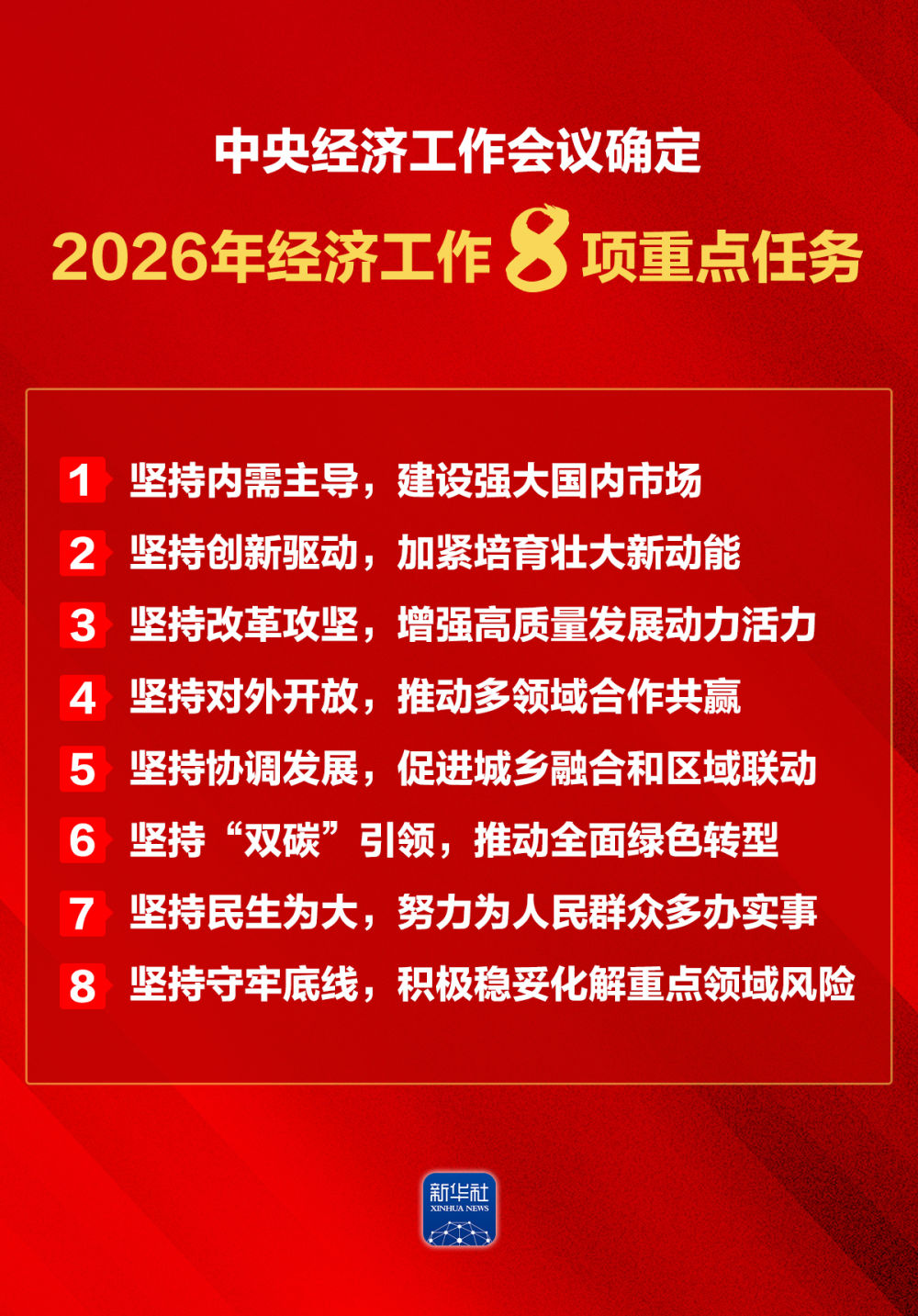
中央经济工作会议:确定明年八大重点任务
2 1 Shi Ji Jing Ji Bao Dao· 2025-12-11 11:21
Core Viewpoint - The Central Economic Work Conference held on December 10-11 in Beijing outlined key tasks for economic work in the coming year, emphasizing a focus on domestic demand, innovation, reform, openness, coordinated development, green transformation, people's livelihood, and risk management [1] Group 1: Economic Focus Areas - Emphasis on domestic demand as the main driver to build a strong domestic market [1] - Innovation-driven approach to accelerate the cultivation and growth of new economic drivers [1] - Commitment to reform efforts to enhance the vitality and momentum for high-quality development [1] Group 2: External Relations and Development - Focus on promoting cooperation and win-win outcomes in multiple fields through openness [1] - Coordination in development to promote urban-rural integration and regional linkage [1] Group 3: Sustainability and Social Welfare - Leadership in "dual carbon" initiatives to promote comprehensive green transformation [1] - Prioritization of people's livelihood with efforts to address practical issues for the populace [1] Group 4: Risk Management - Commitment to maintaining a bottom line by actively and prudently addressing risks in key areas [1]
华夏时评:以“积极宽松”政策锚定“八个坚持”
Hua Xia Shi Bao· 2025-12-11 11:16
Core Viewpoint - The central economic work conference held on December 10-11, 2023, emphasized the importance of utilizing fiscal and monetary policies effectively to achieve the goals set for 2026, marking the beginning of the "15th Five-Year Plan" [2][4]. Group 1: Economic Policy Direction - The conference reiterated the implementation of a more proactive fiscal policy and moderately loose monetary policy, aiming to enhance macroeconomic governance effectiveness [2][4]. - The "Eight Persistences" were highlighted as key strategies for economic work in 2026, focusing on domestic demand, innovation, reform, openness, coordinated development, carbon neutrality, people's livelihood, and risk management [3][4]. Group 2: Implementation Strategies - Fiscal and monetary policies are expected to work in tandem to support the "Eight Persistences," with fiscal funds directed towards infrastructure and innovation, while monetary policy aims to provide low-cost funding to high-tech enterprises [4][5]. - Specific measures include fiscal support for necessary reforms, maintaining a stable financial environment, and promoting regional balance and rural revitalization through targeted fiscal transfers [5][6]. Group 3: Long-term Goals - The success of China's economic development in 2026 will not solely be measured by GDP growth but also by the integration of macro policy resources with the strategic layout of the "Eight Persistences" [6]. - The proactive policies are seen as essential for navigating complex challenges and ensuring a strong start to the "15th Five-Year Plan" [6].

2026中国经济走向趋于明朗
Sou Hu Cai Jing· 2025-12-10 00:35
tion of the w K # 17 10 all of the relation and Bank t = 30 DINGTON 1 10 01 11 日 01 100 al = 中國日 1 al 1 1 1 1 1 1 1 1 1 1 i 11 一周五 10 8-3" 85 ll E. 哥哥 126 2025年12月8日,中共中央政治局会议为2026年经济工作定下"稳中求进、提质增效"的总基调,"更加积极有为的宏观政策"与"坚持内需主导"等八大部署形 成清晰政策框架。恰逢美联储议息会议启幕,外部货币政策环境的潜在宽松窗口,与国内政策的精准发力形成呼应。在"十五五"开局的关键节点,内外因素 的协同共振,让2026年中国经济质的有效提升与量的合理增长路径愈发清晰。 政治局会议释放的核心信号,是宏观政策将延续"积极+宽松"组合并强化协同效应。这一基调的确立,既基于2026年作为"十五五"开局之年的发展需求,也 源于对经济运行主要矛盾的精准把握。会议明确的"更加积极的财政政策和适度宽松的货币政策"双轮驱动,为经济增长提供了稳定预期。 更加积极的财政政策将在支出力度与可持续性之间寻求精准平衡。粤开证券首席经济学 ...