宏观政策协同发力

Search documents
划重点!部委年度工作会议透露今年要做这五件事
Xin Lang Cai Jing· 2026-01-14 06:06
Core Viewpoint - The 2026 economic development blueprint is shaped by five core themes: expanding domestic demand, strengthening industries, preventing risks, promoting openness, and stabilizing livelihoods [1][16]. Group 1: Macroeconomic Policy Coordination - The macroeconomic policy for 2026 will continue the "proactive fiscal + moderately loose monetary" approach, emphasizing precision, coordination, and sustainability [2][17]. - Fiscal policy will focus on enhancing efficiency and effectiveness, with three highlights: reasonable expansion of expenditure scale, targeted funding allocation, and continuous innovation of policy tools [2][18]. - The monetary policy will maintain a loose stance, with the People's Bank of China emphasizing the importance of promoting high-quality economic development and reasonable price recovery [2][18]. Group 2: Domestic Demand Strategy - Expanding domestic demand is crucial for economic recovery, with measures targeting both consumption and investment [4][19]. - A new consumption upgrade policy will be implemented, focusing on service consumption and optimizing the old-for-new policy for various products [4][19][20]. - The government aims to create an international consumption environment and enhance consumer capabilities through financial support [5][20]. Group 3: Investment Promotion - The National Development and Reform Commission will implement measures to stabilize and improve investment efficiency, including increasing government investment and stimulating private investment [6][21]. - The focus will be on major infrastructure projects and enhancing the role of local government bonds and new policy financial tools [7][21]. Group 4: Industrial Upgrade - The 2026 economic work will prioritize the development of new productive forces and the integration of technological and industrial innovation [8][22]. - Policies will support the upgrading of manufacturing core equipment and the enhancement of strategic emerging industries, with artificial intelligence expected to drive significant investment [8][23]. Group 5: Risk Prevention - Risk prevention efforts will focus on local government debt, real estate, and financial sectors, employing market-oriented and legal methods to mitigate risks [10][25]. - The emphasis will be on orderly resolution of local government debt risks and maintaining financial stability through improved regulatory frameworks [10][26]. Group 6: Livelihood Improvement - Various measures will be introduced to address urgent public concerns in employment, pension, healthcare, and housing [13][27]. - The government will enhance the social safety net and improve the quality of public services, particularly in rural areas [13][28]. Group 7: High-Level Openness - The government will promote high-level openness to counter external uncertainties, focusing on trade innovation and foreign investment attraction [15][29]. - Initiatives will include enhancing free trade zones and deepening cooperation under the Belt and Road Initiative [15][29].
中央经济工作会议的十大亮点(申万宏观·赵伟团队)
申万宏源宏观· 2025-12-11 16:03
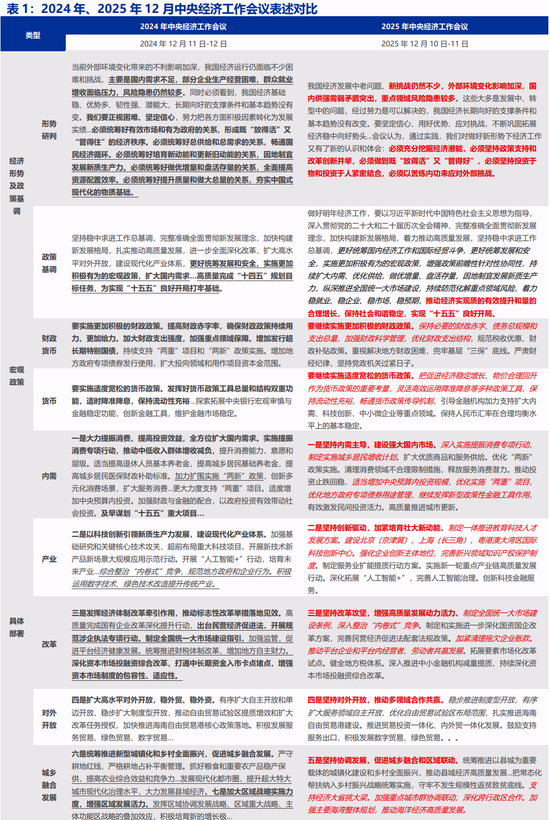
Core Viewpoint - The 2025 Central Economic Work Conference emphasizes five "musts" to address the current economic challenges, highlighting the contradiction of strong supply and weak demand domestically, and focusing on the need for policy support and reform innovation to stimulate economic potential [2][15]. Economic Situation and Policy Framework - The conference identifies persistent "old problems and new challenges" in the economy, particularly the contradiction of strong supply and weak demand, which aligns with the ongoing weakness in PPI and CPI [2][15]. - The 2025 conference shifts focus from the demand side issues highlighted in 2024 to the current supply-demand imbalance, indicating a more targeted approach to economic challenges [2][15]. Economic Goals for 2026 - The conference outlines a focus on overall economic stability and quality improvement, stating the goal of "continuously consolidating and expanding the stable and positive momentum of the economy" without detailing specific indicators [3][16]. Fiscal and Monetary Policy - Fiscal policy remains "more proactive," with an emphasis on maintaining necessary fiscal deficits and total debt levels, while addressing local fiscal difficulties and promoting debt management [4][17]. - Monetary policy aims to support economic stability and reasonable price recovery, with a focus on flexible use of tools like reserve requirement ratio cuts and interest rate reductions [4][17]. Policy Coordination and Reform - The conference stresses the importance of enhancing the consistency and effectiveness of macroeconomic policies, integrating both existing and new policies to align with current economic goals [5][18]. - There is a notable emphasis on combining short-term policy measures with long-term institutional reforms, particularly in expanding domestic demand and addressing "involution" in competition [6][19]. Green Development and Risk Management - The conference prioritizes green and low-carbon initiatives, committing to "double carbon" goals and accelerating the construction of a new energy system [7][20]. - Risk management strategies have evolved from "preventing and resolving" to "actively and prudently resolving," particularly in the real estate sector, with a focus on controlling new supply and optimizing existing stock [8][20].

申万宏源:中央经济工作会议的十大亮点
Xin Lang Cai Jing· 2025-12-11 15:03
Core Insights - The 2025 Central Economic Work Conference emphasized five "musts" to address current economic challenges, focusing on potential economic growth and the need for policy support and reform innovation [1][12][23] - The conference highlighted the significant issue of "strong supply and weak demand" in the domestic economy, contrasting with the previous year's focus on demand-side challenges [2][12][24] - The 2025 conference set a general economic growth target for 2026, aiming for stable and reasonable growth without detailing specific indicators, aligning with the "14th Five-Year Plan" goals [2][24] Economic Policy Focus - Fiscal policy will remain "more proactive," with an emphasis on maintaining necessary fiscal deficits and total debt levels, while addressing local fiscal difficulties [3][25][29] - Monetary policy will focus on promoting stable economic growth and reasonable price recovery, with tools like reserve requirement ratio cuts and interest rate reductions being considered [3][25][26] - The conference stressed the importance of integrating existing and new policies to enhance their effectiveness and ensure alignment with current economic goals [4][26] Domestic Demand and Investment - The conference underscored the need to prioritize domestic demand, with plans to implement urban and rural resident income increase programs and stimulate service consumption [5][27][28] - Investment strategies will include increasing central budget investment and optimizing the use of local government special bonds to enhance investment stability in 2026 [5][27][28] Structural Reforms and Green Development - The conference called for deepening the construction of a unified national market and addressing "involution" competition, aiming for a shift from quantity expansion to quality improvement in the economy [5][28][29] - Green and low-carbon initiatives were prioritized, with a commitment to accelerate the development of a new energy system and expand green electricity applications [5][28][29]

重磅会议将定调明年经济 稳增长政策料持续发力
Zhong Guo Xin Wen Wang· 2025-12-10 09:27
Core Viewpoint - The upcoming Central Economic Work Conference is expected to reinforce "stabilizing growth" policies, laying a foundation for high-quality development during the 14th Five-Year Plan period [1] Group 1: Macroeconomic Policy Coordination - "Stabilizing growth" will play a central role in the 2026 economic work, with expectations for a series of macroeconomic policies to ensure economic operation within a reasonable range [2] - Fiscal policy is anticipated to be more proactive, with higher deficit rates and the continuation of issuing long-term special bonds to stabilize the economy and employment [2] - Monetary policy is expected to remain moderately loose, with potential reductions in reserve requirements and interest rates to lower financing costs for the real economy [2] Group 2: Expanding Domestic Demand - The release of domestic market potential is crucial, with a shift towards stimulating innovation and consumption to create a favorable environment for entrepreneurship [3] - Fiscal support for consumption is likely to expand, focusing on both durable goods and general consumer goods, with an emphasis on service consumption [3] - Investment in equipment upgrades is expected to increase, targeting effective investments in technology innovation and manufacturing upgrades [3] Group 3: Accelerating New Momentum Cultivation - China is at a critical stage of growth momentum transition, requiring new growth paths amid weakening traditional drivers [4] - The World Intellectual Property Organization's report indicates that China has entered the global top ten in innovation index, providing a solid foundation for technology industrialization [4] - Future policies will focus on strengthening basic research and key technology breakthroughs, with an emphasis on strategic emerging industries such as new energy and aerospace [4][5]
(经济观察)重磅会议将定调明年经济 稳增长政策料持续发力
Zhong Guo Xin Wen Wang· 2025-12-10 09:07
Core Viewpoint - The upcoming Central Economic Work Conference is expected to set the tone for China's economic policies in 2026, emphasizing "stability while seeking progress" and focusing on structural adjustments and energy transitions [1] Group 1: Macroeconomic Policy Coordination - "Stability" is anticipated to play a central role in the economic work for 2026, with expectations for a series of macroeconomic policies to ensure economic operation within a reasonable range [2] - Fiscal policy is expected to become more proactive, with higher deficit rates and the continuation of issuing long-term special bonds to stabilize the economy and employment [2] - Monetary policy is likely to remain moderately loose, with expectations for timely reductions in reserve requirements and interest rates to lower financing costs for the real economy [2] Group 2: Expanding Domestic Demand - The release of domestic market potential is seen as crucial, with a shift towards stimulating innovation and consumption to create a favorable environment for entrepreneurship [3] - Fiscal support for consumption is expected to expand, potentially covering a wider range of consumer goods and services, with a focus on service consumption [3] - Investment in equipment upgrades is anticipated to increase, with a focus on technology innovation and manufacturing transformation, while addressing issues of overcapacity and mismatched supply and demand [3] Group 3: Accelerating New Momentum Cultivation - China is at a critical stage of transitioning growth drivers, with a need to explore new growth paths amid weakening traditional drivers [4] - The World Intellectual Property Organization's report indicates that China has entered the global top ten in innovation index, laying a solid foundation for technological industrialization [4] - Future policies are expected to strengthen basic research and the transformation of key technologies, focusing on strategic emerging industries such as new energy, AI, and advanced manufacturing [4][5]
图说高质量丨8月份国民经济运行总体平稳、稳中有进
Xin Hua She· 2025-09-16 00:29
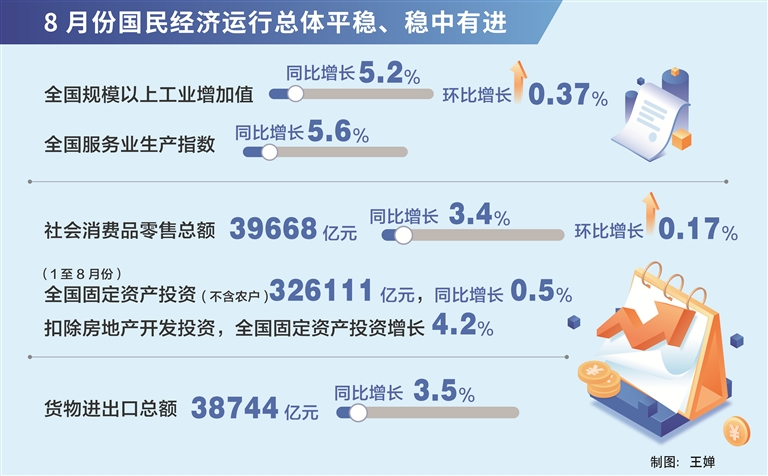
Economic Overview - In August, the national economy maintained overall stability with a steady development trend, supported by stable production demand, employment, and prices, as well as the cultivation of new growth drivers [3][4] Industrial and Service Sector Performance - In August, the industrial added value for large-scale enterprises increased by 5.2% year-on-year and 0.37% month-on-month; the service production index grew by 5.6% year-on-year [3] Market Sales and Investment - The total retail sales of consumer goods reached 39,668 billion yuan in August, reflecting a year-on-year increase of 3.4% and a month-on-month increase of 0.17% [3] - From January to August, fixed asset investment (excluding rural households) totaled 326,111 billion yuan, up by 0.5% year-on-year; excluding real estate development investment, the growth rate was 4.2% [3] Trade Performance - In August, the total import and export value was 38,744 billion yuan, marking a year-on-year increase of 3.5%; exports were 23,035 billion yuan (up 4.8%), and imports were 15,709 billion yuan (up 1.7%) [3] Employment and Price Stability - The average urban survey unemployment rate from January to August was 5.2%; in August, it was 5.3%, an increase of 0.1 percentage points from the previous month, remaining stable compared to the same month last year [3] - The Consumer Price Index (CPI) in August decreased by 0.4% year-on-year, remaining flat month-on-month; the core CPI, excluding food and energy prices, rose by 0.9% year-on-year, with an increase of 0.1 percentage points compared to the previous month [3] Policy and Future Outlook - The macroeconomic policies are working in coordination, contributing to the overall stability of the national economy, with steady progress in transformation and upgrading, and new achievements in high-quality development [4] - There are still many risks and challenges facing the economy due to external instability and uncertainty; future efforts will focus on stabilizing employment, enterprises, markets, and expectations, while deepening reform and opening up [4]
宏观政策协同发力 8月份国民经济运行总体平稳
Qi Huo Ri Bao Wang· 2025-09-15 18:51
Economic Overview - In August, the national economy showed overall stability with coordinated macro policies, steady progress in transformation and upgrading, and new achievements in high-quality development [1][2] - The industrial production and service sectors experienced rapid growth, with industrial added value increasing by 5.2% year-on-year and service production index rising by 5.6% [1] Market Performance - Retail sales and fixed asset investment maintained steady growth, with total retail sales of consumer goods reaching 39,668 billion yuan, a year-on-year increase of 3.4% [1] - From January to August, fixed asset investment (excluding rural households) totaled 326,111 billion yuan, up 0.5% year-on-year, while investment excluding real estate development grew by 4.2% [1] - The total import and export value in August was 38,744 billion yuan, a year-on-year increase of 3.5%, with exports at 23,035 billion yuan (up 4.8%) and imports at 15,709 billion yuan (up 1.7%) [1] Employment and Inflation - The employment situation remained generally stable, with the urban surveyed unemployment rate averaging 5.2% from January to August and at 5.3% in August [1] - The Consumer Price Index (CPI) decreased by 0.4% year-on-year in August, while the core CPI, excluding food and energy, rose by 0.9%, indicating a slight increase in inflationary pressure [1] Real Estate Market - The real estate market showed signs of stabilization, with new residential sales area declining by 4.7% year-on-year, a reduction in the decline compared to the previous year [2] - In August, the inventory of unsold commercial housing decreased by 3.17 million square meters, marking six consecutive months of reduction [2] Future Economic Outlook - The economic foundation remains strong, with macro policies showing effectiveness and ongoing reforms supporting stable growth [4] - Despite external challenges, the economy is expected to maintain a steady and improving development trend, bolstered by new growth drivers and enhanced market vitality [4]
↑ 5.2%!统计局最新公布!
证券时报· 2025-09-15 02:26
Core Viewpoint - The national economy in August showed overall stability and progress, supported by strong leadership and effective macroeconomic policies [1][10]. Group 1: Industrial Production - In August, the industrial added value above designated size increased by 5.2% year-on-year and 0.37% month-on-month, with mining, manufacturing, and electricity sectors growing by 5.1%, 5.7%, and 2.4% respectively [2]. - The equipment manufacturing and high-tech manufacturing sectors performed well, with added value growth of 8.1% and 9.3%, exceeding the overall industrial growth by 2.9 and 4.1 percentage points [2]. - The manufacturing purchasing managers' index was at 49.4, a slight increase from the previous month, while the business activity expectation index rose to 53.7 [2]. Group 2: Service Sector - The service production index increased by 5.6% year-on-year in August, with significant growth in information transmission, finance, and leasing services [3]. - The business activity index for the service sector was at 50.5, indicating expansion, while the business activity expectation index rose to 57.0 [3]. - The revenue of large-scale service enterprises grew by 7.4% year-on-year from January to July [3]. Group 3: Market Sales - The total retail sales of consumer goods reached 39,668 billion yuan in August, growing by 3.4% year-on-year [4]. - Online retail sales amounted to 99,828 billion yuan, with a year-on-year growth of 9.6%, and physical goods online retail sales accounted for 25.0% of total retail sales [4]. - The consumption upgrade policy showed positive effects, with significant growth in categories like furniture and home appliances [4]. Group 4: Fixed Asset Investment - From January to August, fixed asset investment (excluding rural households) was 326,111 billion yuan, with a year-on-year growth of 0.5% [5][6]. - Manufacturing investment grew by 5.1%, while real estate development investment saw a decline of 12.9% [5]. - High-tech industries, particularly information services and aerospace manufacturing, experienced substantial investment growth of 34.1% and 28.0% respectively [6]. Group 5: Trade and Employment - In August, the total import and export value reached 38,744 billion yuan, with exports growing by 4.8% and imports by 1.7% [7]. - The average urban survey unemployment rate was 5.2% from January to August, with a slight increase to 5.3% in August [8]. - The core Consumer Price Index (CPI) rose by 0.9% year-on-year, indicating a slight inflationary trend [9].

前七月社融破23万亿元 信贷“小月”数据波动原因何在
Sou Hu Cai Jing· 2025-08-13 16:27
Core Viewpoint - The financial data for July shows a notable increase in broad money (M2) and social financing scale, indicating a robust credit environment despite seasonal fluctuations and structural adjustments in the economy [1][2][4]. Monetary Data Summary - As of the end of July, M2 balance reached 329.94 trillion yuan, with a year-on-year growth of 8.8%, up 0.5 percentage points from the previous month and 2.5 percentage points from the same period last year [1]. - The narrow money (M1) balance was 111.06 trillion yuan, growing by 5.6% year-on-year, an increase of 1 percentage point from the previous month [1]. - The total social financing scale stood at 431.26 trillion yuan, with a year-on-year growth of 9.0%, slightly up by 0.1 percentage points from the previous month [1]. Credit Growth Analysis - The increase in social financing scale for the first seven months of 2025 reached 23.99 trillion yuan, which is 5.12 trillion yuan more than the previous year [2]. - The fluctuation in credit data during June and July is attributed to seasonal factors, policy adjustments, and structural optimization [3][4]. - The impact of local government bond replacements has significantly influenced loan data, with an estimated 2.6 trillion yuan in refinancing special bonds affecting loan growth by approximately 1 percentage point [4]. Credit Structure Optimization - By the end of July, the balance of RMB loans was 268.51 trillion yuan, reflecting a year-on-year growth of 6.9%, which is notably higher than the nominal economic growth rate [5]. - The growth in loans for small and micro enterprises reached 35.05 trillion yuan, with an 11.8% year-on-year increase, while medium to long-term loans for the manufacturing sector grew by 8.5% [6]. Policy Coordination - The macroeconomic policy has been more proactive, with a significant increase in government bond issuance, which totaled 13.3 trillion yuan in the first half of the year, including 7.89 trillion yuan in national bonds [7]. - The government department's leverage ratio increased by 9 percentage points to 65.3%, while the leverage ratios for non-financial enterprises and households remained relatively stable [8]. - The ongoing fiscal policy aims to stimulate total demand and support economic recovery, which is expected to enhance credit demand and promote a positive cycle between finance and the real economy [8].
央行最新发布!7月金融数据出炉
第一财经· 2025-08-13 09:41
Core Viewpoint - The article discusses the financial data released by the central bank for July 2025, highlighting the acceleration in M2 growth and the stable growth of social financing, indicating a positive trend in credit demand and economic activity [3][4]. Financial Data Overview - As of the end of July 2025, M2 balance reached 329.94 trillion yuan, with a year-on-year growth of 8.8%, up 0.5 percentage points from the previous month and 2.5 percentage points from the same period last year [3]. - The narrow money (M1) balance was 111.06 trillion yuan, growing by 5.6% year-on-year, an increase of 1 percentage point from the previous month [3]. - The total social financing stock was 431.26 trillion yuan, with a year-on-year growth of 9.0%, and an incremental increase of 1.13 trillion yuan, which is 361.3 billion yuan more than the previous year [3][4]. Seasonal Factors Impacting Data - The fluctuations in credit data for June and July are attributed to seasonal factors, policy adjustments, and structural optimization [3][6]. - The timing of financial institutions' half-year reports and the settlement period for enterprises significantly influenced the credit data [6]. - The replacement of local government bonds has notably impacted loan data, with an estimated 2.6 trillion yuan in refinancing special bonds affecting loan growth by approximately 1 percentage point [7][6]. Credit Structure Optimization - By the end of July, the balance of RMB loans was 268.51 trillion yuan, with a year-on-year growth of 6.9%, indicating strong support for the real economy [9]. - The growth of inclusive small and micro loans was 11.8%, and medium to long-term loans for the manufacturing sector grew by 8.5%, both exceeding the overall loan growth rate [10]. Macroeconomic Policy Coordination - The macroeconomic policy has been more proactive, with a significant increase in government bond issuance, totaling 13.3 trillion yuan in the first half of the year, including 7.89 trillion yuan in national bonds [12]. - The government department's leverage ratio increased by 9 percentage points to 65.3%, while the leverage ratios for non-financial enterprises and households remained relatively stable [12][14]. - The article emphasizes that the continuous and stable macroeconomic policies are expected to support effective credit demand and economic recovery [12][14].