
欧洲央行货币政策

Search documents
欧元区经济迎健康检查!GDP与通胀数据发布在即 复苏之路仍显坎坷
智通财经网· 2025-10-27 06:59
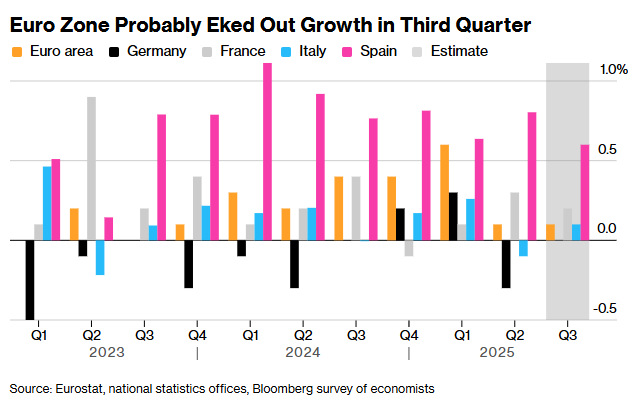
Core Viewpoint - The upcoming economic data releases in Europe, including GDP and inflation figures, are crucial for assessing the impact of U.S. tariffs on economic growth and inflation, with expectations of minimal growth in the Eurozone [1][4]. Economic Indicators - The Eurozone's Q3 GDP is expected to show a slight growth of 0.1%, with significant economic reports from major economies providing further insights [1]. - October inflation data is anticipated to decrease from 2.2% in September to 2.1%, indicating a potential easing of price pressures [4]. - A bank lending survey will be released, which will help evaluate the transmission of monetary policy to the real economy [4]. Economic Activity and Consumer Confidence - Recent corporate surveys indicate a potential recovery in the Eurozone economy, driven primarily by Germany's infrastructure and defense spending [6]. - Despite a strong labor market, consumer confidence remains low, raising concerns about the sustainability of private consumption recovery [4][6]. - The economic outlook for Germany is cautious, with warnings of potential stagnation and the risk of recession if negative growth persists [6][7]. Inflation Trends - The expected slowdown in inflation supports the European Central Bank's assertion that price growth is currently near target levels, with indications that inflation may remain below target in the coming months [9]. - There is a prevailing market sentiment that inflation risks are skewed to the downside, with potential implications for future interest rate discussions [9].

欧洲央行官员称利率已合适 但降息呼声暗流涌动
Xin Hua Cai Jing· 2025-09-24 07:53
Group 1 - The European Central Bank (ECB) is at a critical juncture in monetary policy, with a consensus among members that the current deposit facility rate of 2% is appropriate, and the threshold for short-term adjustments is considered high [1][2] - ECB Executive Board member Piero Cipollone stated that inflation risks are balanced, and the eurozone's output is still expanding, with growth expected to recover after a slowdown [1][2] - There is a divergence in views among eurozone central bank governors, with some advocating for caution and others supporting a more accommodative stance to achieve inflation targets and support economic growth [2][3] Group 2 - The upcoming December meeting of the ECB is anticipated to provide clearer insights into economic forecasts, particularly regarding the impact of U.S. tariffs on the eurozone [2] - The ECB President Christine Lagarde's position is seen as a key variable in breaking the current policy deadlock, as she has not publicly commented on the balance of inflation risks [2][3] - A participant in a closed-door meeting indicated that while the 2% inflation target has been reached, the sustainability of this target remains uncertain and will be addressed in the December meeting [3]
欧洲央行降息周期已结束?管委分歧显现 12月经济预测成关键依据
智通财经网· 2025-09-22 00:16
Core Viewpoint - European Central Bank (ECB) officials are anxiously awaiting new economic forecasts in December to assess if current interest rates are sustainable for achieving a 2% inflation target [1] Group 1: Current Economic Situation - ECB officials believe the current deposit facility rate of 2% is suitable for achieving the inflation target, but there is disagreement on assessing economic risks and tolerance for short-term inflation below the target [1] - ECB President Lagarde stated that the bank has achieved its price stability goal, but uncertainties remain despite a trade agreement with the U.S. [1] - The ECB maintained interest rates in September, indicating that monetary policy is in a "good state," which led to reduced expectations for further rate cuts [1] Group 2: Perspectives from Central Bank Leaders - Latvian central bank governor Martins Kazaks emphasized that it is inappropriate to adjust rates every time inflation deviates from the target, suggesting a high threshold for rate changes in October and December [2] - Greek central bank governor Yannis Stournaras noted that the current balance is acceptable, with no immediate need for rate adjustments, but acknowledged that significant changes in the economic outlook could prompt a reassessment [2] - Maltese central bank governor Edward Scicluna stated that the current interest rate level is appropriate, with no discussions on rate cuts, while monitoring trade tensions and the euro exchange rate [3] Group 3: Future Inflation Predictions - Lithuanian central bank governor Gediminas Simkus expressed a preference for rate cuts to support inflation targets, predicting that mid-term inflation will likely remain below the target [3] - Estonian central bank governor Madis Muller indicated that current rates support growth and inflation is at desired levels, suggesting no need for further action [4] - Portuguese central bank governor Mario Centeno mentioned that while a few quarters of inflation below the target can be tolerated, prolonged low inflation could lead to a de-anchoring of inflation expectations [4]
总台记者观察丨美联储宣布降息 欧洲经济面临多重影响
Sou Hu Cai Jing· 2025-09-18 02:05
Core Viewpoint - The Federal Reserve's decision to cut interest rates by 25 basis points marks a significant shift in monetary policy, which is expected to have multiple impacts on the European economy [1]. Group 1: Impact on European Markets - Historical data suggests that European stock markets tend to perform well in the 3 to 6 months following a Federal Reserve rate cut, primarily due to increased market liquidity and the attractiveness of European markets for investors seeking higher returns [1]. - The rate cut is anticipated to strengthen the euro against the dollar, enhancing the appeal of euro-denominated assets and potentially attracting more investment [3]. Group 2: Economic Challenges - The appreciation of the euro may lead to higher prices for European exports, negatively impacting export-oriented industries as they struggle to compete with cheaper goods, particularly from the U.S., which could hinder overall economic growth in the EU [5]. - The eurozone's economic growth was already under pressure, with a mere 0.1% quarter-on-quarter increase in Q2 2024, the lowest since early 2024, largely due to the impact of U.S. tariffs [5]. Group 3: European Central Bank's Position - Unlike the Federal Reserve, the European Central Bank (ECB) does not have a mandate to create jobs, focusing instead on maintaining low inflation, which may delay any potential rate cuts until inflation stabilizes over a longer period [7]. - The ECB's decision to maintain key interest rates reflects a cautious approach to balancing internal political and policy pressures, with divisions between "hawkish" and "dovish" member states complicating the decision-making process [9].

欧元区9月经济景气指数回暖 通胀担忧略有缓解
Xin Hua Cai Jing· 2025-09-16 14:30
Core Insights - The ZEW Economic Research Institute reported that the Eurozone's economic sentiment index rose by 1.0 points in September, reaching 26.1, which is above the market expectation of 20.3, indicating increased confidence in the regional economic outlook [1] - The current economic situation index improved by 2.4 points to -28.8, while inflation expectations rose by 3.3 points to -3.4, suggesting a slight alleviation of concerns regarding inflationary pressures [1] - Despite the recovery in economic sentiment, rising labor costs continue to pose uncertainty for the inflation outlook, potentially challenging the European Central Bank's monetary policy decisions [1]
看涨情绪浓烈!欧元兑美元迈向四年高位 剑指1.20关键心理关口
智通财经网· 2025-09-16 08:24
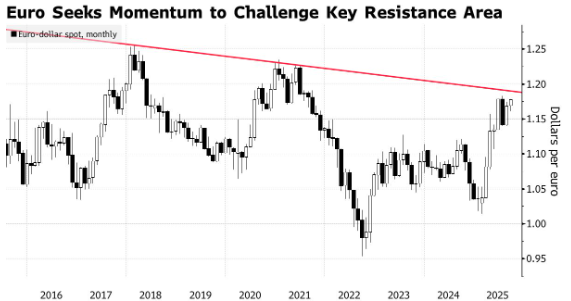
Core Insights - The euro has risen to its highest level since July 3, reaching 1.1791 USD, marking a 0.3% increase and nearly a 14% rise since 2025, the best nine-month performance on record [1] - A potential breakthrough above the July high of 1.1829 USD could set a new peak since September 2021, with options trading indicating a possible approach to the significant 1.20 USD level [1] - Traders are closely monitoring the Federal Reserve's potential interest rate cuts, which could create a divergence between the euro and European Central Bank rates, enhancing the euro's appeal [1] Market Sentiment - The one-week risk reversal indicator shows increasing demand for euro call options since the European Central Bank hinted at the end of its easing policy, with over two-thirds of euro-dollar options traded being bullish [2] - There is particularly strong demand for options with strike prices above 1.20 USD, indicating growing investor confidence [2] - Hedge funds that previously sought bullish opportunities through complex structures are now shifting to simpler bets on growth, reflecting an increase in market sentiment [2] Tactical Positioning - According to Morgan Stanley strategists, the tactical positioning of the dollar is neutral ahead of the Federal Reserve's decision, suggesting that if the Fed confirms expectations for three rate cuts this year, the euro may have further upside potential [6]
欧洲央行宣布了:不降息!机构:下一步可能加息
Zhong Guo Ji Jin Bao· 2025-09-11 21:51
Core Viewpoint - The European Central Bank (ECB) has decided to maintain its key interest rates unchanged, signaling the end of the disinflation process and indicating a potential shift towards tightening monetary policy in the future [1][2]. Interest Rate Decision - The ECB has kept the deposit facility rate at 2.00%, the main refinancing rate at 2.15%, and the marginal lending rate at 2.40% [1]. - This marks the second consecutive meeting where the ECB has opted to keep rates unchanged, aligning with market expectations [2]. Inflation Outlook - Current inflation levels are near the ECB's medium-term target of 2%, with projections for overall inflation at 2.1% in 2025, 1.7% in 2026, and 1.9% in 2027 [2]. - The ECB has adjusted its inflation forecasts upward for 2025 and 2026 while lowering the forecast for 2027 [2]. - Core inflation, excluding energy and food prices, is expected to be 2.4% in 2025, 1.9% in 2026, and 1.8% in 2027 [2]. Economic Growth Projections - The ECB forecasts GDP growth of 1.2% in 2025, an increase from the previous estimate of 0.9%, while projecting a slight decrease to 1.0% in 2026 and maintaining 1.3% for 2027 [2]. Monetary Policy Stance - The ECB is prepared to adjust all tools within its mandate to ensure inflation stability at the 2% target and smooth monetary policy transmission [3]. - Recent improvements in Eurozone economic data and reduced trade uncertainty have bolstered the economic outlook [3]. Market Reactions and Future Expectations - Analysts suggest that the ECB's decision indicates the end of the easing cycle, with some economists predicting that the next move may be an interest rate hike rather than a cut [5][6]. - The ECB has not committed to a specific interest rate path, emphasizing that future decisions will be based on inflation outlooks and economic data [4].
【环球财经】欧洲央行维持三大关键利率不变
Xin Hua She· 2025-09-11 14:26
Core Viewpoint - The European Central Bank (ECB) has decided to maintain the key interest rates in the Eurozone unchanged during its monetary policy meeting held in Frankfurt on September 11, 2023 [1] Interest Rates - The ECB has kept the deposit facility rate at 2.00%, the main refinancing rate at 2.15%, and the marginal lending rate at 2.40% [1] Rate Changes - Since starting the rate cut process in June 2024, the ECB has reduced rates eight times, with the last decision in July 2023 to hold rates steady [1] Inflation and Economic Growth Forecasts - The current inflation rate in the Eurozone is approximately 2%, which is close to the medium-term target set by the ECB [1] - The latest forecast from the ECB indicates that the economic growth rate for the Eurozone in 2025 is expected to be 1.2%, an increase from the previous prediction of 0.9% made in June 2023 [1] - The growth forecast for 2026 has been slightly adjusted down to 1.0%, while the 2027 growth forecast remains unchanged at 1.3% [1]
欧洲央行料继续按兵不动 市场聚焦拉加德释放政策转向信号
Xin Hua Cai Jing· 2025-09-11 08:58
Core Viewpoint - The European Central Bank (ECB) is expected to maintain its key interest rates during the upcoming monetary policy meeting, continuing its pause on rate hikes due to improved economic data from the Eurozone [1][2]. Economic Data - Eurozone GDP grew by 0.1% quarter-on-quarter in Q2, exceeding market expectations and indicating a recovery in economic resilience [1]. - The Harmonized Index of Consumer Prices (HICP) rose by 2.1% year-on-year in August, slightly above the previous value of 2.0% and meeting the ECB's inflation target of 2% [1]. Trade Agreements - Recent trade agreements between the US and Europe provide additional support for the regional economic outlook, helping to alleviate previous downward pressures from external trade uncertainties [1]. Market Expectations - While the current interest rate decision is widely anticipated, market focus has shifted to future policy guidance, with many economists believing the ECB's easing cycle has ended [2]. - The swap market still implies a 25 basis point rate cut within the next 12 months, indicating a divergence between financial market expectations and mainstream economic forecasts [2]. ECB Communication Strategy - ECB President Christine Lagarde is expected to emphasize "enhanced economic resilience" and "reduced external trade uncertainty" in her upcoming press conference [2]. - The ECB management has indicated that further rate cuts would require a significant deterioration in economic prospects or persistent deflation risks, suggesting a cautious approach to future policy adjustments [2].
欧洲央行管委Kazaks:目前没有必要进一步降息
智通财经网· 2025-08-24 23:14
Core Viewpoint - The European Central Bank (ECB) has entered a new phase of monetary policy, focusing on monitoring the economy rather than actively intervening to change its direction, as inflation is currently at the target level of 2% [1][2] Group 1: Monetary Policy Stance - ECB officials are inclined to maintain the current interest rates after pausing further rate cuts in July, with many decision-makers suggesting no changes in the upcoming meeting [1][3] - Kazaks indicated that a further rate cut of 25 basis points would not significantly impact the economy, viewing it more as an insurance measure rather than a necessity [5] - The ECB's current situation is perceived as stable, with Kazaks stating that the existing economic data does not warrant immediate action [1][4] Group 2: Economic Outlook - Despite some uncertainties in business investment due to tariffs on exports, surveys indicate a recovery in the European manufacturing sector, which has struggled for over three years [1] - Wage growth is slowing as expected, which bolsters confidence that mid-term inflation will stabilize at 2% [1] - The ECB's forecast predicts inflation will dip slightly below the target early next year but is expected to rebound to 2% by 2027 [2]