氛围编程

Search documents
00后MIT辍学生,两年干出2000亿神话,英伟达谷歌抢投
3 6 Ke· 2025-11-14 07:14
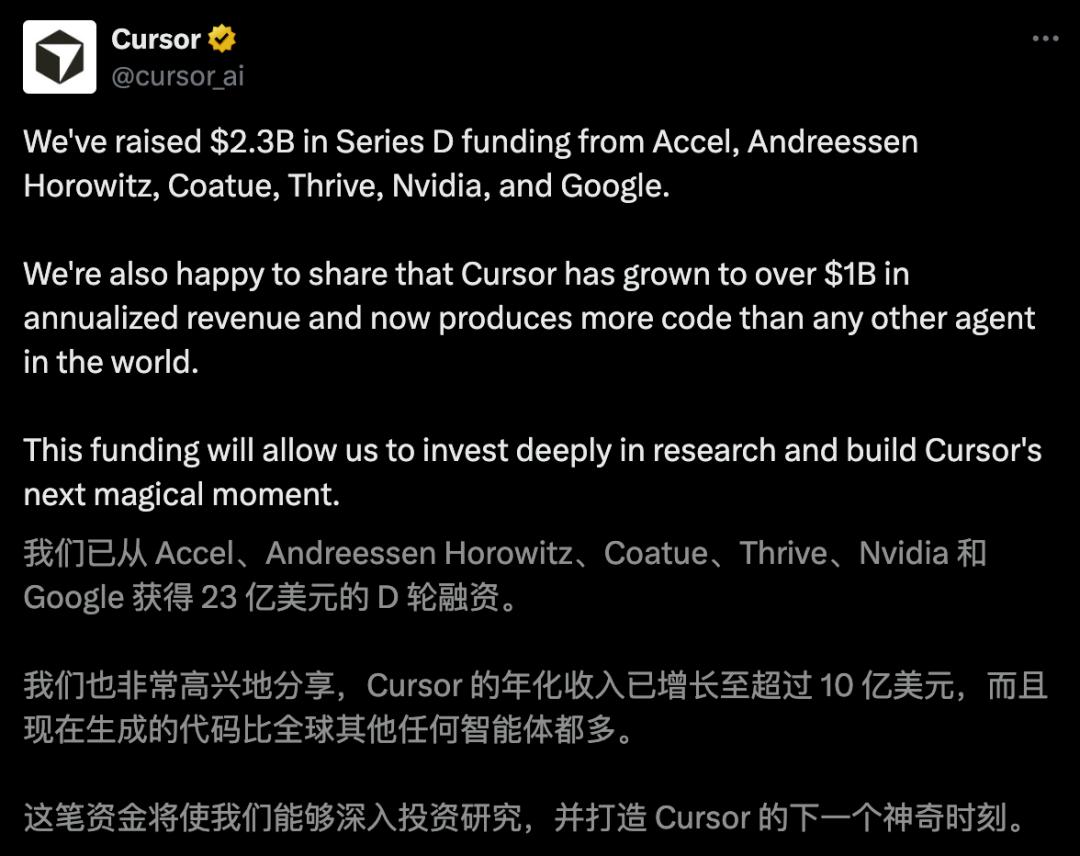
Core Insights - Cursor, an AI programming tool, has achieved an annual recurring revenue of over $1 billion within just two years and is now valued at approximately $30 billion following a recent funding round of $2.3 billion led by Accel and Coatue, with participation from Google and NVIDIA [1][2][18] - The company was founded by four MIT dropouts who have become billionaires, with their combined ownership in the company valued at around $1.3 billion each [5][21] Funding and Valuation - The latest valuation of $29.3 billion is twelve times higher than its valuation in January of this year [2] - Cursor has completed three funding rounds in 2023, accumulating a total of $338 million since its inception [21] Product Development and Features - Cursor was launched in 2022 from the Anysphere research lab and has rapidly become a favored AI assistant for developers [8] - The platform has undergone significant updates, with Cursor 2.0 recently released, which enhances its capabilities in coding efficiency [7][10] - Cursor is designed to eliminate bugs and streamline coding processes, allowing users to generate extensive code with minimal input [10][15] Market Impact and Adoption - Research from the University of Chicago indicates that companies using Cursor have seen a 40% increase in the number of pull requests merged weekly [11] - Cursor is utilized by over 50,000 developer teams globally, including major companies like OpenAI, NVIDIA, Spotify, and Uber [13][18] Founders and Company Culture - The founders, all in their twenties, initially attempted to create AI models for mechanical engineering before pivoting to software engineering, leading to the development of Cursor [19][25] - The company fosters a unique culture with no KPIs or pressure, which has attracted talent and contributed to its rapid growth [26][32]


综述连arXiv都不给发了?最严新规出台:被会议、期刊接收才行,workshop都不行
机器之心· 2025-11-02 03:10
Core Viewpoint - The new arXiv regulation requires that all review and position papers submitted to the computer science category must first be accepted by a formal journal or conference and undergo peer review, aiming to manage the increasing volume of low-quality submissions, particularly those generated by AI [1][3][5]. Group 1: New Submission Requirements - Authors must provide evidence of acceptance and successful peer review from a journal or conference when submitting their review or position papers to arXiv [3]. - Submissions that do not meet these criteria are likely to be rejected by arXiv [3]. Group 2: Rationale Behind the Regulation - The regulation was introduced due to the overwhelming number of review and position papers, which have become difficult to manage [3]. - The influx of low-quality AI-generated papers has significantly increased the workload for volunteer moderators at arXiv, prompting the need for stricter submission guidelines [3][5]. Group 3: Community Reactions - The new regulation has sparked debate within the research community, with concerns that it may undermine arXiv's role in facilitating timely dissemination of research, especially in fast-evolving fields like AI [5][6]. - Many researchers believe the new rules are too stringent and advocate for maintaining access to various reviews, suggesting the creation of a separate section or exploring new review methods [7][9]. Group 4: Proposed Solutions - Some researchers propose establishing a trust system where any individual can endorse articles, allowing readers to choose trusted endorsers for their reading [12].

“氛围工作”时代来临:从微软到OpenAI,白领职场掀起感觉革命
3 6 Ke· 2025-10-22 04:10
Group 1 - The core concept of "Vibe Working" is emerging from Silicon Valley, redefining the way white-collar workers operate by integrating AI into their workflows [1][2] - Generative AI is revolutionizing traditional software development, leading to the rise of "Vibe Programming," which companies are eager to adopt by hiring talent skilled in this area [2][3] - Major tech executives are endorsing this new model, with Google and Meta showcasing its potential to transform job roles and responsibilities [2][3] Group 2 - The concept of "Vibe" reflects a new workplace philosophy that emphasizes a fluid and relaxed work environment, influenced by the Z generation's interpretation of comfort and ease [3][5] - Companies are beginning to implement roles such as "Vibe Growth Manager" and "Chief Vibe Officer" to enhance team dynamics and foster a positive work atmosphere [3][4] - Regular "vibe checks" are becoming a practice among managers to assess team morale and productivity [3][5] Group 3 - Despite the appeal of "Vibe Working," the essence of work remains unchanged, and collaboration with AI requires both experimentation and solid professional knowledge [5][6] - The younger generation is increasingly blurring the lines of traditional work structures, leading to a decline in loyalty to conventional work hours [5][6] - Companies are attempting to reshape workplace culture through a more relaxed "vibe" approach, but this may undermine the value of professional skills [6][7] Group 4 - There is a growing demand for AI-skilled talent, yet many companies lack systematic training programs, creating a gap between talent needs and actual training investments [7][8] - A significant number of employers prefer hiring candidates familiar with AI over those with extensive experience but lacking AI knowledge [7][8] - Employees are taking the initiative to learn AI skills independently, highlighting a bottom-up approach to skill acquisition [7][8]
2026AI Agent六大趋势,编程热潮后谁是下一个风口?
3 6 Ke· 2025-10-22 00:02
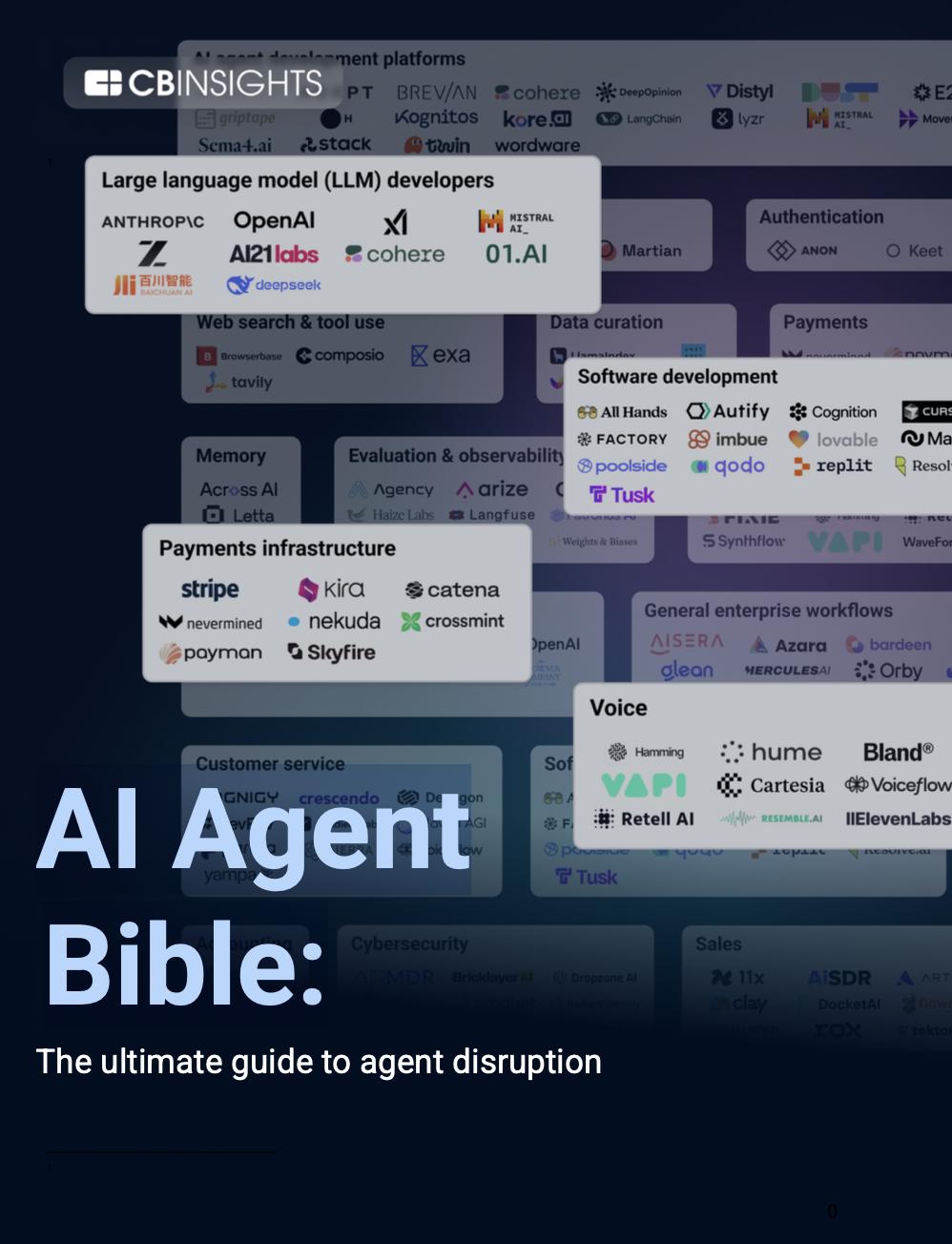
Core Insights - The report by CB Insights titled "AI Agent Bible: The Ultimate Guide to Disruptive Agents" provides a comprehensive overview of the AI Agent ecosystem and predicts significant trends and developments in the field by 2026 [1][3]. Group 1: Market Trends and Predictions - AI Agents have rapidly transitioned from experimental tools to a priority for enterprises, with mentions in earnings calls increasing tenfold since 2023 [4]. - By 2025, 82% of companies plan to implement AI Agents in customer support, indicating a strong market demand [4]. - In 2025, five out of the top ten investment hotspots in technology will be directly related to AI Agents, highlighting their prominence in venture capital [4]. - Among newly minted unicorns, one in five is centered around Agent technology, showcasing its potential for growth [4]. - The top 20 AI Agent startups by revenue in 2025 include companies that have emerged within the last three years, demonstrating rapid growth from zero to significant revenue [4]. Group 2: Evolution of AI Agents - AI Agents are expected to evolve from chatbots to fully autonomous agents by 2026, with increasing capabilities in reasoning, memory, and task execution [5][6]. - The transition from "co-pilot" interfaces to more advanced forms of AI tools is anticipated, which will redefine how work is conducted [6][7]. Group 3: Key Predictions for 2026 - The rise of voice AI is expected to accelerate, with companies preparing for conversational interactions with AI rather than text-based interfaces [10]. - A wave of mergers and acquisitions in the AI Agent space is predicted, as companies seek to build comprehensive solutions for competitive advantage [11]. - Profit pressures are expected to spread across various sectors, impacting AI startups beyond programming [12]. - The foundation for agentic business models is being established, with new startups addressing secure and real-time transaction challenges [13]. - A "data moat war" is reshaping enterprise software, as existing software giants restrict access to customer data [14]. - Monitoring tools for AI Agents are becoming essential to manage risks associated with their reliability [15]. Group 4: Revenue and Performance Insights - Programming AI Agents are leading in commercialization, with several achieving significant annual recurring revenue [16]. - The average age of the top revenue-generating AI startups is only 3.8 years, indicating a young but rapidly maturing market [17]. Group 5: Industry-Specific Developments - Software development agents are evolving to include critical "guardrail" features, enhancing their functionality beyond basic programming assistance [20]. - Web browsing agents are shifting from general applications to specialized solutions, improving decision-making capabilities [21]. - Vertical AI Agents are targeting highly regulated industries, with healthcare and financial services being primary focus areas [22].
Meta公司28岁亿万富豪:下一个比尔·盖茨将在这类少年中产生
财富FORTUNE· 2025-10-16 13:06
Core Insights - Wang Tao, at 28, leads one of Silicon Valley's most ambitious AI projects after becoming the youngest self-made billionaire at 24, emphasizing the importance of programming for the Alpha generation [1][2] - He believes that all code written by engineers will soon be replaced by AI-generated code, urging a shift in focus from traditional programming to mastering AI tools [2][4] - Wang compares the current moment to the pre-PC revolution, suggesting that those who invest time in learning AI tools will gain a significant advantage in the future economy [4][5] Company Ambitions - Meta's infrastructure, scale, and product distribution capabilities are described as unparalleled, with a business model capable of supporting the construction of multi-billion dollar computing systems [5][6] - The lab is intentionally kept small, with a focus on high talent density, aiming to outperform larger competitors [6] - The lab is structured around three pillars: research, product, and infrastructure, with the goal of achieving superintelligence through advanced models [6][7] Programming Evolution - Ambient programming, which allows users to generate and iterate code through natural language prompts, is gaining traction among Silicon Valley executives [8][9] - This approach is seen as a cultural mission for the future, emphasizing the importance of intuitive experience gained from challenging AI tools rather than just the code itself [9][10] - The role of engineers is evolving significantly, reflecting a shift in how programming is approached in the industry [10]


速递|Emergent获Lightspeed领投2300万美元A轮融资,面向非技术用户,助力百万用户创建150万应用
Z Potentials· 2025-09-25 03:05
过去十年间,随着智能手机摄像头性能的提升, Instagram 、 YouTube 和 TikTok 等照片和视频分享平台迅速走 红。许多人从随意的内容发布者转型成为能够赚钱的创作者。 Emergent 由双胞胎兄弟 Mukund 和 Madhav Jha 创立,旨在成为面向普通消费者的应用开发平台。该平台允许非技 术人员通过提示词创建应用程序。 虽然这种模式在 2025 年并不新鲜,但 Emergent 致力于全程协助用户完成应用开发流程,同时管理各类 API 和部 署步骤,让他们无需操心技术细节。 这家初创公司周三宣布获得 2300 万美元 A 轮融资,由 Lightspeed 领投, Y Combinator 、 Together ( Freshworks 旗下 Together Fund 的创始人)以及多位知名天使投资人跟投,包括 a16z 前普通合伙人 Balaji Srinivasan 、谷歌的 Jeff Dean 和 Mistral 创始团队成员 Devendra Chaplot 。 公司迄今融资总额达 3000 万美元。 曾在谷歌投资的印度即时配送初创公司 Dunzo 担任 CTO 的 Muk ...

2025科技圈最新职位:“Vibe Coding擦屁股工程师”,专治老板们的决策性Bug
AI前线· 2025-09-15 08:08
整理|冬梅、核子可乐 "氛围编码"留下的烂摊子,终究要让那些被裁掉的人回来收拾。 自生成式人工智能兴起以来,许多人担心它会对人类员工的生计造成损害。如今,CEO 们也开始承 认人工智能的影响,裁员人数也开始增加。 CEO 希望利用 AI 替换到大批开发者 根据招聘网站 Indeed 的最新报告,科技职位招聘数量较 2020 年下降了 36%。其中一部分裁员是因 为 CEO 想用人工智能(AI)取代员工。 有不少科技公司已开始以 AI 和自动化为由,明确裁员或冻结招聘。今年 5 月,行业巨头 IBM 用人工 智能取代了数百名人力资源员工,这也是其大规模裁员计划的一部分,该计划共裁撤了 8000 名员 工。同样在 5 月,语言学习应用程序多邻国(Duolingo)的首席执行官路易斯・冯・安表示,公司 将不再雇佣承包商从事可由人工智能完成的工作。 "先买后付" 公司克拉纳(Klarna)的首席执行官塞巴斯蒂安・西米亚特科夫斯基在 5 月称,公司已裁 员 40%,部分原因是对人工智能领域的投资。 Workday 首席执行官卡尔·埃森巴赫 (Carl Eschenbach) 在今年早些时候宣布大规模裁员的一封电子 邮件 ...

15年大佬深夜痛哭半小时,氛围编程巨坑曝光,95%程序员沦为「AI保姆」
3 6 Ke· 2025-09-15 07:56
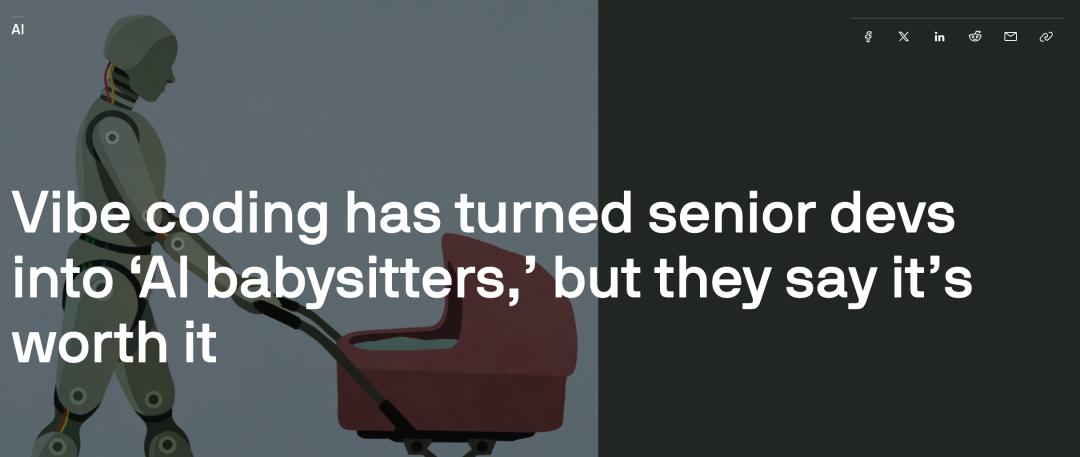
Core Insights - The rise of "Vibe Coding" has transformed many developers into "AI babysitters," leading to a new profession known as "Vibe Code Cleanup Specialist" [5][6][21] - Many developers report spending significant time fixing AI-generated code, with a Fastly report indicating that at least 95% of developers require extra time for this task [5][21] - Despite the challenges, developers acknowledge that AI tools can enhance productivity and improve user interfaces, although manual review remains essential [21][23] Group 1: Vibe Coding Experience - Carla Rover, a senior web developer, experienced significant issues with AI-generated code, leading her to restart a project and express frustration over the reliance on AI [8][9] - Rover's experience reflects a common sentiment among seasoned developers who find themselves constantly rewriting and verifying AI outputs [3][9] - The analogy of using AI for coding is likened to having a smart but inexperienced child assist with tasks, highlighting the unpredictability and potential for errors [13][14] Group 2: Time Allocation and Challenges - Developers like Feridoon Malekzadeh estimate that 50% of their time is spent writing requirements, 10-20% on "Vibe Coding," and 30-40% on fixing AI-generated code [15] - The lack of systematic thinking in AI-generated code often leads to multiple variations of the same function, causing confusion and inefficiency [15][19] - AI-generated code is prone to basic errors, and developers often find themselves correcting these mistakes while also managing the AI's responses [19][21] Group 3: Industry Perspectives - The emergence of "Vibe Coding" has created new IT blind spots and security vulnerabilities, particularly for startups that may overlook traditional coding review processes [19][21] - While many developers find AI tools beneficial, they emphasize the necessity of human oversight before deploying AI-generated code in commercial projects [21][23] - The future of AI programming is seen as not just about writing code but also about guiding AI and taking responsibility for its outputs [25]
氛围编程 101:现代创始人的无代码技术栈
3 6 Ke· 2025-09-07 23:12
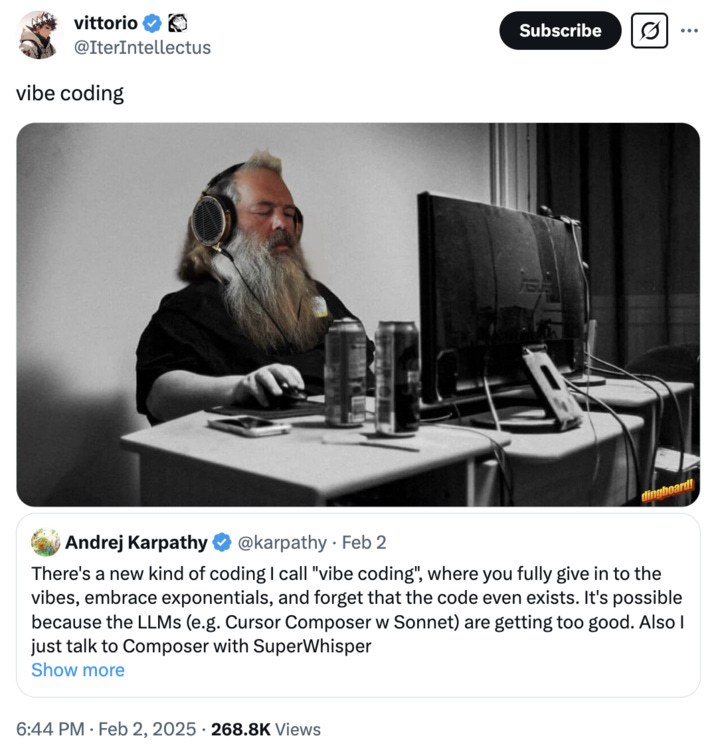
Core Insights - The emergence of "Vibe Coding" represents a paradigm shift in software development, allowing non-engineers to create applications through natural language prompts to AI tools [2][6][42] - This new approach reduces the barriers to entry for product development, enabling domain experts and non-technical founders to rapidly prototype and deploy full-stack products without traditional coding [6][19][20] Group 1: Modern No-Code (Vibe Coding) Technology Stack - The Vibe Coding technology stack consists of AI-native, no-code, and low-code platforms that facilitate seamless interaction and rapid product development [8] - Key tools in the stack include Figma for design, Vercel for frontend deployment, Supabase for backend management, and Cursor for AI collaboration, all of which streamline the development process [8][11] Group 2: Changing Definition of "Technical Ability" - The definition of "technical ability" is evolving; investors now prioritize strategic thinking, AI proficiency, and clarity of vision over traditional coding skills [14][15][18] - Founders can now launch products with minimal engineering resources, focusing instead on guiding AI through structured prompts [16][19] Group 3: New Workflows and Mindsets - The traditional development workflow has shifted from a lengthy process to a rapid, iterative cycle driven by AI, allowing for immediate testing and deployment [21][22][24] - This new approach emphasizes exploration and flexibility, enabling founders to quickly adapt based on user feedback [26][45] Group 4: Advantages and Limitations of Vibe Coding - Vibe Coding excels in scenarios where speed and experimentation are prioritized, serving as an accelerator for turning ideas into viable products [27][31] - However, it may not be suitable for scaling and optimizing complex systems, which still require experienced developers [32][33] Group 5: Emergence of New Roles - New roles such as AI Product Engineer, Prompt Architect, and AI Wrangler are emerging, reflecting the need for individuals who can effectively leverage AI tools in product development [34][36][37] - These roles help bridge the gap between technical execution and strategic vision, enabling faster and more efficient product development [38] Group 6: Vibe Coding as a Gateway to Real Code - Vibe Coding produces real, executable code that can be integrated into production environments, distinguishing it from traditional no-code platforms [38][39] - This approach allows for ongoing development and refinement, ensuring that prototypes can evolve into scalable solutions [39][42] Group 7: Developing with Vision - The ability to discern valuable projects and user needs is crucial in the Vibe Coding landscape, as the market may become saturated with subpar products [43][45] - Successful founders will focus on solving real problems and iterating purposefully, leveraging the speed of Vibe Coding while maintaining a clear vision [45]
Lovable CEO对氛围编程竞争毫不担心
Sou Hu Cai Jing· 2025-09-02 10:42
Core Insights - Lovable is a leading player in the emerging AI category of "ambient programming," enabling users without coding experience to create applications and websites by guiding AI models to generate code [2][3] - The company achieved over $100 million in annual recurring revenue (ARR) within just 8 months and completed a $200 million Series A funding round at an $1.8 billion valuation, making it the fastest-growing unicorn in Europe [2][8] - Lovable has over 2.3 million active users, with 180,000 being paid subscribers, and is currently exploring a Series B funding round with a potential valuation of $4 billion [2][8] Business Model and Strategy - The pricing strategy of Lovable is designed to cover operational costs, with popular use cases including marketing professionals building sales training platforms and engineers managing multiple small businesses [3] - CEO Anton Osika emphasizes that all code, whether AI-generated or human-generated, should be reviewed before release, addressing concerns about the reliability of AI-generated code [3] - Lovable operates on various foundational models, including Anthropic's Claude and OpenAI's GPT-5, while maintaining a competitive edge by leveraging multiple AI model providers [3][4] Competitive Landscape - Osika believes that Lovable's ability to integrate various AI models positions the company favorably against competitors who are limited to their own models, providing users with unparalleled capabilities [4][8] - The company focuses on delivering a simple user experience while ensuring speed and security, which Osika claims will help build customer trust [4] Market Position and Future Plans - Lovable is deeply rooted in the Swedish tech market, with a strong investor base that includes prominent European firms and angel investors [5] - The company plans to continue its operations in Europe, despite having a team in Los Angeles, and aims to avoid the trend of European tech companies relocating to the U.S. for capital [6] - Osika has begun investing in other founders, indicating a commitment to fostering the European startup ecosystem [6][7]