现金流

Search documents
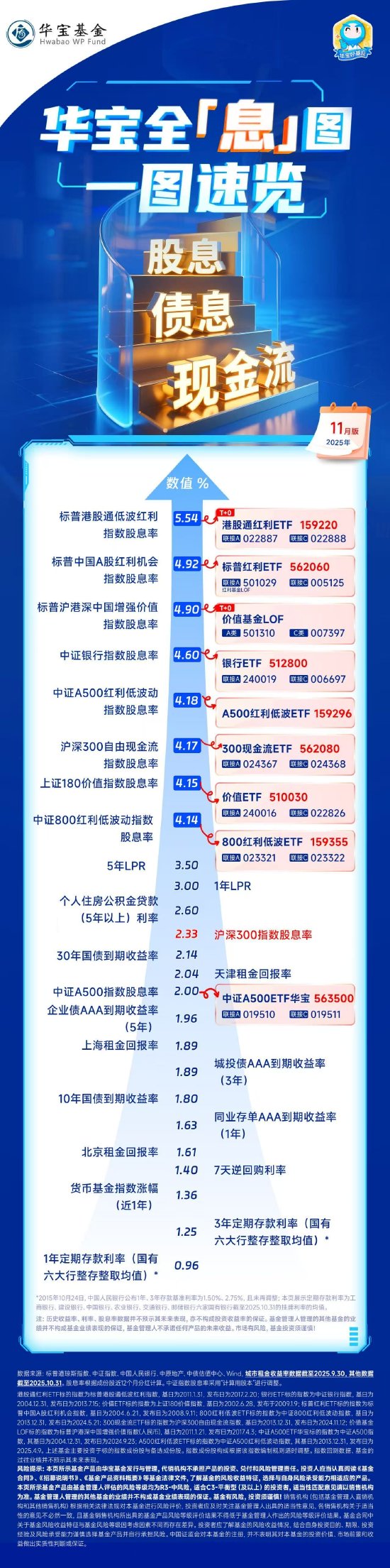
华宝全息图 | 红利指数股息率、债息、现金流,一图速览 (2025年11月)
Xin Lang Ji Jin· 2025-11-11 10:00
Group 1 - The article discusses various dividend yields of different indices, highlighting the performance of specific ETFs and their respective dividend rates [1][2][3] - The S&P Hong Kong Stock Connect Low Volatility Dividend ETF has a dividend yield of 5.54%, while the S&P China A-Share Dividend Opportunity Index shows a yield of 4.92% [1] - The China Securities A500 Low Volatility Dividend Index has a dividend yield of 4.18%, indicating a competitive return compared to other indices [1][3] Group 2 - The Shanghai Composite 180 Value Index has a dividend yield of 4.15%, and the CSI 800 Low Volatility Dividend Index yields 4.14% [3] - The 5-year Loan Prime Rate (LPR) is at 3.50%, while the 1-year LPR is at 3.00%, reflecting the current interest rate environment [3] - The article also mentions various bond yields, including the 10-year government bond yield at 1.80% and the AAA-rated corporate bond yield at 1.96% [3]

搜狐张朝阳:拒做大模型,要在AI狂热中坚守现金流 | 巴伦精选
Tai Mei Ti A P P· 2025-11-08 05:38
Core Insights - Zhang Chaoyang, founder and CEO of Sohu, emphasizes the importance of viewing AI as an efficiency tool rather than a strategic core, advocating for a return to the essence of social interaction in business [2][3] - Sohu is focusing on consumer internet and social media, particularly through its "Attention Flow" product, which prioritizes human relationships over mere content consumption [8][9] Group 1: AI and Business Strategy - Zhang believes that the key to long-term business success is prioritizing cash flow and rational investment decisions, warning against the dangers of excessive debt [3] - He argues that while AI can enhance efficiency, it should not replace human thought processes, as over-reliance on AI may hinder logical thinking and understanding [5][6] - The company does not engage in large model development, distinguishing its approach from competitors heavily investing in AI [2] Group 2: Evolution of the Internet - The internet has evolved from PC to mobile, with significant changes in content consumption methods, moving from text to video and AI-generated content [4] - Zhang highlights the shift from traditional content platforms to social media, where user-generated content is becoming increasingly important [4] Group 3: Challenges and Governance in AI - Zhang identifies significant challenges posed by AI, including defamation, extortion, and privacy issues, which could lead to a proliferation of false information [7] - He suggests that legal frameworks will need to evolve to address new forms of infringement and establish clear responsibilities for platforms [7] Group 4: Sohu's Strategic Focus - Sohu is committed to enhancing its media and video social sectors, with plans to restart its strategy for acquiring American TV shows and movies to enrich its "Attention Flow" ecosystem [8][9] - The company aims to create a social graph that emphasizes real human interactions rather than just content streams, positioning itself as a "real relationship platform" [9]


美的集团(000333):B端业务快速增长 公司盈利能力稳健
Ge Long Hui· 2025-10-31 03:12
Core Insights - The company reported a total revenue of 364.716 billion yuan for Q1-Q3 2025, representing a year-on-year growth of 13.85%, and a net profit attributable to shareholders of 37.883 billion yuan, up 19.51% year-on-year [1] - In Q3 2025 alone, the company achieved a revenue of 112.385 billion yuan, with a year-on-year increase of 9.94%, and a net profit of 11.87 billion yuan, growing 8.95% year-on-year [1] Revenue Growth - The B-end business experienced rapid growth, with revenues from new energy and industrial technology, smart building technology, and robotics and automation increasing by 21% to 30.6 billion yuan, 25% to 28.1 billion yuan, and 9% to 22.6 billion yuan respectively [1] Profitability - The company's gross margin for Q3 2025 improved by 0.41 percentage points to 26.44% [1] - The expense ratios for sales, management, R&D, and finance in Q3 2025 were 8.70%, 3.31%, 3.72%, and -0.68%, showing year-on-year changes of -0.79 percentage points, -0.28 percentage points, +0.06 percentage points, and +1.65 percentage points respectively [1] - The net profit margin for Q3 2025 decreased by 0.11 percentage points to 10.71% [1] Cash Flow and Balance Sheet - The company's operating cash flow for Q3 2025 was 19.785 billion yuan, down 26.11% year-on-year, with cash received from sales of goods decreasing by 13.05% to 104.628 billion yuan [2] - As of Q3 2025, contract liabilities decreased by 2.66% year-on-year, while inventory increased by 12.33% year-on-year [2] Profit Forecast and Investment Recommendation - Based on the performance in Q3 2025 and the overall industry environment, the company is expected to achieve net profits attributable to shareholders of 45.095 billion yuan, 49.613 billion yuan, and 54.141 billion yuan for 2025-2027, reflecting year-on-year growth rates of 17.0%, 10.0%, and 9.1% respectively [2] - The investment rating is maintained at "Buy" [2]

Comcast Stock At 36% Discount, Worth Buying?
Forbes· 2025-10-30 14:35
Core Viewpoint - Comcast (CMCSA) presents a stable investment opportunity due to its steady profits, strong cash flows, and discounted valuation despite not being a high-growth story [2][3]. Financial Metrics - Comcast achieved a revenue growth of 1.3% over the last twelve months (LTM) and 0.9% over the last three-year average, indicating a lack of a strong growth narrative [7]. - The company reported an operating cash flow margin of nearly 22.8% and an operating margin of 18.7% for LTM, with long-term averages of approximately 22.9% and 19.0% respectively [7]. - CMCSA stock is currently offered at a price-to-sales (P/S) multiple of 0.9, representing a 36% discount compared to the previous year [7]. Market Position - Comcast operates as a global media and technology firm, providing a range of services including cable communications, television and streaming, film studios, theme parks, and international media solutions [3]. - The stock has shown average 12-month forward returns of approximately 19% and a win rate of around 72% for selections yielding positive returns [8]. Historical Performance - The stock has experienced significant declines in the past, including a 44% drop during the Dot-Com Bubble and a 62% decline during the Global Financial Crisis, highlighting the inherent risks despite its advantages [9].


Service International(SCI) - 2025 Q3 - Earnings Call Transcript
2025-10-30 14:02
Financial Data and Key Metrics Changes - The company reported adjusted earnings per share (EPS) of $0.87 for Q3 2025, a more than 10% increase from $0.79 in the prior year period [4] - Total comparable funeral revenue declined by almost $2 million, or less than 1%, compared to the prior year quarter [5] - Comparable core funeral revenue decreased by $3 million, or just under 1%, primarily due to a 3.5% decrease in core funeral services performed [6] - Cemetery revenue increased by $31 million or almost 7%, driven by higher core revenue [11] Business Line Data and Key Metrics Changes - Funeral gross profit decreased by $9.5 million, with the gross profit percentage declining by 170 basis points to about 18% [9] - Non-funeral home revenue increased by $3 million, primarily due to a 13.4% increase in the average revenue per service [7] - Comparable cemetery revenue increased by $27.5 million or 7% over the prior year quarter, primarily due to a $27 million increase in total recognized preneed revenue [12] Market Data and Key Metrics Changes - Preneed funeral sales production increased by $6 million or about 2% over Q3 2024, while core preneed funeral sales production increased by $20 million or 9% [10] - Non-funeral home preneed sales revenue decreased by $4.6 million due to the decision to stop delivering preneed merchandise at the time of sale [8] - The core cremation rate increased modestly by 50 basis points to 57.3% [6] Company Strategy and Development Direction - The company confirmed the midpoint of its normalized EPS guidance for 2025, narrowing the range to $3.80 to $3.90 [13] - The company expects modest funeral revenue and gross profit growth compared to Q4 2024, with low to mid single-digit cemetery preneed sales production growth anticipated [14] - The company aims to achieve EPS growth within its long-term growth framework of 8% to 12% [15] Management's Comments on Operating Environment and Future Outlook - Management expressed confidence in the momentum heading into 2026, expecting favorable trends in funeral volume and cemetery sales [15] - The company anticipates that the pull forward effect on funeral volumes will be negligible going forward, with demographics and a strong preneed backlog expected to drive future growth [13][70] - Management highlighted the importance of educating consumers about cremation options to drive sales growth [44] Other Important Information - The company generated adjusted operating cash flow of $268 million in the quarter, an increase of $10 million from the prior year [17] - Capital investments totaled $140 million in the quarter, with $123 million returned to shareholders through dividends and share repurchases [19][20] - The company ended the quarter with liquidity of just under $1.5 billion and a leverage ratio of 3.6 times net debt to EBITDA [23] Q&A Session Summary Question: Can you discuss cemetery preneed sales production trends? - Management noted strong velocity in cemetery preneed sales, with large sales up almost 18% and a focus on flexible financing plans contributing to growth [26][29] Question: What is the confidence level in achieving the 8% to 12% EPS growth target for next year? - Management expressed an 85% to 90% assurance in achieving the target, citing historical growth rates and the importance of revenue growth [31][32] Question: How does the company plan to educate consumers about cremation options? - Management emphasized the need for better visibility and education regarding cremation products, noting that many consumers are unaware of available options [57] Question: What is the outlook for SCI Direct sales production post-transition? - Management expects growth off the new base in 2026 but does not anticipate returning to pre-transition levels for a couple of years [75]

Service International(SCI) - 2025 Q3 - Earnings Call Transcript
2025-10-30 14:00
Financial Data and Key Metrics Changes - The company reported adjusted earnings per share (EPS) of $0.87, a more than 10% increase compared to $0.79 in the prior year period [4] - Total comparable funeral revenue declined by almost $2 million, or less than 1%, compared to the prior year quarter [5] - Funeral gross profit decreased by $9.5 million, with the gross profit percentage declining by 170 basis points to about 18% [9] - Adjusted operating cash flow increased by $10 million from the prior year, totaling $268 million for the quarter [17] - The company confirmed the midpoint of its normalized EPS guidance for 2025, narrowing the range to $3.80 to $3.90 [13] Business Line Data and Key Metrics Changes - Comparable core funeral revenue declined by $3 million, or just under 1%, primarily due to a 3.5% decrease in core funeral services performed [6] - Non-funeral home revenue increased by $3 million, primarily due to a 13.4% increase in the average revenue per service [6] - Comparable cemetery revenue increased by $31 million or almost 7%, driven by a $27 million increase in total recognized preneed revenue [11] - Cemetery gross profit grew by $18 million, with the gross profit percentage increasing by 160 basis points, generating an operating margin percentage of 34% [12] Market Data and Key Metrics Changes - Preneed funeral sales production increased by $6 million or about 2% over the third quarter of 2024 [10] - Core preneed funeral sales production increased by $20 million or 9% [10] - Comparable cemetery preneed sales production grew by $30 million or almost 10% [12] Company Strategy and Development Direction - The company expects modest funeral revenue and gross profit growth compared to the fourth quarter of 2024 [14] - In the cemetery segment, low to mid single-digit cemetery preneed sales production growth is anticipated [14] - The company is focusing on leveraging its scale in field operations and overhead support functions to manage costs effectively [9] Management's Comments on Operating Environment and Future Outlook - Management expressed confidence in achieving EPS growth within the long-term growth framework of 8% to 12% [15] - The company expects favorable trends in funeral volume, average sales, and cemetery sales, alongside lower interest rates [15] - Management noted that the pull forward effect on funeral volumes is expected to be negligible going forward, with demographics and backlog expected to drive future growth [13][15] Other Important Information - The company invested $140 million in the quarter into existing locations, new builds, and acquisitions [18] - A total of $123 million was returned to shareholders through dividends and share repurchases [20] - The company ended the quarter with liquidity of just under $1.5 billion [23] Q&A Session Summary Question: Discussion on cemetery preneed sales production and trends - Management noted strong velocity in cemetery preneed sales, with large sales up almost 19% over the prior year quarter, and expressed confidence in sustaining this trend into 2026 [26][29] Question: Confidence in achieving 8% to 12% EPS growth - Management indicated a historical assurance level of 85% to 90% for achieving the EPS growth target, emphasizing the importance of revenue growth [30][32] Question: Trends in cemetery sales and consumer education - Management expects cemetery sales to trend in low to mid single digits, with a focus on educating cremation consumers about available options [42][46] Question: Impact of the non-insured Flex product on sales - The non-insured Flex product was introduced to meet consumer needs in specific markets, although it generates lower commissions [67][71] Question: Expectations for SCI Direct sales production post-transition - Management anticipates growth in SCI Direct sales production in 2026, although it may not return to pre-transition levels for a couple of years [78][82]
Entergy(ETR) - 2025 Q3 - Earnings Call Presentation
2025-10-29 15:00
Financial Performance - The company's third quarter 2025 adjusted EPS was $1.53[6], compared to $1.50 in 3Q24[83] - The company's third quarter 2025 operating cash flow was $2.1 billion[6] - The company narrowed its adjusted EPS guidance for 2025 to $3.85-$3.95 and extended the outlook period to 2029, expecting greater than 8% CAGR[6] Growth and Strategy - The company increased its data center pipeline to 7 GW to 12 GW[6] - The company secured an additional 4.5 GW of power island equipment for large growth opportunities[6] - The company plans to invest for growth, reliability, and resilience, with strong customer growth and potential upside opportunities from industrial pipelines[18] Capital and Equity Plans - The company has a $40 billion capital plan for 2025E-2028E with a $4.7 billion equity plan[14] - The company has a $41 billion capital plan for 2026E-2029E with a $4.4 billion equity plan[14] Regulatory and Operational Overview - The company's utility operations include 3 million retail customers[24] - The company's utility operations include 24,479 MW of owned and leased generating assets[24] - The company's utility operations include 16,100 circuit miles of interconnected high-voltage transmission lines and 107,255 circuit miles of distribution lines[24]

兔宝宝(002043):单季度营收增速转正,投资收益增厚利润
Shenwan Hongyuan Securities· 2025-10-29 06:16
Investment Rating - The report maintains an "Outperform" rating for the company [2] Core Insights - The company achieved a positive revenue growth in the latest quarter, with a significant increase in investment income contributing to profit [7] - The company’s revenue for the first three quarters of 2025 was 6.32 billion yuan, a year-on-year decrease of 2.2%, while the net profit attributable to shareholders was 630 million yuan, a year-on-year increase of 30.4% [7] - The report highlights the company's strong cash flow performance and enhanced dividend capability [7] Financial Performance Summary - Total revenue projections for 2025 are estimated at 8.88 billion yuan, with a year-on-year decline of 3.4% [6] - The net profit attributable to shareholders is projected to be 814 million yuan in 2025, reflecting a year-on-year growth of 39.1% [6] - The company’s gross margin is expected to improve to 19.3% in 2025, with a return on equity (ROE) of 24.2% [6] - The company’s operating cash flow for the first three quarters was 470 million yuan, an increase of 50 million yuan year-on-year [7]

振华科技(000733):军品高端元器件升级放量、民品底部磨底蓄力
Soochow Securities· 2025-10-28 15:38
Investment Rating - The investment rating for the company is "Buy" (maintained) [1] Core Views - The company reported a total revenue of 3.926 billion yuan for the first three quarters of 2025, representing a year-on-year increase of 4.98%. The net profit attributable to shareholders was 623 million yuan, a slight decrease of 3.31% year-on-year. Despite the minor decline in profit, the performance reflects strong fundamental resilience [7] - The gross profit margin was 45.67%, down 7.92 percentage points year-on-year, primarily due to fluctuations in raw material costs and adjustments in product structure. The net profit margin was 15.87%, which remains at a relatively high level within the electronic components industry, indicating robust profitability in core operations [7] - The company's asset-liability structure is stable, with a debt ratio of 18.20%, slightly down by 0.25 percentage points year-on-year, indicating a low overall leverage level and a secure financial structure [7] - Cash flow performance is solid, with a net cash flow from operating activities of 642 million yuan, significantly higher than the net profit of 623 million yuan, indicating high profit quality and good cash conversion ability [7] - The company maintains its previous profit forecasts, expecting net profits attributable to shareholders to be 1.083 billion yuan, 1.252 billion yuan, and 1.447 billion yuan for 2025, 2026, and 2027, respectively, corresponding to P/E ratios of 27, 24, and 20 times [7] Financial Summary - For 2023, the total revenue is projected at 7.789 billion yuan, with a year-on-year growth of 7.19%. The net profit attributable to shareholders is expected to be 2.682 billion yuan, reflecting a year-on-year increase of 12.57% [1] - The company anticipates total revenues of 5.219 billion yuan in 2024, with a significant decline of 32.99% year-on-year, followed by a recovery to 5.729 billion yuan in 2025, representing a growth of 9.76% [8] - The earnings per share (EPS) for 2023 is estimated at 4.84 yuan, dropping to 1.75 yuan in 2024, and gradually increasing to 2.61 yuan by 2027 [1][8]

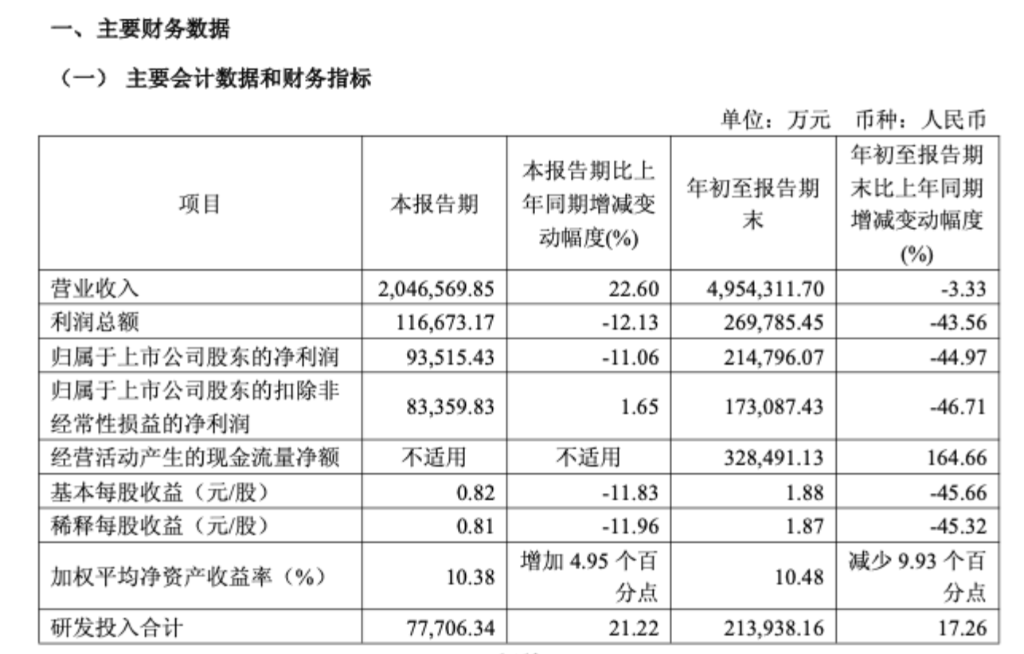
传音控股Q3增收不增利,营收同比增长22.60%,利润同比降11.06%
Hua Er Jie Jian Wen· 2025-10-28 09:55
Core Viewpoint - Transsion Holdings, known as the "King of Smartphones in Africa," reported disappointing Q3 results, with revenue growth but a significant decline in net profit, indicating challenges in profitability and market conditions [1][2]. Financial Performance - Q3 revenue reached 204.66 billion, a year-on-year increase of 22.60%, while net profit decreased by 11.06% to 9.35 billion [4]. - For the first three quarters, total revenue was 495.43 billion, reflecting a decline of 3.33%, and net profit plummeted by 44.97% to 21.48 billion [4]. - The gross margin fell from approximately 21.6% in the previous year to about 19.5%, a drop of over 2 percentage points [2][4]. Profitability Concerns - The decline in net profit was attributed to increased market competition and supply chain costs, with the weighted average return on equity (ROE) dropping to 10.48%, down nearly 10 percentage points from the previous year [2]. - The company's net profit excluding non-recurring items was 17.31 billion, down 46.71%, indicating a rapid deterioration in core profitability [2]. Cost and Cash Flow Management - Operating costs for the first three quarters were 398.97 billion, showing a slight decrease of 0.72% year-on-year, but the decline in revenue exacerbated the pressure on profit margins [2]. - The company reported a significant improvement in operating cash flow, with a net cash flow of 32.85 billion, a year-on-year increase of 164.66%, primarily due to reduced procurement payments [3][4]. Research and Development Investment - R&D expenses increased by 17.26% to 21.39 billion, representing 4.32% of revenue, up from 3.56% the previous year, indicating a commitment to long-term growth despite short-term profitability pressures [3].