跨界投资

Search documents
天音控股操盘拿下酒便利51%控股权
Nan Fang Du Shi Bao· 2025-12-11 23:18
Core Viewpoint - The acquisition of a 51% controlling stake in Henan Jiubianli Commercial Co., Ltd. by Huake Fund for a total price of 68.4 million yuan marks a significant shift in ownership, with Tianyin Holdings indirectly gaining control over Jiubianli, amidst the latter's operational turmoil and financial distress [1][2][3]. Group 1: Acquisition Details - Huake Fund successfully acquired the controlling stake in Jiubianli through a three-part auction, with a total price of 68.4 million yuan, slightly above the starting price of 67.12 million yuan [2]. - The auction saw the 3% stake attract competitive bidding, resulting in a 30% premium, while the remaining stakes were acquired at the base price, leading to a total transaction price that was only 1.9% above the starting price [2]. - Following the acquisition, the original controlling shareholder, Henan Qiaohua, will see its stake plummet from 51% to 1.98%, officially making Huake Fund the new controlling shareholder [2]. Group 2: Financial Performance of Jiubianli - Jiubianli reported a revenue of 1.679 billion yuan in 2024, reflecting a slight decline of 3.89% year-on-year, while net profit turned into a loss of 109 million yuan [3]. - In the first half of 2025, Jiubianli's revenue plummeted by 37.1% to 598 million yuan, with net losses widening to 61.55 million yuan and a debt ratio rising to 74% [3]. - The company is facing severe liquidity issues, with only 14 million yuan in cash remaining on its balance sheet [3]. Group 3: Strategic Rationale for Acquisition - Tianyin Holdings, through Huake Fund, aims to leverage its extensive national distribution network to expand into the high-potential fast-moving consumer goods sector, particularly in alcoholic beverages [5]. - The company views the acquisition as a strategic move to reduce marginal costs for new product sales, capitalizing on the low inventory pressure associated with alcoholic products [5]. - This acquisition is part of Tianyin Holdings' broader strategy to diversify beyond its traditional 3C distribution business, which is currently facing growth challenges [4][5].

A股游戏龙头,狂赚6.4亿!
Xin Lang Cai Jing· 2025-12-11 12:24
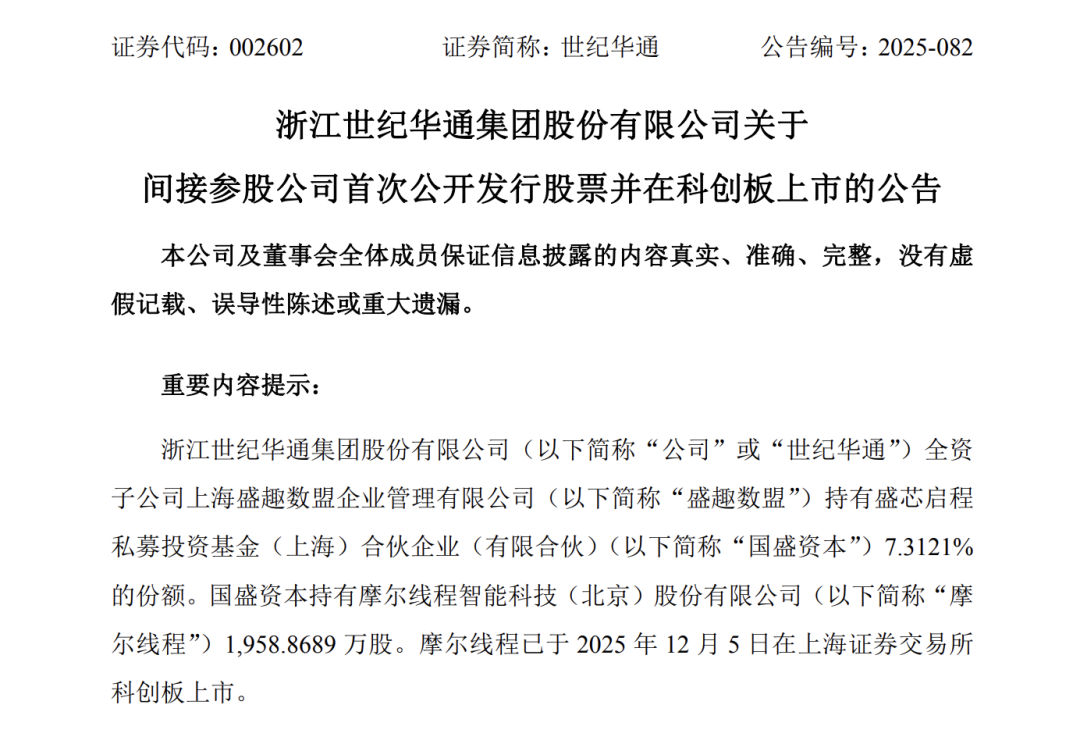
Core Viewpoint - Century Huatong, the largest gaming company by market capitalization in A-shares, announced that its indirect investment in Moer Thread is expected to contribute a net profit of 640 million yuan in Q4 of this year, accounting for approximately 53% of the company's audited net profit for 2024 [1][4]. Investment Impact - The successful cross-industry investment is projected to contribute significantly to Century Huatong's profits, with the investment expected to account for less than 20% of the company's net profit for the first three quarters of 2025, estimated at 4.36 billion yuan [3][9]. - Century Huatong's wholly-owned subsidiary, Shengqu Shumeng, holds about 7.3% of the shares in Guosheng Capital, which in turn holds approximately 19.589 million shares of Moer Thread, representing about 4.9% of the total share capital before the IPO and about 4.2% after the IPO [3][9]. Moer Thread IPO Performance - Moer Thread, known as the "first domestic GPU stock," was listed on the Shanghai Stock Exchange's Sci-Tech Innovation Board on December 5, with an initial price of 114.28 yuan per share. On its first trading day, the stock opened at 650 yuan, more than quadrupling its issue price [3][9]. - As of December 10, Moer Thread's stock closed at 735 yuan, with a total market capitalization of 345.5 billion yuan, reflecting a significant increase of 16.98% on that day [4][10]. Century Huatong's Financial Performance - Century Huatong's stock price has seen substantial growth, rising from around 5 yuan at the beginning of the year to a peak of 22.49 yuan in September, with an overall increase of over 250% year-to-date [4][10]. - The company reported a record quarterly revenue of 10.02 billion yuan in Q3, marking a year-on-year growth of 60.2%, and a net profit of 1.7 billion yuan, up 163.8% year-on-year. For the first three quarters, total revenue reached 27.22 billion yuan, surpassing the previous year's total, with a net profit of 4.36 billion yuan, a year-on-year increase of 141.6% [4][10]. Game Performance - Century Huatong's subsidiary, Diandian Interactive, has achieved significant success with its game "Whiteout Survival," which has topped the overseas revenue charts for Chinese mobile games for 15 consecutive months, with global revenue exceeding 3.8 billion USD (approximately 26.8 billion yuan) as of November [5][11]. - Another successful title, "Kingshot," has also performed well, ranking second in overseas revenue for September and October, with total global revenue exceeding 640 million USD (approximately 4.5 billion yuan) since its launch in February [5][11].


A股游戏龙头靠摩尔线程狂赚6.4亿!世纪华通今年股价已涨2.5倍
Di Yi Cai Jing· 2025-12-10 15:34
MACD金叉信号形成,这些股涨势不错! 12月10日,世纪华通上涨2.81%,报17.57元/股,总市值1305亿元,目前位列A股游戏厂商市值第一。年 初世纪华通的股价在5元/股附近浮动,随后一路走高,9月最高达到22.49元/股,近期有所回调,不过年 内累计涨幅仍超过250%。 【#A股游戏龙头靠摩尔线程狂赚6.4亿#!#世纪华通(维权)今年股价已涨2.5倍#】12月10日,A股市值 第一的游戏厂商世纪华通(002602.SZ)发布公告,因间接投资摩尔线程,预计给今年第四季度带来净 利润6.4亿元,约占2024年度公司经审计归母净利润的53%。 这意味着,一笔成功的跨界投资,几乎贡献了一家游戏龙头去年过半的利润体量。不过,如果按2025年 前三季度世纪华通43.6亿元的净利润计算,这笔投资带来的利润占比预计会在20%以下。 ...
A股游戏龙头靠摩尔线程狂赚6.4亿!今年股价已涨2.5倍
Di Yi Cai Jing· 2025-12-10 15:11
今年前三季度世纪华通净利润已超43亿元。 12月10日,A股市值第一的游戏厂商世纪华通(002602.SZ)发布公告,因间接投资摩尔线程,预计给今年第四季度带来净利润6.4亿元,约占2024年度公司 经审计归母净利润的53%。 这意味着,一笔成功的跨界投资,几乎贡献了一家游戏龙头去年过半的利润体量。不过,如果按2025年前三季度世纪华通43.6亿元的净利润计算,这笔投资 带来的利润占比预计会在20%以下。 据公告,世纪华通全资子公司盛趣数盟持有盛芯启程私募投资基金(简称"国盛资本")约7.3%的份额。国盛资本持有摩尔线程约1958.9万股,占摩尔线程首 次公开发行前总股本的约4.9%,占摩尔线程发行后总股本的约4.2%。据悉,国盛资本持有摩尔线程股份限售期为摩尔线程上市后12个月。 12 月5 日,"国产GPU第一股"摩尔线程在上海证券交易所科创板上市,证券代码688795,发行价格为114.28元/股。上市首日,摩尔线程开盘价650元/股,较 发行价暴涨4倍多。12月10日收盘,摩尔线程大涨16.98%,报735元/股,总市值达3455亿元。 根据企业会计准则相关规定,世纪华通对所持国盛资本的份额划分为"以 ...
天音控股跨界操盘,拿下酒便利51%控股权!公司回应
Nan Fang Du Shi Bao· 2025-12-10 04:33
Group 1 - The core point of the article is that Huake Fund successfully acquired a 51% controlling stake in Jiu Bian Li for a total price of 68.4 million yuan, marking a significant change in ownership amid the company's operational turmoil [1][2] - The acquisition was conducted through a judicial auction, with the total starting price of 67.12 million yuan, which is only 70% of the assessed total price of 95.9 million yuan [2] - The previous controlling shareholder, Henan Qiaohua, will see its stake drop from 51% to 1.98% post-acquisition, with Huake Fund becoming the new controlling shareholder [2] Group 2 - Jiu Bian Li has faced significant operational challenges, reporting a revenue decline of 3.89% to 1.679 billion yuan in 2024, and a net loss of 109 million yuan [3] - In the first half of 2025, the company's revenue plummeted by 37.1% to 598 million yuan, with a net loss of 61.55 million yuan and a debt ratio rising to 74% [3] - Despite these challenges, Jiu Bian Li's core assets are considered valuable, as it pioneered the "alcohol front warehouse model" in China and has established a network of over 300 stores across multiple provinces [3] Group 3 - Huake Fund, the acquirer, is closely tied to Tianyin Holdings, which has a significant stake in the fund and plays a crucial role in investment decisions [4] - Tianyin Holdings has previously entered the alcohol sector, acquiring a 60% stake in Jiu Kuai Dao, which complements Jiu Bian Li's business model [4] - The company aims to leverage its extensive distribution network to expand into the high-potential fast-moving consumer goods sector, particularly in alcohol sales [6]
梦天家居上演“魔幻”行情,重组突然终止却拉7个涨停,实控人转让股份引爆市场猜想
Hua Xia Shi Bao· 2025-12-06 11:56
Core Viewpoint - The stock price of Dream Home Group experienced significant volatility, with a sharp decline followed by a recovery, despite the termination of its planned acquisition of an electronics company and the transfer of control by its actual controller [2][3][5]. Group 1: Stock Performance - On December 3, Dream Home's stock hit the limit down, followed by a 5.88% drop on December 4, closing at 28.51 yuan per share. However, on December 5, the stock rebounded to 30.76 yuan per share, marking a 7.89% increase [2]. - The stock had previously achieved 7 limit-up days within 10 trading days, resulting in a cumulative increase of 114.39% during that period [3]. Group 2: Acquisition and Control Transfer - Dream Home announced plans to acquire control of a well-known electronics company, which led to a temporary suspension of trading. However, both the acquisition and the transfer of control were ultimately terminated due to a lack of consensus among involved parties [3][5]. - The company had previously expressed intentions to enter the electronics sector, having invested 70 million yuan in Chongqing Lingxin Microelectronics Co., becoming its second-largest shareholder [5]. Group 3: Financial Performance - For the first three quarters of the year, Dream Home reported revenues of 773 million yuan, a year-on-year decrease of 2.93%, while net profit attributable to shareholders increased by 37.60% to 56.3 million yuan [6]. - Despite challenges in the housing market affecting the home furnishing industry, Dream Home has maintained a healthy operational status and has diversified its product offerings beyond wooden doors to include cabinets and wall panels [6][7].


海澜之家“玩票”,跨界投资饮用水赛道,分析师:不看好
Sou Hu Cai Jing· 2025-12-06 09:09
Core Viewpoint - Haier's expansion into the beverage industry through the establishment of Jiangyin Hailan Water Beverage Co., Ltd. is seen as a strategic move to diversify and meet internal demands, although the competitive landscape poses significant challenges for market entry [1][3][5]. Company Overview - Jiangyin Hailan Water Beverage Co., Ltd. is a wholly-owned subsidiary of Hailan Home, with a registered capital of 5 million yuan, focusing on the manufacturing of beverages and related products [3][4]. - The company aims to leverage its extensive network of over 7,200 stores to enhance customer service and reduce costs [4][6]. Financial Performance - Hailan Home reported a revenue of 15.599 billion yuan for the first three quarters of the year, reflecting a year-on-year growth of 2.23%, while net profit decreased by 2.37% to 1.862 billion yuan [1][5][6]. - The company's sales expenses have significantly increased, reaching 3.524 billion yuan in the first three quarters, compared to 2.403 billion yuan in 2020 [6]. Market Challenges - The beverage market is characterized by intense competition, with established players dominating the landscape, making it difficult for new entrants like Hailan Water to gain market share quickly [5][6]. - Analysts express skepticism about Hailan's ability to compete effectively due to challenges in brand recognition, channel distribution, and supply chain management [5][6]. Strategic Insights - The move into the beverage sector is viewed as a low-risk diversification strategy, allowing Hailan to experiment with new business models without significant financial commitment [4][5]. - Hailan's reliance on a strong marketing strategy and extensive store network has been a key driver of its sales, but this approach may lead to long-term challenges in product innovation and market relevance [6].

负债百亿还敢乱投资!乐视拟1.8亿炒股,难道要薅百姓的血汗钱?
Sou Hu Cai Jing· 2025-12-05 06:21
Core Viewpoint - LeEco, once a thriving company, is now deeply in debt with a negative net asset of 21.5 billion yuan and liabilities reaching 23.8 billion yuan, yet it has announced stock investment plans twice this year, including a recent plan to invest 180 million yuan in the capital market [2][3][26] Financial Situation - LeEco's financial condition shows a significant imbalance, with a reported 4.59 billion yuan in consolidated cash at the end of Q3, but only 36,600 yuan in cash at the parent company level, indicating poor financial management [8][9] - The company plans to invest 180 million yuan, which is significantly higher than the 50 million yuan planned in the first half of the year [7] Investment Strategy - The investment strategy includes purchasing stocks in the secondary market, with at least 50% allocated to bank stocks and 80% to components of the CSI 300 index [6][3] - This approach raises concerns about the potential risks to ordinary creditors, as the company appears to be gambling with funds rather than focusing on debt repayment [8][11] Business Operations - LeEco's current operations are supported by its intellectual property from classic TV dramas and light asset businesses, generating an estimated 287 million yuan in internet service revenue and nearly 30 million yuan from film distribution in 2024 [13] - The company has attempted various cross-industry ventures, including entering the fast-food industry and exploring new growth points, but these efforts have not yielded significant results [13][15] Debt Management - The company has a significant debt burden, including nearly 4.8 billion yuan owed to related parties controlled by its founder, Jia Yueting, and must also share approximately 2.065 billion yuan in debt and over 2 billion yuan in repurchase obligations [22] - Effective risk isolation mechanisms are necessary to separate debt from business operations, similar to strategies employed by other companies [24] Conclusion - LeEco's operations are centered around survival, but this should not come at the expense of ordinary citizens' rights. The company must prioritize debt repayment and creditor interests over high-risk investments [26][28] - The capital market is unforgiving to those who gamble with public funds, and sustainable operations are essential for regaining trust and stability [28]

股价竟提前涨停?拟265%高溢价参投连亏半导体公司,园林股份遭监管连环拷问
Hua Xia Shi Bao· 2025-12-04 09:51
Core Viewpoint - The recent investment by Hangzhou Garden Landscape Co., Ltd. in semiconductor company Hangzhou Hualan Microelectronics Co., Ltd. raises concerns due to the high valuation and the target company's ongoing losses, leading to scrutiny from regulatory bodies [2][3][4]. Group 1: Investment Details - Hangzhou Garden Landscape plans to invest 112 million yuan to acquire a 6.4969% stake in Hualan Micro, becoming its largest shareholder [3]. - The valuation of Hualan Micro shows a significant premium, with a market value of 1.725 billion yuan, reflecting a 265.23% increase over its book value [3][4]. - Despite the investment being labeled as "financial investment," the choice of a loss-making company raises questions about the rationale behind the investment [4][5]. Group 2: Financial Performance of Hualan Micro - Hualan Micro's revenue has been declining, with 2022 revenue at 565 million yuan, dropping to 221 million yuan in the first nine months of 2023, and projected to further decline in 2025 [4][5]. - The company has consistently reported losses, with no positive net profit during the specified periods [4][5]. Group 3: Market Reactions and Regulatory Scrutiny - Prior to the announcement, Hangzhou Garden Landscape's stock price surged, hitting the daily limit on November 28, raising suspicions of insider trading [6][7]. - Following the announcement and subsequent regulatory inquiries, the stock price fell by 10% on December 2, indicating market skepticism about the investment's viability [6][7]. Group 4: Financial Implications for Hangzhou Garden Landscape - The investment will be financed through a combination of self-owned funds and bank loans, which may strain the company's cash flow, as it only had 253 million yuan in cash reserves as of September 2025 [7]. - The ongoing losses in Hangzhou Garden Landscape's core business, with a 33.4% revenue decline in the first three quarters of 2025, further complicate its financial situation [7].

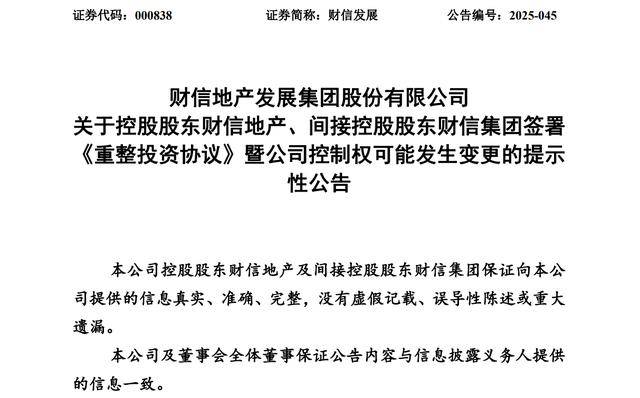
拟控股财信发展!四川南充籍80后青年川商,将拿下年内第2家上市公司→
Sou Hu Cai Jing· 2025-12-03 12:18
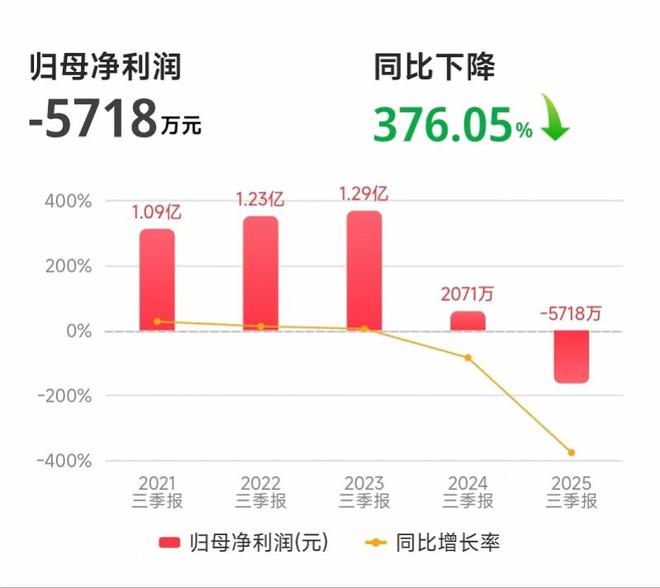
Core Viewpoint - The article discusses the acquisition of a significant stake in Caixin Development by Jiangxi Zhongjiu Natural Gas Group, led by entrepreneur Yong Zhijun, marking a strategic shift in the company's ownership and potential restructuring efforts [1][4]. Group 1: Company Background - Caixin Development, established in 1996, operates in real estate development and environmental protection, previously recognized as one of China's top 100 real estate companies from 2018 to 2022 [4]. - The company has faced continuous losses and operational challenges, with revenue declining from 5.055 billion yuan in 2021 to 828 million yuan in 2024, and net profits remaining negative over the same period [4][6]. Group 2: Acquisition Details - On December 2, 2023, Caixin Development announced that its controlling shareholder, Caixin Real Estate Development Group, signed a restructuring investment agreement with Jiangxi Zhongjiu, which plans to acquire 20% to 29.99% of the company's shares [1][4]. - If the acquisition is completed, Yong Zhijun will become the new actual controller of Caixin Development, changing the company's ownership structure [1][4]. Group 3: Financial Performance - As of the third quarter of 2025, Caixin Development reported total assets of 2.494 billion yuan and liabilities of 2.051 billion yuan, resulting in a high debt-to-asset ratio of 82.24% [7]. - The company reported a net profit of -18.65 million yuan for the year, reflecting a 209.14% year-on-year decline [8]. Group 4: Market Reaction - Following the announcement of the acquisition, Caixin Development's stock price surged to the daily limit of 3.89 yuan per share, with a total market capitalization of 4.281 billion yuan [8].