金融支持实体经济

Search documents
总量较快增长、社会综合融资成本进一步降低——金融支持实体经济持续显效
Xin Hua Wang· 2026-01-15 23:43
河北省邢台市新河县农村信用合作联社近日走访小微经营主体,提供"一站式"金融服务。图为该农 村信用合作联社工作人员在一家公司了解融资需求。李世强摄(人民视觉) 1月15日,国新办举行新闻发布会,介绍货币金融政策支持实体经济高质量发展成效。中国人民银 行新闻发言人、副行长邹澜在会上表示,2025年,人民银行实施适度宽松的货币政策,在货币金融环境 较为宽松的状态下,在存量政策接续发挥作用的基础上,又宣布实施了一揽子金融支持举措,巩固经济 回升向好势头。从全年金融数据看,货币金融政策支持实体经济效果明显。 信贷支持力度强 2025年,金融支持实体经济成效如何?人民银行有关负责人从多个方面作了介绍。 金融总量较快增长。2025年12月末,社会融资规模存量同比增长8.3%,广义货币供应量M2同比增 长8.5%,明显高于名义GDP增速;人民币贷款余额272万亿元,同比增长6.4%,还原地方化债影响后, 增速在7%左右,信贷支持力度持续较强。 中央经济工作会议明确,2026年要继续实施适度宽松的货币政策。邹澜介绍,根据当前经济金融形 势需要,人民银行将先行推出两方面政策措施。一方面是下调各类结构性货币政策工具利率,提高银行 ...


金融支持实体经济持续显效(锐财经)
Ren Min Ri Bao Hai Wai Ban· 2026-01-15 22:44
河北省邢台市新河县农村信用合作联社近日走访小微经营主体,提供"一站式"金融服务。图为该农村信 用合作联社工作人员在一家公司了解融资需求。 李世强摄(人民视觉) 1月15日,国新办举行新闻发布会,介绍货币金融政策支持实体经济高质量发展成效。中国人民银行新 闻发言人、副行长邹澜在会上表示,2025年,人民银行实施适度宽松的货币政策,在货币金融环境较为 宽松的状态下,在存量政策接续发挥作用的基础上,又宣布实施了一揽子金融支持举措,巩固经济回升 向好势头。从全年金融数据看,货币金融政策支持实体经济效果明显。 信贷支持力度强 2025年,金融支持实体经济成效如何?人民银行有关负责人从多个方面作了介绍。 金融总量较快增长。2025年12月末,社会融资规模存量同比增长8.3%,广义货币供应量M2同比增长 8.5%,明显高于名义GDP增速;人民币贷款余额272万亿元,同比增长6.4%,还原地方化债影响后,增 速在7%左右,信贷支持力度持续较强。 社会综合融资成本进一步降低。2018年下半年以来,人民银行累计10次下调政策利率,还通过强化利率 政策执行和监督,更好发挥存量政策效能,促进社会综合融资成本稳步下行。2025年12月 ...

权威数读|金融支持实体经济:效果明显 !一起来看“成绩单”
Xin Hua She· 2026-01-15 14:41
Group 1 - The financial total in China is expected to grow rapidly in 2025, with a significant reduction in the overall social financing cost and an optimized financial structure [1] - The social financing scale stock is projected to reach 442.12 trillion yuan, reflecting a year-on-year growth of 8.3% [4] - The weighted average interest rate for newly issued corporate loans and personal housing loans is approximately 3.1%, marking a decline of 2.5 and 2.6 percentage points respectively since the second half of 2018 [7] Group 2 - There is an increased focus on supporting key areas such as technological innovation and consumption to boost domestic demand, with loans in technology, green, inclusive, elderly care, and digital economy sectors maintaining double-digit growth, significantly outpacing the overall loan growth rate [10] - By 2025, the proportion of financing methods outside of bonds in the new social financing scale increment has exceeded 50% [10] Group 3 - The foreign exchange market is operating smoothly, with a basic balance in supply and demand, and the renminbi appreciating by 4.4% against the US dollar [14] - The yield on 10-year government bonds has stabilized around 1.8% to 1.9%, indicating a healthy development in the bond market [14] - The capital market has seen a boost in confidence, leading to increased trading activity [14] Group 4 - The efficiency of foreign exchange management services for the real economy has significantly improved, with over 220 billion USD in related facilitation services processed nationwide [15] - The foreign exchange market transaction volume is projected to reach 42.6 trillion yuan in 2025, with the corporate foreign exchange hedging ratio rising to 30%, both representing historical highs [15] - There has been a shift from net outflow to net inflow of cross-border funds, with a total net inflow of 30.21 billion USD for the year [15]
央行、外汇局,最新表态!事关降准降息、物价、人民币汇率等
Zhong Guo Ji Jin Bao· 2026-01-15 11:14
Group 1 - The core viewpoint of the news is that the People's Bank of China (PBOC) is implementing various monetary policy measures to support the high-quality development of the real economy, including interest rate cuts and increased lending to key sectors [1][2][4] Group 2 - The PBOC will lower the interest rates of various structural monetary policy tools by 0.25 percentage points, with the one-year re-lending rate decreasing from 1.5% to 1.25% [3] - The PBOC will merge the re-lending for agriculture and small enterprises with rediscounting, increasing the re-lending quota for agriculture and small enterprises by 500 billion yuan, with a separate quota of 1 trillion yuan for private enterprises [3] - The re-lending quota for technological innovation and technological transformation will be increased from 800 billion yuan to 1.2 trillion yuan, expanding the support to include private small and medium-sized enterprises with high R&D investment [3] - The PBOC will establish a combined risk-sharing tool for bonds of technological innovation and private enterprises, providing a total re-lending quota of 200 billion yuan [3] - The PBOC will expand the support areas of carbon reduction tools to include energy-saving renovations and green upgrades [3] - The minimum down payment ratio for commercial property loans will be lowered to 30% to support the commercial real estate market [4] - Financial institutions will be encouraged to enhance their foreign exchange risk management services [4] Group 3 - The PBOC will flexibly conduct government bond trading operations to maintain liquidity and create a favorable monetary environment for government bond issuance [5][6] - There is still room for further cuts in reserve requirement ratios and interest rates, with the average reserve requirement ratio currently at 6.3% [7] - The PBOC aims to create a suitable monetary environment to promote reasonable price recovery while maintaining a moderately loose monetary policy [8] Group 4 - The PBOC emphasizes that it does not intend to devalue the currency to gain international trade advantages, maintaining a stable RMB exchange rate at a reasonable equilibrium level [9] - The PBOC will continue to improve policies for the cross-border use of the RMB and enhance foreign exchange risk management products for foreign trade enterprises [9] Group 5 - The PBOC will enhance financial support for the service consumption sector, including the health industry, by expanding the areas eligible for re-lending [10][11] - Measures will be taken to improve the financial environment for consumption, including optimizing payment services and implementing credit repair policies [11] Group 6 - The PBOC will accelerate the implementation of supportive measures for private enterprises, enhancing financial services and creating a better development environment for them [12] Group 7 - The State Administration of Foreign Exchange (SAFE) will focus on three key areas: enhancing foreign exchange facilitation reforms, promoting high-level opening-up, and ensuring effective regulation of the foreign exchange market [14][15] - SAFE will strengthen the long-term mechanism for foreign exchange risk management services for enterprises [16] Group 8 - SAFE aims to maintain the RMB exchange rate stability and enhance the resilience of the foreign exchange market while monitoring cross-border capital flows [19] - SAFE will promote the orderly issuance of Qualified Domestic Institutional Investor (QDII) investment quotas and enhance the openness of capital projects [20][21]
权威数读丨金融支持实体经济:效果明显 !一起来看“成绩单”
Xin Hua Wang· 2026-01-15 10:29
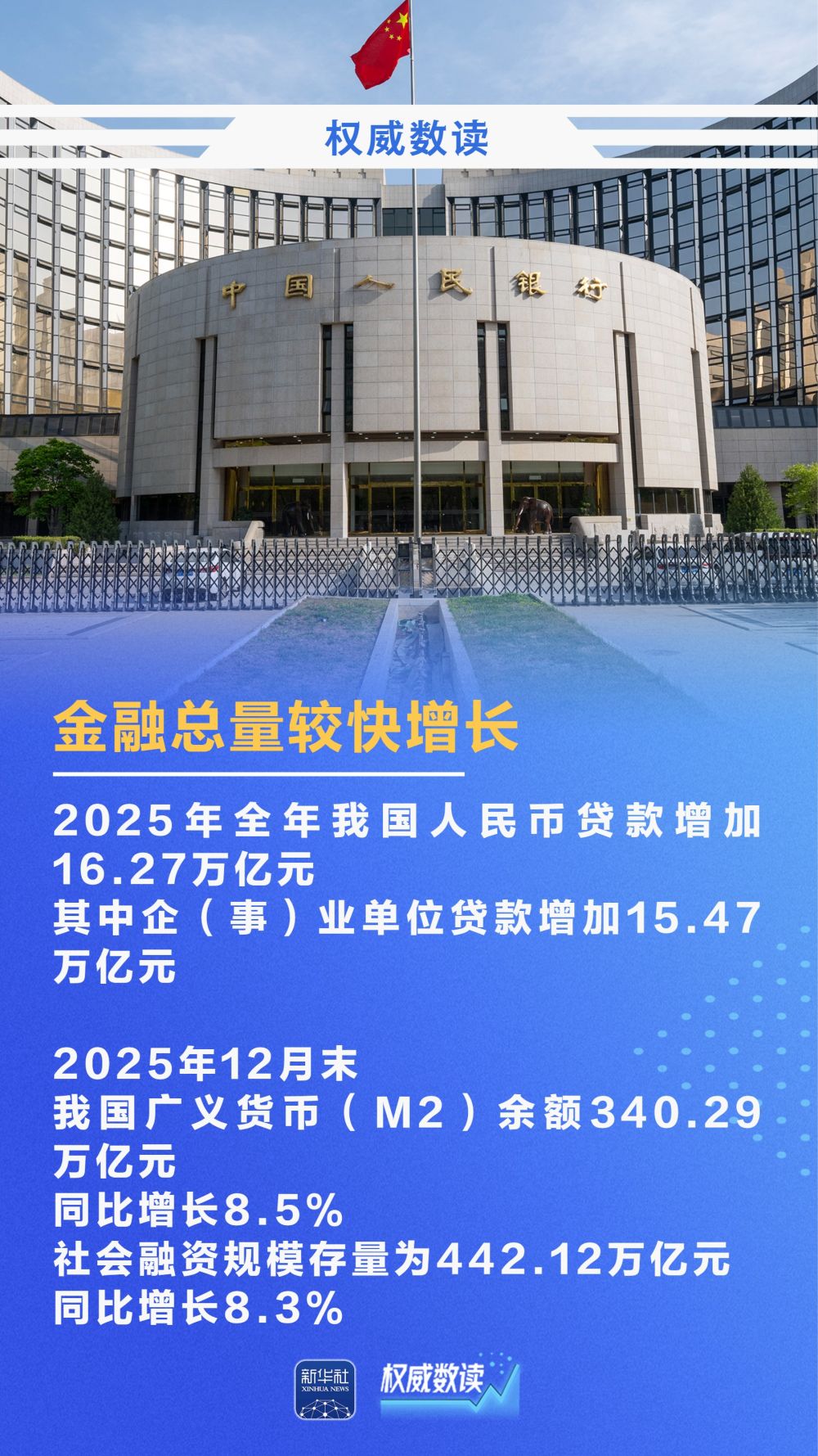
2025年中国金融总量较快增长、社会综合融资成本进一步降低、金融结构不断优化、金融市场平稳运行,货币金融政策支持实体经济效果 明显。跟随这组海报,一起了解下。 万亿元 同比增长8.5% 社会融资规模存量为442.12万亿元 同比增长8.3% 权威数读 / 凯华时 权威数读 社会综合融资成本进一步降( 2025年12月 新发放企业贷款加权平均利率和额 发放个人住房贷款加权平均利率 都大约在3.1%左右 自2018年下半年以来 分别下降了2.5个和2.6个百分点 会融结构不断优化 加大对科技创新、提振消费等扩大内 需重点领域的支持 科技、绿色、普惠、养老产业和数字 经济产业等重点领域贷款都保持了两 位数增长,明显高于全部贷款增速 2025年社会融资规模增量中 债券等贷款以外的融资方式占比已经 超过50% 权威数读 / xing and 双 F757 F 会融市场平稳运行 外汇市场供求基本平衡 人民币对一篮子货币保持基本稳定 对美元汇率升值4.4% 债券市场平稳健康发展 10年期国债收益率 近期稳定在1.8%-1.9%附近 资本市场信心有效提振 交投活跃 权威数读 / 权 同なる 中国 全国办理相关便利化业务超22 ...
引导金融机构加力支持扩大内需
Sou Hu Cai Jing· 2026-01-12 23:16
Core Viewpoint - Expanding domestic demand is a strategic foundation for constructing a new development pattern, with a focus on enhancing the domestic market and supporting key areas such as consumption, technological innovation, and small and micro enterprises [1][2]. Financial Support for Domestic Demand - Financial services play a crucial role in supporting the real economy, and the effectiveness of these services directly impacts the success of expanding domestic demand [1]. - The transition from scale-driven financial support to quality and efficiency-driven support is necessary as the economy shifts from high-speed growth to high-quality development [2][3]. Structural Issues in Financial Support - There are structural issues in financial support for expanding domestic demand, including inadequate mechanisms to promote consumer confidence and willingness to spend [4]. - For enterprises, there is a gap in the supply of medium- and long-term funds necessary for effective investment, leading to mismatches in financing needs [5]. - Financial institutions face challenges in lending and risk management, which affects their ability to support consumer and small business loans effectively [6]. Systemic Reforms Needed - Systemic reforms are required to enhance the quality and efficiency of financial services, focusing on long-term support for manufacturing upgrades and innovative consumption scenarios [7]. - Strengthening the collaboration between fiscal and monetary policies is essential to improve the effectiveness of financial support for expanding domestic demand [8]. Enhancing Financial Institutions' Capabilities - Financial institutions need to shift from collateral-based lending to credit-driven models, utilizing comprehensive data systems to create digital credit profiles [9]. - There is a need for innovative financial support mechanisms that integrate with rural revitalization and local economic development [10].
【微头条】2025年青岛海洋保险保费收入同比增长39.27%
Xin Lang Cai Jing· 2026-01-07 10:51
Core Viewpoint - In 2025, the Qingdao Financial Regulatory Bureau will focus on "Financial Support for High-Quality Economic Development," guiding the banking and insurance sectors to innovate mechanisms, deepen reforms, and optimize services to inject strong financial momentum into the real economy [1][4]. Group 1: Mechanisms for Development - The Qingdao Financial Regulatory Bureau will strengthen the urban real estate financing coordination mechanism, implementing the "1+2+2" action plan to support the delivery of 38,000 housing units [1][4]. - A total of 19 measures will be introduced to enhance financing support for small and micro enterprises, with cumulative loans issued since 2025 reaching 447.1 billion yuan at an average interest rate of 3.37%, which is lower than the national and provincial averages, decreasing by 0.31 percentage points since the establishment of the mechanism [1][4]. Group 2: Pilot Programs for Technological Innovation - The pilot program for equity investment by financial asset investment companies will be fully implemented, with Qingdao achieving full coverage of five AIC funds, registering three funds with a total scale of 1.82 billion yuan, and completing the first AIC equity fund investment project in Shandong Province [1][4]. - A pilot program for loans for technology enterprise mergers and acquisitions will be rapidly implemented, establishing a project database, with the first two pilot transactions completed within a week of policy release, and a total of 7.81 billion yuan in pilot loans issued by 2025 [1][4]. Group 3: Marine Finance and Innovation - The Qingdao Financial Regulatory Bureau will create the "Blue Ocean Financial Chain" brand, compiling a white paper on marine insurance development, with the balance of loans related to marine activities reaching 147.9 billion yuan, a year-on-year increase of 17.86% [2][6]. - Support will be provided for innovative marine industry projects, including modern marine fisheries, seawater energy supply, and offshore photovoltaics, with marine insurance premium income increasing by 39.27% year-on-year [2][6]. Group 4: Financial Support for Livelihood Improvement - The Qingdao Financial Regulatory Bureau will lead the formulation of a three-year action plan for the high-quality development of pension finance, guiding financial institutions to actively participate in the "Kangwan" project to enrich pension financial supply [3][6]. - The bureau will promote the enhancement of agricultural insurance, achieving the largest guarantee scale among planned cities in 2025, with fresh milk insurance recognized as a typical case of financial innovation in supporting agriculture [3][6]. - A special action to enhance services and support consumption will be launched, with personal consumption loans exceeding 10 billion yuan in 2025, benefiting thousands of citizens through interest subsidy policies [3][6].
保险股延续“开门红”,新华、太保、平安均创历史新高
Xin Lang Cai Jing· 2026-01-06 11:05
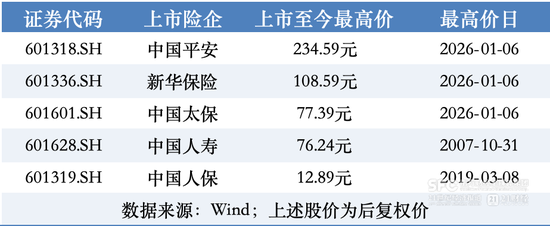
Core Viewpoint - The insurance sector has shown strong performance at the beginning of 2026, driven by multiple factors including a bull market, favorable policies, improved industry fundamentals, and institutional support for valuation recovery [1][2][4] Market Performance - The insurance industry index (886055.WI) rose by 3.29%, leading the industry in gains, with all five major listed insurance companies in A-shares showing positive performance [1][6] - Several insurance stocks reached historical highs on January 6, 2026, with China Ping An (601318.SH) hitting a peak of 234.59 yuan per share, marking a record since its listing [1][2][6] - The total market capitalization of the five major listed insurance companies reached approximately 3.89 trillion yuan, an increase of about 128.8 billion yuan from the previous trading day [7] Policy Environment - In December 2025, the National Financial Regulatory Administration adjusted risk factors for certain insurance company businesses, which is expected to enhance investment capacity and support the sector [3][9] - The release of favorable policies is expected to encourage long-term investments in A-shares, aligning with the strategic direction of "financial support for the real economy" [3][9] Industry Fundamentals - The insurance sector is anticipated to experience a "New Year" surge in premiums, potentially exceeding expectations, driven by a positive feedback loop between assets and liabilities [3][9] - The insurance industry reported a total premium income of 5.76 trillion yuan for the first eleven months of 2025, reflecting a year-on-year growth of 7.6%, with life insurance premiums growing by 9.2% [3][9] Asset Management - The recovery of the equity market and high dividend asset allocation are expected to enhance investment returns, alleviating pressure from interest rate differentials [4][10] - The total assets of the insurance industry surpassed 40 trillion yuan in 2025, with net assets reported at 3.68 trillion yuan [4][10] Future Outlook - The insurance sector is positioned for continued strength in 2026, supported by high demand for protection and savings products, as well as potential inflows of new capital into the market [4][10] - However, attention should be paid to the pace of valuation recovery and the sustainability of the liability side, particularly regarding product structure optimization and agent channel reforms [4][10] Long-term Trends - The industry is shifting from a "scale-driven" model to a "value growth" approach, with leading insurance companies demonstrating greater resilience due to asset-liability matching advantages [5][11]





商业银行并购贷款迎监管新规
Jin Rong Shi Bao· 2026-01-05 02:58
Core Viewpoint - The new regulations on merger and acquisition (M&A) loans by commercial banks aim to optimize loan services, enhance risk management, and better meet the financing needs of enterprises, thereby promoting high-quality development in the M&A market [1][2]. Group 1: Regulatory Changes - The Financial Regulatory Bureau has revised the "Guidelines for Risk Management of M&A Loans" to form the "Management Measures for M&A Loans," which will be published by December 31, 2025 [1]. - The new measures consist of 34 articles that categorize M&A loans into controlling and equity participation types, with differentiated rules for each [2][3]. Group 2: Financing Conditions - The revised regulations broaden the applicable scope of M&A loans, allowing loans for equity participation M&A transactions, provided that the equity stake acquired is at least 20% and does not exceed 60% of the transaction price [4]. - The upper limit for controlling M&A loans has been increased from 60% to 70% of the transaction price, and the maximum loan term has been extended from seven years to ten years [4][5]. Group 3: Risk Management - The new regulations emphasize a balanced approach of "one loose and one tight," enhancing flexibility in supporting the real economy while being more prudent in risk prevention [6]. - Differentiated asset scale requirements have been established for banks engaging in controlling and equity participation M&A loans, ensuring that banks have the capacity to manage these loans effectively [6][7].
用心用力陪伴实体经济成长
Ren Min Ri Bao· 2026-01-04 09:34
Core Viewpoint - The article discusses the importance of financial support for the real economy, emphasizing targeted financial assistance to key sectors and small and medium-sized enterprises (SMEs) rather than a broad approach. It highlights various financial institutions' efforts to provide customized financial solutions to meet the specific needs of businesses, particularly in technology and green manufacturing sectors [4][5][6][8]. Group 1: Focus on Key Areas - Financial institutions are encouraged to support sectors like technology innovation and SMEs, avoiding a "flooding" approach and instead implementing precise financial solutions [4][7]. - The Industrial Bank's customized financing plan for Luozhou Group demonstrates a successful case of targeted financial support, providing 137 million yuan in loans for equipment upgrades and green transformation [5][6]. - The collaboration between financial institutions and enterprises is crucial for achieving effective financial support, with a focus on long-term partnerships and tailored financial products [6][8]. Group 2: Innovative Services - The article highlights the challenges faced by technology companies in securing financing, particularly due to their asset-light nature and long R&D cycles. The Construction Bank's "Technology Transformation Loan" offers a solution by providing funding based on the company's high-tech qualifications rather than traditional collateral [9][10]. - The need for flexible financial solutions is emphasized, with banks encouraged to adapt their services to meet the dynamic needs of technology firms, including adjusting repayment plans during cash flow challenges [11]. Group 3: Technology Empowerment - Financial technology advancements are reshaping banking services, allowing for online, efficient, and accessible financial solutions for small and medium enterprises. The case of Fudiwei Technology Company illustrates how digital banking products can meet urgent funding needs without traditional collateral requirements [12][13][15]. - The shift from traditional banking to digital services enables banks to provide comprehensive financial ecosystems that support businesses throughout their lifecycle, integrating various financial services into a single platform [15][16]. Group 4: Collaborative Efforts - The article underscores the necessity of multi-party collaboration to effectively serve technology companies, moving beyond traditional collateral-based lending. Beijing Bank's partnership with equity investment institutions exemplifies this approach, facilitating a combined financing strategy [16][18]. - The integration of resources from government, industry, and academia is essential for supporting the growth of technology firms, providing a holistic service model that includes financing, expertise, and market access [19].