
非税收入

Search documents
今年以来广义财政收入增速首次转正 增量政策陆续出台实施 | 财税益侃
Di Yi Cai Jing· 2025-10-23 14:23
Core Viewpoint - China's economy has shown stable performance in 2023, leading to a recovery in fiscal revenue, supported by proactive fiscal policies aimed at stabilizing employment, businesses, and market expectations [1][11]. Fiscal Revenue and Taxation - In the first three quarters of 2023, the broad fiscal revenue reached 19.46 trillion yuan, a year-on-year increase of approximately 0.4%, marking the first positive growth in fiscal revenue this year [1]. - The general public budget revenue was 16.39 trillion yuan, with tax revenue at 13.27 trillion yuan, reflecting a year-on-year growth of 0.5% and 0.7% respectively [2]. - Tax revenue growth turned positive in recent months, with September showing an 8.7% year-on-year increase, the highest for the year, driven by improved corporate performance and active capital market transactions [2][3]. Non-Tax Revenue - Non-tax revenue in the general public budget decreased by 0.4% year-on-year to 312.12 billion yuan, significantly lower than the previous year's growth of 13.5% [4]. - The decline in non-tax revenue is attributed to a high base from previous years and stricter regulations on administrative penalties [4][7]. Government Bonds and Fiscal Expenditure - The net financing of government bonds reached 1.146 trillion yuan in the first three quarters, an increase of 428 billion yuan year-on-year [10]. - Fiscal expenditure for the same period was 20.81 trillion yuan, a year-on-year increase of 3.1%, with significant allocations towards social security, education, and healthcare [11]. - The government has accelerated the issuance of special bonds to support major projects, with a total expenditure of 4.21 trillion yuan from various bond types [14][15]. Real Estate and Land Revenue - The revenue from government funds, primarily from land sales, decreased by 0.5% year-on-year to 30.72 billion yuan, with land use rights revenue dropping by 4.2% [7][8]. - Policies aimed at stabilizing the real estate market have led to a narrowing decline in land sale revenues and related taxes [8]. Investment and Economic Stability - The introduction of new policy financial tools worth 500 billion yuan aims to enhance project capital and stimulate total investment by approximately 4.8 trillion yuan [15]. - The fiscal policies are designed to support local governments in managing existing debts and facilitating economic recovery [15].

今年以来广义财政收入增速首次转正,增量政策陆续出台实施|财税益侃
Di Yi Cai Jing· 2025-10-23 11:43
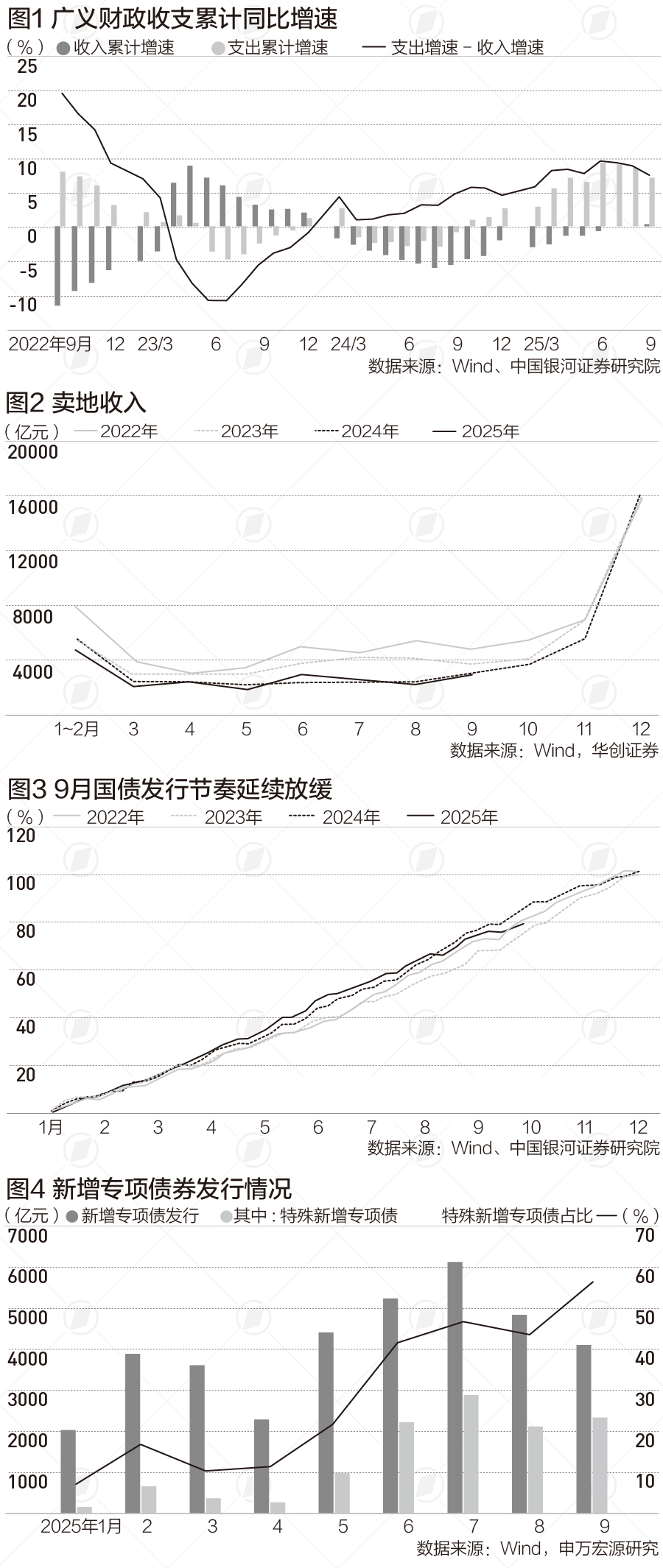
Core Insights - In September, national tax revenue increased by 8.7% year-on-year, marking the highest growth rate of the year [1] - The overall fiscal revenue in the first three quarters reached 19.46 trillion yuan, with a year-on-year growth of approximately 0.4%, indicating a recovery in fiscal income [2][3] - The growth in tax revenue is primarily driven by improved corporate performance and active capital market transactions [3] Fiscal Revenue and Expenditure - The general public budget revenue for the first three quarters was 16.39 trillion yuan, with a year-on-year increase of 0.5%, while tax revenue reached 13.27 trillion yuan, growing by 0.7% [3] - Fiscal expenditure for the same period was 28.30 trillion yuan, up 7.9%, exceeding the economic growth rate of 5.2% [2] - Expenditure on social security and employment, education, and health care grew by 10%, 5.4%, and 4.7% respectively, reflecting a focus on social welfare [12] Tax Revenue Trends - Tax revenue growth has turned positive after being negative earlier in the year, with September's growth significantly higher than August's by 5.3 percentage points [3] - The capital market's performance has positively influenced tax revenue, with securities transaction stamp duty increasing by 110.5% year-on-year [3] - The decline in the Producer Price Index (PPI) has also contributed to the recent tax revenue growth [4] Non-Tax Revenue - Non-tax revenue in the general public budget decreased by 0.4% year-on-year, contrasting with a 13.5% increase in the previous year [5] - The decline in non-tax revenue is attributed to a high base from previous years and stricter regulation on administrative penalties [5][9] Government Fund Revenue - Government fund revenue, primarily from land sales, was 30.72 trillion yuan, down 0.5% year-on-year, with land use rights revenue decreasing by 4.2% [10] - The decline in land sales revenue is expected to narrow due to policies aimed at stabilizing the real estate market [10] Debt Financing and Investment - Net financing from government bonds reached 1.146 trillion yuan, an increase of 428 billion yuan year-on-year [11] - The government has accelerated the issuance of special bonds to support major projects, with a total expenditure of 4.21 trillion yuan from various bond types [15] - New policy financial tools worth 500 billion yuan have been introduced to enhance project capital, expected to drive total project investment by 4.8 trillion yuan [16]
支持农村电网改造!一文了解农网还贷资金
蓝色柳林财税室· 2025-10-22 10:25
Core Viewpoint - The article provides a comprehensive overview of non-tax revenue, specifically focusing on the agricultural network loan repayment fund, its collection methods, standards, and reporting processes [1][2]. Group 1: Agricultural Network Loan Repayment Fund - The agricultural network loan repayment fund is a government fund collected from electricity users in provinces, autonomous regions, and municipalities to repay loans for rural power grid renovation [3]. - Since January 1, 2019, the tax authorities have been responsible for collecting the agricultural network loan repayment fund [4]. Group 2: Collection Methods and Standards - The fund is collected based on the electricity consumption of users in the relevant regions, specifically at a rate of 0.02 yuan per kilowatt-hour [5][6]. - The collection occurs monthly, with companies required to report and pay by the 15th of each month [7]. Group 3: Exemptions and Special Policies - Certain categories of electricity usage are exempt from the fund, including agricultural irrigation, disaster relief, and specific fertilizer production [7]. - For state-owned key coal enterprises and certain nuclear facilities, the fund is charged at a reduced rate of 0.003 yuan per kilowatt-hour [7]. Group 4: Reporting and Payment Process - Payments can be made through the electronic tax bureau or in person at tax service halls, with detailed steps provided for electronic submissions [8][11]. - After completing the declaration, users can pay the fund and obtain relevant receipts through the tax bureau system [11].

9月财政数据点评:增量财政资金落地,补缺口扩投资
LIANCHU SECURITIES· 2025-10-20 11:14
Summary of Key Points 1. Report Industry Investment Rating No industry investment rating is provided in the report. 2. Core View of the Report The fiscal revenue growth rate continues to improve, with an enhanced contribution from tax revenues. The overall fiscal expenditure progress is slow, but the decline in infrastructure - related expenditures has narrowed. Government - funded funds show a divergence between revenue and expenditure, with revenue lagging behind expenditure. In the fourth quarter, the implementation of incremental fiscal funds will help the economy operate smoothly, and more incremental policies are still expected [3][4][5]. 3. Summary by Relevant Catalogs 3.1 Fiscal Revenue Growth Rate Continues to Improve, Tax Revenue Contribution Increases - The growth rate of general public budget revenue from January to September reached 0.5%, 0.2 percentage points higher than the previous value, and improved for three consecutive months. The central government's monthly revenue growth rate improved significantly, and the decline in cumulative growth rate narrowed to - 1.2%, while local fiscal revenue maintained positive growth at a cumulative rate of 1.8%. The fiscal revenue growth rate was slightly higher than the annual budget target by 0.1%, but the completion progress was 74.5%, lower than the historical average [11]. - Tax revenue growth significantly supported the improvement of fiscal revenue, while non - tax revenue growth declined sharply, turning into a negative drag on revenue growth. From January to September, the cumulative year - on - year growth rate of tax revenue was 0.7%, reaching the highest value of the year. Non - tax revenue had negative single - month growth for five consecutive months, and the cumulative growth rate turned slightly negative at - 0.4% [17]. - In terms of tax revenue structure, VAT, corporate income tax, domestic consumption tax, individual income tax, and stamp duty all showed positive growth, while land and real - estate - related tax revenue decline was narrowing [18]. 3.2 Overall Expenditure Progress is Slow, Decline in Infrastructure - Related Expenditure Narrows - From January to September, the year - on - year growth rate of fiscal expenditure was 3.1%, the same as the previous value and lower than the annual budget target of 4.4%. The central government's expenditure growth rate dropped to a new low of 7.3% for the year, while the local government's expenditure growth rate was 2.4%, 0.1 percentage points higher than the previous value. The general public budget expenditure completion progress from January to September was 70.1%, the lowest in the past five years [20]. - In terms of expenditure structure, people's livelihood - related expenditures remained the focus, and infrastructure - related expenditures improved. Social security and employment expenditures maintained a growth rate of 10%, and infrastructure - related expenditures such as energy conservation and environmental protection and transportation had a growth rate close to 20% for two consecutive months [21]. 3.3 Government - Funded Funds' Revenue and Expenditure Diverge, Revenue Lags Behind Expenditure - From January to September, the government - funded funds' revenue decreased by 0.5% year - on - year, lower than the annual budget growth target of 0.7%. The decline in land transfer fees was the main reason for the negative growth. The government - funded funds' expenditure increased by 23.9% year - on - year, higher than the annual budget target of 23.1%. The revenue completion progress was 49.1%, and the expenditure completion progress was 60% [25]. - The issuance of local government special bonds accelerated, with the completion progress of new special bonds in September reaching about 83.6%, still slow in a five - year perspective [25]. 3.4 Incremental Funds are Implemented to Fill Gaps and Expand Investment In September, the National Development and Reform Commission established a new policy - based financial instrument worth 500 billion yuan, and the Agricultural Development Bank of China has disbursed nearly 100 billion yuan. On October 17, the Ministry of Finance issued another 500 billion yuan in carry - over quotas. The implementation of incremental funds will help expand investment and support the stable operation of the economy in the fourth quarter. More incremental policies are still expected [5][30].
前三季度中国财政收入同比增长0.5%
Zhong Guo Xin Wen Wang· 2025-10-17 16:10
Core Insights - China's fiscal revenue for the first three quarters of the year reached 163,876 billion yuan, showing a year-on-year growth of 0.5%, with tax revenue contributing 132,664 billion yuan and a growth of 0.7% [1][2] Group 1: Fiscal Revenue Trends - The growth rate of fiscal revenue has been increasing quarterly, with a decline of 1.1% in Q1, a recovery to 0.6% in Q2, and a notable increase of 2.5% in Q3 [1] - In Q3, tax revenue showed steady growth, with domestic value-added tax increasing by 3.6% and corporate income tax rising by 0.8%, indicating a recovery in industrial profits [1] Group 2: Non-Tax Revenue and Expenditure - Non-tax revenue for the first three quarters was 31,212 billion yuan, reflecting a decline of 0.4%, with a significant drop in penalty income by 7% [2] - Total public budget expenditure reached 208,064 billion yuan, marking a year-on-year increase of 3.1%, with the highest growth rates in social security, education, and health sectors in three years [2] Group 3: Government Fund Budget - The decline in government fund budget revenue narrowed by 1.9 percentage points compared to the first half of the year, while expenditure grew by 23.9%, driven by accelerated use of bond funds [2] - A total of 42,100 billion yuan was spent from various government bonds, enhancing economic momentum and supporting ongoing economic recovery [2]
前三季度财政数据折射经济向好
Di Yi Cai Jing· 2025-10-17 10:17
Core Insights - The national general public budget revenue for the first three quarters reached 163,876 billion yuan, reflecting a year-on-year growth of 0.5%, indicating a positive trend in China's economy [1] - Tax revenue, a key component of the budget, amounted to 132,664 billion yuan, with a growth rate of 0.7%, showcasing resilience despite challenges in the economic environment [1] Revenue Breakdown - The domestic value-added tax, the largest tax type, grew by 3.6% year-on-year, outperforming the overall budget revenue growth by 3.1 percentage points [2] - Corporate income tax increased by 0.8%, with a notable acceleration of 2.7 percentage points compared to the first half of the year, reflecting improved market vitality and industrial profits [2] - Non-tax revenue totaled 31,212 billion yuan, showing a decline of 0.4%, with specific items like state-owned resource usage income increasing by 4% while penalty income dropped by 7% [2] Regional Performance - Local public budget revenue grew by 1.8% year-on-year, with 27 out of 31 regions experiencing positive growth, indicating overall stability in local finances [3] Government Fund Revenue - Government fund revenue, primarily from land sales, reached 30,717 billion yuan, down by 0.5%, with land use rights income declining by 4.2% [4] - The government is accelerating funding through bond issuance, with net financing of government bonds amounting to 11.46 trillion yuan, an increase of 4.28 trillion yuan year-on-year [4] Expenditure Insights - General public budget expenditure for the first three quarters was 20.81 trillion yuan, reflecting a year-on-year increase of 3.1%, with significant growth in social security, education, and environmental protection spending [5] - Government fund expenditure rose by 23.9% to 7.49 trillion yuan, driven by the effective use of bond funds [5][6]
前三季度,全国一般公共预算收入同比增长0.5%
Xin Jing Bao· 2025-10-17 09:54
Core Insights - The national general public budget revenue for the first three quarters of the year reached 16.39 trillion yuan, reflecting a year-on-year growth of 0.5% [1] - The recovery in fiscal revenue growth indicates a generally stable and improving economic operation [1] Revenue Breakdown - Tax revenue increased by 0.7% year-on-year, with the largest tax category, domestic value-added tax, growing by 3.6%, surpassing the overall budget revenue growth by 3.1 percentage points [1] - Corporate income tax, the second largest tax category, saw a year-on-year increase of 0.8%, with the growth rate expanding by 2.7 percentage points compared to the first half of the year, indicating a notable recovery in industrial enterprise profits [1] - Non-tax revenue decreased by 0.4%, a decline of 4.1 percentage points compared to the first half of the year, with state resource usage income increasing by 4% due to local governments activating assets through various channels [1] Local Government Revenue - Local general public budget revenue grew by 1.8% year-on-year, maintaining this growth rate for three consecutive months since July [2] - Among 31 provinces, autonomous regions, and municipalities, 27 regions achieved positive growth compared to the same period last year, despite some areas being affected by falling prices of bulk commodities like coal [2]
支持库区和移民安置区经济发展,一文了解大中型水库移民后期扶持基金
蓝色柳林财税室· 2025-10-17 09:15
Core Points - The article discusses the non-tax revenue, specifically focusing on the Large and Medium-sized Reservoir Resettlement Support Fund, which is established to assist rural migrants affected by large and medium-sized reservoirs in solving their production and living issues, promoting sustainable economic and social development in the reservoir and resettlement areas [1][3]. Group 1: Fund Overview - The Large and Medium-sized Reservoir Resettlement Support Fund is a government fund aimed at supporting rural migrants from large and medium-sized reservoirs [3]. - The fund was collected by the tax authorities starting from January 1, 2019 [4]. Group 2: Collection Scope - The fund is collected from provincial power grid enterprises based on the total electricity sold within their respective provinces, with certain exemptions such as distributed photovoltaic self-consumed electricity and agricultural production electricity [5]. Group 3: Collection Standards and Procedures - In Chongqing, the collection standard is set at 6.225 cents per kilowatt-hour (0.006225 yuan per kilowatt-hour) [6]. - The fund is to be declared and paid monthly, with the deadline for declaration being the 15th of each month, and a final settlement by March 31 of the following year based on actual sales and self-consumed electricity [6][10]. Group 4: Declaration and Payment Methods - The declaration for the fund is done using the "General Non-Tax Revenue Declaration Form," and can be submitted through the electronic tax bureau or in person at tax service halls [6][11]. - The electronic declaration process involves logging into the electronic tax bureau, selecting the appropriate options, and submitting the declaration [8][10].

改善城镇环境!一文了解城镇垃圾处理费及申报操作步骤
蓝色柳林财税室· 2025-09-26 09:46
欢迎扫描下方二维码关注: 非税收入是指除税收收入以外, 由各级国家机关、事业单位、代行政府职能的社会团体及其他组织依法利用国家权力、政 府信誉、国有资源(资产)所有者权益等取得的各项收入。 税务部门征收非税收入起步于1986年教育费附加的开征。为了让您 更清晰地了解非税收入相关政策、掌握申报流程,我们特推出"非税"合集,为大家介绍常见非税收入的相关知识。 今天为大家介绍的是 —— 城镇垃圾处理费 一 什么是城镇垃圾处理费? 城镇垃圾处理费是指 政府依法征收并用于将城市生活垃圾从市政垃圾转运设施运往垃圾处置场进行处置以及相关管理的费用 ,用以增强广大居民和社会单位的"环境消费"意识,促进城市生活垃圾的减量化、资源化、无害化处置,改善城市人居环境。 自2021年7月1日起,城镇垃圾处理费由税务部门负责征收。 二 我市征收范围 在本市城市、镇规划区的建成区范围内产生城市生活垃圾的 单位和个人 。 2 .主城区以外其他区县(自治县)城市生活垃圾处置费收费标准由当地价格主管部门,在 不高于主城区收费标准和不低于主城区 收费标准的80%范围内制定 ,经当地政府批准后执行。 四 征收期限 居民类缴费人 按月征收 ,由代征单 ...

前八月全国一般公共预算收入同比稳步增长
Ren Min Ri Bao· 2025-09-17 22:22
Revenue Summary - From January to August, the national general public budget revenue reached 14,819.8 billion yuan, a year-on-year increase of 0.3% [1] - Tax revenue amounted to 12,108.5 billion yuan, with a slight increase of 0.02% year-on-year [1] - Non-tax revenue was 2,711.3 billion yuan, showing a year-on-year growth of 1.5% [1] - Central government revenue was 6,426.8 billion yuan, a year-on-year decrease of 1.7% [1] - Local government revenue was 8,393.0 billion yuan, with a year-on-year increase of 1.8% [1] Tax Revenue Breakdown - Domestic value-added tax revenue was 4,738.9 billion yuan, increasing by 3.2% year-on-year [1] - Domestic consumption tax revenue reached 1,152.3 billion yuan, up by 2% year-on-year [1] - Revenue from import goods value-added tax and consumption tax was 1,177.0 billion yuan, down by 6.7% year-on-year [1] - Tariff revenue was 152.7 billion yuan, decreasing by 6.5% year-on-year [1] - Stamp duty revenue was 284.4 billion yuan, with a significant increase of 27.4% year-on-year, including securities transaction stamp duty of 118.7 billion yuan, which surged by 81.7% [1] Expenditure Summary - From January to August, the national general public budget expenditure totaled 17,932.4 billion yuan, a year-on-year increase of 3.1% [2] - Central government expenditure was 2,657.0 billion yuan, reflecting a year-on-year growth of 8% [2] - Local government expenditure reached 15,275.4 billion yuan, with a year-on-year increase of 2.3% [2] Key Areas of Expenditure - Education expenditure was 27,078 billion yuan, increasing by 5.6% year-on-year [2] - Science and technology expenditure was 5,874 billion yuan, up by 3.1% year-on-year [2] - Social security and employment expenditure reached 30,723 billion yuan, showing a significant year-on-year growth of 10% [2] - Health expenditure was 13,717 billion yuan, with a year-on-year increase of 5.1% [2]