AI(人工智能)

Search documents
CoreWeave:云中新贵 or 苦命“打工人”?
3 6 Ke· 2025-12-30 23:39
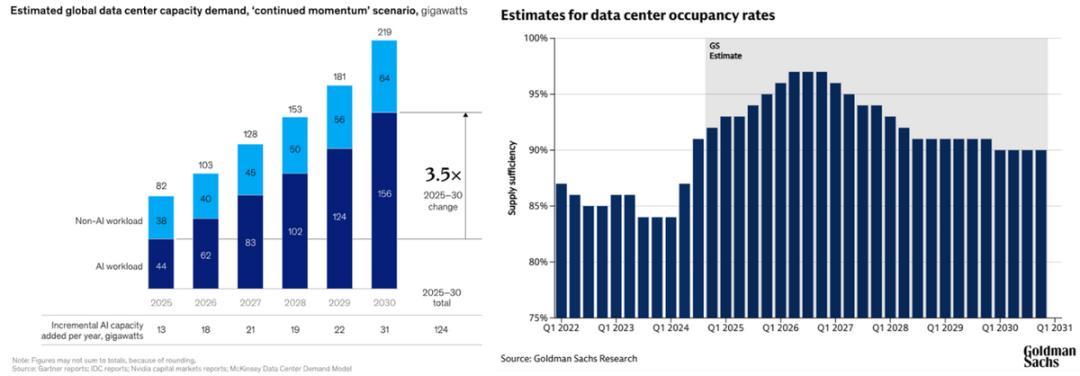
Group 1 - CoreWeave is currently the largest and fastest-growing player in the NeoCloud sector, driven by high demand for computing power and its strategic partnerships, particularly with NVIDIA [1][6][8] - The company benefits from a "take-or-pay" revenue model, ensuring high revenue certainty in the short term despite long-term risks associated with dependence on a few large clients [14][16] - CoreWeave has secured significant energy supply contracts, allowing for substantial future growth in computing capacity without immediate additional energy procurement [20][21] Group 2 - The global demand for data center computing power is expected to increase by approximately 1.7 times from 2025 to 2030, with AI computing power demand projected to grow by 2.5 times [2][4] - CoreWeave's operational efficiency and ability to quickly adapt to market changes give it a competitive edge over larger, traditional cloud service providers [4][6] - The company has a unique advantage in securing NVIDIA GPUs, which enhances its service offerings and market position [8][9] Group 3 - CoreWeave's cost structure reveals a high reliance on capital expenditures, with significant portions of revenue being consumed by operational costs, particularly in technology and infrastructure [24][27] - The company's operating profit margins are currently low, with GAAP margins fluctuating around breakeven, while adjusted margins exceed 15% [24][31] - High levels of debt financing are a concern, as interest expenses account for about 20% of total revenue, impacting overall profitability [42][48] Group 4 - Future revenue projections indicate that CoreWeave needs to achieve a steady-state revenue of approximately $590 billion under conservative estimates to justify its current valuation [50] - Optimistic scenarios suggest that achieving $200 billion in revenue is feasible, especially with existing contracts and market demand trends [53] - The company’s ability to secure contracts with major clients like OpenAI will be crucial for meeting revenue targets and sustaining growth [53][54]

Ed Yardeni 2026展望:美国不衰退,标普7700,美债收益率超4%,金价6000美元
Hua Er Jie Jian Wen· 2025-12-28 04:32
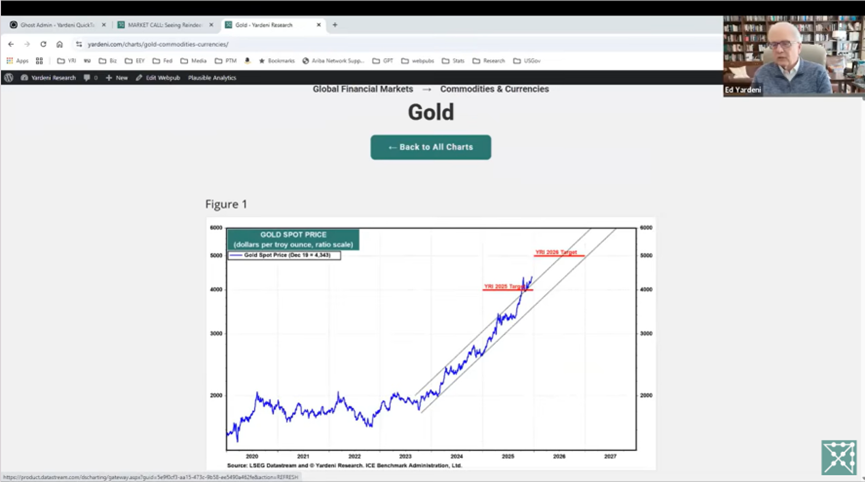
Group 1 - Ed Yardeni predicts that the S&P 500 index could reach 7,700 points by the end of 2026, with an EPS of $350 expected for 2027, and potentially challenge 10,000 points by the end of the decade [1][15][24] - Gold is projected to reach $10,000 per ounce by the end of the decade, with silver also expected to perform well due to industrial demand [1][15][32] - The focus of investment is shifting from AI technology producers to users, as companies leveraging AI to enhance productivity and profit margins are seen as the real beneficiaries [1][4][30] Group 2 - The current economic environment is characterized as the "Roaring 2020s," with expectations of continued resilience in the economy and a potential inflation rate of 2% due to productivity gains [1][9][13] - Analysts are increasingly optimistic about corporate earnings, with expectations for significant growth in the coming years, particularly in 2026 and 2027 [25][27] - The bond market is anticipated to stabilize above 4%, reflecting the ongoing fiscal stimulus and its implications for economic growth [14][13]
海内外市场协同发力 以创新筑牢增长根基
Xin Lang Cai Jing· 2025-12-25 23:05
Core Viewpoint - The automotive industry is rapidly transitioning towards electrification and intelligence, presenting both opportunities and challenges for component manufacturers like Shanghai Kaizhong Materials Technology Co., Ltd. (Kaizhong) [1] Group 1: Strategic Initiatives - Kaizhong is implementing a "domestic optimization + overseas expansion" dual-drive strategy to enhance market collaboration and overall capabilities [2] - The company is investing 308 million yuan in an expansion project at its Nantong base, which will increase annual production capacity for polyurethane damping components by 27 million units and lightweight pedal assemblies by 3.5 million units [2] - Kaizhong's international operations are progressing, with a factory in Mexico set to begin production in 2024, serving major North American clients and covering local automotive production capacity of 4.5 million units per year [2] Group 2: Growth and Innovation - Kaizhong is pursuing the acquisition of 60% of Anhui Tuosheng Automotive Parts Co., Ltd., which specializes in rubber-based damping and sealing components, aligning closely with Kaizhong's core business [3] - The acquisition is expected to create synergies in technology and customer bases, enhancing profitability and market reach [3] - Kaizhong is also developing a new line-controlled braking (EMB) business, projected to begin production in 2026, which is anticipated to be a new growth driver [3] Group 3: Technological Advancements - The company focuses on product improvement and new material applications, significantly enhancing the load capacity of damping components from 10-20 kN to 100 kN [4] - Kaizhong has integrated AI technology into its core processes, improving research efficiency and cost control, while also implementing manufacturing execution systems (MES) and warehouse management systems (WMS) to optimize operations [5] Group 4: Long-term Vision - Kaizhong emphasizes a long-term approach to market management and profitability, aiming for steady growth and consistent dividends for investors [5] - The company believes there is significant room for improvement in the safety, comfort, energy efficiency, and environmental aspects of new energy vehicles, focusing on core technological advancements rather than superficial innovations [5]

凯众股份总经理侯振坤:海内外市场协同发力 以创新筑牢增长根基
Zheng Quan Ri Bao· 2025-12-25 16:39
Core Insights - The automotive industry is rapidly transitioning towards electrification and intelligence, presenting both opportunities and challenges for component manufacturers [2] Group 1: Company Strategy - The company has adopted a "domestic optimization + overseas expansion" dual-drive strategy to enhance market collaboration and overall capabilities [3] - A 308 million yuan convertible bond is being invested in the Nantong base expansion project, which will add an annual production capacity of 27 million polyurethane damping components and 3.5 million lightweight pedal assemblies [3] - The company is implementing a "main production base + satellite factory" model, with plans to establish 2 to 3 additional factories based on business expansion [3] Group 2: International Expansion - The company's factory in Mexico is set to begin mass production in 2024, directly serving major international clients, including well-known new energy vehicle manufacturers and core customers like General Motors and Ford [3] - A factory in Morocco is scheduled to begin construction in Q1 2024, with production expected to start by the end of 2026, leveraging its geographical advantage to serve the European market [3] Group 3: Growth and Innovation - The company is pursuing the acquisition of a 60% stake in Anhui Tuosheng Automotive Parts Co., which specializes in rubber-based damping and sealing components, aligning closely with the company's core business [4] - The acquisition is expected to create synergies, enhance profitability, and broaden market and technology boundaries [5] - The company plans to launch its EMB (electromechanical brake) business by 2026, which is anticipated to become a new growth driver [5] Group 4: Technological Advancements - The company focuses on product improvement and new material applications, significantly enhancing the load capacity of damping components from 10-20 kN to 100 kN [5] - AI technology is being integrated into core processes, improving R&D efficiency and cost control [5] - The implementation of MES and WMS systems has effectively addressed inventory turnover issues, further reducing operational costs [5] Group 5: Long-term Vision - The company emphasizes a long-term approach to market management and profitability, aiming for steady growth and consistent dividends for investors [6] - The company believes there is significant room for improvement in the safety, comfort, energy efficiency, and environmental aspects of new energy vehicles [6] - The focus remains on technological fundamentals while gradually expanding into new application scenarios [6]
股指期货:企稳修复中
Guo Tai Jun An Qi Huo· 2025-12-22 00:42
1. Report's Industry Investment Rating - Not provided in the content 2. Core Viewpoints of the Report - Last week, stock index futures first declined and then rose, showing an overall volatile trend. The decline was due to the continuous fall of the US stocks at the beginning of the week under the adjustment of the AI sector, which put pressure on the risk appetite of global stock markets. The subsequent rise was driven by local hot concepts, such as the merger plan of CICC and the expectation of consumption - boosting policies for commercial department stores. The significantly lower - than - expected US CPI data also contributed to the rebound of US stocks, and the resonance of positive internal and external news pushed the market to stop falling and rebound [1]. - In the later stage, the Fed's easing expectation has re - heated up, bringing a positive impact on global risk assets. The US stock market will enter the Christmas season this week with expected lighter trading, and the domestic market will face a relatively quiet news period. If the news - driven changes are small, the market may continue its recent positive state. Some funds may start to gradually layout for 2026, improving the market capital situation. It is expected that the market will be mainly volatile and strong this week, but the upward revision of the Fed's easing expectation may not be enough to trigger a new upward offensive, and the later general trend may still be in a range - bound pattern [2]. 3. Summary by Relevant Catalogs 3.1 Market Review and Outlook - **Global Stock Index Performance**: Last week, the Dow Jones Index dropped 0.67% weekly, the S&P 500 Index rose 0.1% weekly, and the Nasdaq Index rose 0.48% weekly. In Europe, the UK FTSE 100 Index rose 2.57% weekly, the German DAX Index rose 0.42% weekly, and the French CAC40 Index rose 1.03% weekly. In the Asia - Pacific market, the Nikkei 225 Index dropped 2.61% weekly, and the Hang Seng Index dropped 1.1% weekly [9]. - **Domestic Index Performance**: Since 2025, major domestic indices have generally risen. Last week, most domestic major indices declined. The Shanghai Composite Index rose 0.03%, and the ChiNext Index dropped 2.26% [11]. - **Industry Performance**: In the CSI 300 Index, sectors such as materials and finance had gains, while information and industry sectors had losses. In the CSI 500 Index, raw materials, consumption and other sectors had gains, and the energy sector had losses [12]. 3.2 Strategy Recommendations - **Short - term Strategy**: The intraday trading frequency can refer to the 1 - minute and 5 - minute K - line charts. The stop - loss and take - profit levels of IF, IH, IC, and IM can be set at 91 points/114 points, 74 points/45 points, 179 points/251 points, 221 points/294 points respectively [4]. - **Trend Strategy**: Adopt a long - on - dips strategy. It is expected that the core operating range of the IF main contract IF2601 is between 4435 and 4663 points; the IH main contract IH2601 is between 2929 and 3064 points; the IC main contract IC2601 is between 6955 and 7422 points; the IM main contract IM2601 is between 7078 and 7555 points [4]. - **Cross - variety Strategy**: Hold the strategy of shorting IF (or IH) and going long on IC (or IM) [5]. 3.3 Index Valuation Tracking - As of December 12th, the P/E ratio (TTM) of the Shanghai Composite Index was 16.25 times, the CSI 300 Index was 13.92 times, the SSE 50 Index was 11.73 times, the CSI 500 Index was 32.74 times, and the CSI 1000 Index was 47.13 times [14][16]. 3.4 Market Capital Review - The financing balance of the two markets and the share of newly established equity - biased funds are presented in relevant figures. The capital interest rate was stable at a low level last week, and the central bank had a net injection of funds [16][17].
谷歌CEO「劈柴」亲自下场分芯片,930亿美元填不饱「算力饥荒」
3 6 Ke· 2025-12-21 23:12
Core Viewpoint - Google is facing a "compute famine" despite its vast resources and plans to invest $91 to $93 billion in capital expenditures this year, leading to internal conflicts over chip allocation among various departments [1][25][26]. Group 1: Internal Dynamics and Resource Allocation - A new executive committee has been formed to decide how to allocate limited compute resources among Google Cloud, search, and DeepMind [2][13]. - The committee includes key figures such as Google Cloud CEO Thomas Kurian and DeepMind CEO Demis Hassabis, indicating a significant power restructuring within the company [4][8][13]. - The committee aims to simplify decision-making and ensure equitable distribution of resources among departments, which previously struggled to reach consensus [32][34]. Group 2: Strategic Importance of Compute Resources - The three core lifelines for Google are future AI development, growth through Google Cloud, and sustaining its extensive product matrix [15][20][22]. - Google Cloud is seen as a major growth engine that requires substantial compute power to serve clients and maintain expansion [20]. - The need for top-tier AI models necessitates vast compute resources for continuous iteration, making it critical for Google's competitive positioning [17][18]. Group 3: Financial Implications and Challenges - Despite plans for significant capital expenditure, the long lead times for building data centers and manufacturing chips mean that immediate relief from the compute shortage is unlikely [27][28]. - Google’s capital expenditure in 2023 was only $32 billion, which is considered conservative given the AI boom, contributing to the current compute challenges [29][30]. - CFO Anat Ashkenazi acknowledged that supply-demand imbalances are expected to persist into 2026, indicating ongoing challenges for the company [31]. Group 4: Execution-Level Dynamics - At the execution level, the focus shifts to immediate revenue generation, leading to prioritization of departments that can deliver the most profit [48]. - In DeepMind, resource allocation is complex, with some researchers enjoying privileges that allow them to access multiple compute pools, while others must navigate a more competitive environment [50][54]. - The grassroots level sees a culture of resource sharing and negotiation among researchers, turning compute power into a "hard currency" that relies on personal relationships and exchanges [57][59].


Morgan Stanley's Michael Zezas on policy catalysts to watch in 2026
Youtube· 2025-12-19 18:35
Core Insights - The markets have weathered significant policy changes in 2025, and while there are catalysts to watch in 2026, the major policy decisions have largely been made [2][4] - Economic actors' responses to existing policies will be more influential than new policy choices in 2026, with AI capital expenditures expected to contribute 20-25% to growth [3][4] - The Supreme Court's decisions on tariffs and Fed independence could impact fixed income markets, but existing executive authority may maintain policy continuity regardless of midterm election outcomes [6][7][8] Policy and Economic Outlook - Tariffs are currently four to five times higher than previous levels, and tax incentives from recent legislation are expected to positively influence corporate earnings and equity markets [2][4] - The potential for a Supreme Court ruling on tariff authority may lead the White House to seek alternative measures, suggesting limited changes in policy impact [6] - The ongoing tension between federal and local regulations regarding AI development is a critical theme, with expectations of approximately $3 trillion in capital expenditures over the next few years, including $1.5 trillion in debt financing [10][11]

Labor market is telling us we should continue cutting rates, says Fed Governor Chris Waller
Youtube· 2025-12-17 14:02
Labor Market Analysis - The unemployment rate has increased to 4.6%, indicating a softening labor market with job growth returning in November after losses in October [1] - Recent job numbers have been revised down significantly, suggesting an average job growth of only 50,000 to 60,000 in the last couple of months, which may be further adjusted down by another 50,000 to 60,000 jobs [3][4] - The current state of the labor market is close to zero job growth, which is not considered healthy [4] Future Projections - There is an expectation for improvement in the labor market by 2026, driven by the resolution of tariff uncertainties and the impact of recent rate cuts [4] - The potential influence of AI on productivity and job dynamics remains uncertain, with companies hesitant to hire until they understand the implications of AI on their workforce [5][7] Inflation and Monetary Policy - Inflation is currently above target but is expected to decrease in the next three to four months, with inflation expectations remaining anchored around 2% [6] - The central bank's strategy includes continued rate cuts to support the labor market, as there are no indications of a resurgence in inflation [11][12] - The approach to rate cuts is described as moderate, with no need for dramatic actions unless the labor market deteriorates significantly [12]

【首席观察】全球流动性变奏
Sou Hu Cai Jing· 2025-12-17 11:02
Core Viewpoint - The market is reassessing the value of "time" as the era of "free" yen and "abundant" dollars comes to an end, leading to a potential revaluation of risk premiums based on current cash flows and valuation safety nets [2][15]. Group 1: Market Dynamics - On December 15, a "global liquidity variation" was observed, with mixed signals: U.S. Treasury yields fell and the dollar weakened, indicating a marginal easing of liquidity, while the yen strengthened and risk appetite contracted [3][4]. - Despite a decline in major U.S. stock indices, certain sectors like consumer ETFs showed resilience, suggesting a shift in market dynamics towards undervalued areas such as value stocks and small-cap stocks [4][5]. - The market is experiencing a transition where investors are less willing to pay high premiums for distant narratives, focusing instead on current cash flows and valuation safety [5][20]. Group 2: Central Bank Policies - The Federal Reserve's recent decision to lower interest rates by 25 basis points signals a shift in monetary policy, with an emphasis on maintaining liquidity through short-term Treasury purchases [6][8]. - The Fed's actions are not traditional quantitative easing but are aimed at ensuring sufficient liquidity in the banking system, indicating a complex approach to managing interest rates and market expectations [7][10]. - The Bank of Japan is expected to continue its normalization process, with market anticipation of further interest rate hikes, which could impact yen financing costs and exchange rate volatility [10][13]. Group 3: Risk Assessment - The potential for a stronger yen could lead to a chain reaction affecting global risk assets, prompting a shift from high-leverage, high-volatility investments to more stable cash flow assets [14][19]. - The current environment suggests that while liquidity remains, the cost of "time" has increased, leading to a re-evaluation of risk premiums across various asset classes [15][22]. - Investors are advised to focus on quality earnings, risk control, and opportunities in the Chinese market, rather than blindly chasing high beta assets [22].

自由软件之父怒喷 ChatGPT 是“胡扯生成器”
程序员的那些事· 2025-12-17 01:03
转自:CSDN(ID:CSDNnews) 对于 AI 工具,有人爱,也有人讨厌。 近日,自由软件之父 Richard Stallman( 理查德·斯托曼 ) 在个人网站上发表一篇《不使用 ChatGPT 的理由》的文章,直言现在的 AI 工具并非真 正的智能,它们根本不理解自己生成内容的意义。他甚至将 ChatGPT 称为" 胡扯生成器 ",理由是它生成的内容"对真相毫不在意"。 值得一提的是,Richard Stallman 是 GNU 计划与自由软件基金会(FSF)的创始人。他在 1980 年代发起 GNU 项目,旨在构建一个完全自由的操 作系统,并推动软件应当被自由使用、研究、修改和再发布的理念。他最广为人知的贡献包括 Emacs 编辑器、GNU 编译器套件(GCC)等基础工 具,以及对 GPL 等自由软件许可证的设计和推广。 他发表的言论,也引发了不小的争议。 ChatGPT 并非真正的智能? ChatGPT 并不是"智能",所以请不要称它为"AI"。 我对"智能"的定义是能够认识或理解事物,至少在某个领域内应如此。而 ChatGPT 无法认识或理解任何事物,所以它不是智能。它并不知道自己的输 出意味 ...