
好房子

Search documents
克拉玛依区举办拟出让土地推介会
Sou Hu Cai Jing· 2025-07-07 05:52
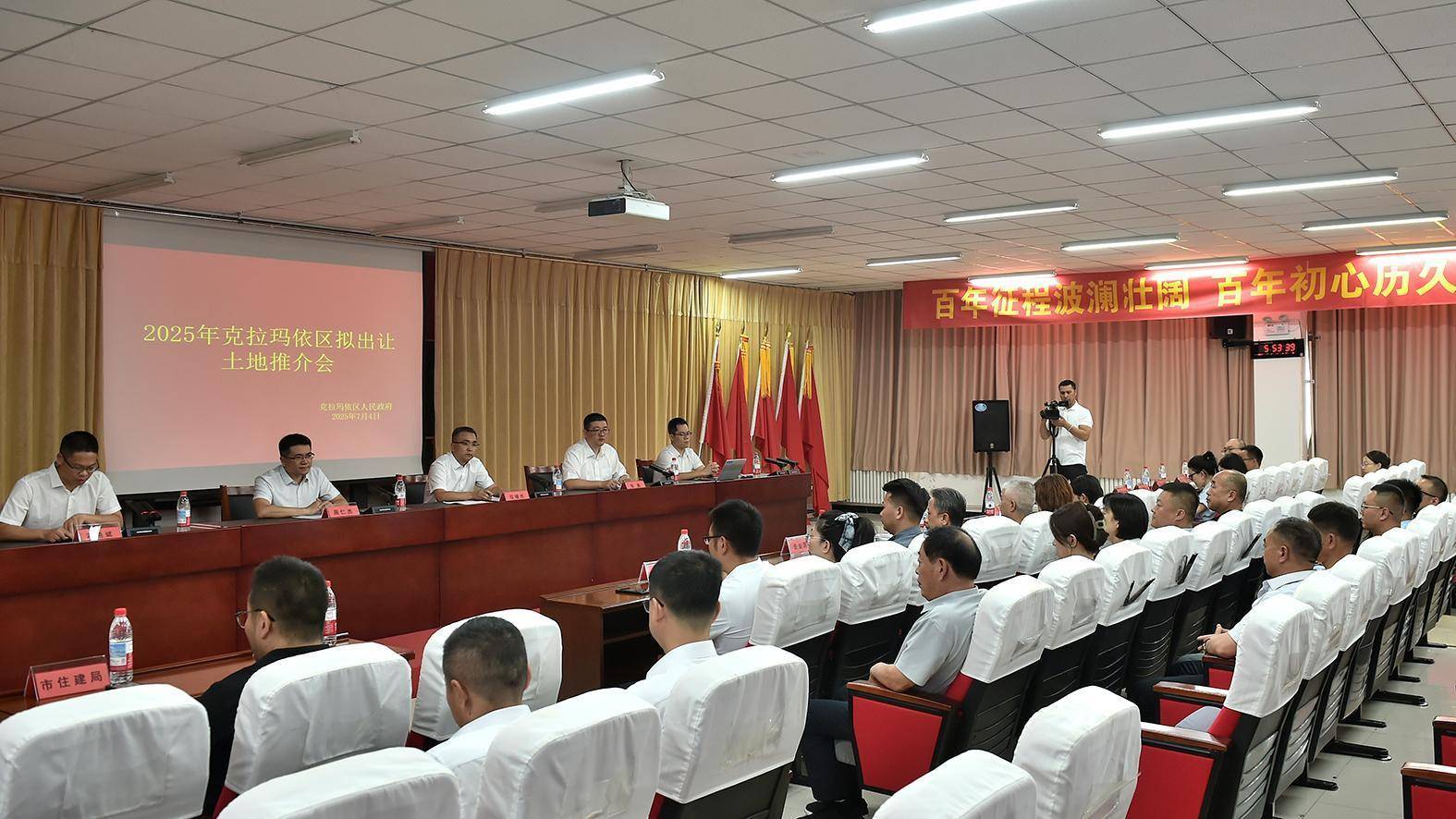
Core Insights - The Karamay District held a land promotion conference on July 4, 2025, to enhance the rational allocation of land resources and optimize the land market transfer mechanism, aiming to promote stable development in the local real estate market [2][3] Group 1: Land Promotion Conference - The conference introduced six residential land parcels with a total area of 37.2 hectares, attracting over ten real estate companies and trade representatives from within and outside the region [2] - The local housing and urban-rural development bureau reported significant achievements in implementing national real estate regulation policies, focusing on digesting existing stock and optimizing new supply [2][3] - The government highlighted the investment value of the six residential land parcels, emphasizing their regional advantages, development plans, industrial layout, and surrounding facilities [2] Group 2: Land Development and Market Trends - The six residential land parcels are characterized by developed transportation networks, mature commercial circles, abundant educational and medical resources, pleasant living environments, and complete public facilities, indicating potential for appreciation [2][3] - The city is exploring a new land transfer model called "transfer with a plan," which aims to pre-compile land planning design schemes before land transfer, optimizing policies to support higher building density and enhancing public space [3] - Real estate transaction areas in Karamay District were 45.62 hectares in 2022, 7.31 hectares in 2023, and 17.61 hectares in 2024, with stable and slightly increasing property sales prices, indicating a reasonable inventory digestion cycle [3] Group 3: Market Confidence and Future Prospects - Representatives from participating companies expressed strong confidence in the future development of the Karamay District real estate market, showing keen interest in the proposed land parcels and indicating plans to actively participate in bidding [3] - The conference was organized by the Karamay District People's Government, with collaboration from the local natural resources bureau and participation from various real estate companies [4]

地产股逆势走强,房地产ETF基金、房地产ETF、地产ETF均涨超1%
Ge Long Hui A P P· 2025-07-07 03:54
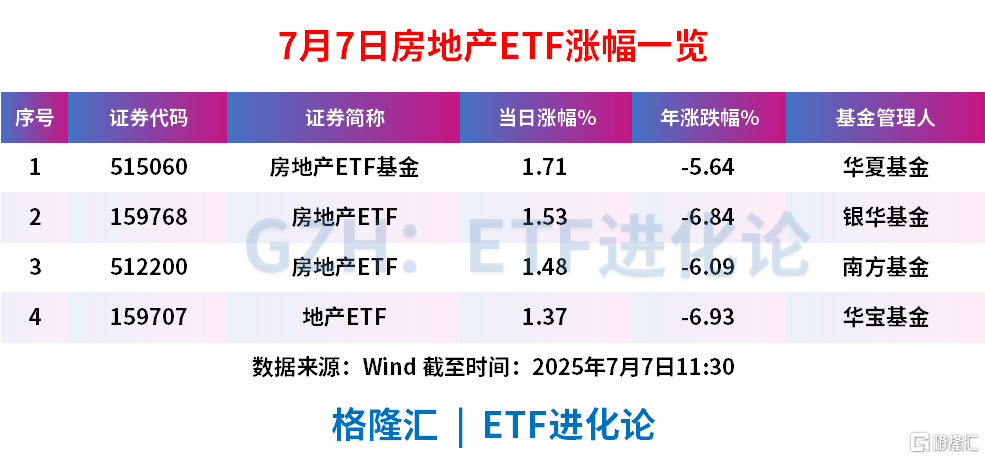
Group 1 - The A-share market saw a rise in real estate stocks, with companies like Yukaifa, Shahe Shares, Caixin Development, and *ST Nanzhi hitting the daily limit, while others like Shilianhang, Shen Property A, Guangyu Group, and China Merchants Shekou also experienced gains [1][5] - Real estate ETFs from various fund managers showed positive performance, with gains of 1.71% for Huaxia Fund, 1.53% for Yinhua Fund, 1.48% for Southern Fund, and 1.37% for Huabao Fund [1][3] - The real estate sector has seen a cumulative decline of 5.6% year-to-date, ranking third among 31 primary industries in A-shares [6][7] Group 2 - The Economic Daily emphasized the need to strengthen support for "good housing" projects and increase the supply of quality land, while encouraging collaborative development and innovation in construction [5] - A recent survey by the Ministry of Housing and Urban-Rural Development highlighted the importance of promoting stable and healthy development in the real estate market, urging local authorities to effectively utilize regulatory policies [5] - The State Council meeting on June 13 pointed out the significance of establishing a new model for real estate development, focusing on long-term stability and systematic policy implementation [5][6] Group 3 - The real estate market has been experiencing a continuous decline in housing prices since Q4 of last year, with May data showing a month-on-month decrease of 0.22% and a year-on-year decrease of 4.08% in new residential prices across 70 cities [6] - The total transaction volume of second-hand homes has also seen a significant drop since April, indicating a need for stimulus policies in the real estate sector [6] - The largest real estate ETF is the Southern Fund Real Estate ETF, with a latest scale of 6.193 billion, followed by Huaxia and Yinhua ETFs at 630 million each, and Huabao ETF at 481 million [9]



专题 | 重点城市住宅新规对产品的影响和效果
克而瑞地产研究· 2025-07-06 01:15
Group 1 - The core concept of "Good Housing" has been introduced by the government to meet the rising demand for high-quality living spaces, shifting the focus from mere availability to quality [2][3] - The "Good Housing" standard was officially implemented on May 1, 2025, marking a transition from policy advocacy to a binding national standard [3][4] - Various provinces and cities have introduced policies to optimize building design standards for new residential projects, enhancing the usable area and product quality [2][5] Group 2 - Major cities like Guangzhou, Shenzhen, and Beijing have implemented new regulations to support high-quality housing, with Guangzhou being the first to release its guidelines in November 2023 [5][6] - The new regulations have led to significant improvements in residential quality, with changes such as relaxed restrictions on balcony and window areas, encouraging the inclusion of sky gardens and duplex designs [8][9] - The sales performance of new regulation-compliant products has generally outperformed older products, indicating a positive market response [9][10] Group 3 - In Beijing, the new policies have particularly benefited small and medium-sized units, with the usable area rate exceeding 90% [10][11] - Guangzhou has seen over 70 new regulation-compliant products launched, primarily focusing on improved four-bedroom units [16][17] - In Shenzhen, while the new regulations have relaxed certain design restrictions, the advantages in sales performance are relatively limited compared to other cities [22][23] Group 4 - Chengdu has focused on innovative living scenarios with new four-bedroom units, showing significantly better sales than surrounding older products [28][33] - Nanjing has officially entered the "fourth-generation housing" era, with innovative designs like duplex living rooms becoming prominent [37] - Chongqing has gradually relaxed restrictions on fourth-generation housing, allowing for diverse product innovations [49][50] Group 5 - The new regulations have led to a trend of high utility rates in new products, with some achieving over 130% [18][46] - However, challenges have emerged, including potential regulatory tightening in response to the high gift area ratios of new products, which may affect the sales of older products [51][52] - The focus of housing upgrades is shifting from merely increasing usable area to enhancing living scenarios, technological integration, and service improvements [53]

2025上半年中国房地产企业品牌传播力TOP50排行榜
克而瑞地产研究· 2025-07-06 01:15
Core Viewpoints - The concept of "Good House" has become the core guiding principle for brand communication among real estate companies in the first half of 2025, with firms focusing on product, marketing, and community engagement to enhance brand recognition and influence [1][3]. Group 1: Product Development - Real estate companies are innovating in product creation. For instance, Jianfa Real Estate utilizes a "culture-value-strategy-technology" framework to build a new Chinese-style product system, highlighting craftsmanship through four major product series [1]. - China Overseas Land & Investment has launched the Living OS system, which includes 16 product systems to meet 172 customer needs, promoting an image of "comprehensive service" [1]. - Xiangyu Real Estate's "Lifetime Home" brand aligns with specific spiritual values and high-end product lines to meet customer demands [1]. Group 2: Marketing Innovation - Real estate firms are leveraging AI and new media to break through communication limitations. Poly Development initiated the "Starry Sky Plan - Star Sea Alliance," aggregating numerous online influencers and fans for an upgraded marketing strategy [1]. - Huafa Group's "Home with AI Understands You Better" campaign attracted significant user participation through immersive experiences, achieving both sales conversion and brand exposure [1]. - Deep Industry Group's "May AI Purchase Festival" integrated AI robots into various scenarios to enhance brand innovation [1]. Group 3: Community Engagement - Community operations are crucial for implementing brand values. Greentown China expanded its community through the "Hundred Flowers Neighborhood Festival," enhancing homeowner belonging [1]. - China Resources Land combined sports and ESG concepts in its activities to shape a responsible real estate image [1]. - China Merchants Shekou's "24-Hour Global Spring Viewing Live Broadcast" broke regional limitations to convey brand positioning [1]. Group 4: Brand Communication Rankings - In the brand communication power rankings for the first half of 2025, Greentown China, Poly Development, and China Resources Land ranked in the top three due to their comprehensive advantages, followed closely by China Overseas Land & Investment and China Merchants Shekou, showcasing strong brand competitiveness [2].




6月量价齐升!“好房子”刺激改善需求,郑州楼市上半年整体向好
Sou Hu Cai Jing· 2025-07-05 19:50
Core Viewpoint - The Chinese government is intensifying efforts to stabilize the real estate market, with a focus on transitioning from a supply-driven model to one that prioritizes resident demand, emphasizing the construction of "good houses" as a key strategy for this shift [1][14]. Group 1: Market Performance - In June, Zhengzhou's total commercial housing sales reached 823,900 square meters, with an average selling price of 10,977 yuan per square meter, both showing year-on-year increases, indicating a rise in both volume and price [1]. - For the first half of the year, Zhengzhou's average commercial housing price was 10,659 yuan per square meter, reflecting a year-on-year growth of 1.42%, suggesting that new home prices have begun to stabilize [2]. - The launch of quality housing projects in June has energized the market, contributing to the upward trend in sales and prices [2][4]. Group 2: Project Highlights - The招商蛇口 project in Zhengzhou has successfully launched 212 units, achieving a sales rate of 92% with a total sales volume of approximately 510 million yuan [4]. - The中海峯境叁號院 project released 132 units, with 87 units sold by the end of June, generating around 500 million yuan in sales [5][7]. - The电建高新华曦府 project has seen significant interest, attracting over 1,500 visitors in just three days after opening its model units [9][11]. Group 3: Future Outlook - The introduction of "good houses" is expected to continue driving new home sales positively in the second half of the year, with several key projects set to enter the market [9][14]. - The concept of "good houses" is not only aimed at boosting short-term market transactions but also serves as a catalyst for the industry to shift from scale expansion to quality competition, which is crucial for restoring market confidence and stimulating demand [14].
绿城中国上半年销售额达1221亿元 投资注重“做一成一”
Zheng Quan Ri Bao· 2025-07-04 07:44
Core Insights - Greentown China Holdings Limited achieved a sales revenue of 122.1 billion yuan, ranking second in the industry for the first half of 2025, demonstrating resilience during the real estate industry's adjustment cycle [2] - The company has established a rigorous investment logic and systematic support, focusing on core cities and lower-tier markets, providing a model for "precise investment-driven high-quality development" [2] Investment Strategy - Greentown China adheres to a "one project, one investment" requirement and a differentiated investment strategy, focusing on core cities and targeting investment opportunities in cities with potential [3] - In 2024, Greentown China launched 42 new projects with a total construction area of approximately 4.18 million square meters and a new value of 108.8 billion yuan, with 92% of the value concentrated in first and second-tier cities [3] - The company has successfully penetrated high-end markets in cities like Suzhou, Shanghai, and Nanjing, achieving significant sales and market share [3][4] Market Coverage - Greentown China has achieved "almost full coverage" in strong third and fourth-tier cities in Zhejiang, capturing 50% of the new housing market share in certain areas [4] - The company believes that even in limited-capacity markets, acquiring scarce land with healthy supply and demand can lead to benchmark projects [4] Product Quality and Innovation - The investment strategy prioritizes project safety, considering factors such as land quality, competition, and the potential for product development [5] - Greentown China has established the "Greentown Good House Standard," which includes 226 clauses, with 189 exceeding national and industry standards, ensuring high-quality project delivery [5] - The company emphasizes continuous innovation driven by customer feedback, addressing pain points to enhance product offerings [6] Strategic Resilience - Greentown China's strategic focus on "precise investment" and "one project, one investment" reflects its strong resilience and development potential amid industry challenges [6] - The company's unique strategic path serves as a reference model for the industry in the new development phase characterized by inventory competition and quality supremacy [6]
《家居人造板材健康消费指南》发布:助力实现安全、健康的“好房子”
Zhong Guo Xin Wen Wang· 2025-07-03 16:13
Group 1 - The core concern for consumers regarding home decoration is formaldehyde pollution, with man-made boards being a major contributor to excessive formaldehyde levels [1] - The release of formaldehyde and volatile organic compounds from board materials directly impacts indoor air quality and human health, highlighting the need for clearer standards and certifications in the market [1] - The China National Forestry and Grassland Administration has established a comprehensive system for formaldehyde release limits, with standards such as E1, E0, and ENF, positioning China as a global leader in this area [1] Group 2 - The industry is evolving towards "low formaldehyde" and "formaldehyde-free" products in response to increasing consumer demand for environmental performance and the "Healthy China" strategy [2] - The revised group standard T/CNFPIA3002-2024 sets the formaldehyde release limit to ≤0.020mg/m³ and mandates a formaldehyde-free production process, indicating a shift from merely testing results to controlling production processes [2] - The "Guide" clarifies that "formaldehyde-free grade" and "formaldehyde-free man-made boards" are not synonymous, with the latter representing a stricter definition focused on the absence of formaldehyde adhesives during production [2] Group 3 - The concept of "good houses" was introduced in the government work report, emphasizing safety as a primary standard, which the association aims to promote through the "Guide" [3] - The release of the "Guide" is seen as a rallying call for the home industry to adopt and implement Chinese standards confidently, moving beyond mere adherence to imported standards [3] - True environmental protection is defined as a comprehensive process rather than just a simple testing result, advocating for a systematic solution that ensures no formaldehyde is added throughout production [3]
《家居人造板材健康消费指南》发布,中国标准定义健康家居未来
Sou Hu Cai Jing· 2025-07-03 07:27
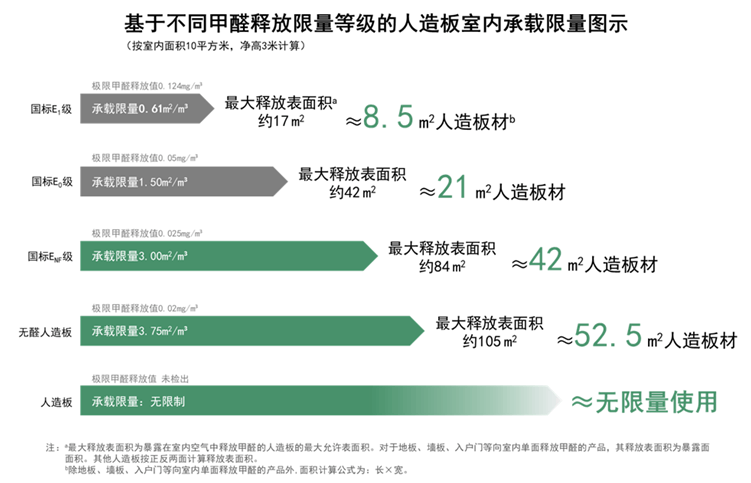
Core Viewpoint - The release of the "Home Artificial Board Health Consumption Guide" aims to enhance consumer understanding of artificial boards, promote healthier living environments, and stimulate the green upgrade of the home furnishing industry [2][3][4]. Group 1: Guide Overview - The guide consists of four main modules: quick entry into artificial boards, comparison of formaldehyde release standards, consumer purchasing strategies, and decoding sales pitches [1]. - It systematically compares domestic and international formaldehyde release standards, showcasing China's leading position in strictness and technical completeness [1][8]. - The guide transforms abstract safety limits into practical answers regarding how much board material can be used in a room, making safety tangible and calculable [1][3]. Group 2: Consumer Empowerment - The guide addresses the confusion consumers face due to diverse standards and complex certification labels, providing a scientific basis for purchasing decisions to protect home health [2][4]. - It aims to shift consumers from passive information reception to active, rational decision-making, fostering a scientific and rational consumption perspective [4]. - By clarifying environmental standards and providing purchasing guidance, the guide helps consumers navigate marketing complexities and promotes informed consumption [4][5]. Group 3: Industry Impact - The home furnishing industry is seen as a key area for expanding domestic demand, with policies encouraging green upgrades and the release of consumption potential [5]. - Nearly 70% of consumers prioritize environmental considerations, prompting companies to accelerate technological innovation [5]. - The guide highlights the distinction between "formaldehyde-free grade" and "formaldehyde-free artificial boards," emphasizing the latter's stricter definition and production process [5][6]. Group 4: Standards Development - China's journey in formaldehyde release standards has evolved from following to leading, with the latest standards establishing the strictest limits globally [8][10]. - The guide illustrates China's advanced position in controlling formaldehyde release, with standards surpassing those of Japan and the EU [8][10]. - A collaborative standard system has been established in China, integrating mandatory national standards, recommended standards, group standards, and enterprise standards to support various application scenarios [8][10]. Group 5: National Confidence and Innovation - The development of China's standards reflects a transition from a "manufacturing power" to a "quality power," showcasing national confidence and innovation [10]. - This confidence is rooted in a solid industrial foundation, a comprehensive innovation system, and a strong human-centered philosophy that prioritizes public health [10]. - The combination of "hard power" and "soft power" is expected to position "Chinese standards" as a reliable international benchmark, contributing to global sustainable development [10].
申万宏源证券晨会报告-20250703
Shenwan Hongyuan Securities· 2025-07-03 00:41
Group 1: Real Estate Sector Insights - The report emphasizes a short-term focus on stabilizing the real estate market, with expectations for new supportive policies such as mortgage rate cuts and increased housing supply [2][9] - The "Good House" policy is highlighted as a key driver for residential consumption and the transformation of real estate companies towards manufacturing [9][10] - The report identifies strong product capability and inventory management as critical factors for real estate companies to succeed in the evolving market [9][10] Group 2: Photovoltaic Industry Analysis - The photovoltaic sector is currently at multiple bottoms, with expectations for a rebound driven by price recovery and improved institutional holdings [3][11] - Recent government meetings have called for the regulation of low-price competition in the photovoltaic industry, indicating a shift towards supply-side reforms [11][12] - The report suggests that companies in the silicon material sector, such as Tongwei Co., Daqo New Energy, and GCL-Poly Energy, are likely to benefit the most from these reforms [11][12] Group 3: General Market Trends - The report notes that the overall market has seen fluctuations in major indices, with the Shanghai Composite Index closing at 3455 points, reflecting a slight decline of 0.09% [1] - Various industry performances are highlighted, with the fishing industry showing a significant increase of 12.06% in the last day, while the ground equipment sector experienced a notable decline of 5.38% [1]
努力让人民住上更好的房子(深入学习贯彻习近平新时代中国特色社会主义思想·学习《习近平经济文选》第一卷专家谈)
Ren Min Ri Bao· 2025-07-03 00:31
Core Viewpoint - The housing issue is both a livelihood and development problem, closely related to the interests of families, social stability, and economic development, emphasizing the importance of addressing housing needs in the context of China's modernization [1][2][3]. Group 1: People's Centered Development - The concept of "housing for living, not for speculation" is central to the housing development strategy, aiming to meet the diverse housing needs of the population [2][4]. - The focus on improving housing quality reflects a shift from quantity to quality in housing development, aligning with the people's expectations for better living conditions [5][9]. Group 2: Achievements in Housing Development - By the end of 2023, the average housing area per urban resident in China exceeded 40 square meters, an increase of over 10 square meters since 2010, with more than 64 million units of affordable and resettlement housing built, benefiting over 150 million people [8]. - The government has initiated urban renewal projects, with nearly 280,000 old urban communities renovated, improving living conditions for 120 million residents [8]. Group 3: Long-term Housing Challenges - The transition from large-scale construction to quality improvement and optimization of existing housing stock is necessary, addressing issues such as insufficient affordable housing and the need for better housing quality to meet family lifecycle demands [9][10]. - The establishment of a rental and purchase housing system is crucial for addressing the evolving housing market dynamics and ensuring stable development [9][10]. Group 4: Technological and Institutional Support - The development of "good housing" requires technological innovation and institutional support, focusing on upgrading old housing and ensuring new constructions meet high standards [11][12]. - Policies must be adapted to support the transformation of housing into a more sustainable and livable environment, integrating various public resources [12][13]. Group 5: Green Housing Initiatives - Promoting green housing construction is essential for enhancing people's well-being and achieving carbon reduction goals, necessitating updates in planning, design, construction, and operation [13][14]. Group 6: Housing Equity and Accessibility - Improving the housing security and supply system is vital for meeting the basic housing needs of the population, particularly for low-income groups and new urban residents [14][15]. - The housing policy should ensure equitable access to housing resources, addressing the needs of various demographic groups [14][15]. Group 7: International Experience and Collaboration - Learning from international housing development practices can enhance China's housing strategies, integrating advanced construction concepts and technologies [15].