大数据

Search documents
全域数据+AI分析 楼宇进化为“智慧生命体”
Zhong Guo Jing Ying Bao· 2026-01-23 07:41
Core Insights - Hitachi Elevators aims to evolve from an "equipment supplier" to a "city service provider" by integrating cutting-edge technologies like AI into its services, contributing to the development of smart cities globally [1] Group 1: AI Integration and Safety Features - Hitachi has launched a new generation of smart elevators, NCA, which incorporates five core technologies, enhancing user experience and safety while increasing peak transport capacity by 50% and reducing average waiting time by 22% [1] - An AI camera developed by Hitachi ensures passenger safety by keeping the elevator doors open when it detects someone approaching, and a remote monitoring system allows for preventive maintenance based on data analysis [2] Group 2: Smart Building Solutions - The "14th Five-Year Plan" emphasizes the construction of safe, comfortable, green, and smart buildings, marking a shift towards quality improvement in housing [3] - Hitachi's comprehensive smart building solution, "HMAX for Building," integrates data access and deep AI analysis, transforming buildings into "smart living entities" and enhancing operational efficiency through various modules [3] Group 3: Future Expansion and Collaboration - Hitachi plans to leverage the "Belt and Road" initiative to expand its smart building solutions internationally, collaborating with Chinese partners and utilizing the global network of the Hitachi Group [4]
美企竞逐卫星互联网,太空新赛道博弈升温
Xin Lang Cai Jing· 2026-01-23 06:33
Core Insights - The competition for near-Earth orbital resources is intensifying, with U.S. companies significantly increasing their investments in satellite internet infrastructure [1][2] - Blue Origin has announced its "TeraWave" project, which aims to provide high-speed data connectivity for enterprise users through a multi-orbit satellite network [1][3] Company Developments - Blue Origin's "TeraWave" will consist of 5,408 satellites, including 5,280 low Earth orbit satellites and 128 medium Earth orbit satellites, offering data speeds of up to 6 terabits per second [1][3] - SpaceX's "Starlink" project has over 9,000 satellites in orbit and serves more than 9 million users, focusing on the mass market and underserved areas [3] - Amazon's "Low Earth Orbit Satellite Plan" plans to deploy over 3,000 satellites, targeting enterprise clients and government agencies [3] Industry Trends - Satellite internet is emerging as a crucial supplement to traditional ground-based communication networks, especially in areas with challenging geographical conditions [2][5] - The global market for satellite internet is expanding, driven by the need for better connectivity in underserved regions, with approximately 2.6 billion people lacking adequate internet access [5] Competitive Landscape - Various U.S. companies are entering the satellite internet space, each with distinct user targets and technological approaches, leading to a diverse competitive environment [3][4] - Companies like AST SpaceMobile are developing satellite networks that connect directly to smartphones, aiming to provide 4G and 5G coverage in remote areas [4] Opportunities and Challenges - The satellite internet sector offers significant market potential due to its global coverage capabilities and redundancy advantages over traditional networks [5] - The competition for orbital positions and spectrum resources is becoming a critical factor in the development of space infrastructure, with challenges related to orbital congestion and space debris management [5]

综述|美企竞逐卫星互联网 太空新赛道博弈升温
Xin Hua She· 2026-01-23 06:04
Core Viewpoint - The competition for satellite internet among U.S. companies is intensifying, with multiple firms launching projects aimed at providing high-speed internet services through satellite networks, marking a shift from conceptual exploration to large-scale competition in space communication [1][2]. Group 1: Company Initiatives - Blue Origin announced its satellite internet project "TeraWave," which aims to provide up to 6 terabits per second of symmetrical data connectivity through a network of 5,408 satellites, including 5,280 low Earth orbit satellites and 128 medium Earth orbit satellites, targeting enterprise, data center, and government users [1][2]. - SpaceX's "Starlink" project has over 9,000 satellites in orbit and serves more than 9 million users, focusing on the mass market and small institutions, particularly in remote areas and emergency communication scenarios [2][3]. - Amazon's "Low Earth Orbit Satellite Plan" plans to deploy over 3,000 low Earth orbit satellites, primarily targeting enterprise customers, government agencies, and remote communities, with a more measured rollout [2][3]. Group 2: Market Dynamics - The satellite internet sector is characterized by varying technical paths and strategic focuses among U.S. companies, with some emphasizing high throughput and redundancy for enterprise users, while others target broader consumer markets [3]. - The global market for satellite internet is expanding due to the limitations of traditional ground-based networks, with approximately 2.6 billion people lacking adequate internet access, particularly in rural and low-income areas [3][4]. - The competition for orbital positions and frequency resources is becoming a critical factor in the future of space infrastructure, with the rapid increase in satellite numbers leading to concerns about orbital congestion and space debris [4].
从健身服务到器械全保护,Keep三大类别商标纳入《北京重点商标保护名录》
Jin Rong Jie· 2026-01-23 04:53
Core Insights - Keep has been recognized for its comprehensive brand protection by being included in the "Beijing Key Trademark Protection Directory" across three categories: fitness services, application software, and smart hardware [1][2] Group 1: Trademark Recognition - The inclusion of Keep's trademarks in the directory signifies the company's high market visibility and brand value in the fitness technology sector [1] - The directory aims to protect registered trademarks that hold significant market leadership and social influence [1] Group 2: Company Achievements - Keep's recognition reflects its long-term investment in fitness services, technological innovation, and product development [2] - The company has received multiple accolades, including being named one of the "Top Ten Copyright Holders" by the China Copyright Protection Center in 2021 and recognized as a "2023 Intellectual Property Advantage Unit" by the Beijing Intellectual Property Bureau [2] Group 3: Business Model and Offerings - Keep App, launched in 2015, focuses on providing professional fitness guidance and a variety of online courses, including yoga and training sessions [2] - The company offers a one-stop sports solution that combines software and hardware, including smart exercise bikes and treadmills, as well as health food products [2] Group 4: Future Strategy - Keep aims to enhance its strategic layout by improving course professionalism and diversity, increasing investment in smart hardware R&D, and utilizing AI and big data for personalized fitness solutions [3] - The company has set a ten-year vision to become a platform for one billion athletes, emphasizing its commitment to promoting fitness and expanding its global presence [3]
科技赋能实体经济,银联商务连续六年荣登毕马威金融科技企业双50榜单
Sou Hu Cai Jing· 2026-01-23 04:13
Core Insights - KPMG China has officially released the "2025 KPMG Financial Technology Double 50" list, recognizing UnionPay Business for its outstanding performance in payment technology innovation and industry digitalization for the sixth consecutive year [1][3] Group 1: KPMG Financial Technology Double 50 - The KPMG Financial Technology Double 50 selection has been held for ten years, known for its rigorous standards and professional industry insights, making it a key window for understanding financial technology trends [3] - The current list continues the "Double 50" structure, covering ten core sectors including comprehensive financial technology, inclusive technology, and payment technology, reflecting the latest advancements in China's financial technology industry [3] Group 2: UnionPay Business's Achievements - UnionPay Business has consistently ranked in the payment technology sector for six years, demonstrating its strong competitiveness and resilience in the payment industry [3] - The company plays a leading role in serving the real economy and promoting industrial digital transformation through its technological capabilities [3] Group 3: Technological Innovations - Financial technology is entering a deep transformation phase characterized by "digital intelligence," with the collaborative application of AI, big data, and blockchain becoming mainstream trends [3] - UnionPay Business has focused on payment as its core business for over 23 years, innovating around "payment + technology" and applying cutting-edge technologies to enhance operational management [3] Group 4: AI Integration - In the realm of AI technology innovation, UnionPay Business has integrated AI large model technology into various industry scenarios, creating replicable digital solutions [4] - The company has launched six products, including "TianGong" intelligent Q&A assistant and "TianMa" AI programming platform, which are widely used in contract review, intelligent customer service, and system quality assurance [4] Group 5: Consumer Promotion and Economic Growth - UnionPay Business actively explores the advantages of its various products and platforms to provide unique "old-for-new" comprehensive solutions for local governments, aligning with national policies to promote consumption and stabilize growth [5] - The application of AI and RPA technologies has significantly improved the efficiency of material review and response times during promotional activities, enhancing the overall effectiveness of subsidy material audits [5] Group 6: Future Outlook - Digital finance is a core engine driving technological innovation and empowering high-quality industrial development, serving as a key tool for financial services to the real economy [5] - UnionPay Business aims to continue deepening its focus on digital finance, addressing core needs of merchants and consumers, and providing convenient, secure, and efficient comprehensive payment and information services [5]


代表委员风采 孙彩宏:技能有舞台 技工有奔头
Liao Ning Ri Bao· 2026-01-23 01:01
Core Insights - The coal mining industry is undergoing significant transformation with the integration of intelligent technology, enhancing both efficiency and safety in operations [1][2] - There is a growing demand for skilled labor as the workforce transitions from traditional roles to more technical positions, highlighting the need for continuous skill development [2] Group 1: Industry Transformation - The recent upgrades in mining equipment have led to substantial improvements in operational efficiency and safety [1] - The application of new technologies such as remote control and automated inspections has significantly increased both production capacity and safety standards in coal mines [1] Group 2: Workforce Development - There is a notable shift in the skill requirements for coal miners, with an emphasis on technical knowledge and professional growth [2] - A dual growth atmosphere is emerging where younger workers learn from experienced mentors, fostering innovation and enhancing team cohesion [2] - The adaptation period for young workers transitioning from education to the workforce is lengthy, with a digital skills gap identified as a major barrier [2] Group 3: Policy Recommendations - Suggestions are being made to improve training policies for young workers, including the establishment of training bases in collaboration with educational institutions [2] - Implementing order-based training programs in vocational schools is proposed to ensure students acquire necessary skills before entering the workforce, thereby increasing employment rates and attracting investment [2]
中经评论:16年规模第一,中国制造当更强
Jing Ji Ri Bao· 2026-01-23 00:09
Core Viewpoint - China's manufacturing sector is expected to maintain its position as the world's largest for 16 consecutive years, with a complete industrial system and a focus on high-end, intelligent, and green transformation [1][2][3] Group 1: Manufacturing Scale - China's manufacturing value added has been the highest globally since 2010, currently accounting for nearly 30% of global manufacturing, making it a key driver of global manufacturing growth [1] - Among 504 major industrial products worldwide, China leads in the production of most, including basic materials like steel and cement, as well as high-end equipment like industrial robots and electric vehicles [1] Group 2: Industrial System Completeness - China is the only country with a complete industrial classification covering all industrial categories, ensuring a stable and efficient production chain that can quickly respond to diverse global market demands [2] Group 3: High-end Manufacturing - High-end manufacturing is crucial for addressing weaknesses in core technologies and enhancing the quality and technical level of Chinese manufacturing, with significant growth expected in equipment and high-tech manufacturing sectors by 2025 [2] Group 4: Intelligent Manufacturing - Intelligent manufacturing, driven by AI, big data, and industrial internet technologies, allows China to compete on equal footing with developed countries, leveraging its advantages in new information technologies [3] Group 5: Green Manufacturing - Green manufacturing focuses on low-carbon technologies and circular economies, with projections indicating that by 2025, China's production of new energy vehicles will exceed 16 million units, maintaining its global leadership [3]
周莉萍:增强金融服务多样性普惠性可及性
Jing Ji Ri Bao· 2026-01-23 00:09
习近平总书记指出,"新时代新征程,金融工作要站稳人民立场,增强服务的多样性、普惠性、可 及性"。普惠金融是金融工作政治性和人民性的集中体现。只有始终坚持以人民为中心的发展思想,推 进普惠金融高质量发展,才能更好满足人民群众和实体经济多样化的金融需求。 (本文来源:经济日报 作者周莉萍系中国社会科学院金融研究所综合研究部副主任、国家金融与发 展实验室高级研究员) (责任编辑:年巍) 一是引导各类金融机构坚守定位。国有大型商业银行的优势主要体现在融资成本低、自身数字化转 型能力强,为实体经济提供"普""惠"兼有的高质量服务。地方中小金融机构对当地不同群体的金融需求 较为了解,能以更低成本解决普惠金融服务的信息不对称问题。非银行业金融机构的数字普惠金融服务 能力较强,应继续对偏远地区、小微企业等领域发挥金融之外的补充作用。此外,还要持续提升政策性 金融机构的普惠功能。 二是强化政策支持和要素保障。金融机构很难完全依靠市场化机制在提供"普""惠"性质服务的同 时,兼顾自身经营的商业可持续性。因此,世界各国的普惠金融发展都离不开政策支持。应加强财政政 策与货币政策协调配合,以财政专项资金、中央银行再贷款等方式为普惠金融 ...
增强金融服务多样性普惠性可及性
Xin Lang Cai Jing· 2026-01-22 22:13
习近平总书记指出,"新时代新征程,金融工作要站稳人民立场,增强服务的多样性、普惠性、可及 性"。普惠金融是金融工作政治性和人民性的集中体现。只有始终坚持以人民为中心的发展思想,推进 普惠金融高质量发展,才能更好满足人民群众和实体经济多样化的金融需求。 金融具有功能性和盈利性双重属性。发展普惠金融是全球议题。一方面,普惠金融不是免费、免息的财 政补贴,讲究有借有还,追求规模效应、标准化服务,在这一点上与普通的商业贷款没有区别。另一方 面,普惠金融致力于为达不到传统金融服务门槛的特定群体提供最基本的金融服务,不能单纯以盈利性 为目标,盈利要服从功能发挥。例如,普惠金融客群的财务和信用等信息往往是非标准化的,一些小微 企业缺乏完整规范的财务信息,没有可抵押的重资产,甚至可能只有一纸技术专利。又如,普惠金融重 点服务的一些群体可能没有连续的工作经历、社保记录,无法形成完善的个人信用信息。需增强服务的 多样性、普惠性、可及性,切实履行好社会责任,实现金融与经济、社会、环境共生共荣,让金融高质 量发展的成果更好惠及广大人民。 我国普惠金融发展走在世界前列,既充分利用发达的商业银行网络,将广泛的网点拓展至社区乡村;又 利用 ...
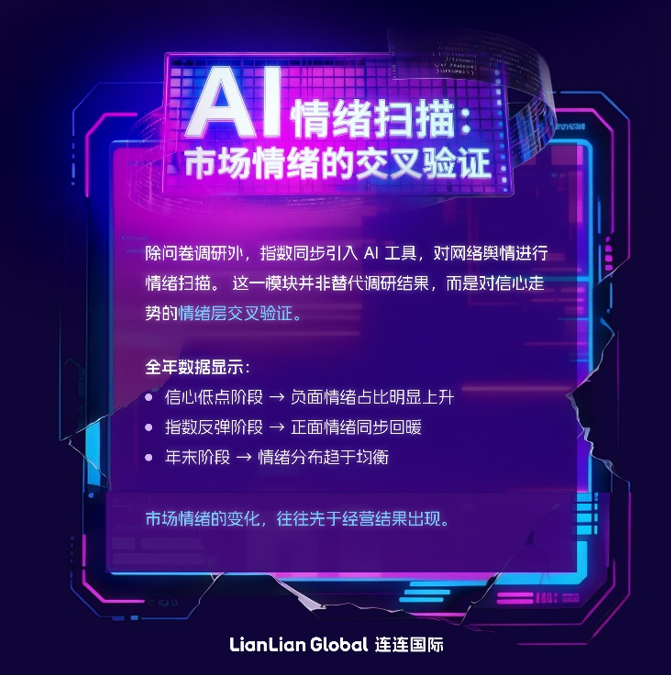
解析连连国际跨境商家信心指数的技术“底座”:云原生×大数据×AI三层架构深度融合
Jin Rong Jie Zi Xun· 2026-01-22 10:19
Core Insights - LianLian International has officially announced the launch of the LianLian Cross-Border Merchant Confidence Index, aimed at providing a quantitative measure of seller expectations and industry confidence in the cross-border e-commerce sector [1] Group 1: Index Overview - The LianLian Cross-Border Merchant Confidence Index has been published monthly since its introduction in January 2025, assessing the current state and future expectations of the cross-border e-commerce industry across seven dimensions [1] - The index is designed to reflect seller performance expectations and industry confidence, providing a systematic way to track changes in the cross-border e-commerce environment [1] Group 2: Technological Infrastructure - The index operates on a cloud-native, big data, and AI-integrated intelligent platform, which includes a globally distributed infrastructure for real-time data collection and analysis [2] - This platform addresses the challenges of capturing critical market signals without being hindered by geographical or temporal barriers, ensuring comprehensive and timely insights [2] - The big data layer organizes vast amounts of heterogeneous data into structured assets, enabling effective analysis and understanding [2] Group 3: Practical Applications - Merchants have described the index as a "digital advisor," aiding in inventory planning, marketing strategy formulation, and risk assessment in new markets [4] - LianLian International emphasizes that the confidence index is not a final product but a mature application of their technology, with plans to develop a comprehensive intelligent infrastructure to reduce uncertainty for cross-border merchants [4] Group 4: Future Outlook - According to the World Trade Organization's 2025 World Trade Report, AI applications could drive global trade growth by nearly 40% by 2040 with appropriate policy support [4] - The cross-border industry is expected to face significant changes in trade policies, rules, and consumer habits as it approaches 2026, highlighting the need for technology-driven insights [4] - LianLian International aims to leverage advanced digital infrastructure to identify key signals that can change the competitive landscape, focusing on technological innovation as a core driver [4][5]