
数字技术

Search documents
以数字技术赋能城市能级提升
Ren Min Ri Bao· 2025-07-27 22:22
Core Viewpoint - Cities play a crucial role in the overall work of the Party and the state, significantly driving economic and social development as well as improving people's livelihoods [1] Group 1: Urban Level and Development - Urban level is an important indicator of a city's development quality and potential, reflecting resource allocation capabilities, innovation-driven levels, and regional influence [1][2] - The continuous improvement of urban levels is essential for sustained prosperity and can lead to the collective development of urban clusters, thereby promoting regional progress [2] Group 2: Role of Digital Technology - Digital technology is integral to urban development, facilitating the enhancement of urban levels through various means such as global information networks and improved logistics efficiency [3] - The integration of digital technology into urban governance can lead to smarter, more precise management of city operations, enhancing overall governance effectiveness [3][5] Group 3: Infrastructure and Innovation - The push for new urban infrastructure is vital for transitioning cities into intelligent, adaptable entities, supporting the elevation of urban levels [4] - Innovation is identified as the primary driving force for development, with a focus on integrating digital technology across various industries to foster new urban development dynamics [4] Group 4: Public Services and Quality of Life - Enhancing public services through digital technology is essential for improving urban living standards and ensuring equitable access to services [6] - The development of smart services in areas such as healthcare, education, and community support is crucial for creating a high-quality urban environment [6] Group 5: Collaboration and Resource Sharing - The changing spatial structure of economic development emphasizes the importance of collaboration among cities, leveraging regional advantages to enhance urban levels [7] - Promoting digital economic cooperation among urban clusters can lead to optimized resource allocation and shared benefits across regions [7]
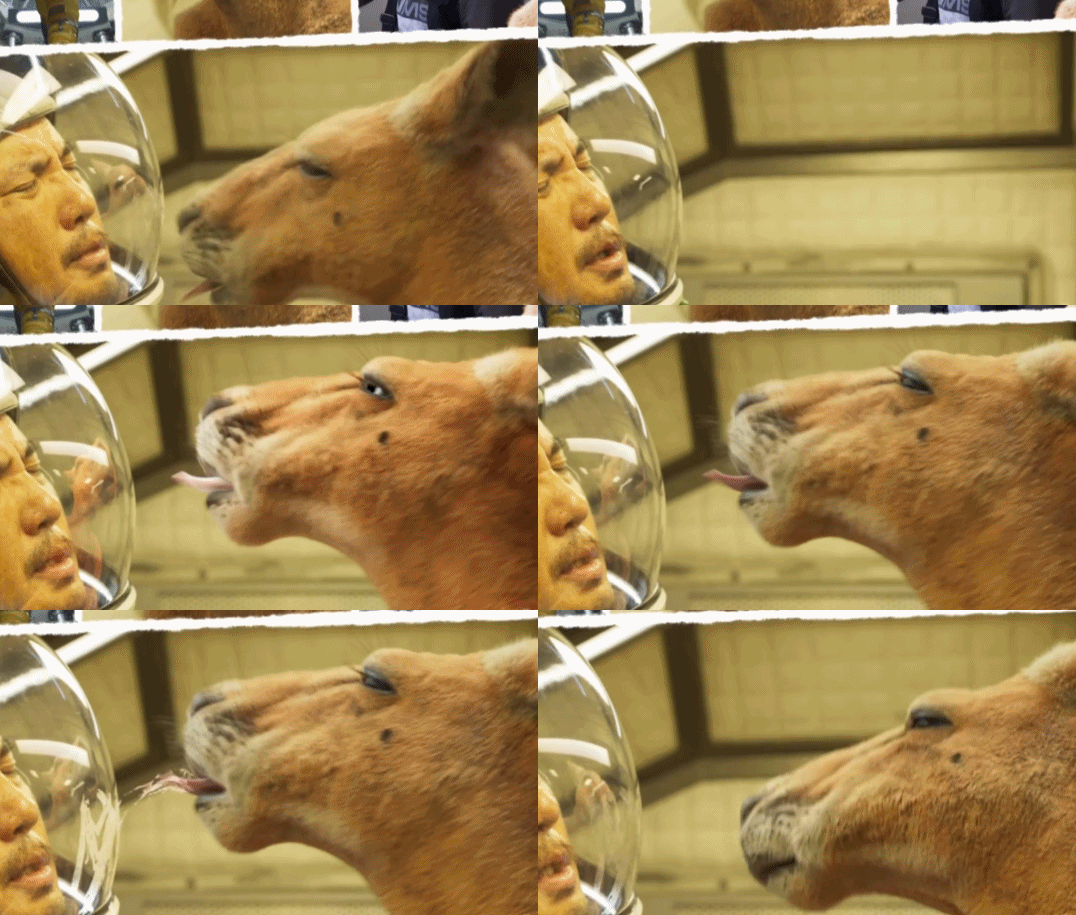
“金刚鼠”从无到有 视觉盛宴的背后是不断创新的数字技术
Yang Shi Xin Wen· 2025-07-26 19:46
Group 1 - The total box office for the summer of 2025 has exceeded 4.7 billion yuan, indicating a strong performance for domestic films [1] - The industry is exploring how to leverage technology to enhance visual effects and reduce costs in film production [1] - The digital effects seen in top films like "The Wandering Earth" and "Assassination of Novelists" were developed in Chengdu, Sichuan [1] Group 2 - The character "King Kong Mouse" in the film "The Wandering Moon" was created using 1,331 target bodies to achieve realistic movements and expressions, with approximately 50 million hair strands [3] - The production team for "The Wandering Earth 3" is preparing to use advanced technologies such as virtual shooting, digital aging, and AI to create stunning visual effects [5] Group 3 - The "Big Light Ball" in Beijing's Shougang Park features hundreds of ultra-high-definition cameras and thousands of LED lights, capable of recreating all lighting effects in film shooting [7] - In VR, XR, and AI film scenarios, the "Big Light Ball" allows for the generation of realistic human models without the need for wearable devices, capturing light position and color information [9] Group 4 - The production cycle for creating 3D digital humans has been reduced from over a month to as little as a week, with costs cut by at least half or more using new technology [11]

东西问|钭晓东:数字技术如何赋能环境权益保护?
Zhong Guo Xin Wen Wang· 2025-07-25 08:02
Core Viewpoint - The integration of digital technology into environmental protection in China is not merely theoretical but has led to practical advancements in the field, enhancing the protection of environmental rights through various innovative approaches [3][10]. Group 1: Key Changes in Environmental Protection - Digital technology has transformed environmental protection methods, particularly through the establishment of a comprehensive monitoring network that quantifies environmental goals and enhances perception capabilities [5][6]. - The national ecological environment smart monitoring platform connects IoT monitoring points and remote sensing satellite data, enabling real-time monitoring of key indicators like air quality and water quality, thus addressing traditional monitoring issues [6][8]. - Digital platforms facilitate a collaborative network among government, enterprises, and the public, exemplified by the "Green Source Smart Governance" system in Zhejiang, which integrates various data sources for improved environmental law enforcement [7][10]. Group 2: Legal and Technical Support for Environmental Rights - Digital technology provides essential technical support for maintaining environmental rights, transforming abstract rights into data-backed evidence, thus enhancing the ability to seek remedies for environmental damages [8][10]. - The use of technologies such as drones and blockchain in environmental public interest litigation aids in establishing a robust evidence chain, significantly reducing the time required to recognize environmental damage [8][10]. Group 3: Risk Prediction and Governance - Digital technology assists in predicting environmental risks, aligning with the "prevention first" principle outlined in the Environmental Protection Law, and enabling actionable prevention strategies [8][10]. - The implementation of smart environmental projects in regions like Beijing-Tianjin-Hebei showcases the use of advanced monitoring systems to enhance air quality forecasting and pollution source tracking [8][10]. Group 4: Legal Framework for Data Governance - The introduction of the "Ecological Environment Statistical Management Measures" by the Ministry of Ecology and Environment in 2023 provides clearer guidelines for data management and protection, emphasizing the dual role of law in guiding and regulating technology [10][12]. - The concept of "digital environmental justice" emerges, addressing new power dynamics introduced by digital technologies, such as algorithmic decision-making and data control, which necessitate effective constraints to prevent exacerbating environmental injustices [12][13]. Group 5: Future Directions in Environmental Rights Protection - The integration of digital technology and ecological civilization is expected to shift governance from a human-centered approach to a human-machine collaborative model, fostering a new community for environmental rights [12][13]. - The protection model is evolving from static rights confirmation to dynamic benefits allocation, enhancing the transparency and traceability of environmental rights [12][13]. - The operational mechanism is transitioning from isolated actions to mutual engagement, promoting a virtuous cycle of digital technology empowerment, legal adaptation, and environmental rights protection [12][13].

大学里的“数字匠人”:为文物注入“青春代码”
Zhong Guo Qing Nian Bao· 2025-07-25 02:24
Core Viewpoint - The article highlights the innovative efforts of a team from Beijing Institute of Technology in using digital technology to preserve and revitalize cultural heritage, particularly through the "Xiangwai Zhijing: Lantian Water and Land Temple Sculpture Art Image Exhibition" [2][9]. Group 1: Digital Heritage Preservation - The team has created over 200 high-precision digital models of cultural heritage, showcasing their commitment to preserving historical artifacts through modern technology [2][5]. - The digitalization efforts began with the Beijing Central Axis project in 2006, evolving from basic hand-drawn methods to advanced 3D modeling and AI-assisted design [4][8]. - The team has collected over 2,000 images and 120 books related to the Beijing Central Axis, establishing a cultural creative image database [5]. Group 2: Technological Innovation - The digital preservation paradigm has shifted from simple replication to interactive and artistic expressions, allowing for a more engaging experience with cultural artifacts [8][9]. - New technologies such as gesture recognition and panoramic projection are employed to create immersive experiences for exhibition visitors [9][11]. - The team emphasizes the importance of integrating modern aesthetics with traditional cultural elements to create appealing cultural products [9][10]. Group 3: Cultural Impact and Community Engagement - The exhibition attracted a diverse audience, enhancing public engagement with cultural heritage and fostering a sense of cultural appreciation [9][12]. - The project aims to create a replicable cultural operating system that encompasses not just visual elements but also the cultural context and spatial characteristics [10]. - The ongoing contributions of students to the digital heritage preservation efforts signify a generational commitment to cultural continuity and innovation [10][12].

坚定信心 乘势而上 上下同心 干字当头
He Nan Ri Bao· 2025-07-24 00:18
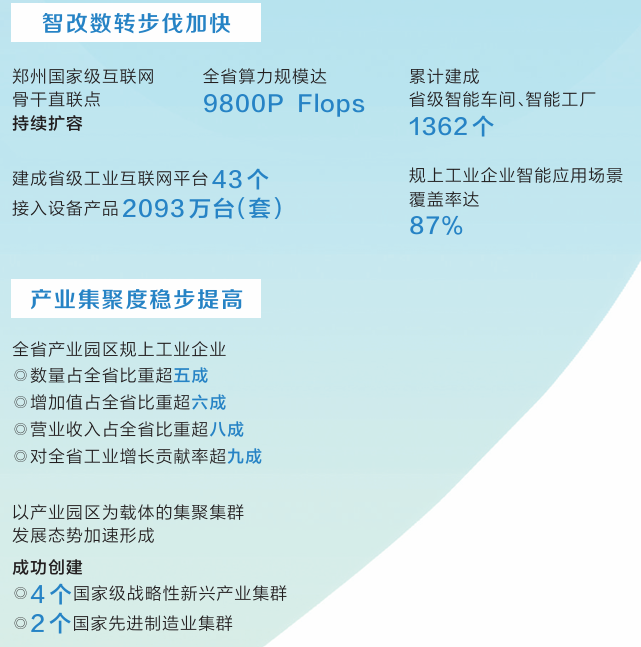
Group 1: Industry Development - The computing power scale in the province has reached 9800 P Flops, with 43 provincial industrial internet platforms established and 20.93 million devices connected [1] - The industrial agglomeration degree is steadily improving, with over 50% of the province's industrial enterprises located in industrial parks, contributing over 90% to the province's industrial growth [1] - The province has successfully created 4 national strategic emerging industry clusters and 2 national advanced manufacturing clusters [1] Group 2: Digital Transformation - Dahuawang has transitioned from traditional media to a digital technology-driven model, implementing a dual strategy of "Internet + News" and "Internet + Technology" [4] - The company has outlined a new development blueprint called "25115," focusing on dual strong development, leveraging five provincial research platforms, and building a data center and a mainstream value corpus [4] - Dahuawang has been recognized as a high-tech enterprise and has formed a closed loop in the data industry, enhancing its core competitiveness [5] Group 3: Company Performance - Luoyang Bearing Group has achieved a 36% year-on-year increase in production value in the first half of the year, showcasing its leadership in the high-end bearing sector [6] - The company is focusing on new industries such as wind power, rail transportation, and new energy vehicles, aiming to enhance its high-end bearing manufacturing capabilities [7] - Shuanghui Investment Development Co., Ltd. is committed to a development strategy centered on industrialization, diversification, internationalization, and digitization, contributing to the construction of a modern industrial system in the province [8]


全球供应链五大新趋势
Sou Hu Cai Jing· 2025-07-23 11:08
Core Insights - The global supply chain is undergoing significant restructuring, influenced by policies from major economies that directly affect its layout and security [1][3][6] - The China International Supply Chain Promotion Expo showcased various companies, including Airbus and Tesla, highlighting the importance of efficient supply chains in supporting product development [2][11] - The 2025 Global Supply Chain Promotion Report indicates that while there are challenges, the overall trend favors cooperation over division, with more promoting factors than retreating ones [3][4][6] Group 1: Supply Chain Dynamics - Major economies are focusing on enhancing their supply chain resilience and security through various policies, although some exhibit protectionist tendencies [6][16] - The report identifies five key trends in global supply chains: improved infrastructure connectivity, inclusive international trade rules, emphasis on supply chain resilience, significant technological innovation, and enhanced financial services accessibility [3][4] - The supply chain resilience index has shown a decline since 2022, indicating challenges in maintaining robust supply chains despite some recovery in 2024 [6][7] Group 2: Industry Participation and Innovation - The expo featured Airbus collaborating with ten supply chain companies to present a comprehensive view of the aircraft industry chain, emphasizing the integration of upstream and downstream sectors [2][5] - Tesla's participation highlighted its reliance on a localized supply chain, with a 95% localization rate for its Model 3 and Model Y vehicles produced in Shanghai [11][14] - The emergence of new technologies, such as AI and green technologies, is driving the digital and sustainable transformation of global supply chains [6][15] Group 3: Geopolitical Influences - Despite uncertainties in US-China trade relations, American companies, including Nvidia and Tesla, continue to engage actively in the Chinese supply chain [8][11] - Geopolitical factors and protectionism are impacting supply chain stability, with concerns over unfair treatment of Chinese companies in antitrust regulations [16][17] - The importance of multilateral cooperation in addressing supply chain disruptions caused by tariffs, environmental issues, and geopolitical conflicts is emphasized [15][16]






广州:培育孵化一批智能体育、虚拟体育、数字体育等高新技术企业
news flash· 2025-07-23 09:38
Core Viewpoint - The Guangzhou Municipal Government has issued the "Guangzhou Sports Strong City Construction Plan (2024-2035)", which emphasizes the promotion of intelligent sports innovation development through artificial intelligence and digital technology [1] Group 1: Intelligent Sports Development - The plan aims to cultivate and attract digital sports industries such as e-sports, online competitions, smart cycling, smart rowing, and simulated flying [1] - It highlights the role of AI models, virtual reality, and 5G technology in enhancing the overall fitness sector [1] Group 2: Sports Equipment and Technology - The initiative encourages sports equipment companies to develop and produce smart fitness equipment, wearable devices, products for elderly sports, and integrated health and sports products [1] - It aims to drive the transformation and upgrading of Guangzhou's sports manufacturing industry [1] Group 3: Collaborative Innovation - The plan supports the formation of joint ventures between sports enterprises and higher education institutions or research organizations, focusing on areas like computer vision, smart sports rehabilitation devices, and sports biomechanics [1] - It promotes the application and dissemination of AI technology in training systems, sports prescriptions, and sports modeling [1] Group 4: Industrial Park and High-tech Enterprises - The plan encourages the establishment of intelligent sports industrial parks to attract high-end sports enterprises' R&D headquarters to settle in Guangzhou [1] - It aims to nurture and incubate a batch of high-tech enterprises in intelligent sports, virtual sports, and digital sports [1]
职业工种批量“上新”!求学就业瞄准这些“新赛道”
Yang Shi Xin Wen· 2025-07-23 06:11
Group 1 - The Ministry of Human Resources and Social Security announced the seventh batch of new occupations, including 17 new professions and 42 new job types, with adjustments made to 9 existing occupations [1][2] - The new professions include roles such as inspection and testing management engineers, cross-border e-commerce operation managers, and drone swarm flight planners, while the new job types include generative AI system testers and service dog trainers [2][3] - The increase in new job types indicates a deepening phase in the release of new occupations, reflecting the evolving demands of industry and society [2][4] Group 2 - The new occupations are closely aligned with public needs, showcasing a trend towards enhancing quality of life, as seen with roles like sleep health managers and smart scenic area managers [3][4] - The introduction of new professions, particularly in public service and social needs, is expected to create more job opportunities [4] - Since 2019, a total of 110 new occupations have been introduced, driven by advancements in digital technologies and the push for carbon neutrality, leading to the emergence of green and digital jobs [5] Group 3 - The Ministry plans to establish national occupational standards for the newly announced professions and will actively promote training programs [6] - A project-based training model will be implemented, focusing on job demand, skills training, skills evaluation, and employment services to support the new occupations [6] - The Ministry will explore regional cooperation mechanisms to analyze and respond to labor market trends in key economic areas [6]
新职业等你来!17个新职业、42个新工种 紧跟民生需求凸显新特点
Yang Shi Wang· 2025-07-23 03:42
Core Viewpoint - The release of the 7th batch of new occupations and jobs by the Ministry of Human Resources and Social Security reflects the evolving labor market, with a focus on emerging technologies and public service needs [1][11]. Group 1: New Occupations and Jobs - The 7th batch includes 17 new occupations such as inspection and testing management engineers, cross-border e-commerce operation managers, and drone swarm flight planners, along with 42 new job types like generative AI system testers and sleep health managers [3][10]. - Compared to previous batches, the number of new occupations remains stable, but there is a significant increase in new job types, indicating a trend towards greater specialization [5][7]. Group 2: Societal and Economic Implications - The introduction of new occupations is closely tied to public service and societal needs, such as the addition of sleep health managers and elderly care service providers, which aim to enhance quality of life [8][10]. - Since 2019, a total of 110 new occupations have been introduced, reflecting the demand for talent in new technologies and the transformation of traditional industries [11][13]. Group 3: Future Directions and Training - The rapid development of digital technologies like AI, big data, and blockchain has led to the emergence of new digital occupations, while the push for carbon neutrality has created demand for green jobs [13][15]. - The Ministry plans to enhance the cultivation of new occupations and will develop national occupational standards and training programs to support these new roles [16][17].

数字技术为青年创新创业开启“机遇之门”
Zhong Guo Qing Nian Bao· 2025-07-22 23:47
Core Insights - Digital technology is recognized as a transformative force driving innovation and entrepreneurship, particularly among youth globally [1][2][3] - The 2025 China-Africa Youth Innovation and Entrepreneurship Forum highlighted the significant role of digital technology in fostering sustainable entrepreneurial growth [1][3] Group 1: Impact of Digital Technology - Digital technology is essential for personal growth and building trust between businesses, facilitating cooperation across countries [2] - Entrepreneurs shared experiences of how digital technology has enabled them to overcome challenges and expand their projects internationally [1][2] - Digital platforms are being utilized to create solutions for educational support and communication in resource-limited areas [3] Group 2: Youth Engagement and Collaboration - The forum attracted over 90 young talents from various countries, emphasizing the importance of youth engagement in discussions about digital innovation [1] - Continuous networking and exchange of ideas among young entrepreneurs occurred even after formal events, indicating a strong collaborative spirit [2] - Initiatives like the "African Digital Leaders Program" aim to enhance digital literacy among African youth, preparing them for leadership roles in the digital age [2]

