民生需求

Search documents
聚焦健康与智能领域!山东集中批复设立4所高职院校!
Qi Lu Wan Bao· 2026-01-26 06:15
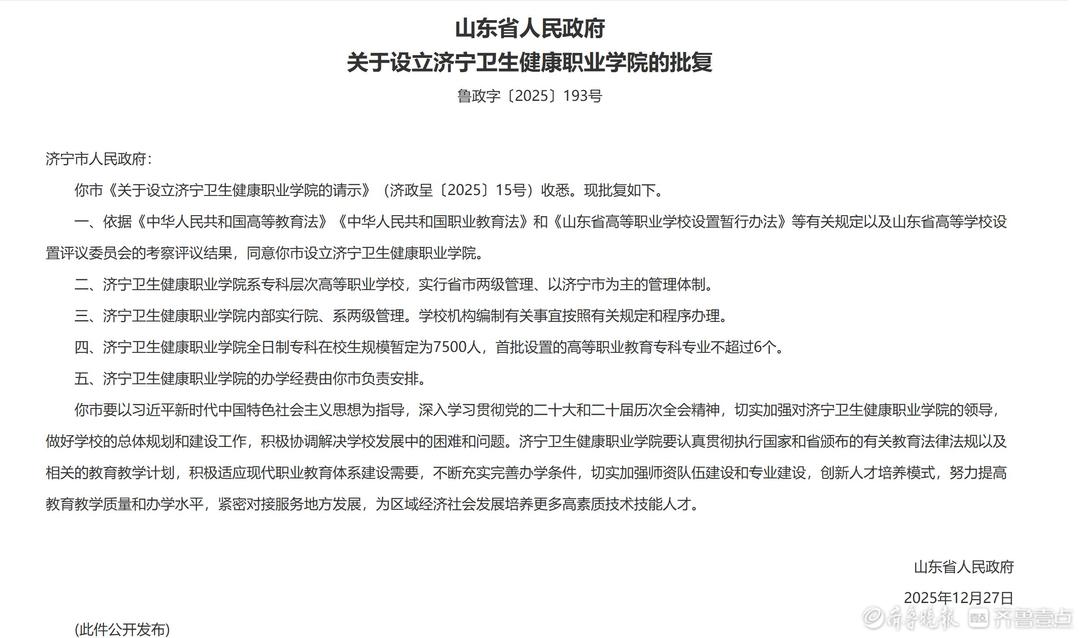
Core Viewpoint - The Shandong Provincial Government has approved the establishment of four new vocational colleges, focusing on health and technology sectors, to meet regional industry demands and enhance local talent development [1][8][10]. Group 1: Establishment of New Colleges - The four new colleges include Jining Health and Wellness Vocational College, Qingdao Health Technology Vocational College, Dezhou Intelligent Technology Vocational College, and Binzhou Health Technology Vocational College [1][4]. - Jining Health and Wellness Vocational College will have a student capacity of 7,500 and will offer up to 6 vocational programs [2][9]. - Qingdao Health Technology Vocational College will be the largest with a student capacity of 12,000 and will offer up to 7 vocational programs [4][9]. Group 2: Management and Funding - All four colleges will operate under a dual management system involving both provincial and municipal authorities, with local governments responsible for funding [8][9]. - Binzhou Health Technology Vocational College is the only private non-profit institution among the four, managed by a board of directors and funded by the board [8]. Group 3: Alignment with Regional Needs - The new colleges are designed to align closely with current industrial upgrades and public needs, particularly in the health sector and intelligent manufacturing [8][10]. - The establishment of these colleges is part of a broader strategy to optimize higher education in Shandong, filling gaps in regional talent cultivation for economic development [10].

拟2026年出台管理办法 广州统一校服引发多方讨论
Jiang Nan Shi Bao· 2025-12-25 11:37
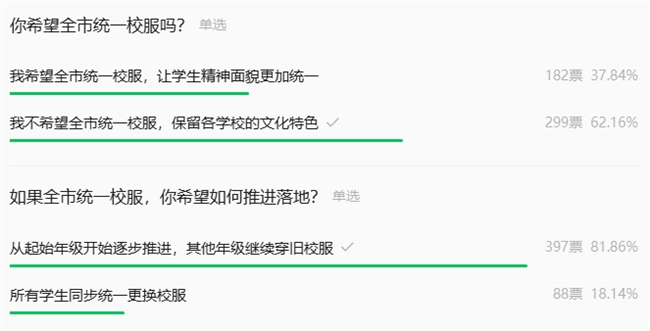
Core Viewpoint - Guangzhou is planning to implement a uniform school uniform policy for primary and secondary students, with the revised "Guangzhou School Uniform Management Measures" expected to be officially released in March 2026. This initiative has sparked significant debate regarding campus culture, educational equity, and public demand, as a recent survey indicates that 62.08% of respondents oppose the uniform policy [1][2]. Group 1: Policy Development - The initiative for a uniform school uniform in Guangzhou is supported by two recent actions from the local education bureau: the launch of the fourth school uniform design competition on December 12, 2023, and the inclusion of the revised management measures in the 2026 regulatory document release plan [1]. - The online survey conducted among parents and students shows a clear division in public opinion, with 37.92% in favor of a uniform policy for a more unified student appearance, while 62.08% prefer to retain the cultural characteristics of individual schools [2]. Group 2: Public Opinion and Concerns - Supporters of the uniform policy cite benefits such as easier social supervision and reduced risk of profit-driven relationships between manufacturers and schools. There is a preference for a gradual implementation approach, with 81.82% of respondents favoring a phased transition starting from the first grade [3]. - Opponents argue that school uniforms represent a vital aspect of campus culture and identity, with concerns that a uniform policy could erase historical ties to individual schools. Safety issues have also been raised, referencing incidents in Shanghai where uniformity led to difficulties in identifying students [3]. Group 3: Historical Context and Previous Feedback - The Guangzhou education bureau previously indicated that the current "one school, one style" model aligns with the collective decision-making process involving schools, parents, and students. A survey in 2022 showed that 94.54% of respondents were satisfied with existing uniform styles, suggesting that the current system is effective [7]. - Education experts recommend that Guangzhou should learn from other regions' balanced practices and avoid a one-size-fits-all approach, emphasizing the need for transparency in decision-making processes involving parents [9].
赵刚在西安调研冬季供暖工作时强调强化服务保障 及时回应诉求 确保人民群众温暖舒心过冬
Shan Xi Ri Bao· 2025-11-27 22:53
Core Insights - The provincial governor emphasizes the importance of winter heating as a basic livelihood need and stresses the need for effective service guarantees to ensure residents are warm during winter [1][2] Group 1: Heating Service Management - The governor conducted on-site inspections of heating facilities, checking parameters such as boiler pressure, flow, and water temperatures to ensure service quality [1] - There is a call for heating companies to enhance their responsibility and improve service levels through better heat source assurance and facility maintenance [1][2] - The need for real-time monitoring and precise scheduling of heating services is highlighted, along with regular household visits to assess temperature and equipment [1][2] Group 2: Systematic Approach to Heating - A systematic and problem-oriented approach is advocated, focusing on energy reserves, distribution, and communication among stakeholders [2] - The governor encourages the integration of small and weak heating entities and the development of interconnected heating networks to enhance overall heating capacity [2] - Emphasis is placed on improving management services, including increased frequency of inspections and the establishment of emergency plans for extreme weather [2] Group 3: Community Engagement and Feedback - The importance of addressing community complaints regarding heating issues is stressed, with a focus on establishing effective feedback mechanisms [2] - The governor insists on a collaborative approach to quickly resolve heating-related problems and ensure that residents' needs are met promptly [2]
新职业等你来!17个新职业、42个新工种 紧跟民生需求凸显新特点
Yang Shi Wang· 2025-07-23 03:42
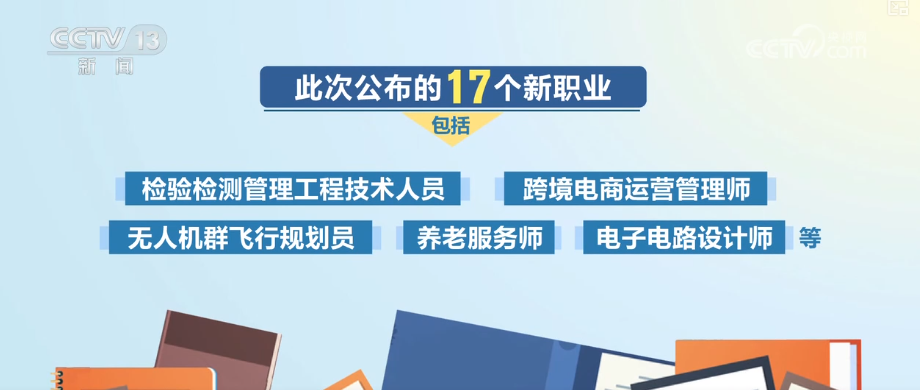
Core Viewpoint - The release of the 7th batch of new occupations and jobs by the Ministry of Human Resources and Social Security reflects the evolving labor market, with a focus on emerging technologies and public service needs [1][11]. Group 1: New Occupations and Jobs - The 7th batch includes 17 new occupations such as inspection and testing management engineers, cross-border e-commerce operation managers, and drone swarm flight planners, along with 42 new job types like generative AI system testers and sleep health managers [3][10]. - Compared to previous batches, the number of new occupations remains stable, but there is a significant increase in new job types, indicating a trend towards greater specialization [5][7]. Group 2: Societal and Economic Implications - The introduction of new occupations is closely tied to public service and societal needs, such as the addition of sleep health managers and elderly care service providers, which aim to enhance quality of life [8][10]. - Since 2019, a total of 110 new occupations have been introduced, reflecting the demand for talent in new technologies and the transformation of traditional industries [11][13]. Group 3: Future Directions and Training - The rapid development of digital technologies like AI, big data, and blockchain has led to the emergence of new digital occupations, while the push for carbon neutrality has created demand for green jobs [13][15]. - The Ministry plans to enhance the cultivation of new occupations and will develop national occupational standards and training programs to support these new roles [16][17].
“十四五”冲刺!国家发改委在首场发布会为何提到荔枝和早茶
Nan Fang Du Shi Bao· 2025-07-09 14:09
Economic Growth and Contributions - China's GDP has achieved a "four consecutive jumps" over the past five years, with an expected increase of over 35 trillion yuan, equivalent to "recreating a Yangtze River Delta" [1] - The average contribution rate of domestic demand to economic growth is over 86.4%, highlighting its role as the main driver of China's economy [3] - Final consumption contributed an average of 56.2% to economic growth, an increase of 8.6 percentage points compared to the "13th Five-Year Plan" [4] Infrastructure Development - The national comprehensive transportation network has a completion rate of over 90%, covering over 80% of counties and serving about 90% of the economy and population [7] - The logistics cost savings for society are projected to exceed 4 billion yuan in 2024, with an additional expected savings of around 3 billion yuan this year [7] - The average hourly throughput at national ports is expected to reach 38,000 standard containers by 2024, a 26% increase from 2020 [8] Innovation and Technology - R&D expenditure increased by nearly 50% compared to the end of the "13th Five-Year Plan," reaching an increment of 1.2 trillion yuan, with R&D intensity rising to 2.68% [9] - China has achieved significant breakthroughs in innovation, including the launch of the first domestically produced aircraft carrier and the completion of the first Chinese space station [10] Governance and Efficiency - The business environment in China has improved, with over 58 million private enterprises, an increase of over 40% since the end of the "13th Five-Year Plan" [11] - The ability to mobilize and act effectively has been demonstrated in disaster response, such as the rapid organization of rescue efforts following a 6.8 magnitude earthquake [12] Social Welfare and Public Services - The "14th Five-Year Plan" includes seven social welfare indicators, the highest proportion in any five-year plan, aimed at enhancing people's sense of gain, happiness, and security [13] - Employment stability has been maintained with over 12 million new urban jobs created annually, and the income growth of residents is synchronized with economic growth [15] - The healthcare system has been expanded, with a significant increase in the number of practicing physicians per thousand people, from 2.9 to 3.6 [15]
盘和林:链博会“六链一展区”透露三大投资新风向
Sou Hu Cai Jing· 2025-06-20 01:03
Group 1 - The third Chain Expo will be held in Beijing from July 16 to July 20, with the theme "Linking the World, Co-Creating the Future" [2] - The expo will feature six chains and one exhibition area, including advanced manufacturing, smart vehicles, green agriculture, clean energy, digital technology, health living, and supply chain services [3] Group 2 - Three new investment trends are highlighted: 1. Technology integration driving industrial upgrades, such as the combination of advanced manufacturing and digital technology creating a trillion-level market demand [4] 2. Green economy restructuring the value chain, emphasizing the importance of green supply chains to achieve carbon neutrality goals [4] 3. Emerging consumer demands creating new sectors, focusing on precision medicine, the silver economy, and smart home appliances [4] Group 3 - The collaboration between smart vehicles and clean energy is particularly noteworthy, involving cross-chain cooperation among vehicle manufacturers, energy companies, and material suppliers [5] - The presence of international tech giants like NVIDIA at the expo indicates a trend of localization and collaboration with Chinese companies in the AI innovation ecosystem [6] Group 4 - AI is rapidly penetrating various sectors such as medical rehabilitation, smart manufacturing, and smart agriculture, transforming into AI+ applications [8] - The establishment of a "New Product Launch Zone" at the expo aims to create a four-dimensional cooperation network, facilitating technology validation, global procurement, standard-setting collaboration, and investment financing [9]