
人类命运共同体

Search documents
扩大高水平对外开放 大力提振消费(权威访谈·学习贯彻党的二十届四中全会精神)
Ren Min Ri Bao· 2025-12-05 23:39
Core Viewpoint - The "14th Five-Year Plan" emphasizes the importance of a strong domestic market and high-level opening-up as strategic foundations for China's modernization, highlighting the need for open cooperation and mutual benefits [1][2]. Group 1: High-Level Opening-Up - The "14th Five-Year Plan" includes a dedicated section on expanding high-level opening-up, reflecting the central government's commitment to open cooperation and mutual benefits [2]. - High-level opening-up is seen as a crucial tool for promoting reform and development, with China maintaining its position as the world's largest goods trader for eight consecutive years and achieving over $1 trillion in service trade [2][3]. - The plan aims to enhance the synergy between domestic and international markets, promoting qualitative improvements and reasonable growth in the economy [2]. Group 2: Key Tasks for High-Level Opening-Up - The plan outlines four main tasks for expanding high-level opening-up, including strengthening party leadership, promoting autonomous opening, and actively engaging in international trade agreements [4]. - Emphasis is placed on trade innovation, including optimizing goods trade, expanding service trade, and developing digital trade to enhance trade digitalization [5]. - The plan also focuses on expanding investment cooperation, improving the investment environment, and promoting the integration of trade and investment [5]. Group 3: Domestic Demand and Consumption - The "14th Five-Year Plan" stresses the importance of expanding domestic demand, leveraging China's large market size and growing middle-income population to boost consumption [7]. - The plan aims to enhance service consumption by relaxing market access and promoting new growth areas such as tourism and sports events [8]. - Efforts will be made to upgrade goods consumption, including promoting durable goods and supporting the consumption of domestic and international quality products [9]. Group 4: Innovation in Consumption Scenarios - The plan encourages the creation of new consumption scenarios by establishing management methods that adapt to new business models and consumer behaviors [9]. - It aims to cultivate international consumption centers and enhance the integration of commerce, tourism, and culture to create diverse consumption experiences [9].
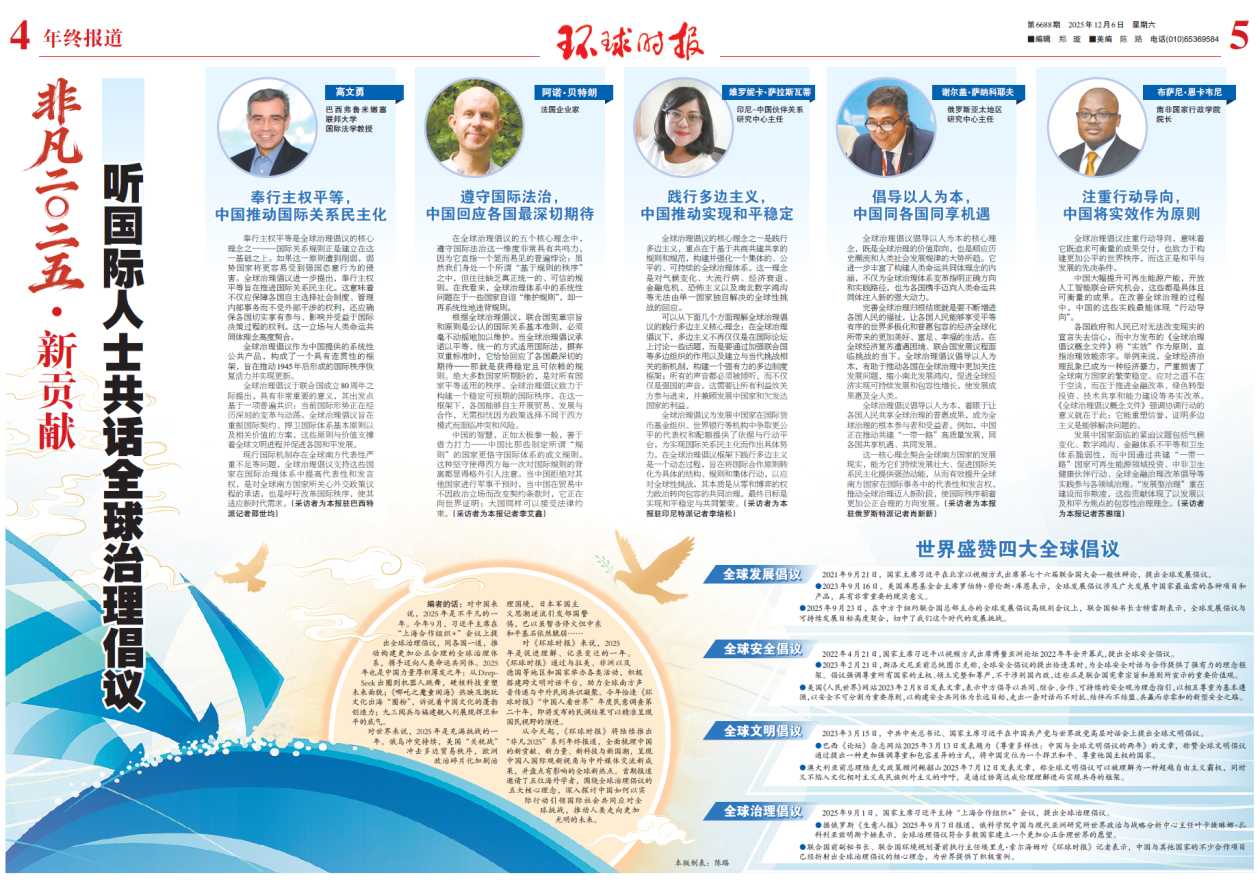
“非凡2025”系列年终报道:听国际人士共话全球治理倡议
Huan Qiu Shi Bao· 2025-12-05 23:27
Core Viewpoint - The articles discuss China's global governance initiative, emphasizing its role in promoting a more equitable international order and addressing global challenges through multilateralism and respect for sovereignty [2][3][4][6]. Group 1: Global Governance Initiative - The global governance initiative is presented as a systematic public product aimed at revitalizing and updating the post-1945 international order, responding to profound changes and turmoil in the current international landscape [6]. - It emphasizes the importance of sovereign equality and aims to democratize international relations, ensuring that all countries have the right to participate in and benefit from international decision-making processes [4][6]. - The initiative seeks to enhance the representation and voice of the Global South in international governance, addressing their diplomatic policy agendas and calling for reforms to adapt the international order to contemporary needs [6][10]. Group 2: Core Principles of the Initiative - One core principle is adherence to international law, which aims to establish a stable and reliable set of rules applicable to all nations, countering the double standards often seen in international relations [8][10]. - The initiative promotes multilateralism, focusing on collective governance to address global challenges such as climate change, pandemics, and economic crises, which cannot be solved by individual nations alone [10][12]. - It advocates a people-centered approach, aiming to enhance the well-being of people globally and ensure that the benefits of globalization are shared equitably among all nations [12][14]. Group 3: Action-Oriented Approach - The initiative emphasizes an action-oriented approach, focusing on measurable outcomes and the establishment of a fairer world order as prerequisites for peace and development [14][15]. - China's efforts in renewable energy capacity and AI research collaborations are highlighted as concrete examples of this action-oriented principle [14][15]. - The initiative addresses urgent issues faced by developing countries, such as climate change and financial inequality, through practical reforms and investments [15][16].

扩大高水平对外开放 大力提振消费——访商务部党组书记、部长王文涛(权威访谈·学习贯彻党的二十届四中全会精神)
Ren Min Ri Bao· 2025-12-05 22:53
Core Viewpoint - The "14th Five-Year Plan" emphasizes the importance of a strong domestic market and high-level opening-up as strategic foundations for China's modernization, highlighting the need for cooperation and mutual benefits in international relations [1][2]. Group 1: High-Level Opening-Up - The "14th Five-Year Plan" proposes a dedicated chapter on expanding high-level opening-up, reflecting the central government's commitment to open cooperation and mutual benefits [2]. - The period of the "14th Five-Year Plan" is crucial for achieving socialist modernization, with high-level opening-up serving as a key tool for reform and development [2]. - China has maintained its position as the world's largest goods trader for eight consecutive years, with service trade exceeding $1 trillion and foreign investment goals for the "14th Five-Year Plan" achieved six months ahead of schedule [2][3]. Group 2: International Trade and Investment - China is a major trading partner for over 150 countries and regions, with imports and exports exceeding $15 trillion during the "14th Five-Year Plan" period, contributing over $300 billion in taxes to host countries [3]. - Despite rising unilateralism and protectionism, economic globalization remains a historical trend, with China signing 24 free trade agreements with 31 countries and regions [3]. - The government aims to enhance trade innovation, optimize goods trade, and promote service trade, including digital trade and cross-border e-commerce [5]. Group 3: Domestic Consumption - The "14th Five-Year Plan" emphasizes expanding domestic demand as a strategic foundation, leveraging China's large population and growing middle-income group to boost consumption [7]. - The contribution of consumption to economic growth has averaged 60% annually, with a focus on enhancing service and goods consumption [7][8]. - Initiatives will be implemented to promote service consumption, upgrade goods consumption, and innovate consumption scenarios to meet diverse consumer needs [8][9]. Group 4: Belt and Road Initiative - The Belt and Road Initiative is framed as a collaborative effort, focusing on strategic alignment with partner countries and promoting both large-scale and small-scale projects [6]. - The initiative aims to deepen cooperation in trade, investment, and industry while expanding collaboration in green, digital, and AI sectors [6].
“以中非现代化助力全球南方现代化”(《习近平谈治国理政》大家读)
Ren Min Ri Bao· 2025-12-05 19:46
Core Viewpoint - The summit emphasizes the strengthening of China-Africa relations, elevating them to a strategic partnership level, and aims to promote modernization through ten key cooperative actions [1]. Group 1: Strategic Partnership - China has upgraded its bilateral relations with all African countries to a strategic level, establishing a new era of an all-weather China-Africa community of shared destiny [1]. - The new positioning reflects China's unwavering commitment to Africa's development, aiming to help African people achieve greater dreams [2]. Group 2: Infrastructure Development - China has participated in the construction and renovation of over 10,000 kilometers of railways, nearly 100,000 kilometers of roads, close to 1,000 bridges, nearly 100 ports, and 66,000 kilometers of power transmission and transformation lines [2]. - More than 10 million people have benefited from China's aid projects in Africa, which include food security, water supply, maternal and child health, and education [2]. Group 3: Modernization Support - China's experiences in poverty alleviation, governance modernization, technological innovation, and education are highly relevant to the modernization efforts of African countries [3]. - The cooperation projects between China and Africa are seen as a practical embodiment of the principle of not leaving any country or nation behind in the development process [2]. Group 4: Global Impact - The collaborative efforts between China and Africa are setting a global example of solidarity and cooperation among the Global South, influencing the modernization development path worldwide [3]. - The initiatives are expected to accelerate changes in the global landscape and inject strong momentum into the cause of peace and justice for humanity [3].
贯彻落实党的二十届四中全会精神权威访谈|扩大高水平对外开放 加快建设强大国内市场——访商务部党组书记、部长王文涛
Xin Hua She· 2025-12-05 15:05
新华社北京12月5日电 题:扩大高水平对外开放加快建设强大国内市场——访商务部党组书记、部长王 文涛 新华社记者谢希瑶 党的二十届四中全会审议通过的《中共中央关于制定国民经济和社会发展第十五个五年规划的建议》 (以下简称《建议》),就"扩大高水平对外开放""建设强大国内市场"作出部署,提出"积极扩大自主 开放""大力提振消费"等具体举措。 如何落实扩大高水平对外开放的重要任务?怎样进一步释放消费潜力,为建设强大国内市场提供有力支 撑?记者采访了商务部党组书记、部长王文涛。 坚持开放合作、互利共赢是中国式现代化的必然要求 问:《建议》对"扩大高水平对外开放,开创合作共赢新局面"作了专章部署,"十五五"时期,我国扩大 高水平对外开放有什么重要意义? 答:"十五五"时期是基本实现社会主义现代化夯实基础、全面发力的关键时期,扩大高水平对外开放具 有重大意义。 ——扩大高水平对外开放,是全面推动高质量发展的强大动力。"十五五"时期,我国发展面临的战略机 遇和风险挑战并存、不确定难预料因素增多,要求我们积极识变应变求变,用好发展机遇、潜力和优 势,完整准确全面贯彻新发展理念,加快构建新发展格局,因地制宜发展新质生产力,着 ...
贯彻落实党的二十届四中全会精神权威访谈|扩大高水平对外开放 加快建设强大国内市场——访商务部党组书记、部长王文涛
Xin Hua She· 2025-12-05 11:09
Core Viewpoint - The article discusses the key strategies outlined in the "Suggestions for Formulating the 15th Five-Year Plan for National Economic and Social Development," emphasizing the importance of expanding high-level opening-up and boosting domestic consumption as essential components for achieving modernization in China [1]. Group 1: Importance of High-Level Opening-Up - Expanding high-level opening-up is a strong driving force for promoting high-quality development during the 15th Five-Year period, as it helps leverage both domestic and international markets and resources [2]. - High-level opening-up is an inherent requirement to meet the people's needs for a better life, with nearly 700,000 foreign trade enterprises and around 500,000 foreign-funded enterprises contributing to employment and consumption upgrades [3]. - It is a proactive measure to promote economic globalization, countering unilateralism and protectionism while enhancing international cooperation in supply chains [4]. Group 2: Key Tasks for High-Level Opening-Up - The plan outlines four main tasks for expanding high-level opening-up, including actively expanding autonomous opening, enhancing trade innovation, expanding bilateral investment cooperation, and high-quality co-building of the Belt and Road Initiative [5][6][7][8]. - Emphasis is placed on aligning with international high-standard trade rules, particularly in the service sector, and expanding market access [5]. - The strategy includes optimizing trade structures, promoting digital trade, and enhancing the balance of imports and exports to meet both industrial and consumer needs [7]. Group 3: Boosting Domestic Consumption - The plan highlights the need to strengthen the domestic market as a strategic foundation for modernization, with a focus on boosting consumption to leverage the large population and growing middle-income group [9]. - Specific actions include expanding service consumption, promoting goods consumption upgrades, and innovating consumption scenarios to adapt to new consumer behaviors [10][11]. - The government aims to implement policies that enhance consumer experiences and stimulate demand across various sectors, including durable goods and services [10].
多所高校调整重组外语学院 外语专业批量停招
Di Yi Cai Jing· 2025-12-05 11:06
随着人工智能的发展及多种因素,外语类专业面临着诸多挑战,一些高校也对外语学院进行了调整。 近日,随着景德镇陶瓷大学在原有外国语学院基础上,整合文化研究、新闻传播、中文教育等方面的师 资力量和软硬条件,成立文化传播学院,关于"外语学院调整组建"的讨论再度在高教领域引起关注。 早在去年12月举行的将景德镇陶瓷大学外国语学院更名为"文化传播学院"的专家论证会上,专家组就提 出,希望学院在更名后能进一步转型发展,改造升级老旧专业,围绕中国陶瓷文化国际传播进一步凝练 特色,做好以陶瓷文化为主要对象的区域国别研究,切实提高中国陶瓷文化国际传播的效能和水平,为 服务国家对外战略,构建人类命运共同体贡献陶大力量。 根据高教领域媒体统计,近期就有多所高校将传统外语学院调整组建成新学院。其中,不少将外语专业 与传播等专业合并组建复合型学院。整体来看,各高校通过对外语学院合并、重组、更名,来应对AI 时代的诸多挑战。 厦门大学经济学系副教授丁长发对第一财经分析,随着人工智能的发展,AI对很多领域的冲击很大, 其中外语类专业受AI影响非常大,所以这些外语类学院需要调整和整合。 麦可思研究院《2023年中国本科生就业报告》显示,202 ...
扩大高水平对外开放 加快建设强大国内市场——访商务部党组书记、部长王文涛
Xin Hua She· 2025-12-05 10:15
Core Viewpoint - The article discusses the key strategies outlined in the "Suggestions for Formulating the 15th Five-Year Plan for National Economic and Social Development," emphasizing the importance of expanding high-level opening-up and building a strong domestic market as essential components for China's modernization and economic growth [1]. Group 1: Importance of High-Level Opening-Up - Expanding high-level opening-up is a strong driving force for promoting high-quality development, especially during the critical "15th Five-Year" period, which faces both strategic opportunities and challenges [2]. - High-level opening-up is an inherent requirement to meet the people's needs for a better life, with nearly 700,000 foreign trade enterprises and around 500,000 foreign-funded enterprises contributing to employment and consumption upgrades [3]. - It is also a proactive measure to promote economic globalization, countering rising protectionism and unilateralism while maintaining multilateralism and free trade [4]. Group 2: Key Tasks for High-Level Opening-Up - The "Suggestions" outline four main tasks for expanding high-level opening-up, including strengthening party leadership, enhancing openness levels, and expanding the development space for Chinese-style modernization [5]. - The first task is to actively expand autonomous opening-up by aligning with international high-standard trade rules and increasing market access, particularly in the service sector [5][6]. - The second task focuses on promoting trade innovation and development, enhancing goods, services, and digital trade, and balancing import and export growth [7]. - The third task involves expanding bilateral and multilateral investment cooperation, improving the investment environment, and ensuring foreign investments are welcomed and retained [7]. - The fourth task emphasizes high-quality co-construction of the "Belt and Road" initiative, enhancing cooperation in trade, investment, and cultural exchanges with partner countries [8]. Group 3: Strengthening Domestic Market and Consumption - The "Suggestions" highlight the importance of a strong domestic market as a strategic foundation for modernization, with a focus on boosting consumption [9]. - The plan aims to expand service consumption by relaxing access restrictions and promoting new growth points in sectors like tourism and sports [10]. - It also seeks to upgrade goods consumption through policies that directly benefit consumers, promoting durable goods and supporting domestic brands [10]. - Finally, the initiative includes innovating consumption scenarios by establishing management methods for new consumption models and fostering international consumption centers [11].
商务部部长王文涛:扩大高水平对外开放 加快建设强大国内市场
Xin Lang Cai Jing· 2025-12-05 10:08
Core Viewpoint - The article emphasizes the importance of expanding high-level opening-up and accelerating the construction of a strong domestic market as outlined in the 15th Five-Year Plan, highlighting specific measures such as actively expanding autonomous opening and significantly boosting consumption [1][12]. Group 1: Importance of High-Level Opening-Up - Expanding high-level opening-up is a strong driving force for promoting high-quality development, especially during the critical period of the 15th Five-Year Plan, which faces both strategic opportunities and risks [2][13]. - It is an inherent requirement to meet the people's needs for a better life, with nearly 700,000 foreign trade enterprises and around 500,000 foreign-funded enterprises projected for 2024, directly and indirectly supporting over 200 million jobs [3][14]. - It serves as proactive engagement in economic globalization, countering unilateralism and protectionism while promoting multilateralism and free trade [3][15]. Group 2: Key Tasks for High-Level Opening-Up - The 15th Five-Year Plan outlines four key tasks for expanding high-level opening-up, including strengthening the Party's leadership in open work and enhancing the level of opening-up [5][16]. - Actively expanding autonomous opening by aligning with international high-standard trade rules, focusing on service sectors, and increasing market access [5][16]. - Promoting trade innovation development by solidifying the three pillars of goods trade, service trade, and digital trade, while enhancing import and export balance [7][17]. Group 3: Boosting Domestic Consumption - The plan emphasizes the strategic basis of expanding domestic demand, with China's market advantages including a population of over 1.4 billion and a growing middle-income group [9][19]. - Significant efforts will be made to enhance service consumption through policy measures and the development of new growth points in sectors like tourism and sports [10][20]. - The initiative aims to innovate consumption scenarios and establish a management framework that adapts to new consumption models, supporting the development of international consumption center cities [11][21].
贯彻落实党的二十届四中全会精神权威访谈丨扩大高水平对外开放 加快建设强大国内市场——访商务部党组书记、部长王文涛
Xin Hua Wang· 2025-12-05 10:04
Core Viewpoint - The article emphasizes the importance of expanding high-level opening-up and accelerating the construction of a strong domestic market as outlined in the 15th Five-Year Plan proposal, highlighting specific measures such as actively expanding autonomous opening and significantly boosting consumption [1]. Group 1: Importance of High-Level Opening-Up - Expanding high-level opening-up is a strong driving force for promoting high-quality development, especially during the critical period of the 15th Five-Year Plan, which faces both strategic opportunities and challenges [2]. - It is an inherent requirement to meet the people's needs for a better life, with nearly 700,000 foreign trade enterprises and about 500,000 foreign-funded enterprises expected to contribute to employment and consumption upgrades [3]. - High-level opening-up is a proactive measure to promote economic globalization, countering unilateralism and protectionism while maintaining multilateralism and free trade [4]. Group 2: Key Tasks for High-Level Opening-Up - The proposal outlines four key tasks for the 15th Five-Year Plan period, including actively expanding autonomous opening by aligning with international high-standard trade rules and focusing on service sector market access [5]. - Promoting trade innovation development by enhancing goods, services, and digital trade, while also balancing imports and exports to meet both industrial and consumer needs [7]. - Expanding bilateral investment cooperation by creating a transparent and stable environment for foreign investment and enhancing overseas investment management [6]. Group 3: Strengthening Domestic Market and Consumption - The proposal stresses the strategic importance of expanding domestic demand, with a focus on boosting consumption as a key driver of economic growth, supported by a large population and a growing middle-income group [9]. - Specific measures to enhance service consumption include relaxing access restrictions and promoting new growth areas such as tourism and sports events [10]. - Efforts to upgrade goods consumption will involve implementing policies to increase consumer access to quality products and promoting durable goods consumption [11].