
ROE

Search documents
破局1xPB与4%股息率? - 银行股配置重构
2025-08-05 03:16
Summary of Conference Call on Banking Sector Industry Overview - The banking sector is currently influenced by a relatively weak macroeconomic environment and declining dividend yields of large state-owned banks, which has led to market divergence [1][2][3] - The sector is expected to stabilize, with mid-year reports validating profit stability due to a rapid decline in deposit interest rates and easing margin pressures [1][7] Key Points and Arguments Valuation and Investment Strategy - Banks should be categorized into two asset types for valuation: - State-owned banks as bond-like assets priced on dividend yield - High-quality regional banks priced on Return on Equity (ROE) [1][4] - High-quality regional banks, such as those in Jiangsu and Chengdu, are currently undervalued and have significant room for valuation recovery [1][6] Market Performance - After a strong performance in early July, banking stocks experienced a correction of approximately 10% due to a shift in market risk appetite and profit-taking by investors [9][10] - The adjustment has revealed the investment value of leading regional banks, which now offer attractive dividend yields above 4% [10] Future Expectations - Large state-owned banks are expected to maintain stability and potentially exceed a 4% dividend yield, while high-quality regional banks are projected to achieve a high ROE of around 15% over the next three years [5][7] - The overall banking sector is entering a stabilization phase, supported by a clear downward trend in deposit interest rates, which will bolster net interest income and profit growth [7] Dividend and Earnings Stability - The upcoming mid-year reports are anticipated to show a stabilization trend in earnings, with many banks implementing interim dividends for the first time, enhancing market confidence [11] - The focus on dividend returns and earnings stability is crucial for high ROE banks, as these metrics are more significant than mere PB ratios [8] Additional Important Insights - Insurance capital is increasing its equity allocation, particularly in A-shares, providing support for adjusted banking stocks [12] - The low valuation of large state-owned banks in the Hong Kong market is becoming more pronounced, with long-term capital driving valuation recovery [12][13] - Specific attention is recommended for high-quality regional banks that have shown strong profit growth and ROE, as well as for undervalued large state-owned banks in the Hong Kong market [13]
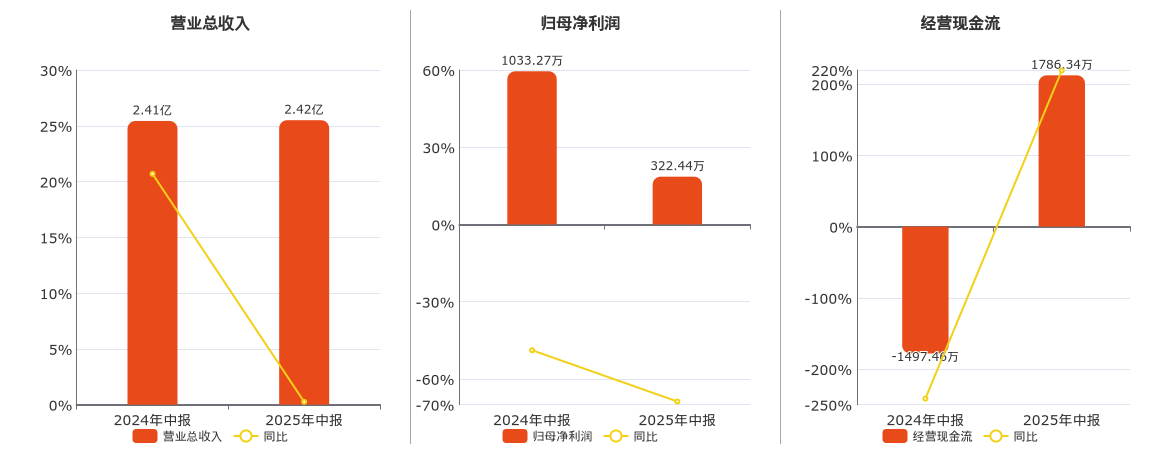
丰立智能(301368.SZ):2025年中报净利润为322.44万元
Xin Lang Cai Jing· 2025-08-05 01:41
Core Insights - The company, Fengli Intelligent (301368.SZ), reported a total revenue of 242 million yuan for the first half of 2025, marking an increase of 615,600 yuan compared to the same period last year, achieving a 0.25% year-on-year growth [1] - The net profit attributable to shareholders was 3.2244 million yuan, with net cash inflow from operating activities amounting to 17.8634 million yuan, an increase of 32.8381 million yuan from the previous year [1] Financial Metrics - The latest debt-to-asset ratio stands at 33.52% [3] - The gross profit margin is reported at 13.85%, reflecting an increase of 1.33 percentage points from the previous quarter [3] - The return on equity (ROE) is at 0.33% [3] - The diluted earnings per share (EPS) is 0.03 yuan [3] - The total asset turnover ratio is 0.17 times, while the inventory turnover ratio is 1.34 times [3] Shareholder Information - The number of shareholders is 26,900, with the top ten shareholders holding a total of 63.4506 million shares, accounting for 52.83% of the total share capital [3] - The largest shareholder is Zhejiang Fengli Transmission Technology Co., Ltd., holding 36.9% of the shares [3]


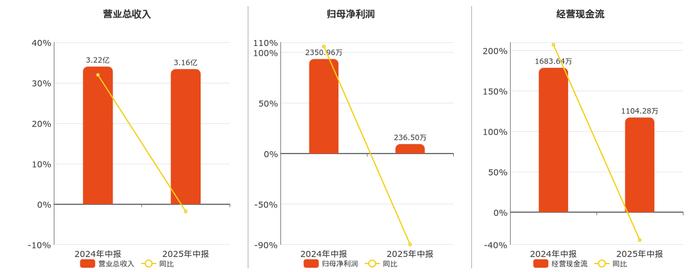
凯尔达(688255.SH):2025年中报净利润为236.50万元
Xin Lang Cai Jing· 2025-08-05 01:35
2025年8月5日,凯尔达(688255.SH)发布2025年中报。 公司营业总收入为3.16亿元。归母净利润为236.50万元。经营活动现金净流入为1104.28万元。 | 序号 | 股东名称 | 持股比例 | | --- | --- | --- | | T | 凯尔达集团有限公司 | 34.40% | | 2 | 安川电机(中国)有限公司 | 13.75% | | 3 | 海南珍金投资合伙企业(普通合伙) | 1.79% | | 4 | 黄兆京 | 1.48% | | 5 | 兴业银行股份有限公司-华夏中证机器人交易型开放式指数证券投资基金 | 1.36% | | 6 | 王霖 | 1.31% | | 7 | 林秀玲 | 1.11% | | 8 | 浙江东南网架集团有限公司 | 0.93% | | 9 | 平安基金-中国平安人寿保险股份有限公司-寿险传统-低-平安基金-平安人寿权益 4号MOM单一资产管理计划 | 0.82% | | 10 | 邵逸群 | 0.55% | 公司最新毛利率为17.51%。最新ROE为0.23%。 公司摊薄每股收益为0.02元。 公司最新总资产周转率为0.26次。最新存货周转率 ...

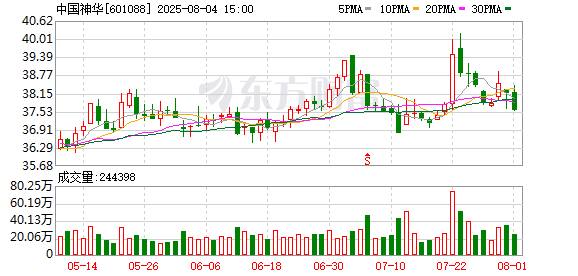
民生证券给予中国神华推荐评级,事件点评:大规模资产收购启动,黑金龙头再启航
Mei Ri Jing Ji Xin Wen· 2025-08-05 00:37
Group 1 - The core viewpoint of the report is a recommendation for China Shenhua (601088.SH) with a latest price of 37.56 yuan [2] - The asset coverage includes "coal, electricity, chemical, transportation, and sales," which addresses industry competition issues and enhances integrated operational capabilities [2] - Post-restructuring, the coal resource volume and production capacity have significantly increased [2] - The company is expected to maintain a high dividend payout ratio [2] - The company has ample cash on hand, which is likely to improve its cash utilization and enhance overall ROE [2]

中信银行(00998.HK):被低估的底部股份行 ROE有望更早企稳
Ge Long Hui· 2025-08-01 19:41
Core Viewpoint - The investment community should not overlook the proactive measures taken by the management of CITIC Bank, which has shown early signs of improvement in asset quality, asset structure, and return on equity (ROE), despite ongoing industry pressures. The current valuation presents an opportunity for a premium due to the certainty of these improvements [1]. Group 1: Asset Quality and Risk Management - CITIC Bank has focused on early and thorough exposure of non-performing assets (NPAs), transitioning from a "correction period" to a "health phase." The bank's non-performing loan (NPL) generation rate from 2018 to 2020 was 1.55%, higher than the industry average by approximately 10 basis points [2]. - The bank has written off a total of 239 billion from 2018 to 2021, exceeding the total from 2013 to 2017, leading to a peak in corporate real estate NPLs in 2021, which have since declined [2]. - As of Q1 2025, the NPL ratio has decreased to 1.16%, with a stable NPL generation rate of around 0.9% and a provision coverage ratio of 207%, marking a ten-year high [2]. Group 2: Financial Performance and ROE - CITIC Bank's ROE has stabilized and is expected to continue leading the industry, supported by a shift in loan structure that emphasizes infrastructure and emerging sectors, with a significant reduction in real estate loan ratios [3]. - The bank's net interest margin (NIM) has shown resilience, with a projected decline of only 28 basis points from 2021 to 2024, compared to a 60 basis point decline for peers [3]. - The bank's average daily corporate demand deposits account for 37.5% of total deposits, which is approximately 10 percentage points higher than the industry average, indicating a favorable deposit structure [3]. Group 3: Strategic Management and Future Outlook - The advantages of CITIC Bank's transformation and stable balance sheet are attributed to the resources of CITIC Group, which provides a collaborative advantage and supports credit pricing stability [4]. - The bank's core Tier 1 capital adequacy ratio stands at 9.45%, exceeding regulatory requirements, and the capital position is expected to support up to 1.8 trillion in lending [4]. - The management's strategic focus since 2019 on "burden reduction," "stable interest margins," and "customer acquisition" has yielded significant results, with a new leadership team expected to bring fresh perspectives in the upcoming three-year plan [5].

为什么说中国的城市更新,已经进入“反效率”时代?
3 6 Ke· 2025-08-01 02:11
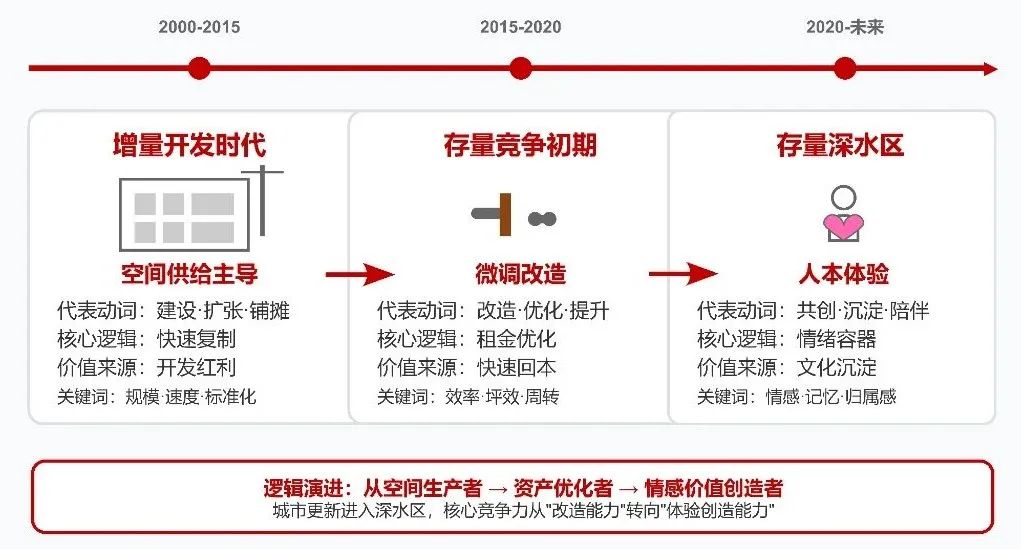
在城市更新这件事上,我们曾习惯一个朴素的共识:只要把空间"效率"提上去,人自然就会留下来。于是,在过去十年,许多商业更新项目将"坪效提 升""动线优化""货品组合升级"当作铁律,试图以更紧凑的业态、更高频的运营、更快的回报率,换来一个"看起来热闹"的改造成果。 但今天,问题开始浮现: 为什么一些租金高的商场,客流依旧"冷启动"? 为什么一些投入千万级装修改造的街区,用户愿意拍照却不愿久留? 为什么我们反复精算动线、加码招商,却换不来真正的复购与社群? 城市更新做了这么多,却始终留不住"关系"。这不是设计的问题,也不是招商的问题。这是一个关于"空间公式是否过时"的问题。 以效率为核心的城市更新范式,在增量市场下或许高效,但在存量竞争中,它开始显露局限。今天的用户,不缺"能逛"的地方,而缺"值得停留"的理由。 他们不是奔着"逛完就走"的流程来的,而是带着"是否值得驻足、能否建立关系"的评判在进入空间。 因此,我们需要重新理解更新的意义——不是如何更高效地使用空间,而是如何用空间重新组织人与人、人与内容、人与城市的关系。而这,注定不是一 套ROI模型可以回答的。本文希望提出一种新的观察路径:在城市更新迈入存量周期之 ...
中信银行(00998):被低估的底部股份行,ROE有望更早企稳
Shenwan Hongyuan Securities· 2025-07-31 12:23
Investment Rating - The report assigns a "Buy" rating for the company, marking its first coverage [2][8]. Core Views - The report highlights that the company is undervalued and is expected to stabilize its Return on Equity (ROE) earlier than its peers. The current market conditions present a favorable opportunity for valuation recovery [7][8]. - The management's proactive approach in addressing asset quality issues and the company's strategic focus on risk control are seen as key strengths that will support long-term valuation premiums [7][10]. Financial Data and Profit Forecast - Projected operating revenue (in million) for the company is as follows: - 2023: 205,896 - 2024: 213,646 - 2025E: 213,032 - 2026E: 217,022 - 2027E: 224,121 - Year-on-year growth rates are expected to be: - 2023: -2.60% - 2024: 3.76% - 2025E: -0.29% - 2026E: 1.87% - 2027E: 3.27% [6] - Projected net profit attributable to shareholders (in million) is as follows: - 2023: 67,016 - 2024: 68,576 - 2025E: 69,936 - 2026E: 72,249 - 2027E: 75,435 - Year-on-year growth rates are expected to be: - 2023: 7.91% - 2024: 2.33% - 2025E: 1.98% - 2026E: 3.31% - 2027E: 4.41% [6] - Earnings per share (in CNY) are projected as follows: - 2023: 1.27 - 2024: 1.17 - 2025E: 1.17 - 2026E: 1.21 - 2027E: 1.27 [6] - The report anticipates a stable long-term ROE of around 11% due to improved net interest margins and reduced credit costs [10][9]. Investment Analysis - The report emphasizes that the market has not fully recognized the management's effective actions and the sustainable ROE trend, which are critical for the company's long-term valuation premium [8][10]. - The company is expected to benefit from a stable dividend payout exceeding 30%, alongside a favorable fundamental outlook for 2025 [8][9]. - The target valuation is set at 0.64 times the 2025 Price-to-Book (PB) ratio, indicating a potential upside of 25% [8].
宁德时代(300750.SZ):2025年中报净利润为304.85亿元
Xin Lang Cai Jing· 2025-07-31 01:05
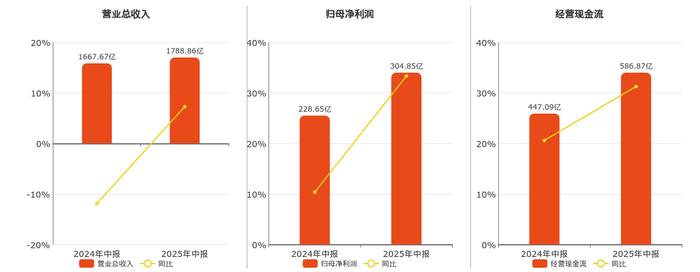
2025年7月31日,宁德时代(300750.SZ)发布2025年中报。 公司最新总资产周转率为0.22次,较去年同期总资产周转率减少0.02次,同比较去年同期下降7.09%。 最新存货周转率为2.03次,较去年同期存货周转率减少0.59次,同比较去年同期下降22.53%。 公司营业总收入为1788.86亿元。归母净利润为304.85亿元。经营活动现金净流入为586.87亿元。 公司股东户数为22.64万户,前十大股东持股数量为29.25亿股,占总股本比例为64.16%,前十大股东持 股情况如下: 公司最新资产负债率为62.59%。 公司最新毛利率为25.02%,较去年同期毛利率减少1.51个百分点。最新ROE为10.34%,较去年同期ROE 减少1.32个百分点。 公司摊薄每股收益为6.92元。 | 序号 | 股东名称 | 持股比例 | | --- | --- | --- | | J | 厦门瑞庭投资有限公司 | 22.47% | | 2 | 香港中央结算有限公司 | 13.31% | | 3 | 黄世霖 | 10.22% | | 4 | 宁波联合创新新能源投资管理合伙企业(有限合伙) | 6.23% | ...

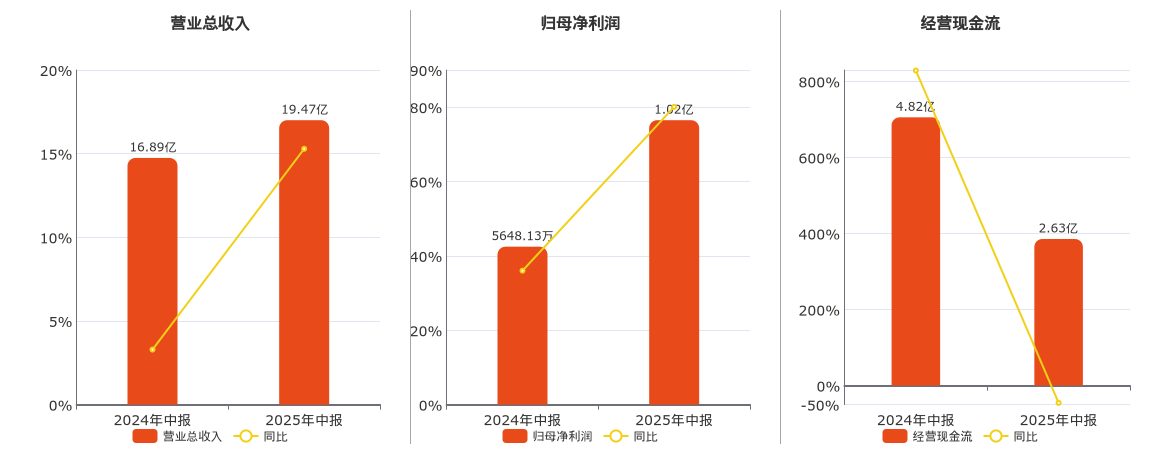
智微智能(001339.SZ):2025年中报净利润为1.02亿元
Xin Lang Cai Jing· 2025-07-31 01:03
公司摊薄每股收益为0.41元。 公司最新总资产周转率为0.36次,较去年同期总资产周转率减少0.12次,同比较去年同期下降24.81%。最新存货周转率为1.32次,较去年同期存货周转率减 少0.34次,同比较去年同期下降20.29%。 公司股东户数为3.84万户,前十大股东持股数量为1.82亿股,占总股本比例为72.46%,前十大股东持股情况如下: | 序号 | 股东名称 | 持股 | | --- | --- | --- | | 1 | 袁微微 | 39.6 | | 2 | 郭旭辉 | 30.2 | | 3 | 香港中央结算有限公司 | 0.49 | | ব | 东台智展企业管理合伙企业(有限合伙) | 0.32 | | 5 | 中国银行股份有限公司-易方达供给改革灵活配置混合型证券投资基金 | 0.32 | | 6 | 中国农业银行股份有限公司 宝盈策略增长混合型证券投资基金 | 0.30 | | 7 | 招商银行股份有限公司-南方中证1000交易型开放式指数证券投资基金 | 0.28 | | 8 | 马新成 | 0.27 | | g | 中国农业银行股份有限公司-宝盈科技30灵活配置混合型证券投资基金 | ...
交银国际:升中国平安(02318)目标价至73港元 维持“买入”评级
智通财经网· 2025-07-30 03:23
Group 1 - The core viewpoint of the report is that China Ping An's target price has been raised by 22% from HKD 60 to HKD 73, maintaining a "Buy" rating based on a 1.2 times price-to-book ratio for 2025 [1] - The company’s earnings forecast has been upgraded, with expected operating profit growth of 7% year-on-year and net profit attributable to shareholders growth of 5% year-on-year for 2025 [1] - The report anticipates that the company's return on equity (ROE) will remain above 13% from 2025 to 2027, with an attractive valuation as the 2025 price-to-book ratio is below 1 and the dividend yield is around 5% [1] Group 2 - For the first half of 2025, the company is expected to achieve a 5% year-on-year growth in net operating profit attributable to shareholders, with stable contributions from its three core business segments: life insurance, health insurance, and property & casualty insurance [1] - The report projects a 13.5% year-on-year increase in net profit attributable to shareholders for the second quarter, with significant improvements in the underwriting side of property & casualty insurance and steady performance on the investment side [1] - The new business value is expected to grow by 36% year-on-year in the first half of 2025, with an upward trend in value rate [1]
