
合成生物学

Search documents
中国科学院院士刘耀光:实施育种全链条攻关,加快生物育种产业化应用
Nan Fang Nong Cun Bao· 2025-08-26 07:06
Core Viewpoint - The emphasis is on accelerating the industrial application of biological breeding through comprehensive innovation and addressing key technological challenges in the breeding sector [2][12][22]. Group 1: Current Situation and Challenges - Global competition in the seed industry is intensifying, with China achieving basic self-sufficiency in staple crops like rice and wheat [6][7]. - Guangdong province is a major agricultural region with a leading number of preserved germplasm resources, but it faces weaknesses in germplasm protection and utilization, as well as in foundational research and cutting-edge technology [8][9][22]. Group 2: Recommendations for Advancement - Implement a full-chain approach to tackle "bottleneck" technologies, focusing on intelligent design breeding, gene editing, and synthetic biology, while establishing an integrated innovation chain from germplasm protection to variety selection [12][13][14]. - Build high-level platforms to enhance collaborative innovation by integrating resources from universities, research institutes, and enterprises, and creating national key laboratories in the field of biological breeding [16][17][18]. - Deepen the integration of government, research, and enterprises to accelerate the transformation of research results, supporting leading companies in forming innovation consortia and establishing testing and demonstration bases for new varieties and technologies [19][20][21]. Group 3: Strategic Importance - Biological breeding is a strategic support for ensuring national food security, and Guangdong has the foundation, conditions, and responsibility to lead in this field nationally [22][23]. - The goal is to revitalize the seed industry in Guangdong, contributing significantly to building a strong agricultural province and ensuring national food security [24].


海正药业:核心产品发力 上半年扣非净利润同比增长23.92%
Zhong Zheng Wang· 2025-08-26 05:12
Core Insights - The company reported a revenue of 5.25 billion yuan and a net profit attributable to shareholders of 299 million yuan for the first half of 2025, with a year-on-year growth of 23.92% in net profit [1] - The company implemented a series of reforms including structural optimization and brand enhancement, leading to steady business growth and improved operational performance [1] Financial Performance - The operating cash flow net amount reached 1.211 billion yuan, reflecting a significant year-on-year increase of 54.98% [1] - The sales of core products such as "Saismei" and "Meiman" contributed positively to the revenue growth of the formulation segment [1] Business Segments - The pet medicine business experienced remarkable growth, exceeding 60%, with e-commerce sales surpassing 100 million yuan [1] - The company celebrated the 10th anniversary of its domestic deworming drug "Hailiemiao," which has sold over 45 million tablets [1] R&D and Innovation - The company adopted a combination of self-research and collaboration for innovative drug development, with its self-developed small molecule innovative drug HS387 entering clinical development [2] - Strategic partnerships with AI pharmaceutical companies aim to enhance drug development capabilities, focusing on cutting-edge technology platforms [2] Future Outlook - The company plans to continue leveraging synthetic biology and AI-driven drug development to enhance innovation and global strategy [2] - The establishment of a subsidiary focused on synthetic biology marks a significant step into the high-end synthetic biology industry [2]

海正药业: 浙江海正药业股份有限公司2025年半年度报告
Zheng Quan Zhi Xing· 2025-08-25 17:05
Core Viewpoint - Zhejiang Hisun Pharmaceutical Co., Ltd. reported a slight increase in revenue but a significant decrease in net profit for the first half of 2025, indicating challenges in profitability despite stable sales performance [2][3]. Company Overview and Key Financial Indicators - The company generated revenue of approximately 5.25 billion RMB, a marginal increase of 0.13% compared to the same period last year [2]. - Total profit decreased by 16.74% to approximately 404.3 million RMB, while net profit attributable to shareholders fell by 31.29% to about 299.07 million RMB [2]. - The net cash flow from operating activities increased by 54.98% to approximately 1.21 billion RMB, reflecting improved efficiency in accounts receivable turnover [2]. - As of June 30, 2025, the company's total assets were approximately 15.56 billion RMB, a decrease of 2.56% from the end of the previous year [2]. Industry and Main Business Situation - The pharmaceutical industry is a crucial part of China's economy, with growing market demand driven by an aging population and increasing health awareness [3]. - In the first half of 2025, the pharmaceutical manufacturing industry reported a revenue of approximately 1.23 trillion RMB, a decrease of 1.2% year-on-year, and total profit of about 176.69 billion RMB, down 2.8% [3]. Main Business Segments - The company operates in various segments, including pharmaceutical formulations, active pharmaceutical ingredients (APIs), and animal health products [4][9]. - The pharmaceutical formulation business focuses on hospital sales, with specialized divisions for cardiovascular, infectious diseases, and oncology [5][6][7]. - The API business leverages over 50 years of fermentation technology, with a diverse product line and significant export capabilities [9]. - The animal health segment has established a strong market presence with over 50 products and partnerships with major livestock groups [10]. Market Position and Performance Drivers - The company has been recognized as a leading comprehensive pharmaceutical enterprise in China, with a focus on innovation and quality [11]. - Key performance drivers include structural optimization, business expansion, and management innovation, leading to a 23.92% increase in net profit excluding non-recurring items [12]. - The company has successfully expanded its market presence through a multi-channel strategy, including e-commerce and international markets, achieving significant growth in sales and market share [12].
圣达生物: 浙江圣达生物药业股份有限公司2025年半年度报告
Zheng Quan Zhi Xing· 2025-08-25 16:53
Core Viewpoint - The report highlights the financial performance and operational strategies of Shengda Bio-Pharm Co., Ltd. for the first half of 2025, showcasing significant growth in revenue and profit driven by enhanced management practices and market expansion in the vitamin and bio-preservative sectors [1][3]. Financial Performance - The company's operating income for the first half of 2025 reached approximately 400.73 million RMB, representing a 4.23% increase compared to the same period last year [3]. - Total profit amounted to approximately 50.27 million RMB, a substantial increase of 107.77% year-on-year [3]. - The net profit attributable to shareholders was approximately 37.81 million RMB, reflecting a 129.20% increase compared to the previous year [3]. - The net cash flow from operating activities was approximately 22.96 million RMB, up 97.59% from the previous year [3]. Industry Overview - The vitamin industry in China is experiencing steady growth, with the country being a major global producer of various vitamins, including biotin and folic acid [6][8]. - The bio-preservative and functional ingredient market is expanding rapidly, driven by increasing consumer demand for natural and safe food additives [6][8]. - The report indicates that the domestic vitamin market faced price declines in the first half of 2025, but the overall demand remains stable [6][8]. Company Positioning - Shengda Bio-Pharm is recognized as one of the leading suppliers of biotin and folic acid in China, ranking among the top five suppliers of biotin and top four suppliers of folic acid in 2024 [6][8]. - The company is one of the few in China capable of producing multiple types of bio-preservatives, including nisin and natamycin, and is a key player in setting industry standards [6][8]. - Shengda Bio-Pharm has established a strong reputation in the market, supported by long-term partnerships with major domestic and international clients [11][12]. Operational Strategies - The company employs a "sales-driven production" model, optimizing procurement and production processes to enhance efficiency and reduce costs [7][8]. - Shengda Bio-Pharm has invested in smart manufacturing technologies to improve product consistency and operational efficiency [7][8]. - The company is focused on continuous innovation and R&D, with a significant increase in R&D expenditure by 22.39% in the first half of 2025 [3][8]. Market Expansion - The company has successfully registered its biotin products in India, the EU, and South Korea, paving the way for entry into higher-end pharmaceutical markets [8][9]. - Shengda Bio-Pharm's subsidiaries have shown strong performance, with significant sales growth in key products such as lactic acid bacteria and natamycin [8][9].

天津工生所在檀香精油高效合成方面取得新进展
合成生物学与绿色生物制造· 2025-08-25 16:45
Core Viewpoint - The article discusses the sustainable and large-scale production of sandalwood essential oil through synthetic biology, addressing the resource scarcity and high costs associated with natural sandalwood [1][3]. Group 1: Sandalwood Essential Oil Overview - Sandalwood essential oil, derived from sandalwood heartwood, is highly valued for its unique woody fragrance and is used in perfumes, cosmetics, pharmaceuticals, and religious ceremonies [1]. - The slow growth of sandalwood trees, which take decades to mature, along with overharvesting, has led to a significant increase in market prices, approximately $2,500 per kilogram, and unstable supply [1]. Group 2: Synthetic Biology Approach - The research team at the Tianjin Institute of Industrial Biotechnology has successfully developed a yeast cell factory capable of producing sandalwood alcohol, achieving a record yield of 10.4 g/L, which is the highest reported in literature [3][4]. - The team utilized subcellular compartment engineering to enhance the production process, specifically targeting the peroxisome for enzyme localization, which significantly improved the conversion rates of sandalwood precursors [4]. Group 3: Research and Development Achievements - The study demonstrated a 5.1-fold increase in total yield of sandalwood alcohol and sandalwood olefin, reaching 0.9 g/L, with further innovations leading to a conversion rate increase to 60.6% [4]. - The research has received funding from various national programs and has resulted in multiple patent applications, with findings published in the Journal of Agricultural and Food Chemistry [5].

亨通股份: 浙江亨通控股股份有限公司2025年半年度报告
Zheng Quan Zhi Xing· 2025-08-25 16:30
Core Viewpoint - Zhejiang Hengtong Holding Co., Ltd. reported a significant increase in revenue and net profit for the first half of 2025, driven primarily by the growth in copper foil sales and steam business profits [2][12][13]. Company Overview and Key Financial Indicators - The company achieved an operating income of 818.21 million yuan, a year-on-year increase of 45.80% [2][12]. - The total profit reached 140.72 million yuan, up 16.68% from the previous year [2][12]. - The net profit attributable to shareholders was 126.95 million yuan, reflecting an 8.91% increase [2][12]. - The company's total assets grew by 7.07% to 4.81 billion yuan, while net assets increased by 3.96% to 3.55 billion yuan [2][12]. Industry and Main Business Situation - The company's revenue primarily comes from the production and sales of electrolytic copper foil, veterinary drugs, and feed additives, as well as combined heat and power supply [12][13]. - The electrolytic copper foil market is expected to grow due to increasing demand from the PCB industry and the rise of AI applications, which require high-performance materials [12][13]. - The global PCB market is projected to grow at a compound annual growth rate (CAGR) of 5.2% from 2024 to 2029, reaching approximately 94.66 billion USD by 2029 [12][13]. - The lithium battery copper foil market is also expanding, driven by the growth of the new energy vehicle sector and energy storage systems [12][13]. Business Performance and Development - The company’s subsidiary, Hengtong Copper Foil, has successfully developed high-value-added products such as reverse copper foil (RTF) and low-profile copper foil (LP), which are now in mass production [12][13]. - The company is actively expanding its market presence and enhancing its product offerings in high-end copper foil products to meet the increasing demands of the electronics industry [12][13]. - The company is investing in a small variety amino acid production base, which will add 11,880 tons/year of production capacity, enhancing its competitive position in the amino acid market [12][15]. Research and Development - Hengtong Copper Foil has established a robust R&D framework, collaborating with renowned universities to innovate and improve product quality [12][19]. - The company has applied for 70 patents and received 25 authorizations, indicating a strong commitment to technological advancement and intellectual property protection [12][19]. Market Trends - The demand for feed additives, particularly amino acids, is expected to grow due to the increasing focus on animal nutrition and the reduction of soybean meal in feed formulations [12][7]. - The veterinary drug market is also expanding, with the company focusing on international markets, particularly in South America and Asia [12][16].

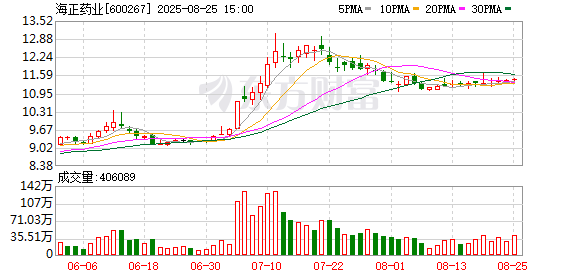
海正药业上半年实现营业收入52.5亿元 制剂销售业务稳步增长
Zheng Quan Shi Bao Wang· 2025-08-25 15:07
Core Viewpoint - Haizheng Pharmaceutical reported a slight increase in revenue but a significant decline in net profit, primarily due to non-recurring factors, while core business segments showed growth and operational efficiency improvements [2][3]. Financial Performance - The company achieved a revenue of 5.25 billion yuan, a year-on-year increase of 0.13% [2]. - Net profit attributable to shareholders decreased by 31.29% to 299 million yuan, influenced by reduced convertible bond repurchase income; however, after excluding this factor, the net profit grew by 23.92% to 321 million yuan [2]. Business Segments - The formulation sales business maintained steady growth, with core products such as Saismei, Mitomycin, and Hailemao contributing to revenue increases [2]. - The pet segment performed exceptionally well, with sales reaching a historical high and a 60% overall growth, including over 100 million yuan in pet e-commerce sales [2]. Market Strategy - The company expanded its domestic business through county hospital coverage, accelerated e-commerce platform development, and implemented an AI-driven marketing system, achieving a 100% success rate in national procurement and a 90% success rate in provincial procurement [2]. - Internationally, Haizheng's first introduced product in the U.S. reached a 21% market share in Q2, and its animal health product "Hailiwang" gained market access in Vietnam [3]. R&D and Innovation - The company continues to focus on R&D and industrial upgrades, employing a dual-driven approach of "self-research + introduction" to enhance its global patent pipeline, particularly in cardiovascular and metabolic disease areas [3]. - A new small molecule innovative drug, HS387, has entered clinical development, and the company is actively introducing clinical-stage pipelines [3]. Future Growth Areas - Key growth drivers identified include the ramp-up of innovative drug Saismei, growth in consumer-oriented pharmaceuticals, advancements in synthetic biology, and the expansion of the pet medicine sector [5]. - The company aims to launch new products in the medical aesthetics sector and is focused on introducing new products to enhance market competitiveness [5].
瑞普生物20250825
2025-08-25 14:36
Summary of Reap Bio's Conference Call Company Overview - **Company**: Reap Bio - **Industry**: Animal Health and Veterinary Pharmaceuticals Key Financial Performance - **Revenue Growth**: 2025 H1 revenue reached 1.708 billion CNY, a year-on-year increase of 20.5% [3] - **Net Profit**: Net profit attributable to shareholders was 257 million CNY, up 58% year-on-year [3] - **Adjusted Net Profit**: Non-GAAP net profit was 188 million CNY, reflecting a 34% increase [3] - **Core Product Revenue**: Core product revenue was nearly 600 million CNY, a 33% increase [4] Segment Performance - **Poultry Vaccines**: Revenue from poultry vaccines grew by 24.7% to 610 million CNY [7] - **Livestock Vaccines**: Livestock vaccine revenue doubled, increasing by 110% [2] - **Pet Segment**: Pet segment revenue surged by 108%, primarily through the Zhongrui supply chain [2] Strategic Initiatives - **Innovation and R&D**: The company focused on technological innovation, obtaining multiple new veterinary drug registrations, including the world's first mRNA vaccine for food animals [2][6] - **Partnerships**: Strengthened collaborations with leading breeding groups and accelerated overseas expansion [6] - **Pet Medical Focus**: Aiming for at least 100 million CNY in revenue from the Reap brand and targeting 1 billion CNY in the pet supply chain [10] Government Procurement - **Government Sales**: Government procurement revenue increased by 182%, accounting for 5% of total sales [21] - **Key Products**: Significant growth in high pathogenic avian influenza and foot-and-mouth disease vaccines [21] Cost Management - **Raw Material Prices**: Fluctuations in raw material prices impacted cost control positively in Q2, with a decrease in prices aiding management [15] - **Dragonxiang Subsidiary**: The subsidiary played a crucial role in stabilizing production costs and improving profitability [15] Future Outlook - **Growth Projections**: The company expects to achieve over 800 million CNY in revenue and aims for a profit of around 20 million CNY for the year [27] - **Market Trends**: Anticipates continued growth in the pet and livestock segments, leveraging deep service models for large breeding groups [20][31] Challenges and Risks - **Market Competition**: The animal health market remains competitive, particularly in the poultry and livestock sectors [31] - **Price Pressures**: Ongoing price declines in downstream markets may pose challenges [20] Additional Insights - **Product Mix**: The shift towards higher-margin biological products has contributed to an increase in overall gross margin, which is expected to rise by at least one percentage point annually [30] - **Investment in Supply Chain**: The Zhongrui supply chain's performance has been strong, although profits have temporarily declined due to high initial investments [26] This summary encapsulates the key points from Reap Bio's conference call, highlighting financial performance, strategic initiatives, and future outlook while addressing potential challenges in the industry.

韩国拟削减25%石脑油产能,六部门部署规范光伏产业竞争秩序
Huaan Securities· 2025-08-25 09:18
Investment Rating - The industry investment rating is "Overweight" [1] Core Insights - The chemical sector's overall performance ranked 15th this week, with a change of 2.86%, underperforming the Shanghai Composite Index by 0.63 percentage points and the ChiNext Index by 3.00 percentage points [4][22] - The chemical industry is expected to continue its trend of differentiated performance in 2025, with recommendations to focus on synthetic biology, pesticides, chromatography media, sweeteners, vitamins, light hydrocarbon chemicals, COC polymers, and MDI [4] Industry Performance - The chemical sector's performance for the week of August 18-22, 2025, showed a 2.86% increase, while the Shanghai Composite Index increased by 3.49% and the ChiNext Index by 5.85% [4][22] - The top three performing sub-sectors were other rubber products (8.53%), polyurethane (6.34%), and titanium dioxide (5.69%), while the bottom three were synthetic resin (-1.67%), carbon black (-1.00%), and other plastic products (-0.34%) [23][22] Key Industry Dynamics - South Korea plans to cut naphtha cracking capacity by 25%, affecting 2.7 to 3.7 million tons based on an annual capacity of 14.7 million tons, as part of efforts to restructure its petrochemical industry [35] - The Ministry of Industry and Information Technology of China held a meeting to regulate the photovoltaic industry, emphasizing the importance of maintaining a healthy competitive environment [35] Recommended Focus Areas - Synthetic biology is highlighted as a key area for growth, with traditional chemical companies needing to adapt to energy costs and carbon taxes [4] - The third-generation refrigerants are expected to enter a high-growth cycle due to supply constraints and increasing demand from markets like Southeast Asia [5] - The electronic specialty gases market presents significant opportunities for domestic companies due to high technical barriers and increasing demand from semiconductor and photovoltaic sectors [6][8] - Light hydrocarbon chemicals are becoming a global trend, with a shift towards lighter raw materials for ethylene production [8] - The COC polymer industry is accelerating its domestic industrialization process, driven by supply chain security concerns [9] - Potash fertilizer prices are expected to rebound as major producers reduce output and demand increases from farmers [10] - The MDI market is characterized by oligopoly, with a favorable supply structure anticipated as demand recovers [12]


专家学者共探生物工程前沿科技
Zhong Guo Hua Gong Bao· 2025-08-25 02:29
Group 1 - The second academic conference on bioreactor engineering and biomanufacturing was held in Shanghai, focusing on cutting-edge technologies and industry development in the field [1] - East China University of Science and Technology aims to seize opportunities in the biomanufacturing sector, enhancing research in fine chemicals, electronic chemicals, and new energy [1] - Advanced biomanufacturing is recognized as a disruptive technology that transcends traditional disciplines, necessitating a new foundational development logic [1][2] Group 2 - Bioreactors are identified as the "core engine" of biomanufacturing, with next-generation intelligent bioreactors expected to facilitate the efficient conversion of synthetic biology achievements [1] - The importance of bioreactor engineering in the industrialization of synthetic biology outcomes is emphasized, calling for enhanced collaboration between industry, academia, and research [1] - Key figures in the field discussed various topics, including the development of synthetic biology, the application of core materials in biopharmaceutical innovation, and the upgrade of the health industry driven by food and medicine integration [2]